
Good interviewers don't have better instincts. They run a craft.
The shift behind that sentence is the one most hiring teams haven't made yet. For most of the last decade, good interviewer meant pattern-matched veteran. Someone who'd done it enough times to feel their way through it.
The role traveled with the person, and when the person left, the craft left with them.
Now the craft can be operated. The rubric anchors the call before it starts. The capture happens on a structured layer. The comparison runs against the evidence, not against memory.
This post unpacks the moves an interviewer makes in the room, the failure modes that recur, and the data layer a recruiting leader builds underneath all of it. The argument: good interviewing is operated, and the team that operates it best hires the candidates everyone else lost.
The traits good interviewers run
Strip the personality factors away and the trait inventory is short. Six behaviors recur across recruiters and hiring managers who consistently bring the right people through the funnel.
What separates an instinct-led interviewer from one who runs the craft is where the evidence lives. The instinct-led version trusts recall. The craft version trusts the artifact.
| Trait | Instinct-led version | Craft version |
|---|---|---|
| Care about outcomes | Treats the interview as a calendar block | Treats every interview as a data point |
| Seek depth | Follows the script question by question | Follows the candidate's strongest example |
| Prepare intentionally | Skims the CV in the corridor | Anchors questions to the rubric in advance |
| Write clear feedback | Vibe-based recap from memory | Evidence-mapped scorecard from the call |
| Acknowledge bias | Trusts gut and hopes for the best | Routes the call through structured signals |
| Collaborate as a team | Hands off the scorecard and moves on | Hands off the same evidence everyone reviewed |
Shahriar's piece on the behaviors that separate good interviewers from bad ones goes deeper on the trait inventory. The next move along is the one this post makes: the traits compound only when the data layer carries them.
Evidence beats impression when both sides of the panel see the same artifact.
The 5-move playbook in the room
Five moves separate the interview that's hard to learn from the interview that's hard to repeat. They don't replace judgment. They give judgment something concrete to work against.
1. Prepare with the rubric in hand
Most weak interviews start in the calendar invite. The interviewer opens the CV the day of the call, picks two or three questions that feel relevant, and walks in. The rubric, if there is one, sits in a separate document nobody opens.
Put the rubric in the room with you. Pick the two or three competencies you own for this loop. Write down what a 3 versus a 5 looks like for each. The rubric before the room is the single highest-leverage habit a new interviewer can build.
2. Run a structured conversation
Structured doesn't mean scripted. Every candidate gets the same opportunity to show evidence against the same competencies, in roughly the same order. Warmth is fine. Random question order is not.
Structure makes comparison possible. Two candidates answering the same anchor question give the panel a clean side-by-side. Two candidates answering different questions force the panel to triangulate from memory, which is where bias sneaks in.
3. Go deep with follow-up questions
The first answer is the rehearsal. The depth lives in the third and fourth follow-ups. Three-layer probing is the standard: what they did, why that way, and what they'd do differently now.
Interviewers who do this well treat each anchor question as a five-minute exploration. They listen for the moment the candidate stops describing the cleaned-up version and starts describing what happened, then they live there.
4. Capture by routing, not typing
Typing during the call is the move most interviewers know is wrong and do anyway. The cost is attention. The interviewer who's typing isn't listening, and the candidate can feel it.
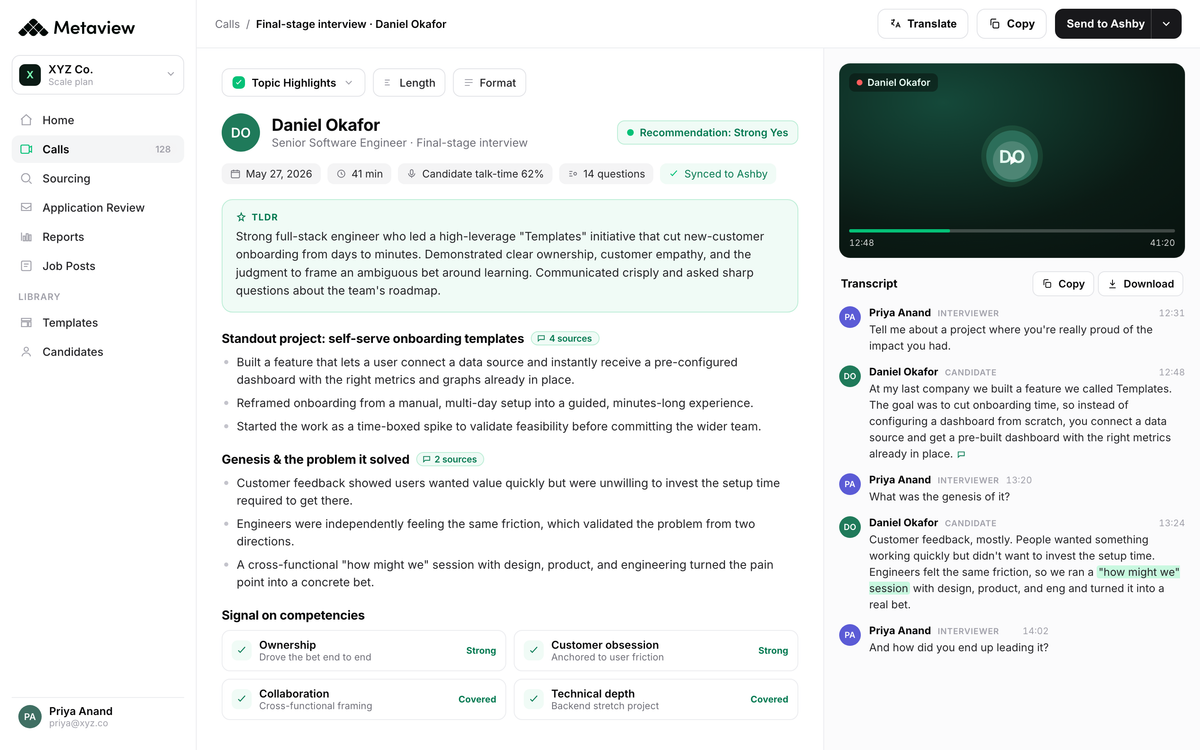
The fix removes note-taking from the interviewer's job. Our Notetaker captures the call and writes notes against the rubric you set. Route, don't type.
5. Score against the rubric while it's fresh
The longer the gap between the call and the scorecard, the more memory does the work. Aim for thirty minutes. If you can't, score within the same calendar block.
Structured capture from move four makes this faster. The scorecard is already drafted against the rubric and the interviewer is reviewing, not reconstructing.
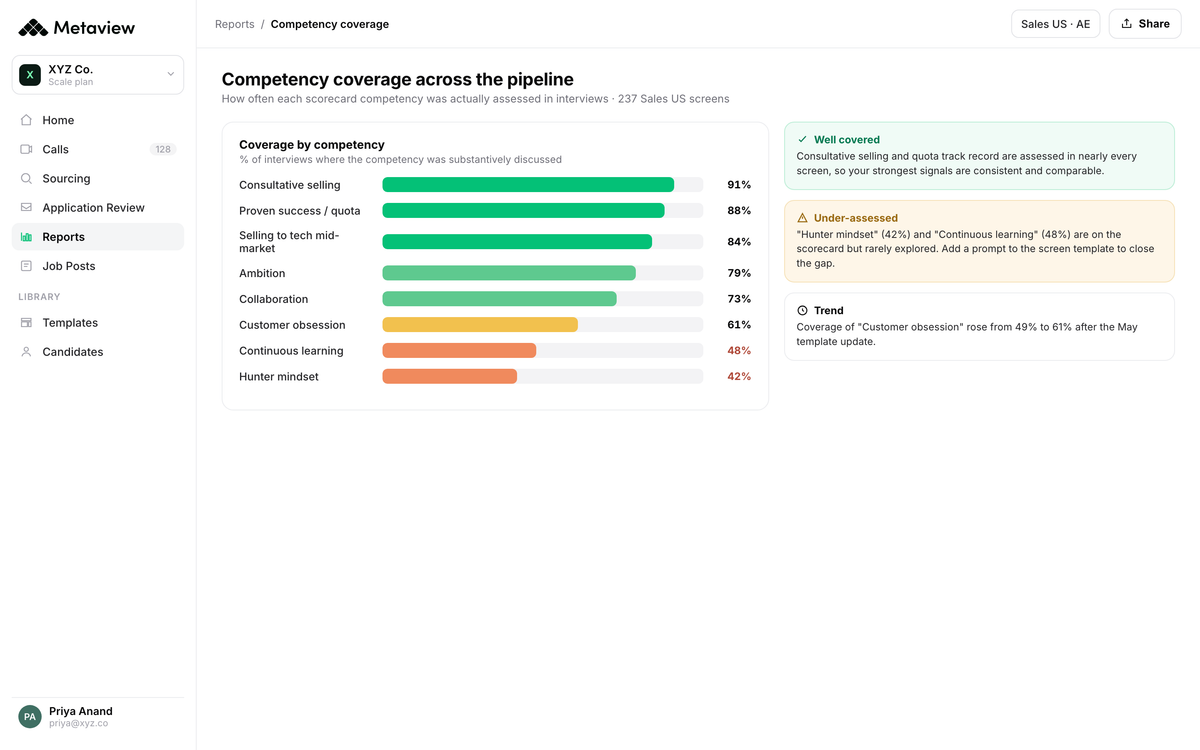
Our Reports surface lets a recruiting leader see every scorecard against every rubric across the team. Score while it's fresh, before the next meeting overwrites the last.
The failure modes that recur
When interviewers slip, they slip in patterns. Naming them as patterns rather than character flaws makes them coachable, because the reset move is structural.
Four failure modes recur often enough that any recruiting leader running calibration sessions will spot them within the first month.
Bias is a fifth category with its own playbook. The short version on interviewer bias: pattern-recognition fixes the traps above; the active-bias-management moves sit one layer deeper. Recurring traps, not character flaws.
What recruiting leaders see across the team
Everything above happens at the interviewer-to-candidate scale. The leader-layer happens at the team-to-corpus scale. Three things a recruiting leader can do once the evidence layer is shared.
Consistency across interviewers
When every interview is captured against the same rubric, the leader sees whether the rubric is being applied or only nodded at.
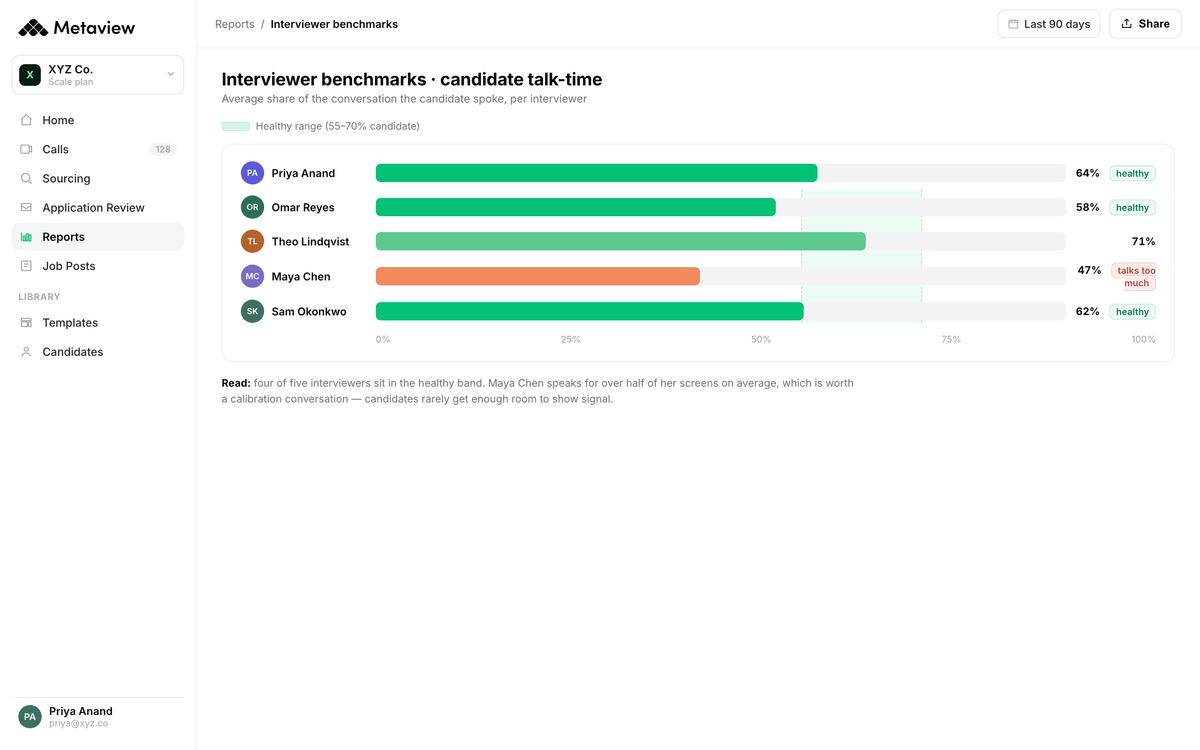
Two interviewers giving the same candidate a 3 and a 5 on one competency is a calibration signal, not a personality clash. Cross-interviewer evidence turns disagreement into data.
Calibration sessions that close drift
Drift is silent until someone surfaces it. Monthly sessions on three or four anonymized scorecards close most of it. The leader doesn't watch every interview; they look at where the same evidence got scored differently and ask the panel to talk through it.
Coaching by evidence, not anecdote
The hardest version of coaching is "be a better interviewer, somehow." The easiest is "in this call, the third follow-up surfaced the answer, here's the timestamp." Coaching by evidence works because the interviewer sees what changed.
Why craft and evidence compound
Good interviewers operating against shared evidence don't just hire better candidates this quarter. They build a team where the next interviewer onboards into the rubric the team already runs, and the calibration loop closes faster every cycle.
According to Metaview's 2026 AI Hiring Alignment Report, surveying 505 recruiting leaders and hiring managers across North America and EMEA, the pattern is quantifiable.
The comparison: teams where AI is core report excellent recruiter-to-hiring-manager relationships 55% of the time. Teams that don't use AI report the same at 14%.
The gap isn't about the tools. It's about what the tools make visible: a shared rubric, captured evidence, and a calibration loop that closes inside the cycle. Alignment is the differentiator, and the data layer is what carries it.
Quality of hire starts with quality of interview. If funnel conversions don't make sense or aren't where we want them to be, my next step is to look at Metaview and see what's happening with these interviews to try to get to the root cause.”

The craft compounds. The data layer carries it.
Interviewers improve faster because the evidence shows them what to change. The recruiting leader coaches with specificity because the corpus is queryable.
The team converges on a way of running interviews that holds up across roles, which is what makes the candidate experience consistent at scale.
You don't get there by training individual interviewers harder. You get there by giving the craft something concrete to run against, and letting the loop close back into the next interview.
Bring Metaview into your hiring stack.
Live notes, structured scorecards, and ATS sync - set up in under 10 minutes.
Frequently asked
What's the fastest way to become a better interviewer this quarter?
Sequence the five moves rather than spread practice thinly. The rubric move and the capture move beat scripted-questions every time, so build those two as muscle first.
How do recruiting leaders coach for consistency without watching every interview?
Run cross-interviewer comparisons on the same candidate in Reports, then route a thirty-minute calibration session to the two or three interviewers whose evidence diverged most from the rubric anchors.
Should every interview be recorded?
Consent script first, then yes for high-stakes panels and executive screens. A ninety-second framing at the start of the call covers it. Intro screens are a softer call.
How is this different from training individual interviewers harder?
Individual training tops out at the interviewer's ceiling. The team-level evidence layer compounds because each interview improves the rubric for the next one, and the next interviewer onboards into the rubric the team already runs.
What if my interviewers push back on AI in the room?
Two-week ramp with one calibration session at the end of week one tends to flip most resistant interviewers. The usual concern is whether candidates will feel watched, which the consent script handles.
