
Here’s a classic case: an agency put forward a candidate, your team interviewed them, and you turned them down. Now the agency recruiter has come knocking and wants to know why.
When deciding whether to share interview notes with an agency, send a short evidence summary instead of the notes themselves. It covers the decision, the evidence that settled it, and what the candidate was missing against the brief you gave the agency.
Forwarding the scorecards or replying that the candidate wasn’t the right fit gives the agency little to act on. A scorecard was written for your hiring manager, and it often doesn’t say which of the candidate’s answers decided the outcome.
Keep the recording, the transcript, the scorecards, and every other candidate’s notes in-house. For the next role you give an agency, agree in writing on what it will receive and by when.
What should you send when you share interview notes with an agency?
Send a summary of the evidence behind the decision. Interview notes here means everything your team recorded about the candidate: each interviewer’s own notes, their scorecards, and, if the interviews were recorded, the recording and its transcript.
Draw the agency’s summary from all of that, and put three things in it:
- State the decision plainly, and the stage it was made at.
- Give the two or three pieces of evidence that decided it, each tied to a criterion in the brief, because the brief is what the agency searches against. Evidence is what the candidate said or did in the interview, such as an answer or a work sample; an interviewer’s rating is the conclusion they drew from it.
- Name the gap: what the candidate would have needed to show, in the brief’s own wording.
Whatever else you trim, never drop the gap. It’s the part an agency can act on most directly, because it says what to look for in the next candidate. “Not the right fit” tells the agency there was a gap without saying what it was.
For more on wording feedback someone can act on, read this guide to giving interview feedback.
Keep the notes and the debrief in-house.
Everything except the summary stays inside your company, and that includes the debrief, the meeting where your interviewers compare what they saw and agree on a decision. The table below lists each part, why it stays, and what the agency gets instead:
| What stays in-house | Why it stays | What the agency gets instead |
|---|---|---|
| The recording and the transcript | It’s the candidate’s whole conversation, recorded for your hiring decision, including everything they said that had nothing to do with the role | The two or three lines of evidence, in your words |
| Each interviewer’s notes and scorecard | Each one is one person’s view of one conversation, written for the hiring manager, and interviewers sometimes disagree | The one decision your team reached in its debrief, and the reasons for it |
| Other candidates’ notes, or how this candidate compared with them | Those notes are about other people, and describing them to an outside firm shares their details without their knowledge | The bar the candidate was measured against, stated in the brief’s criteria |
| The debrief’s discussion, including anything said about budget or offers | It’s where interviewers disagree openly and may discuss budget or offers, and an agency that knows your budget can use it when it negotiates its next candidate’s offer | Nothing beyond what the summary already says |
Check what your privacy notice tells candidates.
Interview notes hold personal data about the candidate, and an agency is a separate company, so even a short summary is personal data leaving your company. Your candidate privacy notice is the document that tells applicants what you collect about them, why you collect it, and who you share it with.
Before your first summary goes out, ask whoever owns privacy at your company two questions. Does the candidate privacy notice tell applicants that you share interview feedback with the agency that put them forward? And does the agency agreement, the contract you sign with the agency before it works on your roles, say what the agency may do with that feedback? Write the answers into the agency agreement for the next role you give an agency.
Keep the agency summary short enough to read.
Make the summary a short message the agency recruiter can read in under a minute. Open with the decision and the interview stage where your team made it, give one sentence for each piece of evidence, and end with the gap. Write it the way you’d write to any colleague, with a greeting and your name, so it reads as a reply from a person.
Whoever writes the summary should follow one more rule:
Your own hiring team may get a longer write-up after the interviews. For how to write that one, see this guide to writing an interview summary.
Send the summary as a rejection note in Greenhouse.
Greenhouse Recruiting gives agencies a portal called “Agencies” where they submit candidates and receive feedback on them, so if your company uses Greenhouse, you can send the summary there. By default, an agency recruiter sees only each candidate’s status and the rejection notes you share with them. They don’t see your other notes, scorecards, or interview feedback. To send the summary when you reject the candidate:
- Open the candidate’s profile from the “Candidates” tab on the job’s “Job Dashboard” so the rejection goes on the right application.
- Choose this job in the right panel if the candidate is attached to more than one job, so you reject them only from this role.
- Open the “Stages” tab and then click “Reject” at the top of the page to bring up the rejection window.
- Pick a “Rejection reason” so your own records show why the candidate left the process.
- Add your summary in the rejection notes for the agency. Greenhouse shows those notes to the agency recruiter as feedback in “Agencies” and keeps them from the rejected candidate. The agency can still pass the summary on, which is why you wrote it for the candidate.
- If your team tells candidates itself, review the rejection email and finish with “Reject and send email”; if the agency agreement leaves that to the agency, finish with “Reject and don’t send email” instead. Either way, the candidate hears the decision once, from the right person.
If you use another applicant tracking system, check whether it has an agency portal and what that portal shows agencies before you send feedback through it.
Agree on what the agency gets before it submits anyone.
Settle what the agency will get before it sends you its first candidate, while no candidate is waiting on an answer. A well-run agency asks for a feedback commitment at intake, when it first takes on your role.
To see how an agency handles intake with a new client, read this guide to agency client onboarding.
Write that commitment into the agency agreement as five short clauses:
- Say what the feedback contains: the three parts of the summary described above.
- Set its form: a written summary from one named person on your team, never forwarded notes.
- Fix its timing: a number of working days. I’d make it two.
- List what never goes to the agency: everything the table above keeps in-house.
- Say whether the agency may forward your summary to the candidate word for word or should pass it on in its own words, so you know whose wording the candidate will read.
Count the working days from the decision, not from the interview, because no one can write the summary until your team has decided. If your team can’t keep to two, write in a number it can keep. Then set your team a deadline for deciding after the final interview, so a slow debrief doesn’t delay the summary.
An agency recruiter makes the case for agreeing early, too. In episode 21 of the 10x Recruiting podcast, Annie Wenzel, a senior partner at Swing Search, talks through how she runs a search from the agency side, and one of her points is that every great search starts with alignment ahead of speed.
Where Metaview fits in agency feedback.
The hardest part of an agency summary is finding the evidence, which is spread across several interviews and several people’s notes. A recorded interview lets you look for that evidence in the candidate’s own words.
If both the candidate and the interviewer consent, the Metaview Notetaker joins the interview as a visible participant and records and transcribes the call. Your team collects that consent under its own policy. The Notetaker then turns the recorded conversation into structured notes.
Metaview captures every spoken word of a recorded interview. So before the summary goes to the agency, you can check each line of evidence against what the candidate said, while the transcript itself stays with your hiring team.
Metaview can also combine notes from several conversations, along with documents such as the résumé and the job description, into a single set of notes, so the evidence from those conversations sits in one place.
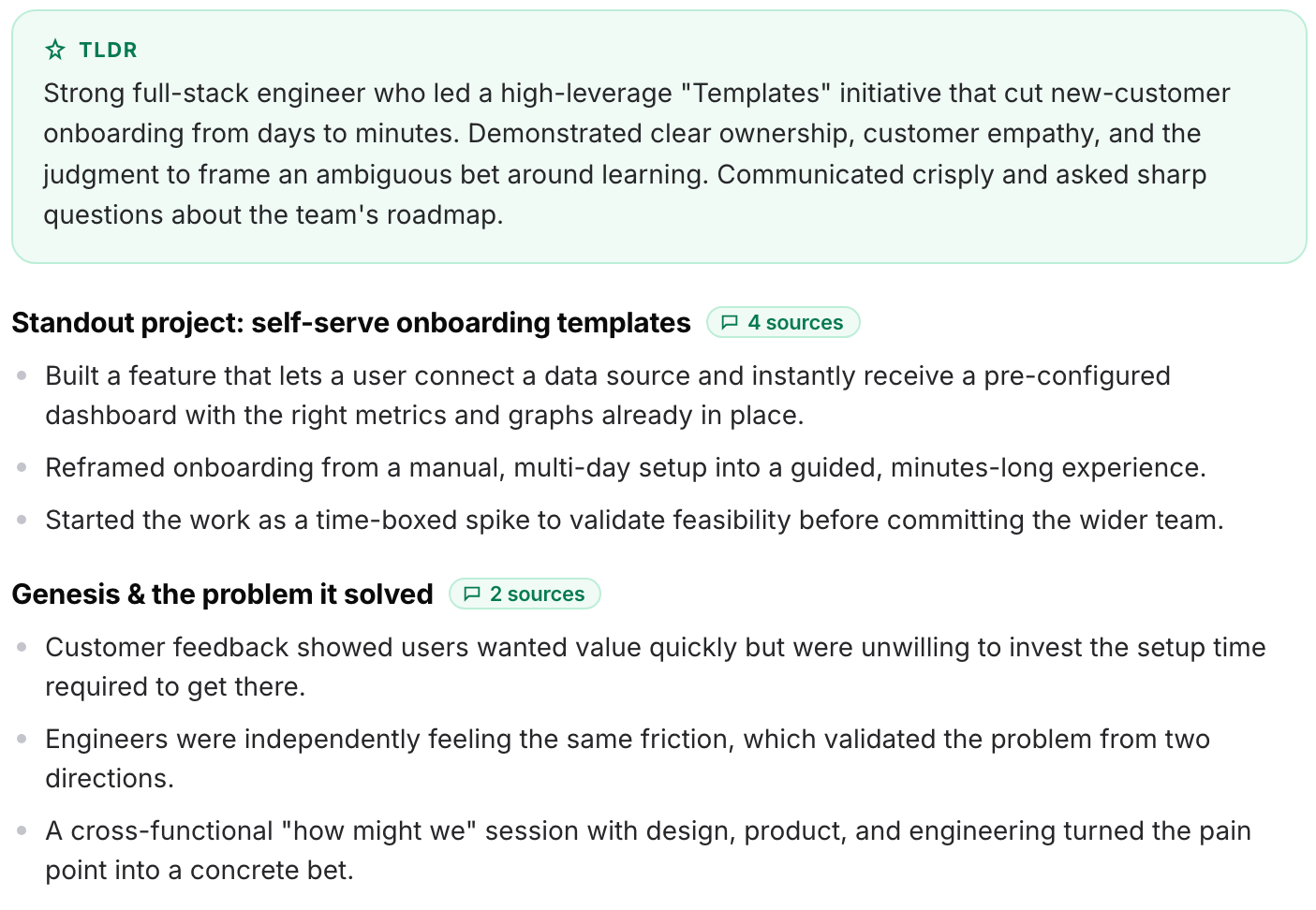
The screenshot below shows the notes from one interview:
Decide what leaves the company.
You write the agency summary from the notes, and you decide what leaves the company. Shahriar Tajbakhsh, Metaview’s co-founder, wrote in 2022 about what the debrief is for:
The debrief is a great opportunity for hiring managers to give feedback on the quality of the scorecards and note what was helpful or not in informing the ultimate decision.”

Ask the same of every line you write for the agency: did it help inform the decision? Leave out the lines that didn’t.
Check whether your agency feedback gets through.
Four things show whether your feedback is landing: the agency’s next submissions, its questions, what reaches the candidate, and your own timing. Each sign in the table below points to what to check first:
| What you notice | What to check first |
|---|---|
| The agency’s next candidate has the same gap as the last one | Whether the summary named the gap against the brief, or only described the candidate |
| The agency asks what an interviewer said | Whether each line of evidence is specific enough to stand on its own |
| The candidate is surprised by what the agency passed on | Whether every line was written to be read by the candidate |
| Feedback goes out later than the agreement says | Who owns writing it, and whether the working days are counted from the decision |
Watch most closely for the same gap turning up again. When the agency’s next candidate closes the gap you named, that’s the best evidence your feedback is working.
Write agency feedback from notes you can check.
Start your agency summaries from what the candidate said in the interview.
Frequently asked.
Should you send the recording if the agency asks for it?
No. A request for the recording can mean the summary didn’t answer a question the agency has, so ask what that question is and answer it in writing. If the agency still has questions after that, offer a short call to walk through the summary.
What if the candidate asks for their own interview notes?
Treat any message asking for their notes, or for what you recorded about them, as a formal request for their personal information, whatever words it uses. Pass it to your privacy owner the day it arrives, so they have as much time as possible to answer. Your company then answers the candidate directly, not through the agency, even if the request reached you that way, unless your privacy owner confirms the agency is entitled to act for the candidate.
Do agencies get feedback on candidates turned down at the résumé stage?
Send one line naming the criterion the résumé didn’t show. Save the three-part summary for candidates your team interviewed, where there’s evidence to share.
What if an interviewer’s scorecard says something you’d never send?
Leave it out of the summary. Write the summary fresh from the evidence, and nothing from a scorecard reaches the agency unless you put it there. If the comment shouldn’t be in any scorecard, even one that stays inside your team, raise it with the interviewer.
What if the candidate met the brief but someone else got the role?
Tell the agency the candidate met the brief and that the role went to someone else. Keep how the two candidates compared inside your company.
Should the agency get feedback when you hire its candidate?
Yes, send a short version: what the interviews confirmed, set against the brief. It tells the agency which parts of the brief it read correctly, which helps on the next search it runs for you.
