

Every experienced agency recruiter has lived the same scene at least once. Four weeks into a search, the client pulls a stakeholder into the room who was not on the original intake. They re-litigate the must-haves. They narrow the profile in ways nobody flagged at kickoff. The agency goes back to the intake notes to make sure they did not miss anything. The intake notes are eleven bullet points in a Google Doc. Half of them are fragments. The decision the team needed to anchor against is not in there.
This is not a process problem in week four. It is an onboarding problem in week one. The thing that determines whether a search runs clean is whether the agency captured the intake conversation in a way the entire team, and the client, can still reference six weeks later. Most agencies still treat onboarding as a calendar gap between the contract signing and the first sourcing day. The agencies that win treat it as the part of the engagement where every later decision gets set.
This guide walks through the 7-step intake workflow that high-functioning agencies run, what leaks out of each step when it is not captured properly, where AI changes the shape of the work, and the 5-day template you can drop onto your next engagement. The thesis underneath all of it: the agency that captures the cleanest signal at intake spends the rest of the search advising the client instead of relitigating decisions.
Why onboarding is the shape of the search.
Onboarding in an agency context is rarely framed by the team that runs it as a stage that decides the search. It is framed as scope-and-paperwork: the contract, the intake call, a recap email, then sourcing starts. The framing is wrong, and the cost of it shows up downstream. Every misaligned hire, every shortlist the client calls ‘not quite right,’ every late-stage pivot on must-haves traces back to a piece of information that either was not captured at intake or was captured but could not be found when it mattered.
The reason it gets framed as paperwork is that the steps look like paperwork. Intake call, contract, debrief, profile, process map, tech setup, recap email. Each step looks like a deliverable. None of them, taken individually, looks like the decision layer of the search. Taken together, though, they are exactly that. The must-haves, the deal-breakers, the interview process, the comp band, the start date, the stakeholder map: every single one of those is set in onboarding, and every single one is what the agency is going to be measured against for the next eight weeks.
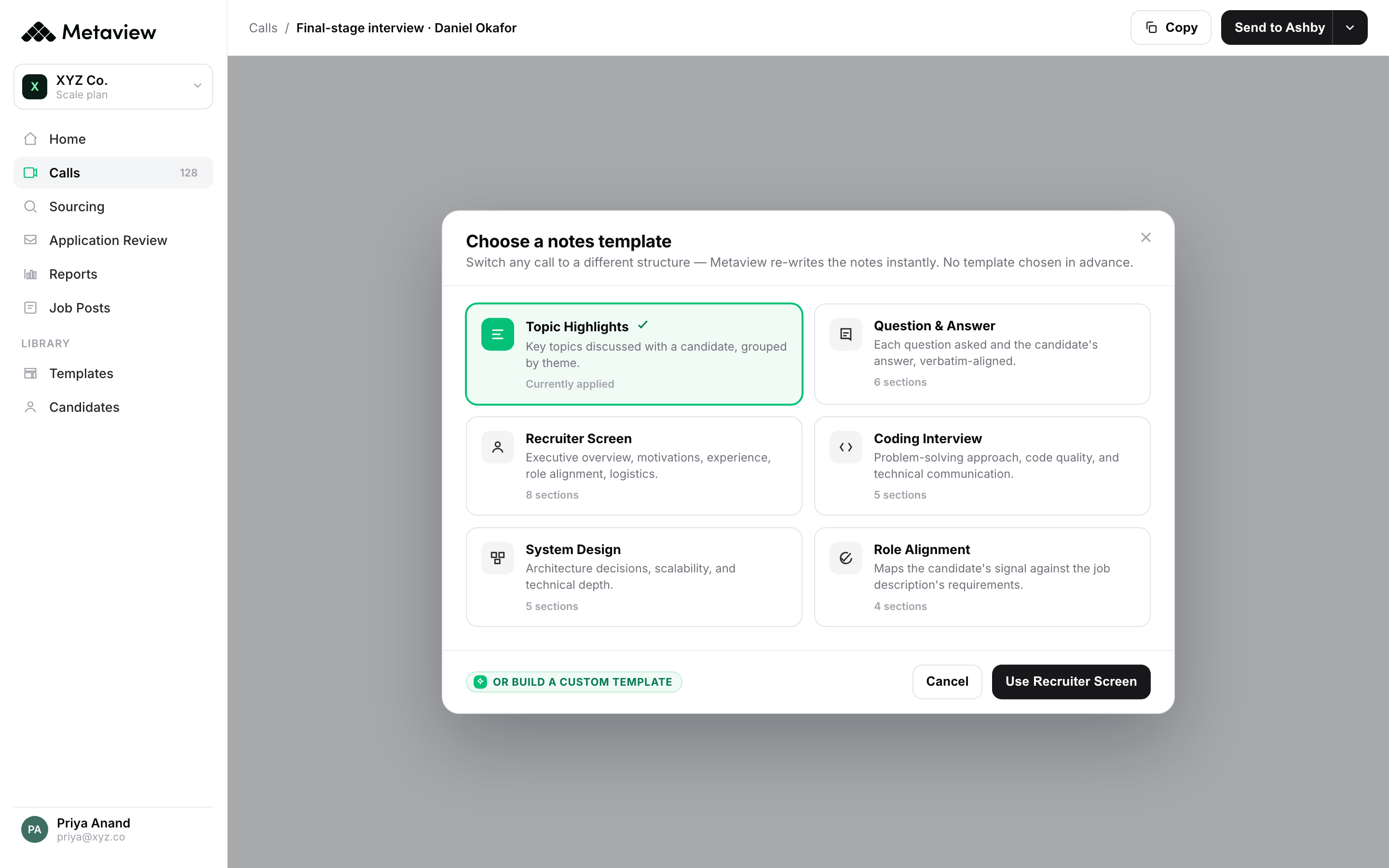
Below is the surface most agencies use to start an intake call: the meeting auto-detection screen with the client’s name and the intake template already loaded. The point of showing it is not the product. It is that the structure of the conversation is set before the conversation starts, and that the structure is the same one the rest of the search will inherit.
The data behind the framing is uncomfortable. According to Metaview’s 2026 AI & Hiring Alignment Report - surveying 505 recruiting leaders and hiring managers across North America and EMEA, only 49% of searches start with high alignment on requirements when teams do not use AI. With AI core to hiring, that number jumps to 68%. The 19-point gap is not about AI being smarter than recruiters. It is about AI capturing what gets said, in a structure the whole team can read, before the memory of who said what starts to drift.
My intake is daunting: an hour-or-two form. I don’t even schedule the kickoff until they’ve returned it within 24 hours. I want them to fill it out on a Saturday morning with a fresh cup of coffee, not when they’re getting a thousand Slacks. When founders understand the why, they do it.”

The 7-step intake-to-kickoff workflow.
The 7-step workflow below is the spine of a clean agency-client onboarding. Each step has a job: capture a specific piece of signal, lock it into a place the rest of the team can read, and confirm it with the client before sourcing starts. Skipped or rushed, each one becomes a problem in week four. Run cleanly, each one compounds the next.
1. Intake call (the real kickoff).
The intake call is the single most leveraged hour of the engagement. The job is not to take notes. The job is to extract the founder or hiring leader’s actual answers to the questions that decide the search: what great looks like, what is genuinely a deal-breaker versus a preference, who the decision-makers are, what the prior hiring attempts looked like and why they failed. The mistake most recruiters make here is splitting attention between asking the question and typing the answer. The fix is to stop typing. The client tells you more when you are listening than when you are scribbling.
2. Scope and contract terms.
Scope and contract are the place where the agency tightens what was said on the call into a written agreement. Search model (retained, contingent, engaged), deliverables, timeline, communication cadence, replacement guarantees, data-handling, IP. The point of this step is not the legal document. It is to write down the shared expectations in a way the client cannot misremember, and the agency cannot drift away from, when the engagement gets tense in week six.
3. Recruiter debrief and internal kickoff.
If the intake call was captured properly, the internal debrief is a short conversation about what to do next. If it was not, the recruiter tries to retell the entire call from memory, the team interrupts with clarifying questions, and the meeting takes an hour. The signal that this step is healthy: every internal team member reads the same intake summary and walks in with the same picture of the role. The signal that it is broken: three recruiters describe the role differently in week two.
4. Position profile creation.
The position profile is the document the rest of the search runs against. It is not the job description. It is a clean translation of what the founder actually said into competencies, must-haves, nice-to-haves, and deal-breakers. The discipline here is to pull the profile directly from the intake conversation, not from the JD the client sent over. Position profiles built from JDs drift. Profiles built from the intake conversation hold.
5. Interview process mapping.
Interview process mapping is the part most agencies leave to the client and regret. The number of stages, the people in each stage, the average calendar gap between stages, the decision criteria at each stage, the feedback SLA. Capture all of it on the intake call, write it into the recap, get the client to confirm it before kickoff. The agency that maps the process up front does not get blindsided by a six-day gap between final-round and offer.
6. Tech and admin setup.
Tech and admin is the necessary plumbing that should take less than an hour. ATS or CRM record, shared Slack or Teams channel, file-sharing folder, automation rules for status updates and reminders, dashboard configured. The mistake here is over-investing in the setup and under-investing in the integrations that actually save time. The point is not a beautiful CRM record. The point is that the intake summary, the position profile, and the process map all sync into the system once, so the recruiter is not pasting them into three places.
7. Alignment recap and kickoff email.
The recap is the artifact the client will reference every time something gets fuzzy. It restates the goal, the must-haves, the deal-breakers, the process, and the timeline in one place. It goes out same business day as the intake call, while the conversation is still fresh in the client’s mind. Sending the recap late is the most common preventable error in agency onboarding. The client’s memory of the intake decays measurably day by day.
What leaks without structured capture.
Most onboarding failures share a single root cause: the agency captured pieces of the intake conversation in different places, in different formats, at different fidelities. The recruiter has a notebook. The hiring manager has an email. The client has their own memory. Three weeks in, they all confidently describe the agreed search slightly differently, and there is no source-of-truth to settle it.
Below is what the foundation layer looks like when the intake call gets captured cleanly: the structured summary, the candidate response captured verbatim where it matters, the rubric tags running down the side. Every other onboarding step pulls from this. Position profile? Built from this. Scope tightening? Reads from this. Debrief? Reads from this. Recap email? Generated from this.
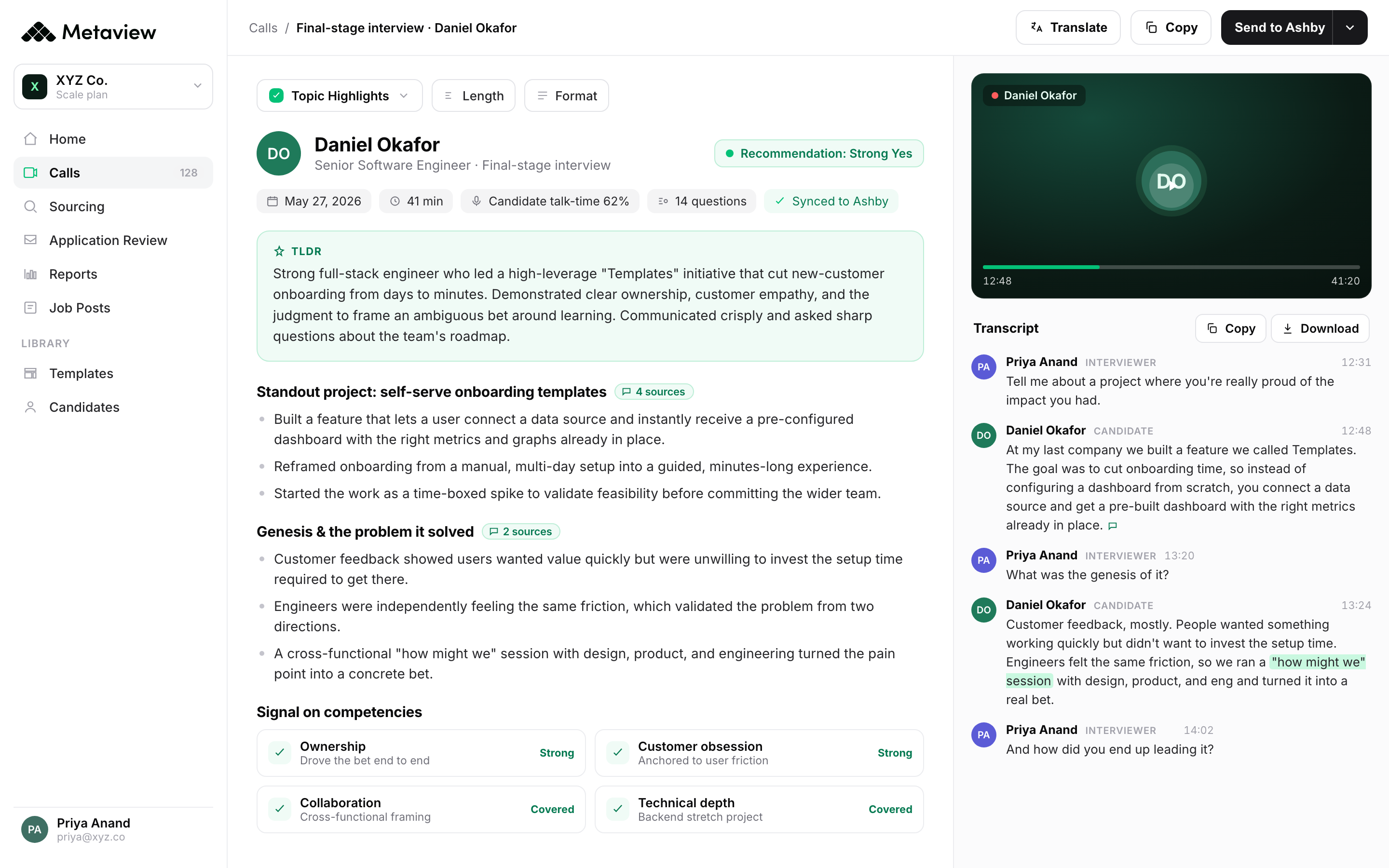
The four most common leaks in this stage are predictable. First, intake notes that capture what the recruiter thought they heard rather than what the client actually said. Second, must-haves and nice-to-haves that get blurred together because the intake template did not separate them. Third, deal-breakers that get mentioned once on the call and never written down. Fourth, stakeholder maps that capture the named decision-maker but miss the silent one who will veto the finalist in week six.
Fixing the leaks is not about being more diligent on the call. It is about changing what the recruiter is doing during the call. The recruiter who is fully present, asking the next question, listening for the subtle hesitation that flags a real deal-breaker, captures more than the recruiter who is typing furiously to keep up.
Manual intake, generic AI, or Metaview: where each one leaks.
There are three honest modes an agency can run intake in: manual, generic AI, or structured AI. They look similar on the surface and diverge sharply in the second week of the search. Below is what each mode does at each step, and where each one tends to leak.
| Onboarding step | Manual intake | Generic AI | Metaview |
|---|---|---|---|
| 1. Intake call | Notes scribbled, half-remembered later | Generic transcript dump, no structure | Live capture, rubric-tagged summary the moment the call ends |
| 2. Scope and contract | Emailed PDF, signed by the client three days later | Same PDF, AI-drafted body that everyone still rewrites | Scope drawn straight from the intake summary so nothing is invented |
| 3. Recruiter debrief | Recruiter retells the call from memory, with gaps | Recruiter pastes a transcript into Slack, the team skims it | Team reads one structured client summary, asks targeted follow-ups |
| 4. Position profile | Built from a job description that bears no resemblance to the call | AI-drafted profile, lifted from the JD, not the conversation | Profile draws on what the founder actually said about must-haves, deal-breakers, and the role’s real shape |
| 5. Interview process map | Client emails a vague stage list, agency builds it in the ATS later | AI guesses at stages from the JD, recruiter overrides most of them | Stages, interviewers, and decision points captured verbatim from the call and confirmed once |
| 6. Tech and admin setup | CRM record, Slack channel, shared drive, all hand-built | Same setup, AI suggests names for the channels | ATS sync pushes the structured summary, scorecards, and stages into the system in one pass |
| 7. Alignment recap and kickoff email | Recruiter rewrites the recap from memory in a quiet hour that never arrives | AI-drafted recap, generic phrasing, recruiter still edits for accuracy | Client-ready recap auto-generated from the intake summary, sent same day, archived as source-of-truth |
The pattern is consistent across the seven steps. Manual intake works fine on small books of business when the recruiter has total context. Generic AI saves typing without saving signal. Structured AI is the only mode where the output of one step automatically becomes the input of the next, so the search compresses without the recruiter holding it all in their head. This is also the place where the audit on the original draft called out ‘no tables.’ A workflow comparison is exactly the kind of thing that needs a side-by-side, not three more paragraphs of prose.
How AI compresses the cycle without dropping clarity.
The real cost of badly captured intake is not the admin time the recruiter spends rewriting the recap on a Saturday. It is the lost candidate. A candidate who has interviewed at three agencies in the last two months can tell which one has its act together by the end of the first call. The agency that asks them to repeat the intake the first interviewer should have heard about, in week three, signals that the search is loose.
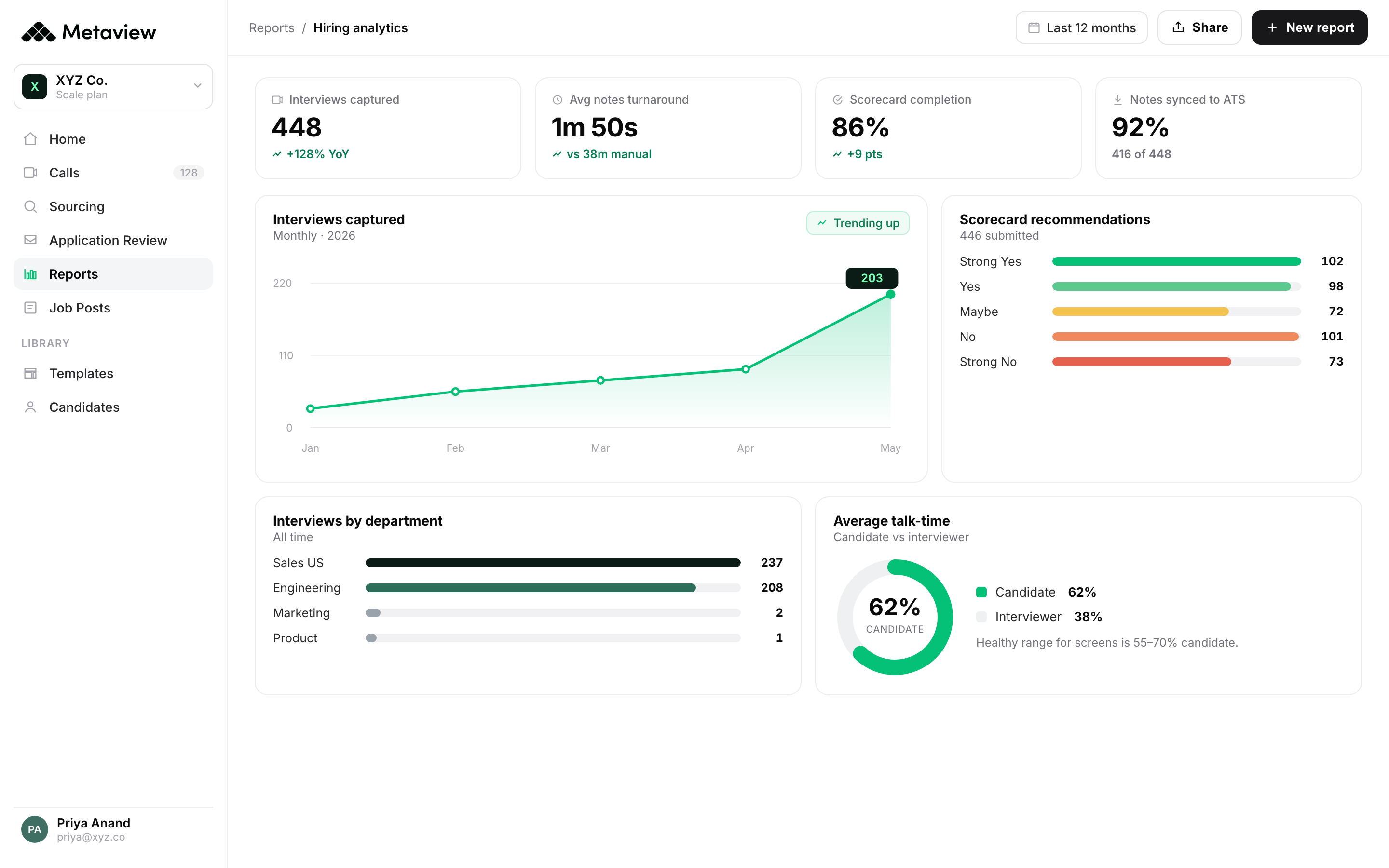
AI compresses the cycle by collapsing the lag between when the signal gets generated and when it becomes usable. Metaview’s AI Notes join the intake call as a participant, transcribe the conversation, tag the answers against the intake rubric, and produce a structured summary the moment the call ends. The recap that used to take 40 minutes on a Friday evening lands in the client’s inbox before they have closed the calendar event.
Metaview’s Reports turn the structured signal into the weekly client update without the recruiter writing prose. AI Sourcing uses the must-haves and deal-breakers from the intake summary as the search parameters, so the first slate is targeted, not generic. AI Job Posts turn the intake conversation into a posted role in seconds, not the hour the recruiter usually spends rewriting the client’s JD.
The clearest articulation of how this shift changes the day-to-day comes from Annie Wenzel at Swing Search, who runs a deliberately heavy intake process because she has watched what happens when you don’t. Worth listening to the full episode if you run searches at the senior end of the market.
Fantastic, intuitive tool with a Swiss Army level of use cases. The biggest win with Metaview is how much time it saves. Literal hours of writing up candidate reports for clients, Metaview automates the heavy lifting, allowing me to focus on fine-tuning each report with the points I want to highlight for the client. It opens up my day for lots more higher-leverage work.”
The 5-day agency onboarding template.
The 5-day template below is what a clean onboarding looks like for a retained agency engagement on a typical senior role. Compress or expand depending on complexity. The discipline is not the calendar; it is keeping every artifact in one structured place, and letting the next step pull from the previous one rather than rebuilding.
- Day 1: intake call with the hiring leader. Live capture during the call, structured summary lands the same hour, recap email goes out same business day. Scope and contract terms drafted from the recap by end of day.
- Day 2: client signs scope. Internal recruiter debrief is a short stand-up because the team has already read the structured summary. Position profile drafted directly from the intake conversation, not from the JD.
- Day 3: position profile review call with the client. Walk through must-haves, nice-to-haves, deal-breakers, stakeholder map. Client confirms or corrects each one. Profile is locked by end of call.
- Day 4: interview process mapping. Stages, interviewers, calendar gaps, decision criteria, feedback SLA all captured and confirmed. Tech and admin setup done in parallel: ATS record, shared channel, file-sharing, dashboards.
- Day 5: alignment recap. One artifact summarizing the goal, must-haves, deal-breakers, process, and timeline. Sourcing begins the same afternoon, with the first directional slate targeted for day 7.
If a search is going to break, it usually breaks because one of the five days above got skipped or compressed into a Slack thread. The agencies that consistently deliver inside the SLA are not the ones running heroically fast searches. They are the ones running disciplined onboardings. Harrison Walker Grant’s LinkedIn post below makes the same point from the agency-recruiter seat: the agencies that use structured intake capture across intakes, reference calls, panels, and debriefs are the ones whose searches compound.
 Harrison Walker Grant
Bring Metaview into your hiring stack.
Live notes, structured scorecards, and ATS sync - set up in under 10 minutes.
Frequently asked.
How long should agency-client onboarding actually take?
From signed scope to kickoff email, most well-run agency onboardings land in three to five working days. Faster is possible on repeat clients where the intake form is already mapped. Slower than a week usually signals one of three things: the client is not internally aligned, the agency is rebuilding the position profile from scratch each time, or someone is rewriting the recap from memory. With AI capturing the intake, the bottleneck stops being the agency’s admin load and starts being the client’s decision velocity.
Which onboarding decision gets revisited most often?
The position profile. Specifically, the must-haves versus nice-to-haves distinction. When the agency rebuilds the profile from a job description instead of from the intake conversation, the profile drifts. Three weeks into the search the client says ‘wait, we said this was a deal-breaker.’ The agency goes back to the call recording, except there is no call recording, and now there is a hard conversation about what was actually agreed. A structured intake summary that captures the founder’s exact language on each requirement prevents this.
What is the right cadence between intake call and first shortlist?
On most retained searches, the agency should be sending a directional first slate inside seven calendar days. That cadence is only achievable when the position profile is locked inside 72 hours of the intake call. The faster the recap and the profile move, the faster sourcing can start. The agencies that consistently miss the 7-day mark are almost always the ones where the recap takes a week to write up.
Does the client need to sign off on the position profile?
Yes, and the cleanest version of this happens in a single short call rather than an email exchange. The agency walks the client through the structured intake summary, the must-haves and nice-to-haves it generated, and the deal-breakers. The client confirms or corrects each one. The whole thing fits in 20 minutes when the intake summary is already built. Stretches to 60 minutes plus three email rounds when it is not.
How does AI change the agency’s billable-hour model?
The hours do not disappear. They shift. The hours previously spent writing up intake notes, drafting recaps, building position profiles from scratch, and reformatting reports for each client move into work clients actually pay retainers for: candidate strategy, market mapping, founder coaching, and offer negotiation. Agencies running this shift well report the same revenue with fewer recruiters, or higher revenue with the same headcount. The choice is theirs.
What metrics prove onboarding worked?
Three to track: time from signed scope to first shortlist (target: under 7 days), number of position-profile revisions during the search (target: zero post-week-one), and time-to-first client recap (target: same business day as the intake call). When all three hit target, the search rarely runs into the misalignment problems that come up in week four. When one slips, the others tend to slip with it.
