
Most executive searches are lost in the first hour. Not on a candidate, not on a competitor, not on comp. On the brief. The retained client says one thing in intake, you write down three lines, and by candidate four the room is litigating a profile no one actually agreed to. Sourcing volume cannot fix that. More candidates make it worse.
The good executive search firms compete on a different surface: how much of the intake conversation survives the search. A capture-first workflow makes the brief structured, the calibration legible, and the shortlist defensible. The board-ready deck stops being a Sunday-night writing exercise and starts being a query against the conversation data you have been building since the kickoff call.
That is what changes when AI sits on the interview layer rather than the sourcing layer. Sourcing is a feature now. Calibration captured once and reused across the panel, the shortlist, the debrief, and the next retainer from the same client - that is the moat. This is the workflow.
Why executive search compounds (or does not).
Those are the four stages. They look procedural; they are not. Each one is a place where intelligence either accumulates or evaporates. A retained search firm that captures the intake well and loses the calibration is still a firm that produces a Sunday-night deck. A firm that captures the calibration but never closes the debrief loop is a firm that wins a retainer and never wins the next one from the same client.
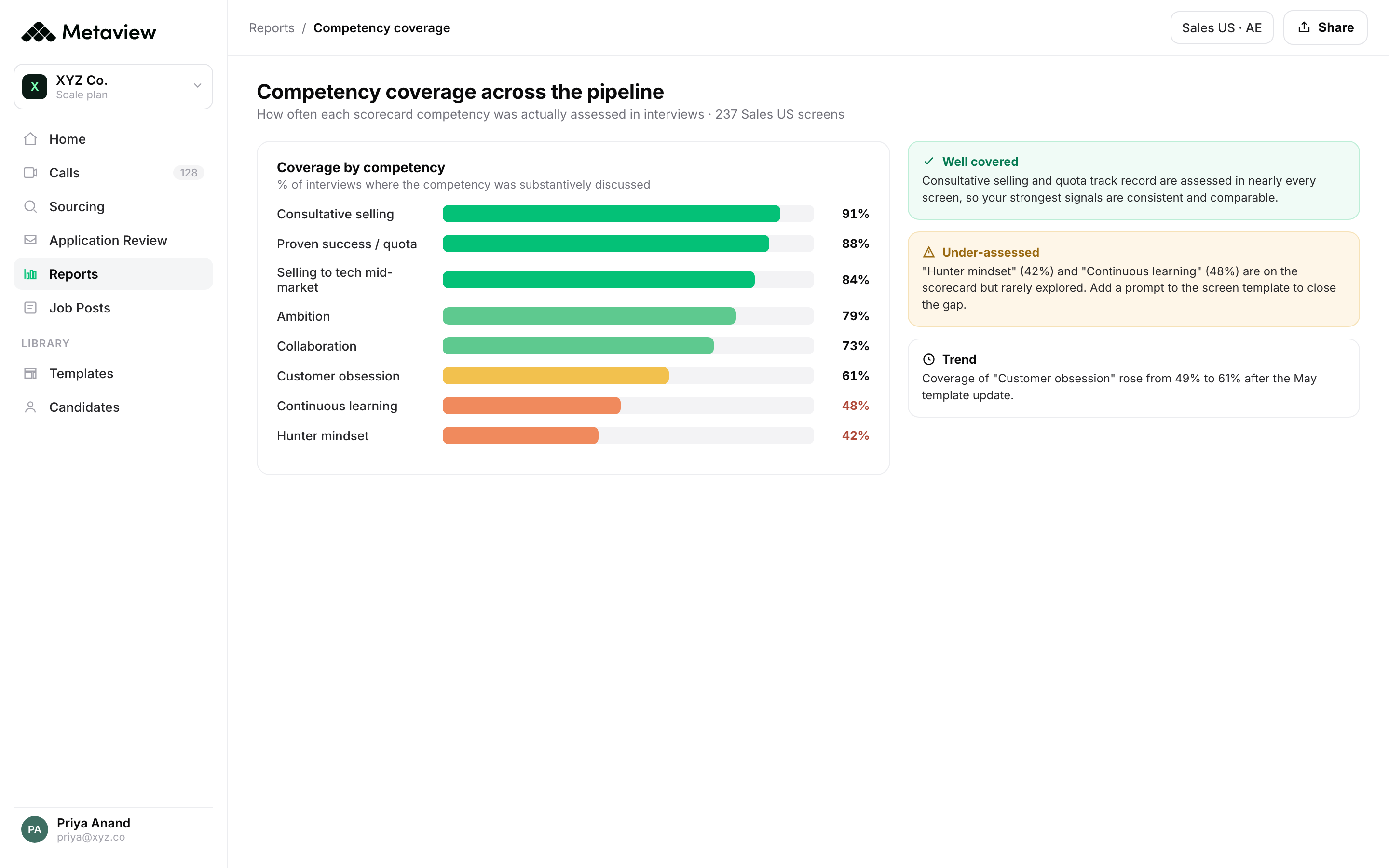
The compounding question is structural. Does each stage hand the next one a richer, more structured artifact than it received? Or does each stage start from a recruiter’s memory and a three-line Slack note? That is the variable that separates the firms whose average client gives them two mandates a year from the firms whose average client gives them six.
We are using stats here from Metaview’s 2026 AI & Hiring Alignment Report - surveying 505 recruiting leaders and hiring managers across North America and EMEA. On page 17, teams that put AI at the core of hiring are 3.8x more likely to rate their cross-functional relationship as excellent. For executive search firms, ‘cross-functional’ is the client. The 3.8x is the retainer renewal.
The intake call is the highest-leverage hour in your business.
Sixty minutes with the retained client commits you to a profile that you will then re-pitch across twelve candidates, six panelists, and four board members. The math on leverage is brutal: every word said in intake gets multiplied by the size of the rest of the engagement. Mis-hearing ‘ideally’ as ‘must’ in the first hour produces a month of mismatched submissions.
Capture every word, structure the must-haves separately.
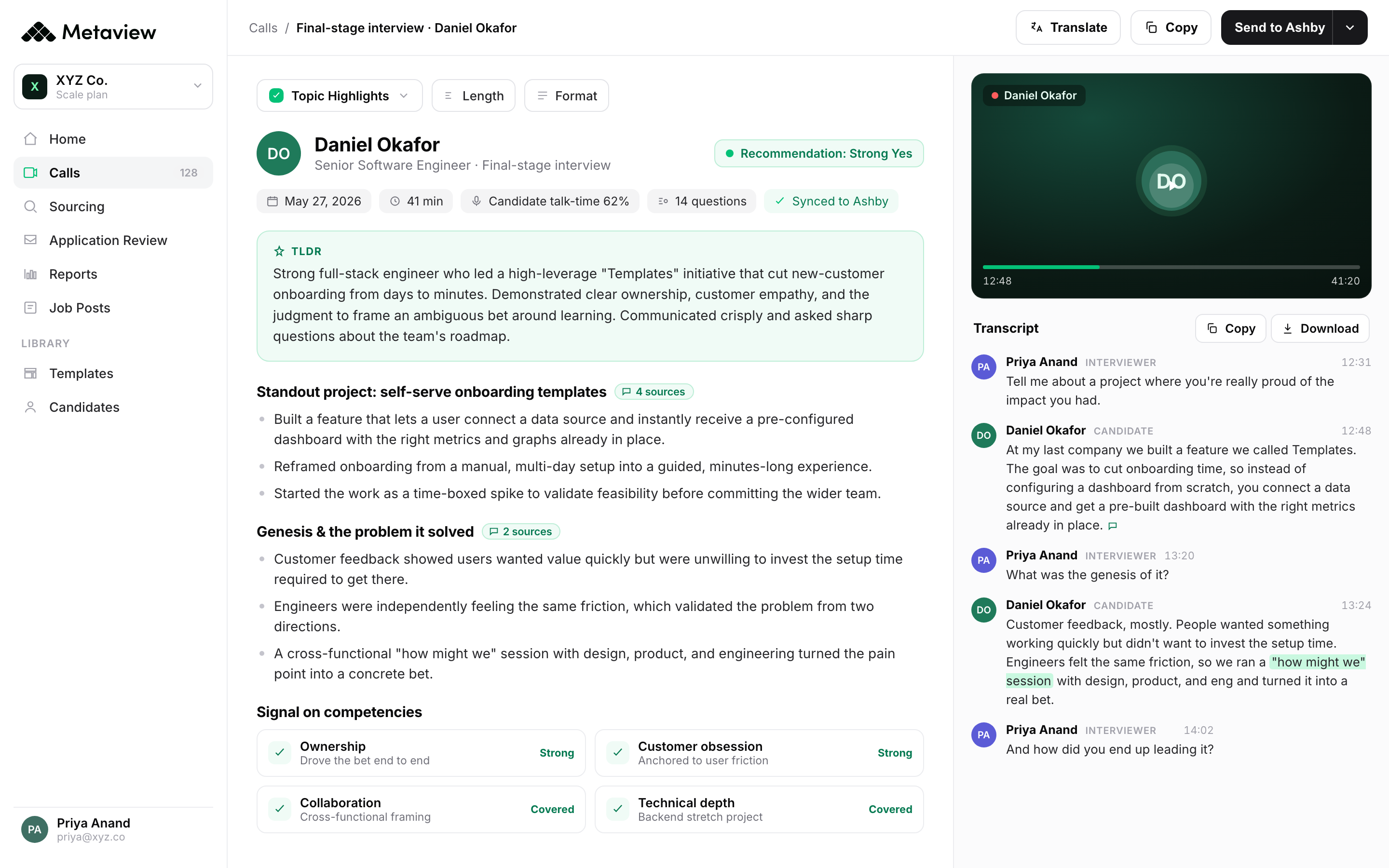
The traditional approach is a notebook and a recruiter’s post-call rewrite. Both fail in the same place: under pressure, the recruiter remembers the loudest thing the client said, not the most strategically important. A captured transcript plus an auto-generated structured summary against a calibrated intake template removes the ambiguity. The transcript holds the candour; the template holds the commitments.
Force the client to disambiguate, on record.
A good intake template forces the client to answer the questions they normally leave implicit. What does ‘executive presence’ mean for this seat, specifically? Which past hire embodied it? Which past hire was supposed to and did not? Capture the answers, name the trade-offs in the summary, and the calibration phase is half-done before you start sourcing.
Ship the intake summary back to the client inside 24 hours.
The structured summary you ship after intake is the single highest-leverage piece of writing in the mandate. It is the contract. If the client reads it and corrects two things, you have just saved a month of misaligned submissions. If the client reads it and says ‘perfect’, you have a written commitment to the brief that survives the second candidate.
What you’re really dealing with at the end of the day is a CEO and founder who’s really afraid they’re gonna make the wrong hire, and a candidate who’s really afraid they’re gonna make the wrong decision for their family. And that oftentimes isn’t actually tied to money.”

Calibrate once, run the search forever.
Calibration is the moment the abstract brief meets a real shortlist of twenty named candidates and the client tells you which ones are wrong and why. It is the most expensive hour of the search, and most firms throw away the output. They take notes in Slack, summarize into the project tracker, and lose the ‘why’ - the actual reasoning that would have told the second panelist what ‘close but no’ means for this seat.
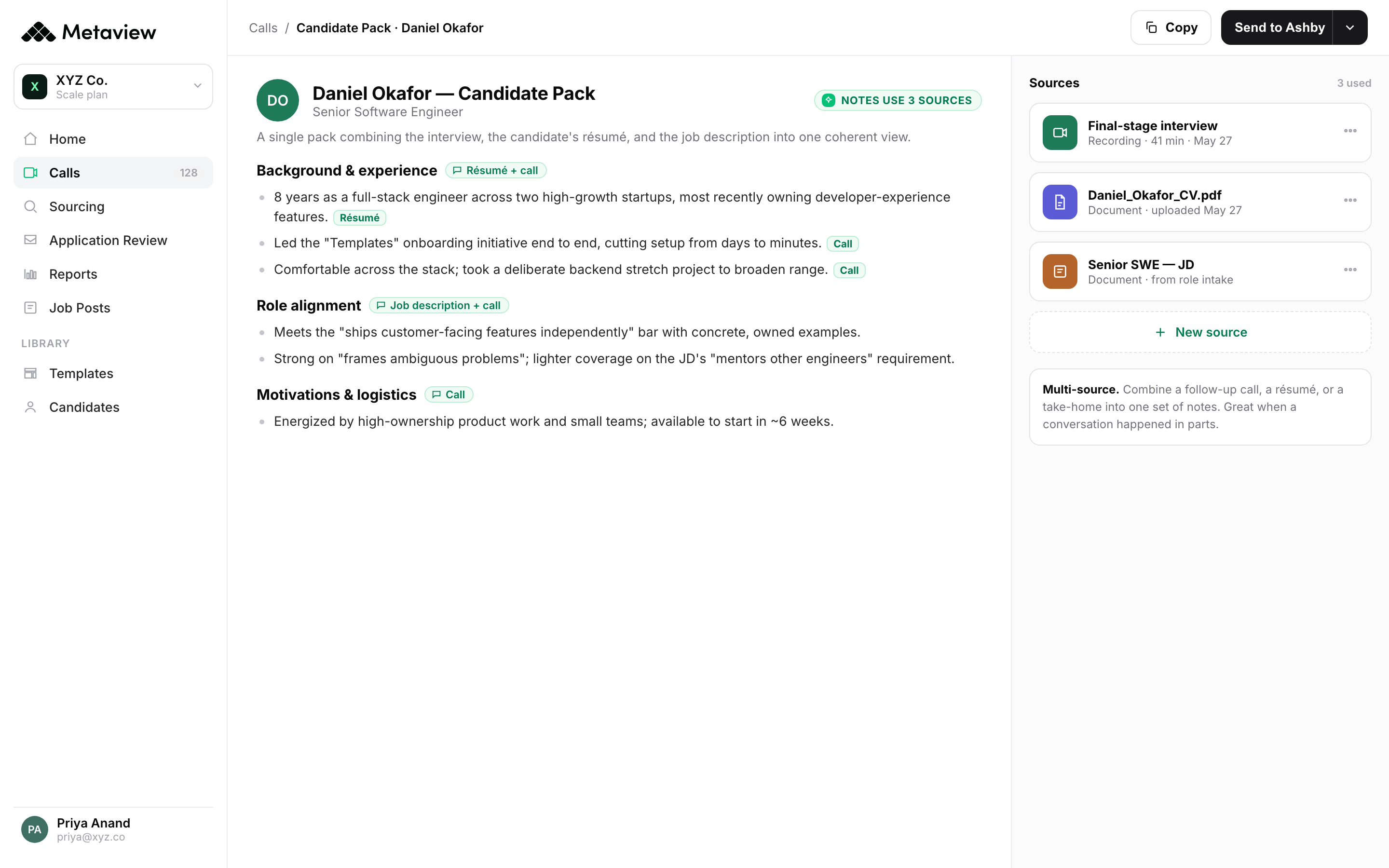
Three modes of running calibration produce three different downstream cost curves. The manual mode is what most search firms still do. Generic AI captures something but misses the framework. A capture-first system anchored to the intake template does both.
| Calibration dimension | Manual | Generic AI notetaker | Metaview (capture-first) |
|---|---|---|---|
| What the recruiter writes down | Three Slack lines after the call | A transcript and a generic summary | A structured summary anchored to the intake competencies |
| What the second panelist sees | The recruiter’s memory, three days later | A transcript no one will read | A scorecard pre-populated against the same template the first panelist used |
| What the debrief deck pulls from | A blank slide and a Sunday night | Generic AI summaries strung together | Cross-panel summaries already structured to the client’s board format |
| What survives to the next retainer | A few names in the CRM | A transcript folder no one searches | A calibrated baseline for the same client’s next seat |
| Cost when calibration drifts | Three weeks of misaligned submissions | Same, with more reading material | Caught in the second panel because the template flags it |
The fourth row is where the compounding shows up. The same client comes back six months later with another mandate. The manual-mode firm starts from zero. The capture-first firm starts from a calibrated intake template, the candidates the client rejected and why, and the language the client’s board actually uses. The second retainer is half-priced in intelligence-acquisition cost. The third is faster than the second.
From shortlist to board-ready deck.
The board pack is the deliverable the retainer is actually paying for. Everything before it - the intake, the market map, the candidate calls - is an input to that one document. And almost every executive search firm writes it the same way: a senior consultant sits down on Sunday and reconstructs the search from memory, calendar entries, and a Slack scrollback.
That deck is a re-creation, not a query. Which means it is bounded by what the consultant can recall and willing to re-listen to. The candidate’s ‘exact phrase about turning around the EMEA P&L’ from week two of the search will not make it in unless someone wrote it down. With auto-captured calls, the same deck becomes a query against the conversation data. The exact phrase is there because the call is there.
- Sunday-night reconstruction from memory, calendar, and Slack scrollback.
- Candidate quotes paraphrased, often softened, occasionally invented.
- Each consultant’s deck reads differently; the firm has no house voice.
- The deck dies the day it is delivered. No reusable artifact for the next mandate.
- Deck pre-populates from the structured summaries you already shipped after each call.
- Verbatim candidate quotes pulled from transcripts, linked to the timestamp that proves them.
- House voice enforced because every deck is built from the same structured fields.
- The deck is reusable structured data. The next mandate inherits the calibration baseline.
Senior consultants will say the deck is the craft. They are right. The point of the capture-first workflow is not to remove the craft; it is to remove the typing. Pre-populate with the structured signal, and the consultant spends Sunday night doing what they were actually trained to do - frame, weigh, and recommend - rather than reconstructing what was already said.
Fantastic, intuitive tool with a Swiss Army level of use cases. The biggest win with Metaview is how much time it saves. Literal hours of writing up candidate reports for clients, Metaview automates the heavy lifting, allowing me to focus on fine-tuning each report with the points I want to highlight for the client. It opens up my day for lots more higher-leverage work.”
The post-placement loop is where compounding actually happens.
The placement closes. The invoice goes out. Most firms stop there. The capture-first firms do four things in the next thirty days that determine whether the same client gives them the next mandate.
All four are structured queries against the data the search already produced. None of them require a new conversation. The infrastructure was built across the previous five stages. The post-placement loop is just where the firm actually realizes the return on having built it.
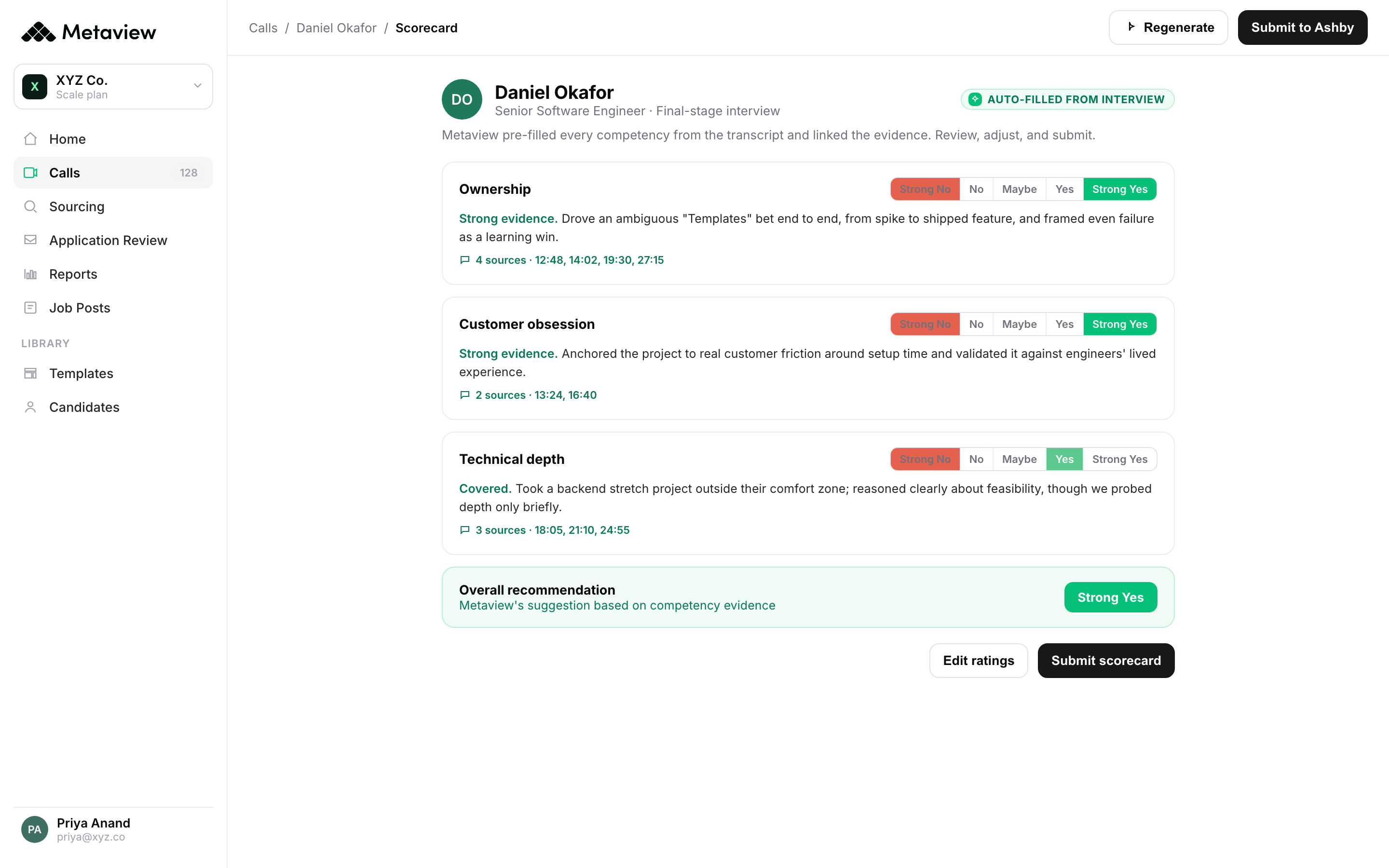
- 1Auto-generated summary against the same intake competencies the panel used.
- 2Verbatim candidate quotes pulled from transcript, linked to timestamp.
- 3Calibrated decision artifact - reusable as the baseline for the next retainer.
- 4Cross-mandate query surface: search every prior intake by client, role, or competency.
The four moves: ship a placement debrief deck to the client board within two weeks, anchored to the captured calibration. Capture a six-month check-in with the placed executive and surface the early signals back to the client. Pre-write the talent map for the seat one level down from the placement. And quote the next mandate against the calibrated baseline you now have, not against a cold-start hour.
How to install the workflow.
Five moves get a mid-sized executive search firm from manual capture to compounding across retainers. None requires changing the consultants’ craft. Each one moves a structured artifact one stage further down the workflow than it currently goes.
- Pick three template families and lock them. CEO, CFO, CHRO - or whatever your firm specializes in. The template is the artifact that survives intake. Without it, capture is just a transcript.
- Capture every client and candidate call on the same platform. Mixed-platform firms produce mixed-fidelity artifacts. One platform, one template family per search, every call recorded with consent.
- Auto-ship the intake summary to the client inside 24 hours. The structured summary, not the transcript. If the client corrects two things, you have just saved a month. If they say ‘perfect’, you have a written contract on the brief.
- Make the second panelist’s scorecard pre-populate. From the captured calibration, against the locked template, anchored to the same competencies. No more first-panel-versus-second-panel scoring drift.
- Run the post-placement loop within 30 days, every time. Placement debrief deck, six-month check-in scheduled, talent map for the seat below, quote for the next mandate. Four moves, all queries against existing data.
Rhys Hughes' framing translates directly: the firms that win retained searches are the firms that treat the next hire as the last resort and the calibration system as the moat. Build the system once, run it across the next twenty mandates.
 Metaview Technologies
See how the intake call, the panel scorecards, and the client board pack all run from one structured signal trail.
