
Interview notes are the substrate of every downstream hiring decision you make. Scorecards, debriefs, offer rationale, calibration, hiring-manager alignment, leveling, even the post-mortem on a candidate you lost. All of it traces back to the notes. When the notes are thin, the rest of the funnel runs on memory and vibes.
Most recruiting teams still treat interview notes as administrative residue, the thing you clean up between calls. That framing is the problem. Notes are not paperwork. They are the evidence layer of your hiring system, and if the evidence is bad, the decisions sitting on top of it cannot be trusted.
This is the move that AI notetaking actually unlocks. Not faster typing. Not cleaner formatting. A shift from notes-as-admin to notes-as-data, which is the difference between a hiring process that compounds insight and one that resets every conversation.
Why interview notes matter more than you think
Every hiring decision you make is, in the end, a decision about what you remember the candidate did. Not what they actually did. What you remember. Interview notes are the only mechanism that closes the gap between those two things.
When the notes are good, the debrief is fast and grounded. The hiring manager and recruiter argue about evidence, not impressions. When the notes are bad, the loudest interviewer wins, the most recent interview overweighs, and the candidate who was actually strongest gets quietly downranked because the third panelist had thin notes and a strong personality.
This is not a minor process issue. The downstream cost shows up in every hire you regret, every offer that gets declined for vague reasons, and every calibration session that loops back to "what did they say in round two again?" The notes were the moment to lock that in. They didn't.
Interview notes are not a write-up. They're the only durable record of what actually happened in the room. Treat them like paperwork and you'll make paperwork decisions.”

What a great interview note actually looks like
The first mistake recruiting teams make is treating notes as a transcript. A transcript is not a note. A transcript captures every word and weights none of them. A note captures the few things that matter and discards the rest.
A great interview note does four things. It logs concrete evidence, the specific examples or claims the candidate made. It maps those examples to the scorecard signal they actually inform. It surfaces candidate motivations and red flags, the things that change how you close them or whether you should. And it leaves open questions, what the next interviewer needs to validate.
None of this requires more words. A 200-word note in this shape is more useful than a 2000-word transcript that loops back to "they seemed strong." The bar is structure, not length. If your notes don't have those four pieces, you are not running an evidence-based hiring process. You are running a memory contest.
- Recruiter splits attention between candidate and keyboard
- Notes written hours later from memory, full of gaps
- Format varies wildly by interviewer and round
- Debriefs rehash the conversation instead of debating the decision
- Recruiter fully present, no typing during the conversation
- Notes delivered instantly, structured against scorecard signals
- Same format across every interviewer, comparable across candidates
- Debriefs start from evidence, faster decisions and tighter calibration
Why manual notetaking quietly breaks hiring
The structural problem with manual notetaking is that you cannot listen and write at the same time. Anyone who has tried to do both knows this. You either capture the words and miss the candidate's hesitation, body language, the thing they didn't say. Or you stay present and lose half the detail by the time you write it up afterwards.
This is not a discipline problem you can fix with training. It is a bandwidth problem you cannot beat by trying harder. The recruiter who looks the most composed in interviews is usually the one taking the worst notes. The one taking the best notes is barely making eye contact. Neither of those is a great interview experience for the candidate, and neither produces the evidence layer the hiring team actually needs.
The cost compounds at volume. A single recruiter doing 30 first-round screens a week is making 30 micro-tradeoffs between presence and accuracy. By Friday, the notes from Monday are vague, the notes from Wednesday are detailed but missing the human read, and the notes from Friday are skeletal because the recruiter is exhausted. Calibration across that week is impossible.
Inside Metaview Notetaker: the capture layer
This is the problem Metaview Notetaker was built to solve. It joins your interviews, captures the full conversation, and turns it into a structured note that maps directly to your scorecard. The recruiter doesn't type. The candidate gets full attention. The note is delivered seconds after the call ends, in the same shape every time.
The Notes UI is built around the four things that actually matter in an interview write-up: a clear TLDR at the top, the Q&A structure mapped to your template, the candidate's own words for the moments that drive a decision, and the open questions the next interviewer should probe. This is what notes-as-data looks like in practice.
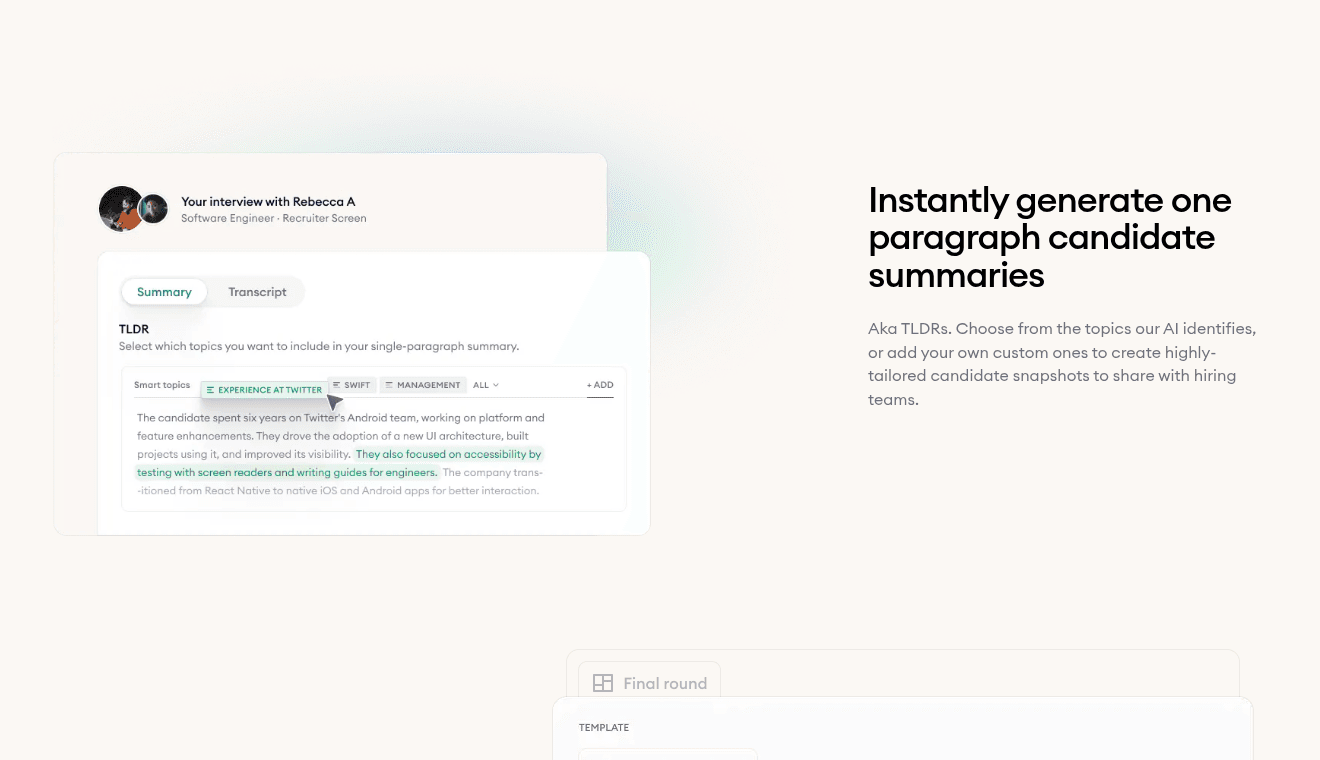
- 1Header pins the candidate, role, and round so the note is never decoupled from its context.
- 2Q&A template maps every answer to the signal it informs on your scorecard.
- 3TLDR summary surfaces the decision-relevant takeaways without rebuilding the full transcript.
What changes when notes become data
The shift is not "now we have better notes." The shift is that notes stop being a paragraph in a Greenhouse field and start being structured signal you can search, compare, and roll up. That changes how the entire hiring funnel operates.
Debriefs run on evidence instead of impressions. A hiring manager who couldn't make the panel can read the notes in three minutes and weigh in without slowing the process. Scorecards stop being recall exercises and become annotations on what actually happened. Calibration across candidates becomes a real activity, not a guess about who the panel liked best three weeks ago.
And the recruiter-hiring manager relationship stops depending on personal chemistry and starts depending on a shared evidence layer. That is the alignment unlock most teams have been chasing for years without naming what was actually in their way: they didn't have the data to align on.
Once notes are structured data, every conversation downstream gets sharper. The debrief, the scorecard, the offer call, the post-mortem. You stop arguing about what happened and start arguing about what to do.”
Where AI gives recruiting teams use
Notes are the capture point, but the use doesn't stop there. When the capture layer is solid, every other surface in the hiring stack gets sharper. That is the actual product story of an AI-augmented recruiting function: not "we automated typing," but "we built an evidence pipeline that feeds everything downstream."
Intake notes feed sourcing criteria directly, so the search starts from what the hiring manager actually said in the kickoff, not a stale job spec.
Triage ranks applicants against the actual signals captured in interview notes from past hires, not a generic ICP that hasn't been refreshed in months.
The capture layer itself, structured Q&A, TLDR, and motivations delivered seconds after every interview ends.
Roll up notes into pipeline-wide dashboards so quality-of-hire stops being a story and starts being a metric.
The size of the prize here is not abstract. According to Metaview's 2026 AI & Hiring Alignment Report, surveying 505 recruiting leaders and hiring managers across North America and EMEA, teams that have made AI core to hiring are running materially better processes than those that haven't. The same data shows what happens when the recruiter-hiring manager relationship breaks down, which is the exact relationship that bad notes silently corrode.
Read those four numbers together. Teams that have wired AI into their hiring process are more aligned, faster, and losing fewer candidates. The teams that haven't are bleeding qualified people every month and missing business goals because their recruiter-hiring manager relationships are running on memory. Notes are not the whole story, but they are the load-bearing piece. The full picture sits in the AI Hiring Alignment Report.
The operating shift
Moving from notes-as-admin to notes-as-data is not a tooling swap. It is an operating shift, and the teams that get it right do three specific things.
One: stop typing in interviews. Every interview a recruiter runs is either an act of attention or an act of transcription. It cannot be both. The first move is to take typing off the recruiter's plate entirely so the conversation gets the bandwidth it deserves. This is the prerequisite, not the upgrade.
Two: standardize the note shape across every interviewer. A great note from one panelist and a thin paragraph from another is not a hiring process, it is a hiring lottery. The whole panel runs on the same interview notes template, the same Q&A structure, the same TLDR convention. Comparable notes are what makes recruiter-hiring manager calibration possible at all.
Three: treat notes as a system input, not a deliverable. Notes should feed scorecards, debriefs, sourcing refreshes, and pipeline reports. If your notes live in a Greenhouse field and never get read again, you are leaving the entire downstream signal layer on the table. The point of capturing them is to use them. Pair this with sharper debriefs and the compound interest shows up fast.
Bring Metaview into your hiring stack.
Live notes, structured scorecards, and ATS sync - set up in under 10 minutes.
Frequently asked questions
How detailed should interview notes be?
Detailed enough to ground a decision, not detailed enough to rebuild the conversation. The bar is evidence, signal, motivation, and open questions, not length. A 200-word note that hits those four is more useful than a 2000-word transcript that hits none of them.
Should every interviewer use the same note format?
Yes. Consistent structure is what makes comparison across candidates and across rounds possible. Without it, you cannot run real calibration. With it, debriefs collapse from hour-long rehashes into focused decision conversations.
When should notes get to the hiring manager?
Inside the hour. Hiring managers make better decisions when context is fresh, and candidates feel the difference when feedback loops are tight. Late notes lose accuracy and let competitors move faster on the same candidate.
Do great notes replace debrief meetings?
No, but they change what debriefs are for. Instead of rebuilding the conversation, the panel debates the decision. That is the meeting that adds value, and it is the only meeting worth holding once the evidence is already in the room.
How is AI notetaking different from a transcript tool?
A transcript is unstructured words. An AI note is a structured artifact mapped to your scorecard, with a TLDR, Q&A, motivations, and open questions surfaced automatically. The first is a search tool. The second is a decision tool.
