
Here's the 6-step debrief I run after every panel, in the order that matters. Prepare, go around the room, summarize, dive deeper, decide, action. Most of the work happens before anyone sits down.
Done well, an interview debrief brings clarity to the panel, anchors decisions in shared evidence, and improves the next interview loop. Done as a chat, it loses signal.
The cost is real: the candidate hangs in the pipeline for days, the panel rehashes feelings in Slack, and the team that moves faster gets the offer in.
This is the playbook I learned by watching the teams that get it right. Two leaders shaped it: Jan Chong, VP of Engineering at Tally, and Jill Macri, Partner at Growth by Design Talent. The structure holds whether you're hiring engineering, sales, or operations.
The hour itself is short. The discipline that earns the hour is what changes the outcome.
Hiring managers own the debrief, and what breaks when they skip it
The single highest-leverage move in the interview process is naming the hiring manager as the owner of the debrief. Recruiters facilitate, interviewers contribute, but the hiring manager runs the hour and makes the call.
When that ownership is fuzzy, the meeting drifts into a discussion, the loudest voice locks the read, and the candidate hangs in the pipeline for days.
Jill Macri puts it bluntly: hiring managers own debriefs because they own the decision. The other interviewers carry real responsibility too. They run good interviews, ship written feedback within 24 hours, and bring a clear recommendation.
The whole machine breaks when the hiring manager treats the debrief as a scheduling problem instead of a leadership move.
The cost of weak ownership scales upward, all the way to the CEO. Amina Moinuddin Darwish, Global Head of Talent at Vercel, has talked about how an offer-approval moment exposes whether the panel was run well.
Top talent hires top talent. The first thing the CEO looks at when approving an offer is the interview panel. Is he going to say, I believe in the people that are interviewing this person? I understand they're going to have the right feedback and I trust that feedback.”

The CEO doesn't trust the panel by default. The panel earns that trust through the discipline of the meeting itself: the rubric anchored before the candidate, the feedback collected before the discussion, the hiring manager owning the call.
The 6-step playbook
Here are the six steps, in the order that serves the decision. Each step earns its place; the meeting falls apart when teams skip the prep and try to do all the work in the room.
1. Prepare in advance
The hiring manager walks into the meeting already knowing where the panel agrees and where the signal is thin.
That requires three pre-reads: every interviewer's written feedback, the rubric the panel scored against, and any candidate artifacts (work sample, take-home, prior interview transcripts) that touch the areas under question.
Before the debrief, the hiring manager should:
- Read every written feedback submission. Identify the themes that recur across interviewers and the splits where one or two voices disagree with the rest.
- Note the under-explored areas. Where the feedback is thin, line up the probing questions you'll bring to the meeting.
- Open the multi-source view. If your stack supports it, the pre-built cross-panel summary saves the hiring manager 20 minutes of synthesis work before the meeting even starts.
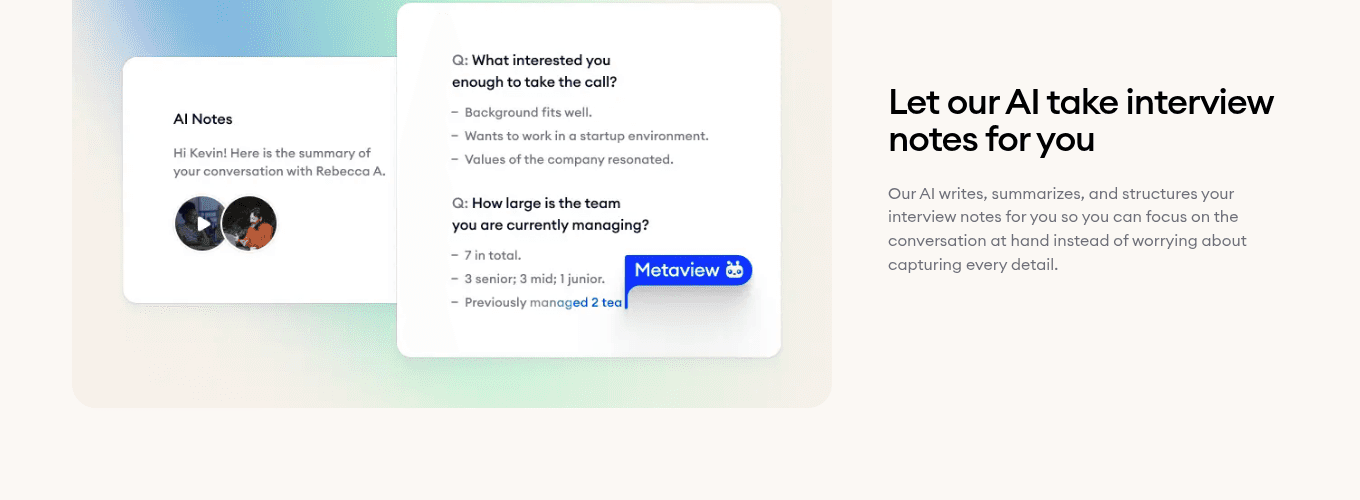
- 1Per-interviewer structured notes, anchored to the rubric.
- 2Question-by-question signal, ready for the hiring manager to scan.
- 3Topic chips surface themes across the panel before the meeting starts.
2. Go around the room
Each interviewer shares 1-2 minutes on their focus area. Nothing here should surprise the hiring manager, because the written feedback already arrived.
Jan Chong recommends each interviewer cover three things: their judgment on the candidate's overall performance in their area, particular strengths, and weaknesses or concerns. No surprises, no monologues.
The round-robin is the fairness lever: every voice gets oxygen before the senior voice locks the room.
3. Summarize the discussion
The hiring manager plays back what they're hearing. "Sounds like the engineering bar is solid, the communication is uneven, and the architecture instinct is the question mark. Is that right?"
The summary is a check, not a verdict. Interviewers get the chance to flag what's been misread before the discussion moves to the deep dive. This is where you catch the misalignment that would otherwise leak into the decision.
4. Dive deeper
Now spend the time on the areas that matter: concerns where the weakness might disqualify, and strengths where the signal is thin. The hiring manager runs this part, and three rules apply:
- Don't dismiss the "feelings." Interviewers often sense something they can't immediately name. Probe for the specific behaviors that triggered the read: "When in the interview did you first start to feel that way?" The behavior is the evidence; the feeling is just the flag.
- Go after under-explored strengths. You need the same depth of evidence on what the candidate is great at as on what they're shaky at. A confident hire-or-no-hire call requires both halves of the picture.
- Listen back on thin signal. If a five-minute exchange decides the candidate, replay it. Interview recordings give you the actual exchange, not the interviewer's summary of it.
5. Make the decision
Based on the evidence, the panel decides: advance, reject, or gather more data with a follow-up interview. This is where the hiring manager's ownership becomes visible.
Below 80%, either the panel isn't aligned on what to look for, the interviewers aren't well trained at eliciting signal, or the hiring manager doesn't have a clear picture of what they need.
6. Create action items and follow-up steps
The recruiter writes the debrief notes, documents the decision against the rubric, updates the ATS, and assigns who's communicating with the candidate.
Transparency is the rule even on rejections; fast, specific feedback builds the careers-page reputation that compounds over years.
The post-decision step also feeds the next debrief: per-interviewer signal trends over time tell the hiring manager who's calibrating well and who needs a coaching nudge.
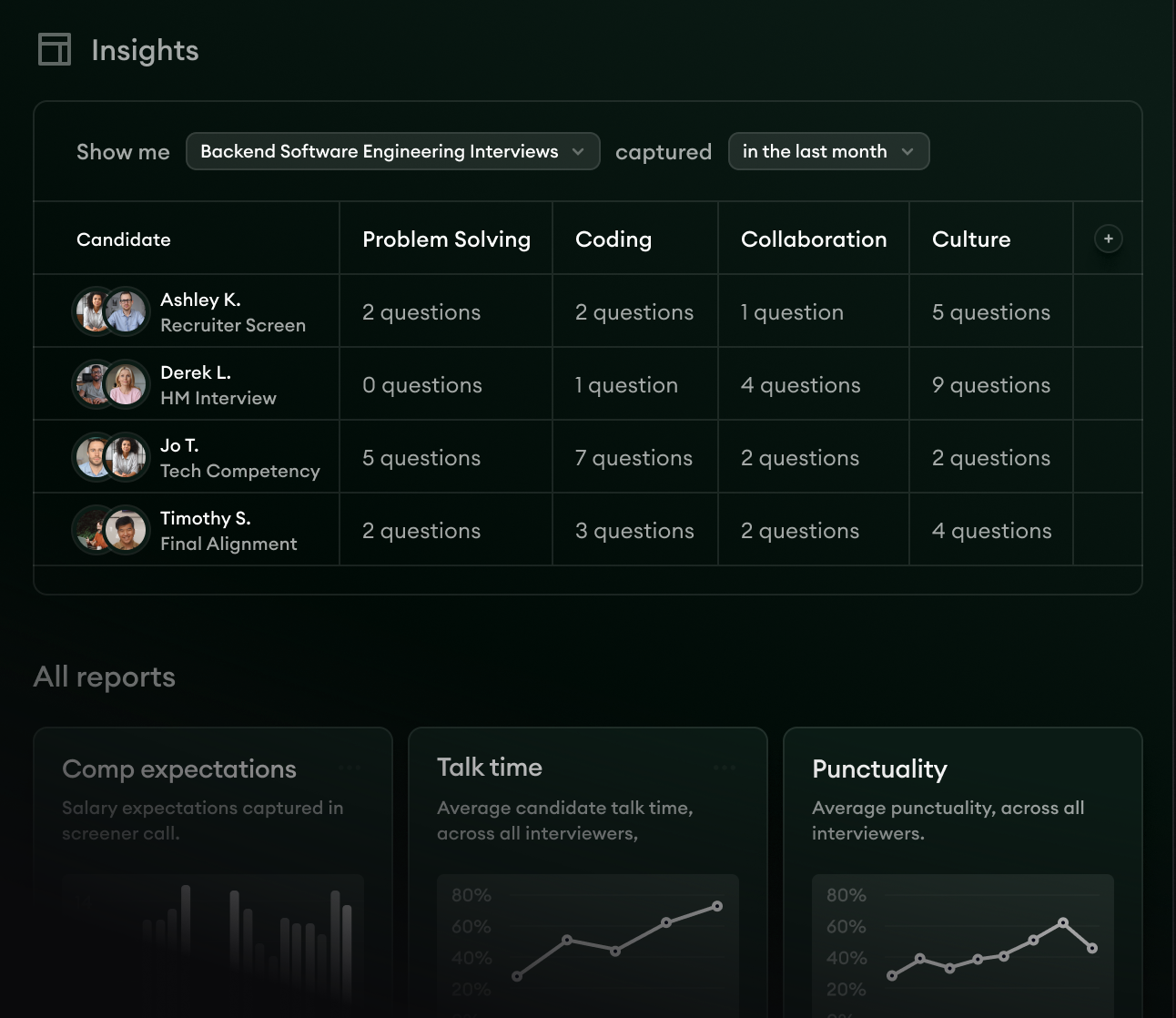
- 1Per-interviewer competency coverage, tracked across the corpus.
- 2Signal trends surface who's calibrating well and who needs a coaching nudge.
- 3The post-decision view that compounds every future debrief.
How to prevent groupthink before it locks the room
Groupthink is what kills the signal in a panel debrief. One confident interviewer speaks first, lands a read, and the rest of the panel quietly aligns. The candidate either gets passed on for reasons that nobody can defend, or moves forward on a thesis that nobody really owns.
Three levers work to protect the signal, in order of importance:
- Lock feedback before the meeting. The discussion starts from independent reads; the meeting becomes a structured aggregation, not the first place people form an opinion. This single lever does more than the other two combined.
- Round-robin, junior voices first. Every voice gets airtime. The junior interviewer who would otherwise compress their read in the presence of a senior voice gets a clean 90 seconds to share what they saw.
- The hiring manager listens first. They don't share their own view until everyone else has. Their job in the first half of the meeting is to surface signal, not to deliver verdicts.
The hardest part of this is enforcing the written-feedback gate when the team is under pressure to move fast. The teams that hold the line get an unexpected benefit: the feedback itself becomes the data layer that tells you, in hindsight, what you missed.
We have a 24-hour SLA on interview feedback. We've been doing this for two and a half years now, which means we have unbelievable data. When we make the wrong hiring decision and go back to the feedback, nine times out of ten we're like, oh yep, there it is.”

That's the operating-system effect of holding the feedback gate: the signal was always there. The teams that read it during the debrief catch the misalignment before the offer goes out. The teams that don't read it learn the same thing from a quarter of attrition data later.
What happens when the panel disagrees
You won't always converge. Two patterns to watch: optimize for consensus and you'll lose outliers (candidates with one extreme strength that didn't surface in every interview).
You'll also be forced to weight every interviewer's recommendation equally even when their tenure and calibration vary.
The frame that works is buy-in over agreement. The hiring manager decides. Interviewers who disagree can still commit to the call when the reasoning is transparent.
That transparency is the entire point of the structured debrief. Without it, disagreement curdles into resentment and the next interview round runs less carefully.
A great debrief delivers four distinct outcomes. Getting to a decision is only the most visible.

Advance, reject, or gather more data. Specific, evidence-anchored, and owned by the hiring manager.

The panel aligns on what good looks like and what's nice-to-have, so the next interview loop runs sharper.

Even disagreeing interviewers commit because the reasoning is visible. Disagreement without buy-in poisons future loops.

The quality of the signal in the debrief tells you whether the interviews themselves need work. The meeting reveals the system.
As long as the hiring manager can explain the call clearly, disagreeing with the panel doesn't damage the working relationship. The transparency does the work, and the next debrief opens with a panel that trusts the process.
How Metaview makes the debrief sharper
The playbook works without any product. It works much better when the per-interviewer record, the cross-panel summary, and the calibration trends are already structured before the hiring manager opens the meeting.
That's where our product slots in. Each of the six steps gets a Metaview surface that compresses prep time and tightens the signal.
- Hiring manager reads four free-text forms, synthesizes by hand
- Per-interviewer notes inconsistent in format and depth
- Summary lives in someone's head until the meeting
- Disputes get resolved by memory, not evidence
- Calibration drift surfaces a quarter too late
- Multi-Source Pack auto-built before the meeting, themes pre-surfaced
- Structured AI Notes per interviewer, anchored to the rubric
- Cross-panel summary lands in the hiring manager's inbox
- Replay the actual exchange when the signal is thin
- Reports surface per-interviewer drift between debriefs, not after
The biggest shift is the prep stage. When the hiring manager opens the meeting with the cross-panel summary already structured, the first 10 minutes (which used to be the hiring manager catching up) become the first dive-deeper move instead.
The Pack opens already calibrated, and the panel uses the hour for the parts that need a room.
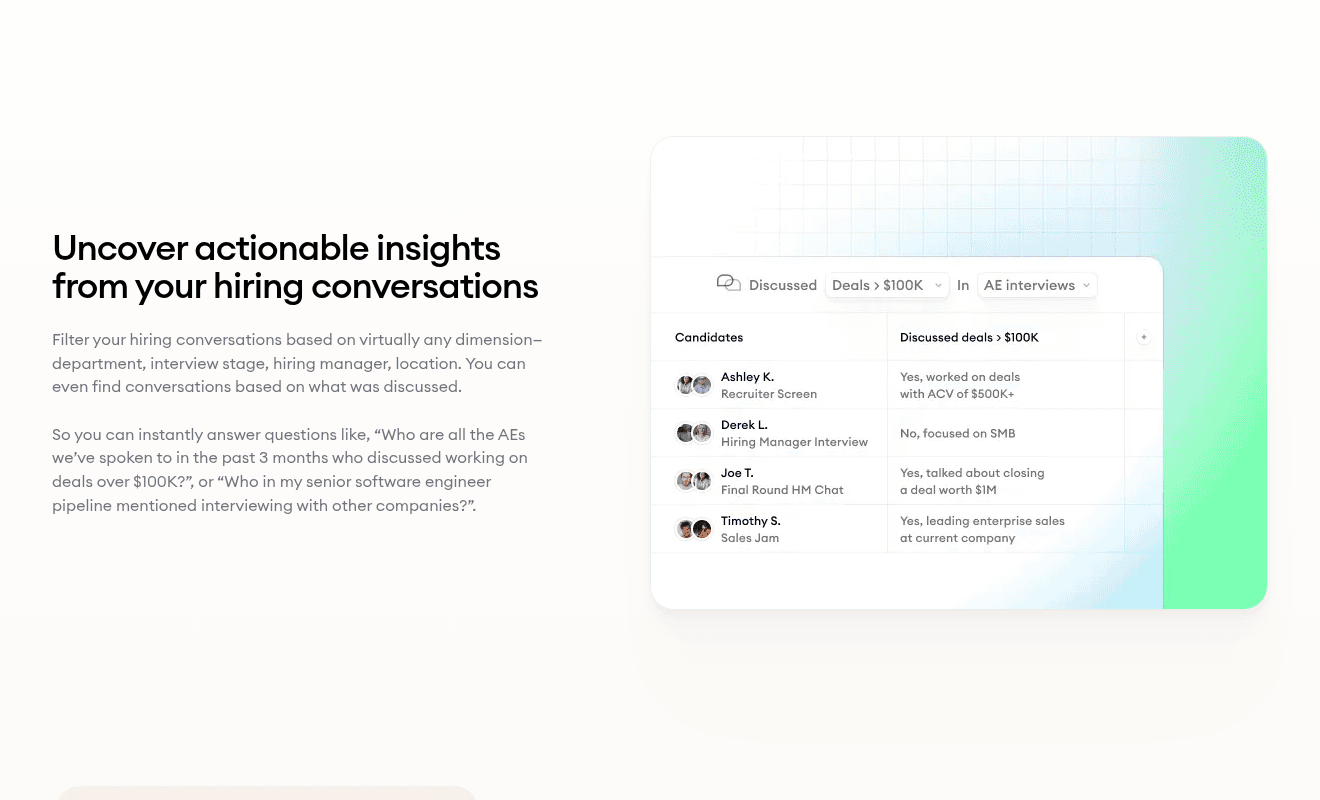
- 1Cross-panel themes synthesized from every interviewer's notes.
- 2Areas of disagreement flagged so the hiring manager knows where to probe.
- 3Direct links back to the moments in the interview that drove each signal.
The structure-first principle holds for the interviewer side too. When the hiring manager has less interviewing experience, the rubric and the prompts they need to ask are right there in their notes view, which keeps every round on the same evaluation rails.
Being able to structure their questions and give them guidance on what they should be asking, which is then represented in the scorecard and their notes, makes that more consistent.”

Frequently asked
What is an interview debrief?
An interview debrief is the structured meeting after a round of candidate interviews where the hiring manager, recruiter, and interviewers align on feedback and decide next steps. Some teams call it a wash-up meeting; the format is the same, and the 6-step playbook above holds either way.
Why do good interview debriefs matter?
Skipping the debrief, or running it as a chat, costs more than it saves. Across a quarter, the gap shows up as longer time-to-hire, more candidate drop-off in the offer stage, weaker candidate review conversations, and a hiring funnel that gets harder to debug because the signal was never written down.
How long should an interview debrief meeting last?
Thirty to forty-five minutes is the default for a four-interviewer panel; bigger panels or more senior roles scale up. If the meeting keeps overrunning, the duration is usually the symptom; the rubric or the pre-read prep is the cause. Tighten the upstream, and the meeting tightens with it.
Who should be in the debrief meeting?
The hiring manager, the recruiter, and every interviewer in the loop. Skip-level approvers stay out; their input lives in the offer-prep stage, not the debrief, because they didn't see the interviews themselves. For senior roles with a hiring committee, run a second meeting with the hiring manager as the bridge between the two rooms.
What's the difference between a debrief and a wash-up meeting?
Same meeting, different vocabulary. US teams say debrief, UK teams say wash-up. The 6-step playbook holds either way. If you inherit a stack that calls it something else (rate-card review, panel sync, hiring huddle), don't change the name; change the discipline.
The meeting itself is short. The discipline that earns the meeting (written feedback in advance, locked scorecards, a hiring manager who's read the pre-reads, a structured cross-panel summary) is what changes the hire rate over a quarter.
The meeting is the data layer, and the playbook compounds across every candidate the team evaluates next. If you want to see the strategic frame this execution sits inside, the quality-of-hire playbook walks the system-level case for why each step makes the next one easier.
Bring Metaview into your hiring stack.
Live notes, structured scorecards, and ATS sync - set up in under 10 minutes.
