

Macro uncertainty isn't going anywhere. Recession headlines, AI restructuring, layoff cycles. They cycle back every 18 months.
When markets feel uncertain, candidates evaluate offers differently. They ask harder questions. They take longer to commit.
Most interviewers aren't ready for the questions. The teams that win offers have a script and real examples on hand. The teams that don't lose candidates to faster-moving competitors.
What candidates ask when the market feels uncertain.
The macro conversation in interviews isn't a one-cycle thing. It comes back every time the economy feels uneven.
Between early 2021 and mid-2022, mentions of macroeconomic keywords in interviews on Metaview doubled. They went from 7% of interviews to 14% in about eighteen months.
The same pattern repeats with every new cycle. In one quarter the keyword is "recession," in the next it's "layoffs," in the one after that it's "AI restructuring."
The structure underneath is the same. Candidates evaluating a company against the macro headlines they read this morning.
In practice that looks like questions about job security, runway, hiring pace, and how the company has handled past downturns. They're harder than the standard mission-and-team set. They want specifics.
This is why prep matters. The interviewer who tries to wing it on a "what would happen if the market turns" question sounds defensive. The interviewer who has a 90-second answer ready sounds like they've thought about it.
Candidates feel the difference.
Why prep matters more in uncertain markets.
In a confident market, candidates have one or two offers and time to compare. In an uncertain market, they have three or four offers and a much shorter window to commit before one gets pulled back.
If your interviewers can't address the candidate's macro concern on the call, you don't get a second chance. The candidate has already moved to the team that did.
Without a coordinated script, every interviewer answers the same question differently. The candidate hears "we're doing fine" from one, "we're being cautious" from another, and "we're not sure" from a third.
The signal they take away is that the company isn't aligned.
Internal alignment is already strained in a normal cycle. The 2026 Alignment Report found 58% of recruiting leaders and hiring managers wish they could work around their counterpart. In an uncertain cycle, that gap widens, and the candidate experience pays for it.
A script for the tough questions.
Keep responses concise, under two minutes, and structured the same way every time.
What we recommend:
"We're continuing to hire because [specific reason tied to product, customer, or roadmap]. While we're keeping an eye on the macro, we're in a strong position: [two or three proof points]. We believe it's always a good time to hire exceptional talent."
That structure works because it acknowledges the macro without dwelling on it, names the specific reason your team is still hiring, and gives the candidate concrete proof points to take into their own decision.
Three of the most common questions, with a weak answer, a stronger answer, and the deeper version:
| Candidate question | Weaker answer | Stronger answer |
|---|---|---|
| How are layoffs going to affect this role? | We're not planning any layoffs right now. | This role sits on the team that owns [specific revenue or product line]. That team has grown headcount in each of the last three quarters because [proof point]. We plan around the workload of this role, not the macro headlines. |
| What's your runway? | We're well-funded. | We last raised in [year], and we're tracking to [milestone or breakeven] before we'd need to raise again. We're hiring against a plan that's been validated by our board, not against optimism. |
| How did the team handle the last downturn? | We kept hiring through it. | In [year], we did [specific action: paused hiring in X area, doubled down in Y, restructured Z]. The result was [outcome]. We learned [lesson] and apply it now by [current practice]. |
How Metaview captures and coaches this.
The script is the easy part. The harder part is making sure every interviewer on the loop uses it under pressure.
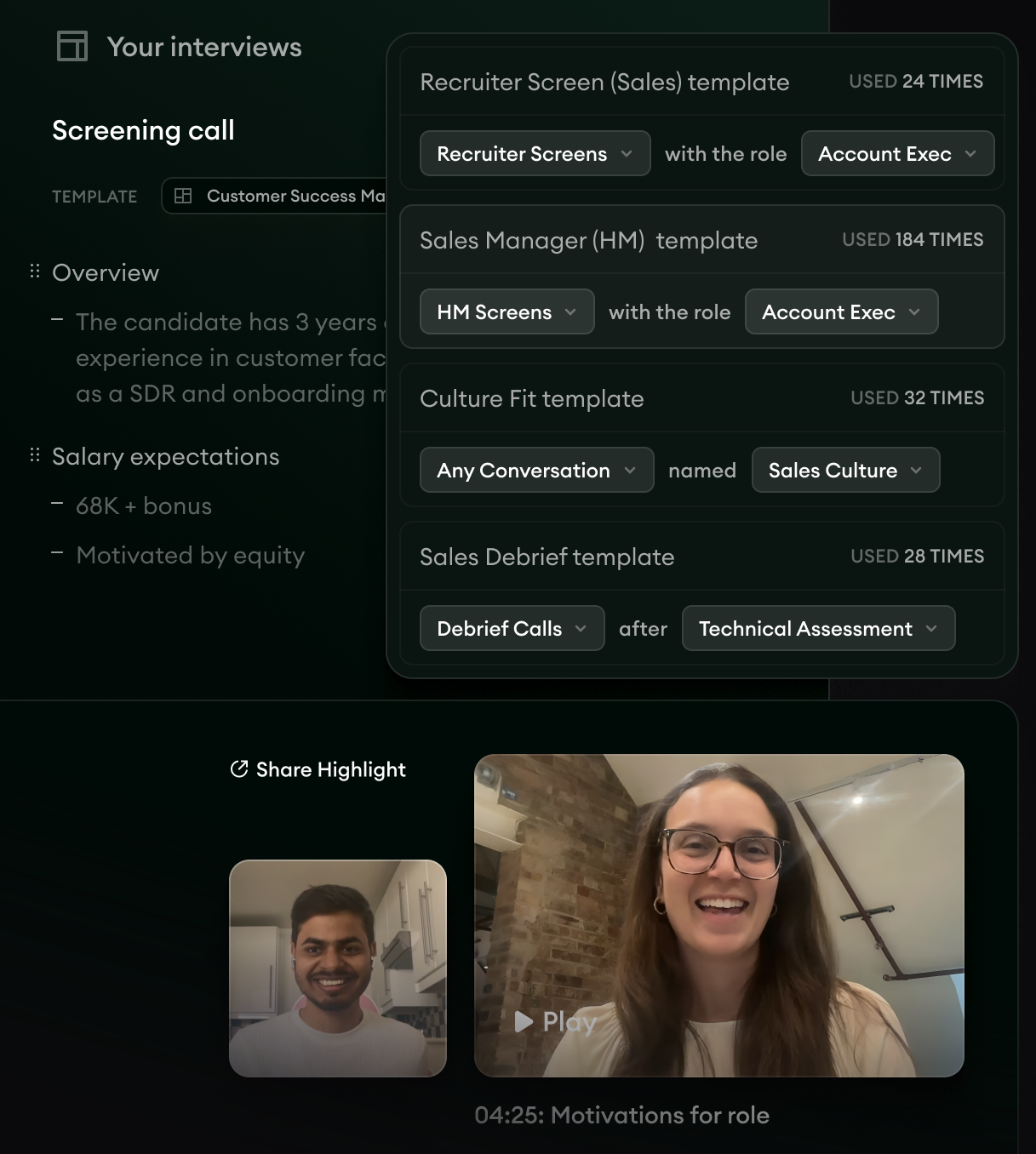
Metaview's Notetaker records and transcribes every interview automatically. Once a few weeks of interviews are captured, the patterns become specific questions about your team.
Open AI Filters and type, in plain language, "find interviews where the candidate asked about layoffs" or "show me the strongest answers our team has given on runway questions."
The list returns ranked, with the recordings one click away.
That's the coaching loop. Share the strong clips with junior interviewers, retire the weak ones from the playbook, and the next round of interviews lands cleaner.
Teams like Raines International use this loop to keep every interviewer on the same page, no matter how the market shifts.
How hiring improves when the team is ready.
When every interviewer has the script and a feel for which proof points land, you stop losing candidates in the days between offer and accept.
Candidate experience improves at the same time. Candidates remember the team that answered their hardest questions calmly and specifically. They also remember the team that fumbled.
Calibration tightens. The same coaching loop that sharpens macro-question answers also surfaces the upstream interviewer behaviors that decide whether the rest of the interview surfaces real signal. We covered those in the three most common mistakes new interviewers make.
If your interviewers don't have a shared script for macro questions, the offer-acceptance gap you're seeing isn't a comp problem. It's a coaching problem, and it's solvable in a few weeks once the data is in front of the right person.
Frequently asked.
How do you interview candidates during a recession?
The same way you interview in any other cycle, plus a script. Expect more questions about job security, runway, and how the company has handled past downturns. Prepare a 90-second answer for each one that names the specific reason your team is still hiring and offers two or three proof points. Candidates can tell the difference between a defensive answer and a prepared one inside the first ten seconds.
What questions do candidates ask during economic uncertainty?
Mostly four clusters. Job security ("how stable is this role"). Company stability ("what's your runway, when did you last raise"). Track record ("how did you handle the last downturn"). And forward-looking ("what would trigger a hiring freeze"). The exact phrasing changes with the cycle (recession, layoffs, AI restructuring) but the underlying concerns are stable.
How should I answer when candidates ask about layoffs?
Be specific and brief. Don't say "we're not planning any layoffs right now." That's a non-answer and candidates know it. Name the team or product line the role sits on, share a concrete proof point about that team's trajectory (revenue, customer growth, recent product launches), and connect the role to a workload that isn't going away. The shape: acknowledge the macro, name your specific position, give one concrete proof point.
How do you keep hiring quality high in a market downturn?
Move faster and coach harder. 67% of teams in our 2026 Alignment Report lose qualified candidates to faster-moving competitors every month, and that gap widens under stress. Coaching matters because the upstream interviewer behaviors that decide hire quality (setting expectations, asking for concrete examples, avoiding leading questions) get sloppier when teams are anxious. Capture interviews, surface the patterns, run weekly debriefs from real clips.
Bring Metaview into your hiring stack.
Live notes, structured scorecards, and ATS sync - set up in under 10 minutes.
