
Most coding interviews fail one of two ways. The interviewer panics, jumps in too early, scores how well the candidate took a hint. Or they sit silent, watch the candidate spiral, call it raising the bar.
Neither leaves the room with the data you need to hire.
This is the 7-step playbook engineering teams use to fix that. Six signals to score. One step for what happens after. Plus the workflow Metaview's Notetaker wraps around each, so the signal lands in the scorecard the moment the call ends.
The six signals you're scoring.
A coding interview is not a code review. It's an evidence-gathering exercise about whether this person can ship, communicate, and adapt under pressure. Score these six. Drop the rest.
1. Define the signals before you write the question.
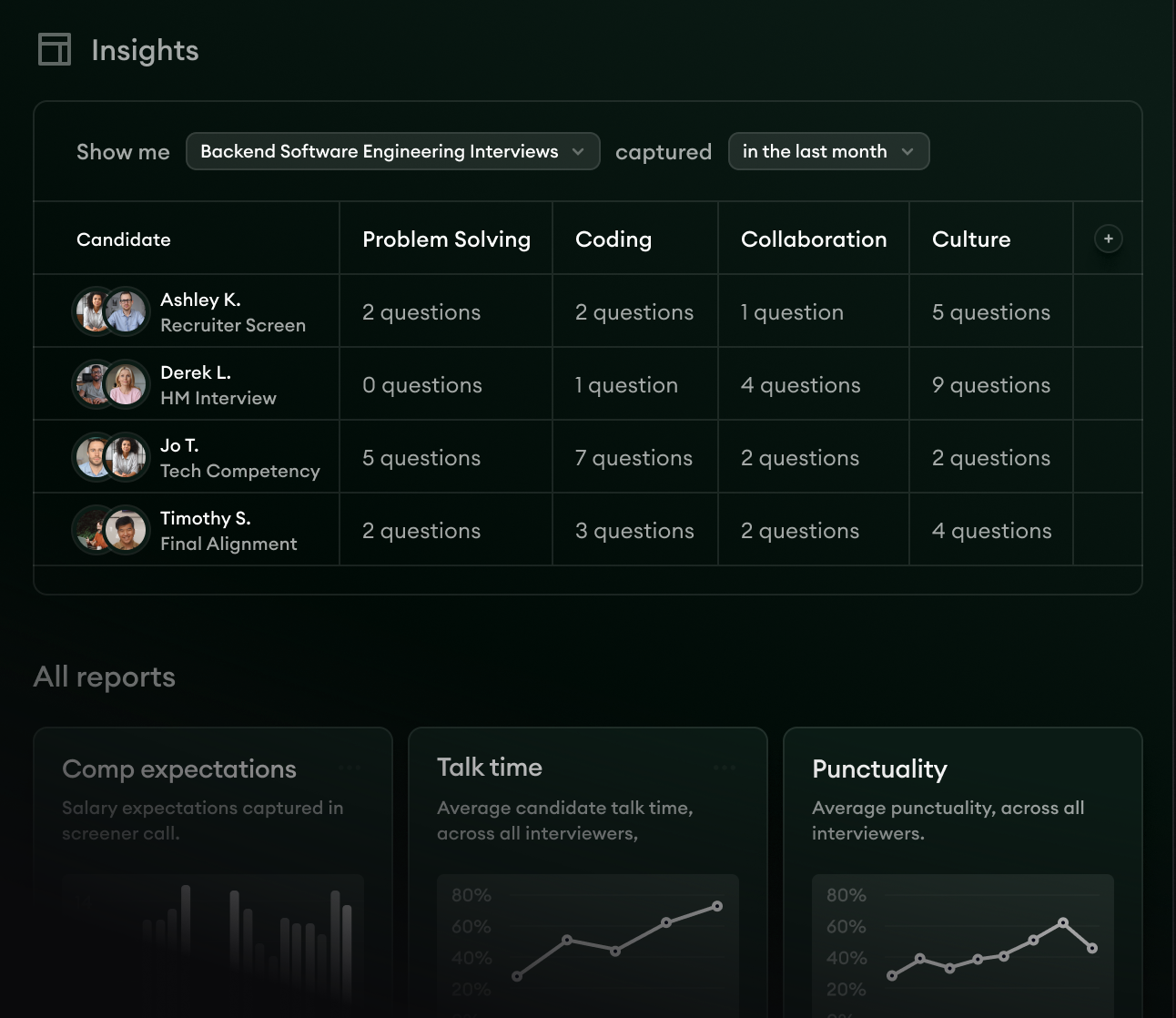
Most coding interviews fail at this step. Pick four to six signals: problem decomposition, code quality, communication, edge-case thinking, debugging instinct, learning agility. Write down what a 1, 3, and 5 look like for each.
If the scorecard exists, the question writes itself.
2. Set expectations upfront.
Tell the candidate the format, the rules, what you're scoring, and what you'll do if they get stuck. Get explicit consent for recording. The 90 seconds you spend here pays back twice in cleaner signal.
3. Present a multi-stage problem.
One question with compounding complexity beats five short ones. Stage 1 should be a warm-up the candidate can solve in 10 minutes. Stage 2 is where the real signal lives. Stage 3 is an extension you reach only if the first two land fast.
4. Help only after you've gathered the signal you need.
The most expensive interviewer mistake is rescuing the candidate too early. Give them a few minutes of productive struggle. If they ask, "What's the right way to think about this?" say, "Talk me through what you're considering."
5. Communicate with intent.
Tell the candidate when you want them to think aloud and when you want them to focus. Use silence as a tool. If you must hint, give the smallest possible nudge ("what happens at the boundary?") rather than the answer.
6. Have an ease-off prepared.
If the candidate is clearly off, don't ride out the full 45 minutes for the sake of it. Have a smaller question or a discussion prompt ready so they leave intact. Bad signal collected at high cost is worse than less signal collected at low cost.
7. Score the call while it's happening.
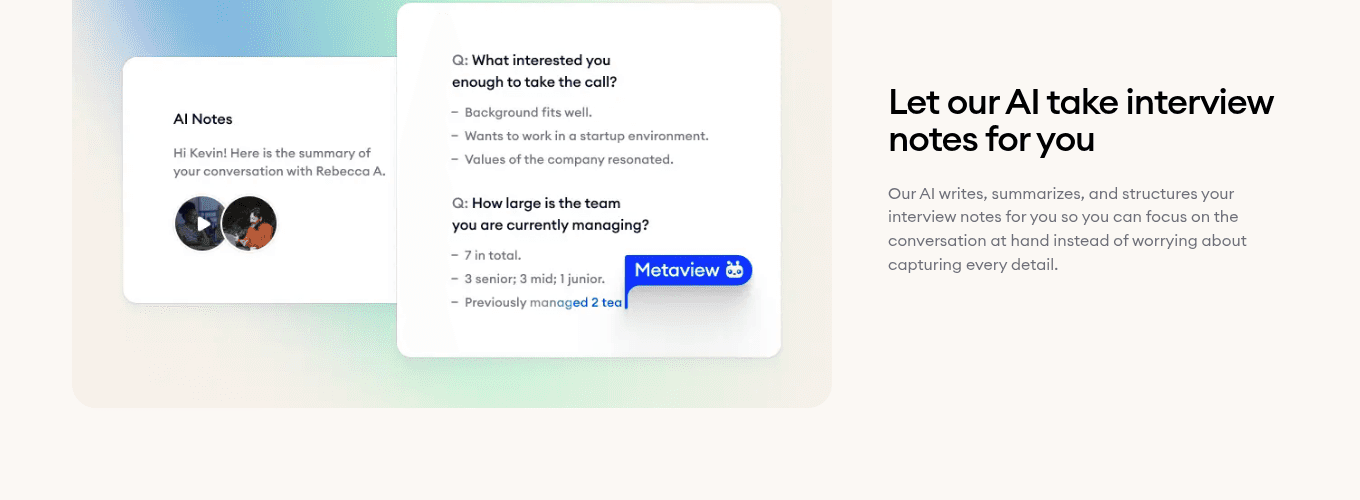
Don't write the scorecard from memory two hours later. Pause 30 seconds at each stage to capture what you saw. Or let Notetaker write the scorecard from the live transcript while the conversation is still vivid.
Score-from-memory is the biggest contributor to noisy quality-of-hire metrics. Score in the room, and the data you track reflects the interviews you ran.
What changes when the scorecard is built into the workflow.
The six signals are useful as a list. They become a hiring system when they're embedded in the place the interview happens.
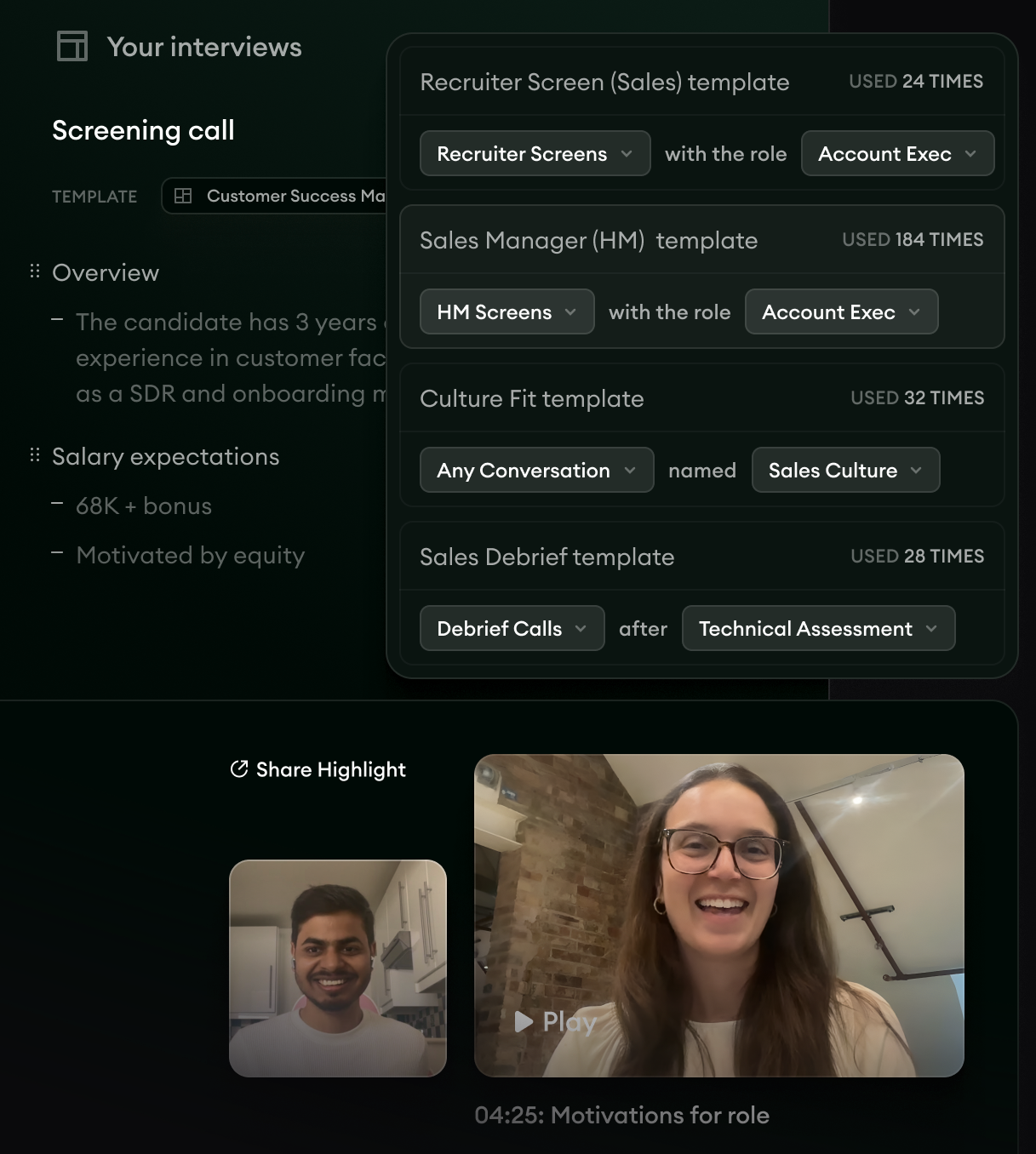
Metaview's Notetaker captures every spoken word in the candidate's chosen language. It flags the moments where each signal is on display. It writes the scorecard against your rubric the moment the call ends.
The interviewer reviews and edits. They don't write the scorecard from scratch.
- Notes captured during the call distract from the interview
- Scorecards written from memory two hours later
- Signals scored inconsistently across panel members
- Debriefs argue about what the candidate said, not what it meant
- Interviewer pays attention to the candidate, not the notepad
- Scorecard lands the moment the call ends, mapped to your rubric
- Every panel member sees the same evidence for each signal
- Debrief takes five minutes and starts from a shared artifact
What teams running this playbook see.
The pattern shows up in the numbers from Metaview's 2026 AI & Hiring Alignment Report, surveying 505 recruiting leaders and hiring managers across North America and EMEA.
The fix isn't another tool. It's compressing the cycle between the interview and the decision. Score in the room, debrief in five minutes, decide in the same day. That's where time-to-hire moves from a quarterly metric to a weekly habit.
When you're doing technical interviews, you feel huge pressure to make sure that you don't miss certain things that would be really important for this candidate."

Frequently asked.
What if the interview is pair-programming, not solo coding?
The six signals still work. Communication and learning agility lift in weight because the pair format makes them more observable. Problem decomposition and edge-case thinking lift slightly because you can see the candidate respond to a real other person. Adjust the rubric weights, keep the rest.
Does this approach work for take-homes?
The signals do. The workflow doesn't, because there's no live capture. Use take-homes as input to a 30-minute review interview, then score that review interview through the six-signal rubric. Notetaker captures the review.
Does Metaview integrate with Greenhouse, Ashby, or Workday?
Yes. Notetaker captures the interview from the calendar invite, writes the scorecard against your rubric, and pushes the structured record back into the candidate's ATS profile through the same workflow your recruiters already use. See the full integration list.
Does the recruiter still own the scorecard?
The recruiter still owns the decision. The scorecard lands written. The recruiter reviews, edits the evidence column where the AI got it wrong, and submits. The point isn't to remove the recruiter. It's to remove the part of the job that has the recruiter typing notes instead of asking follow-ups.
Run the next coding interview on the playbook.
The next time you sit down to run a coding round, take 10 minutes before the call. Write down what a 1, 3, and 5 look like for each of the six signals on this role.
Run the interview. Score in the room. Debrief in five minutes.
If the scorecard takes more than 10 minutes to land, the workflow is the bottleneck, not the candidate.
Bring Metaview into your hiring stack.
Live notes, structured scorecards, and ATS sync - set up in under 10 minutes.
