
Give every role two checks for fake job applicants before it opens: a pre-call check for high-risk fraud flags and an interview check for medium-risk ones. Engineering and data roles had the highest shares of applications that a fraud-detection model flagged as medium or high risk. Sales roles had the highest share at the most serious level, rated high risk.
In the pre-call check, someone you name reviews the application before anyone books a call. In the interview check, the interviewer asks about a project on the applicant’s resume during the first call, the same way every time, to see whether the answers hold up.
If you can’t set up both checks on every role at once, I’d start with the pre-call check on sales roles and the interview check on engineering and data roles. Then add the missing checks until every role has both.
Engineering and data roles had the highest shares flagged as medium or high risk.
The numbers below come from Metaview’s fraud-detection model, which rated 905,562 applications sent to teams that use Metaview as low, medium, or high risk.¹ Medium and high ratings both count as flags, and the table shows them together for four types of role.
| Roles | Applications flagged as medium or high risk | How it compares |
|---|---|---|
| Engineering | 34.9% | Highest of all roles |
| Data | 32.8% | Second-highest |
| Sales | 28.3% | Near the overall share. Highest share rated high risk (next section). |
| Recruiting and HR | 20.5% | Lowest of all roles |
| All applications | 28.59% | The overall share |
So on engineering and data roles, expect a larger share of applications to need one of the two checks than on the other roles in the table.
Sales roles had the highest share of applications rated high risk.
Sales stands out once you look at the most serious level: 11.3% of applications to sales roles were rated high risk, the highest of any role.¹ That’s why the pre-call check starts with sales roles.
Flags point to possible fake job applicants, and a person checks each one.
The model watches for two kinds of fraud: a person pretending to be someone else, and an automated tool sending applications. Each flag comes with a reason. From there, a person checks the application and decides whether it’s genuine.
Across all applications, 24.88% were rated medium risk and 3.71% were rated high risk.¹ That’s 28.59% flagged as medium or high risk in total, so most flags are medium.
Medium-risk flags go to the interview check, so expect that check to handle most flags. High-risk flags go to the pre-call check.
Set a pre-call check and an interview check for every role before it opens.
Both checks start from the risk level your fraud-detection tool puts on an application. Write both checks down before the role opens, so whoever spots a flag knows what to do next.
Run a pre-call check on every high-risk flag.
Name one person for the role in advance. When a flag is high risk, they read the flag and its reason, then check the application before anyone invites the applicant to a call.
For example, they can search your applicant tracking system for other applications with the same resume text, email address, or phone number, a check the Federal Bureau of Investigation recommends for remote hiring. Hold the call invitation until they’re done. It’s much easier to hold an invitation than to take one back.
Run an interview check when you invite a medium-risk applicant.
When a flag is medium risk and you’d invite the applicant anyway, let the first call go ahead. Have the interviewer run one quick check, the same way every time.
For example, the interviewer asks what the applicant did on a project or deal from their resume. If the answers don’t hold up, the interviewer passes the application to the person you named for the pre-call check, who decides what happens next.
Start with sales roles, then engineering and data.
Every role gets both checks. When you can’t set them all up at once, here’s the order I’d use:
| Roles | Why | Where to start |
|---|---|---|
| Sales | The highest share rated high risk | Name who runs the pre-call check, and give them time for it |
| Engineering and data | The highest shares flagged as medium or high risk | Brief every interviewer on the interview check |
| Every other role, including recruiting and HR | Lower shares flagged as medium or high risk | Both checks, after the roles above |
Bring both checks to the kickoff meeting for every new role, along with the scorecard and the interview plan. The hiring manager can then agree to them before the first application arrives.
Write down what each check found, next to the flag. After a few weeks, you’ll see whether each check is worth the time on that role, and you can adjust it.
What a check looks for depends on the kind of fake application. A separate guide to spotting fake job applications sorts them by kind and gives the checks to run for each.
For more on the problem, the 10x Recruiting podcast has an episode on fighting the rise of fake candidates.
How the flags were counted.
Each application was rated once and counted under the type of role it was for, like engineering or sales. Each role’s share is out of its own applications, so engineering’s 34.9% counts applications to engineering roles only.¹
If you also want figures from outside studies, a separate roundup of candidate fraud statistics collects them in one place.
Where Metaview fits.
Each check begins with a flag and its risk level.
Metaview is the Agentic Recruiting Platform. Its Application Review agent assesses every application for signs of identity deception and application automation before it goes further in your process. Those are the two kinds of fraud described above: someone posing as another person, or a tool sending applications automatically.
Each flagged application includes a risk level and explanation in plain language, so whoever runs the checks for that role sees the reason along with the level.
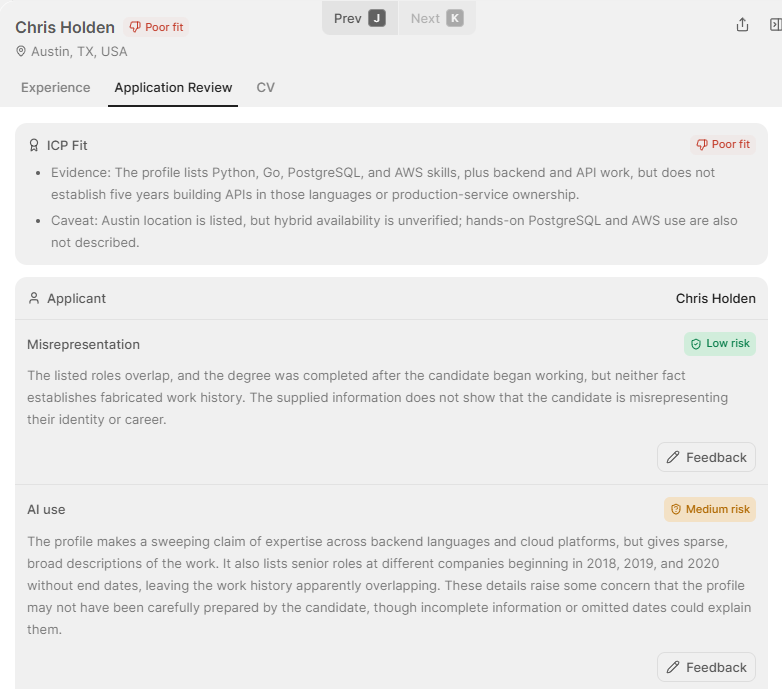
Fraud detection is on by default for Application Review customers and needs no setup. Application Review flags potential fraud, and the recruiter makes the final call. It never rejects an application on its own.
Once a flagged applicant reaches an interview, Metaview captures every spoken word of that conversation. Afterward, the interviewer can compare what the applicant said with what the application claimed, without relying on memory. Recording only happens if consent is given, and the consent process belongs to your team.
Read the reason behind every fraud flag.
Book a demo to see Application Review assess every application for fraud risk, explain each flag, and leave every decision to your team.
Frequently asked.
Do these shares describe every company’s applicants?
No. They come from applications to teams that use Metaview, so they reflect the roles and markets those teams recruit in. Your mix of roles, locations, and job boards will differ. Use these shares to pick where to start, then count your own flags per role for a few weeks and adjust the checks to match.
Does a fraud flag mean the applicant used AI to write their resume?
Not on its own. The model behind these figures looks for two kinds of fraud: a person pretending to be someone else, and a tool sending applications automatically. A flag on either is a reason for a person to read its explanation and check the application, never proof that the applicant used AI or did anything wrong.
Should a high-risk flag lead straight to a rejection?
No. A high-risk flag is the strongest reason to check an application before you spend interview time on it. Read the flag’s reason, run the pre-call check, and write down what you found. Then decide. That way a real applicant who tripped the model isn’t turned away on the flag alone.
Should I tell applicants that their applications are checked for fraud?
I would. It tells honest applicants what to expect. Add a line to the job post saying that applications are checked for fraud, and that a person reviews anything flagged. Run the wording past your legal counsel before it goes into a post.
Sources.
Every figure in this piece comes from one source, marked ¹ where it first appears in each section.
- Metaview aggregate data: 905,562 applications assessed by the fraud-detection model in Metaview customers’ workspaces, by risk level and by type of role, as of June 17, 2026. A flag is a medium or high risk rating from the model.
