

You are reopening a role your team has already filled twice. You run an artificial intelligence (AI) search across the people who have been through your process before, and four names come back. None of them is worth calling. The next conversation is with the hiring manager, and the line you are about to say is that the past pipeline is exhausted and this one starts from scratch.
I would not say it yet. An empty result is evidence about two things at once: the people in your hiring history, and the record your team kept about them. Only the first of those is a verdict on candidates, and the second is the one you can do something about this afternoon. That record is often thin. Across the interviews captured on Metaview, 31.21% received a scorecard at all.¹
So four checks come before the verdict. Not one of them is about the search. All four are about something your team owns, and together they take less time than the first day of a fresh sourcing project.
What a rediscovery search reaches, and what it cannot.
Metaview’s sourcing agent searches the web, the connected applicant tracking system (ATS), and your organization’s own past Metaview conversations from one natural-language prompt, and returns candidates with the reasoning for each. It surfaces and explains those candidates; it does not contact them and it does not assess them. Who is worth a second conversation stays a recruiter’s decision.
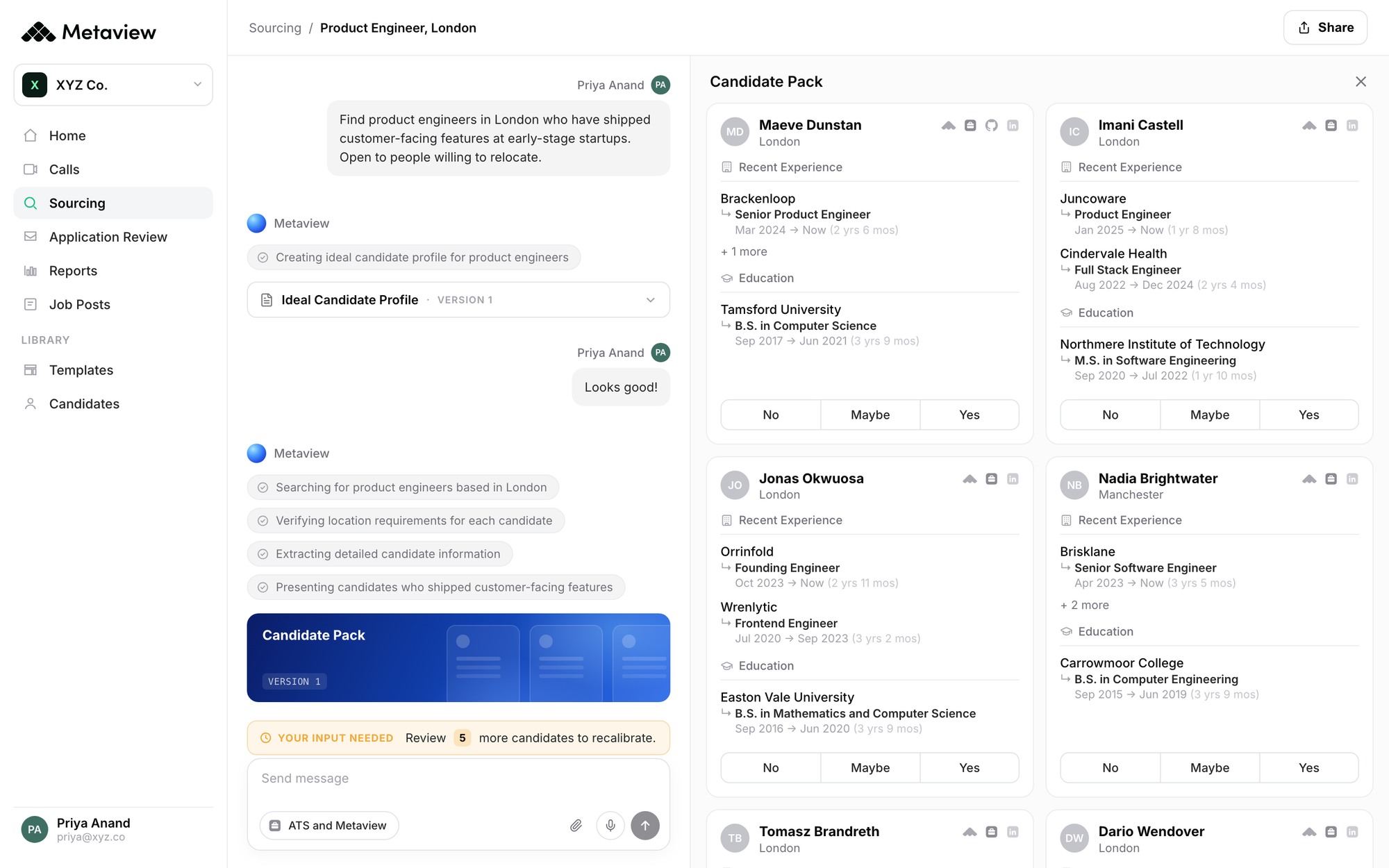
The wider practice has been written up already, and this post does not restate it: candidate rediscovery covers turning past interviews and ATS records into hires, and rediscovering talent from your ATS covers re-engaging the people you find. What follows is the narrower question of how much weight an empty result can carry.
Sara Machado, who leads hiring for backend engineering roles at Eneba, builds the profile for a backend role out of the hires she has already made. “I use Metaview to break down the things that all the successful candidates did well in the scorecard, and any red flags I need to avoid,” she says in Eneba’s case study. A record that can produce a profile is a record that can be searched.
Metaview’s co-founder and chief executive, Siadhal Magos, has said where the value in that record sits:
We built the #1 AI Notetaker for recruiting, but that was just the wedge. It gave us access to the most valuable data in hiring: your conversations”

A rediscovery search can only read the conversations that were captured and the notes that were written about them. The four checks below find out what yours hold.
The same idea runs through an episode of Metaview’s 10x Recruiting podcast on references. Nolan Church and Siadhal Magos close it on checking what the interviews covered against what the role called for, and taking the gaps into the reference calls.
Four checks before you call the past pipeline empty.
Does the brief describe the role as it stands today?
Write the brief for the role as it stands today. An old job description from the last time you hired can pull the search toward the role as it was. Two years of scope change is ordinary, and a brief describing the job as it was will rank the near-misses from that round well and the people who fit the current version badly.
Read the brief against the requisition the hiring manager signed this month. This is the cheapest of the four checks and the one most often skipped, because the old description is right there and it is nearly right.
Does each near-miss record say why?
A past candidate is worth a second conversation only if the reason they weren’t hired last time no longer applies. That is easy to agree with and hard to act on, because the reason is usually the part that never got written down.
Where scorecards started as AI-generated drafts, interviewers submitted 50.3% of them, against 28.6% of the ones they started from a blank form, in a capped sample of 120,000 created scorecards.² Scorecards that do get created are often thin. Of 13,373 created for interviews captured on Metaview, 25.6% had no field filled at all and 27.5% had one field or none.³ In the same data, 26.6% of 13,382 pieces of written feedback ran to five words or fewer.⁴
Take the five or six people who got furthest last round and read what your records say about each of them. “Not a fit” is not a reason. “Wanted a title the team could not offer then” is a reason, and it is the kind that expires. A record full of the first kind cannot tell you whether the pipeline is exhausted, only that the reason was never written down.
Which past conversations were never recorded?
Matching on past interviews can only draw on the interviews Metaview captured. It captures every spoken word of the interviews it joins, where the Notetaker is a visible participant and only records the conversation if consent is given, under a process that belongs to your team. If your team started capturing interviews eighteen months ago, everyone who interviewed before that is matched on their application and nothing else, so a missing match is a gap in the record rather than a verdict on the person.
Ask when capture started and which conversations it covers. Phone screens are the usual omission, and a phone screen is where the reason someone was passed over most often gets said out loud and never typed anywhere.
Who is off limits before anyone reaches out?
The fourth check runs the other way. Some of the people who should come back should not be contacted: candidates who asked not to be, employees of a client covered by a non-solicit, and whatever else your team keeps on that list. Settle it before anyone writes to a rediscovered candidate, because a rediscovery search is precisely the search most likely to surface someone who already told you no.
Each of the four is a question about your own records, and each one can be answered in an afternoon by the people who ran the last round.
What an empty result is evidence of.
When someone does come back, the match means they line up with the profile you approved. Metaview’s help center notes that a match isn’t a judgment about candidate quality, and the reverse holds too: an absence is not a judgment either.
Run the four checks on a role your team has filled before, where you can name two or three people who ought to come back. If they do not, you have found a gap in your own record, and a gap you can describe is a better thing to bring a hiring manager than an empty list.
Bring Metaview into your hiring stack.
Once your ATS is connected, AI Sourcing returns the candidates it finds there with its reasoning for each.
Frequently asked.
What is AI talent rediscovery?
Searching the records of people who have already been through your hiring process, rather than the open market, for someone who fits a role you are opening now. Review why each candidate was passed over and whether that reason still applies.
How far back should a rediscovery search go?
As far back as your records still describe the person rather than the role they applied for. A three-year-old near-miss whose notes say why they were passed over is more use than a six-month-old record that says only “not a fit”. Let the quality of the record set the limit.
What should your first outreach to a sourced candidate include?
A short note on how you found the person, and on how they can ask you to delete their details or stop contacting them. Whoever owns data protection at your company should approve that wording and confirm your legal basis for sourcing, and that your privacy notice covers it.
Who owns the reason a candidate was not hired?
Whoever ran the process. The reason is worth writing down at the point of the decision rather than reconstructed a year later, and it is what makes a rediscovery search answerable at all.
Sources.
¹ Aggregated and anonymized Metaview interview data: the share of 5,207,185 candidate interviews with at least one scorecard attached.
² Submission rates from the same data, in a capped sample of 120,000 created scorecards: 93,502 AI-generated and 26,498 started from a blank form.
³ Fields filled in a sample of 13,373 created scorecards, from the same data.
⁴ Length of written scorecard feedback in a sample of 13,382, from the same data.
