
It’s easy for a recruiting team to send the one message it promised not to: to a candidate who asked last year to be left alone, or to someone at a client whose staff the contract puts off limits.
Recruiters rated 1,228,405 of the candidates Metaview’s sourcing agent surfaced, and 41.5% of the clear “Yes” or “No” ratings were a “Yes”.¹ Each rating is a recruiter’s call against the brief, and it teaches the agent what to look for next. Permission is a separate question, and its answer belongs on a do-not-contact list: a candidate can be a perfect fit for the brief and still have asked your team last spring to leave them alone. Unless someone wrote that request down, it lives in a few people’s memories and gets checked when the right person happens to be copied on the thread.
My view is that the list only works when every name on it carries a reason and an owner, and when it’s checked before a candidate can receive a single message. One type of entry is out of your team’s hands: an understanding with another employer to leave its staff alone goes to counsel with its record intact, and counsel decides whether your recruiters keep honoring it.
What is a do-not-contact list in recruiting?
A do-not-contact list is the written record of the people your recruiting team has decided not to approach, with the reason each one is on it. A search can leave out people who were already contacted in a sequence or are already in your applicant tracking system, but it only knows what your systems recorded, and the list holds the rest: a request made on a call, or a clause in a client contract.
People end up on it for different reasons, and the reason decides who owns the entry and how long it lasts:
- They asked you to stop contacting them.
- A contract with a client or vendor puts them off limits, or they’re on your own payroll.
- Your business decided, on its own, to leave them alone for now.
Metaview’s own guidance for its sourcing agent says that when your team reaches out to candidates, your company is the data controller for that outreach, and that if a candidate asks not to be contacted, “that is your responsibility to action.” It adds that the tooling comes from Metaview, but “managing outreach preferences sits with your team.”
Who belongs on a do-not-contact list.
Split the list by who asked for each entry, because the parts need different owners and expire on different schedules.
Candidates who asked you to stop.
The request can arrive in a reply to an outreach email or in passing on a call. A reply to a Metaview sequence cancels that sequence for the candidate on its own, and so does an interview Metaview detects for them. The request itself, with what it covers and how long it lasts, still needs a row on the list.
Metaview’s guidance asks you to give every candidate a simple way to opt out in your candidate outreach and to honor the request without delay, and its help center says every first-touch sequence needs a simple opt-out saved in its template.
In the European Union, the General Data Protection Regulation gives people the right to object to processing a business bases on its legitimate interests (Article 21), and where the objection stands, it can give them a right to have their data erased (Article 17). The right to object also has to be spelled out to them, apart from any other information, by the first communication at the latest, which for a candidate you’ve never contacted is your first outreach message. The United Kingdom’s own version of the regulation does the same. Your counsel should say how that applies to you, but either way the request has to be findable by a later recruiter who wasn’t there when it was made.
If the request comes on a call the candidate agreed to have recorded, Metaview captures every spoken word, so the request is in the transcript in their own words. Copy it into the list itself, with the date, so the entry doesn’t depend on anyone finding the call again.
I don’t think the answer to an information problem is making decisions with even less information.”

Siadhal Magos is Metaview’s Co-founder and Chief Executive Officer, and that line was about screening applications. It holds for this list too: a bare “do not contact” flag can’t tell the next recruiter whether the candidate meant one type of role or your company for good. The candidates you’ve already spoken to, the people most worth rediscovering later, are also the people who’ve had the most chances to ask you to stop.
The request also has to survive a handoff. At Raines International, an executive search firm that works with private equity firms and Fortune 500 companies, team members covered for each other over a summer of travel and weddings. Jessica DeOliveira, the firm’s Managing Director for Strategic Initiatives and Client Delivery, says Metaview made it easy to hand off work. The firm uses it for interview notes and reporting, and people covering for colleagues “get up to speed without losing context, and can plug and play without clients noticing any change.” A candidate’s request to stop is context too, and it belongs in a row that anyone covering the desk can read.
Staff a contract puts off limits.
This part starts in your commercial team’s contracts, and recruiting inherits it. If you run an agency or a search firm, client agreements can restrict recruiting the client’s own staff for a period, and in executive search the result is often called an off-limits list. In-house teams can find similar clauses in vendor and services agreements, or in the terms that came with an acquisition.
Your own employees sit here too, though no contract puts them here: internal moves run through a different process, and an employee shouldn’t learn about an opening from a cold message sent by their own company.
Record which agreement each restriction comes from and when it ends, and list the companies it covers by name. Then have counsel review every one, because a signed contract doesn’t settle whether a restriction is allowed. The January 2025 antitrust guidance from the Department of Justice and the Federal Trade Commission says companies “can be labor market competitors even if they have some other collaborative or cooperative relationship.” It says agreements between competing employers not to hire or solicit each other’s workers are illegal even if they did no harm such as lowering wages. A restraint that is “subordinate and collateral” to a broader collaboration, such as a joint venture, and “reasonably necessary” to it may get a fuller analysis of its effects instead. Whether a clause of yours counts, and how, is your lawyers’ call, and the list should carry their answer.
Decisions your business made on its own.
A candidate who has turned down two of your roles this quarter might get a rest before the next approach, and someone already in a live process with one of your recruiters shouldn’t get a second, cold approach from another.
Rows like these shape how your company comes across to people it keeps approaching, which is what the 10x Recruiting episode below, with guest Kellie McCann, is about: why the best employer brands attract the right people and put the wrong ones off.
Give each of these rows the name of whoever made the call and a date to look at it again, because a rest without an end date stays in force until someone notices it. Before you add one, check who else is involved: if another company asked for the entry, or your company agreed to it in return for the same courtesy, it isn’t your call to add, and it goes to counsel instead.
The entry to leave for counsel: an understanding with another employer.
Some teams have a company their recruiters never source from, and when you ask why, the only answer is an understanding between the two businesses. The January 2025 guidance says that businesses competing for workers “may be committing an antitrust crime” if they enter into an agreement “not to recruit, solicit, or hire workers.” Such an agreement, it adds, “need not be written down or talked about at all.”
The guidance treats an agreement not to “cold call” another company’s workers as a no-solicit agreement, even where the companies still hire people who apply on their own. It also counts an agreement “to request permission from the other company before trying to hire an employee” as a no-poach agreement. It says the Department of Justice may open a criminal investigation and, “where appropriate, bring felony charges” against the individuals and companies involved. The guidelines say of themselves that they have “no force or effect of law,” and they describe how the two agencies approached these cases when they were issued in January 2025.
That changes what the row is, because it can be the only written record that the understanding exists. My advice is to take it to counsel before anyone edits or deletes the row, and to let counsel decide whether your recruiters keep honoring it.
Check the list before anyone starts receiving messages.
A candidate moves from a Metaview search into an outreach sequence in one of two ways: a recruiter adds them, which records a “Yes” for them, or the search is connected to the sequence, which enrolls its “Yes” candidates without anyone adding them. Either way, a person’s “Yes” decides who hears from you.
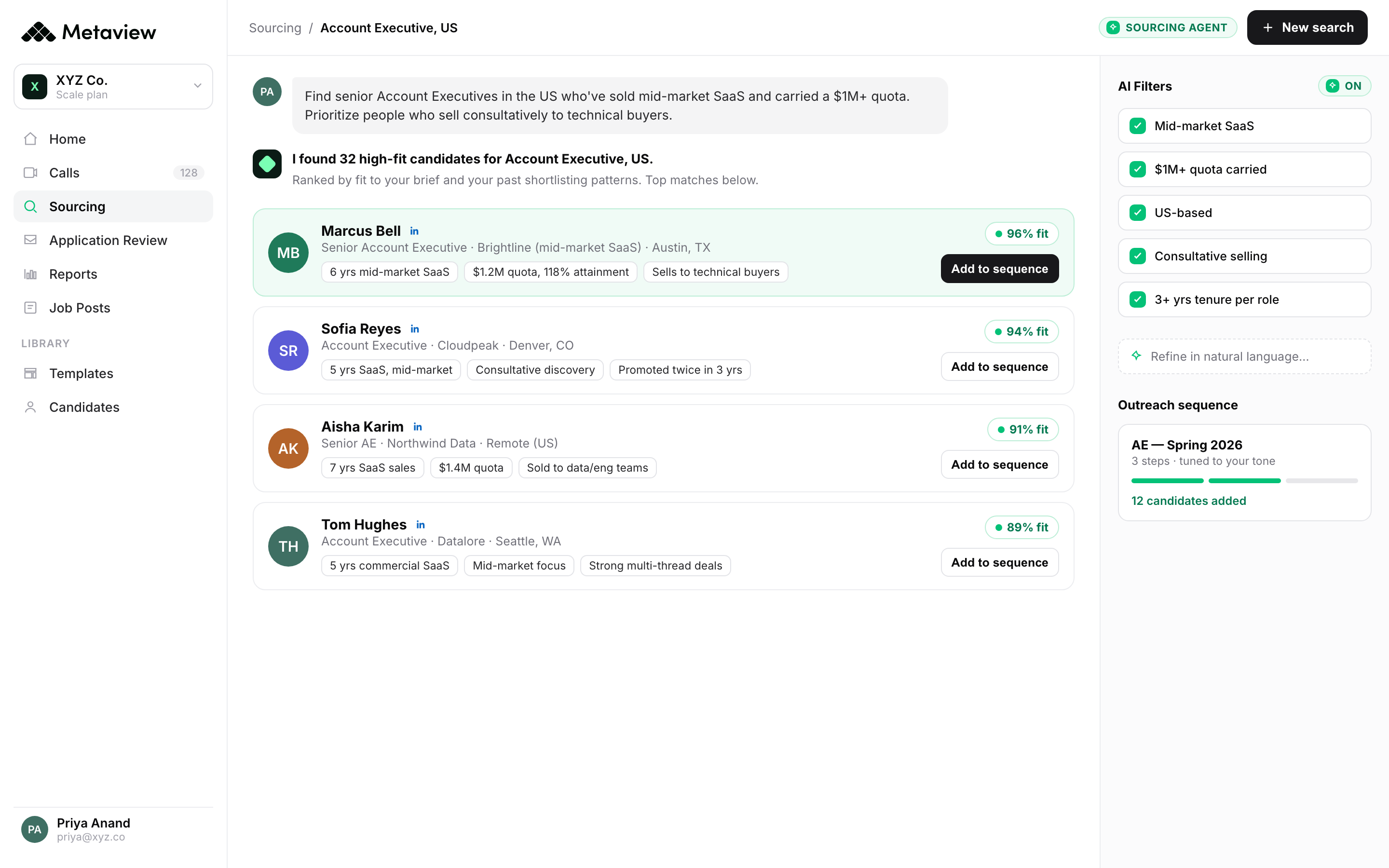
The agent doesn’t make that call for you. Metaview’s sourcing agent had surfaced more than 9.1 million distinct candidates across 138,224 searches by June 2026,² and its guidance says the agent doesn’t “automatically contact, progress, or reject any candidate.”
The person marking a candidate “Yes” is judging them against the brief, and a candidate who told one of your recruiters on a call to stop contacting them can still be a strong match for the role. Nothing about the match tells the recruiter about that request unless someone recorded it where they’ll see it.
So put the check wherever messages can start. Before a sequence goes live, agree the enrolled list against the do-not-contact list. Connecting a search to a sequence can enroll every earlier “Yes” at once, so check the search’s “Yes” candidates before you connect it, and if the connection enrolls candidates live instead of paused, check each new candidate before anyone marks them “Yes”.
A check that runs after the first message has gone out can still stop the later steps, but the candidate who asked you to stop has already heard from you.
Give every row an owner and a review date.
Names on an unowned list get added and never reviewed, so rows outlive their reasons: a client you stopped working with stays on the list, and so does a candidate whose process with a colleague ended months ago.
Give each part an owner, the person who already holds its reasons:
- Candidate requests belong to whoever runs recruiting operations.
- Contractual restrictions belong to whoever owns the client or vendor agreement.
- Your own employees belong to whoever runs internal moves.
- Your business’s own decisions stay with the person who made them.
If I were cleaning up an existing list, I’d start with the rows no one can explain, because that’s where an informal pact between employers would hide, and I’d send those to counsel before touching anything else.
A candidate’s request stands until the candidate says otherwise. Every other row gets a review date: contractual rows on the end date recorded with them, or sooner if the agreement changes, and your business’s own decisions once a year. For the rows your team owns, taking a name off is the risky direction, so the owner approves each removal and someone else records it. Keep retired contract and business rows instead of deleting them, each with who approved its removal and why it existed, so a restriction can come back if the client does.
Three checks on your own records show whether the list is being kept:
- Pick ten names at random and read each row. Where one doesn’t say who asked for it and when, ask its owner. If no one knows, or the answer involves another company, send it to counsel as it stands.
- Look at which rows came due for review last quarter. If none was reviewed, the dates aren’t being kept, so put each owner’s next review in the calendar first.
- Take the last sequence that went live and find when its enrolled list was checked, and whether a search feeds it candidates live. If the list was never checked, move the check in front of the next “Yes”, and in front of any search you connect, before you change anything else.
When those checks come back clean, anyone about to contact a candidate can see who not to contact and why, with an owner beside every name and any arrangement with another employer in counsel’s hands. Check it before the next “Yes”, and before the next search you connect.
Keep every contact decision with your team.
See how Metaview’s sourcing agent surfaces candidates for a brief, while the choice of who hears from you stays with a recruiter.
Frequently asked.
Where should a do-not-contact list live?
In one place every recruiter reads before reaching out. Your applicant tracking system can hold the list, but a “Yes” in a Metaview search can enroll someone without anyone opening the system, and replies to a Metaview sequence don’t sync back to it, so a stop request that arrives as a reply has to be copied onto the list by hand. Keep one copy with the reason and the date beside each name. Check anyone who leaves your systems some other way, such as an export to another outreach tool, before they go.
Is a do-not-contact list the same as a do-not-rehire list?
They’re different records. A do-not-rehire list holds a judgment about someone’s past work at your company, and it often sits with the people team, while the list this article describes holds permission to approach someone at all. Keep them apart, because a former employee can be welcome back and still have asked not to hear from you this year.
What if a candidate asks to stop after a sequence has started?
If they replied to a Metaview sequence, the reply has already canceled that sequence for them. Record the request that day, with the date and their own words. Then take them out of any other sequence they sit in, and reply once to confirm it’s done.
Can someone stay on the list after asking you to delete their data?
Ask your data protection lead first. Where they agree it’s allowed, keep only what you need to recognize the person later, such as their name and email address beside the date of their request. If the whole record goes, nothing stops the next recruiter from finding the same person through a new search.
Does a contract that names one client cover its subsidiaries?
Ask your counsel, and record the answer as a list of named companies with the date it was checked. Recruiters shouldn’t infer the reach of a restriction from the shape of a corporate group, and an acquisition can move that boundary without anyone telling the recruiting team. Check it again whenever the agreement renews.
Does the list cover calls and LinkedIn messages too?
It does, unless the row records a narrower request. Check the list before a call or a LinkedIn message as well as before an email. In a Metaview sequence those steps are manual tasks a recruiter carries out, which puts a person at each one.
Sources.
¹ Aggregated and anonymized Metaview Sourcing data: recruiters’ ratings of the candidates the agent put in front of them, counting “Yes” against “Yes” plus “No”.
² The same data: distinct candidates surfaced, and the searches that surfaced them, from August 2025 to the June 2026 data pull.
