
The second interview goes in the calendar because the first one went well. What gets written down is rarely what it went well at.
When the panel walks in without that, the safe move is to start from the beginning. Background, motivation, a lighter version of the competency the screen already covered. The hour produces a second impression of things the team had mostly decided, and the question that would have settled the argument never gets asked.
Across the interviews captured on Metaview, 56.3% of candidates who advanced from a loop with more than one interviewer had at least one scorecard recommending against them. More often than not, then, a disagreement travels with the candidate into the next round.
A second interview does one thing the first cannot. It resolves what the first one left open, and that requires knowing what was left open. I would write every question for round two from the record of round one, and start with any disagreement it shows.
What the first interview leaves unresolved.
Advancing a candidate is not the same as agreeing about them. A scorecard recommendation tracks closely with what happens next. In interviews captured on Metaview, candidates rated strong yes advance at 7.6 times the rate of those rated no.
It still doesn’t settle the question. In the same data, 6.2% of scorecards whose recommendation was a no belong to a candidate who advanced to a later round anyway, and each of those carries an objection the process moved past.
What that figure cannot tell you is why. The data records that the objection existed and that the candidate moved on. It does not record the conversation in between, or whether there was one. A no on the record is as consistent with a panel that weighed the objection and set it aside as with one that let it pass.
Either way, the objection is still sitting there when round two starts. It either gets tested or it gets inherited, and that is worth planning for.
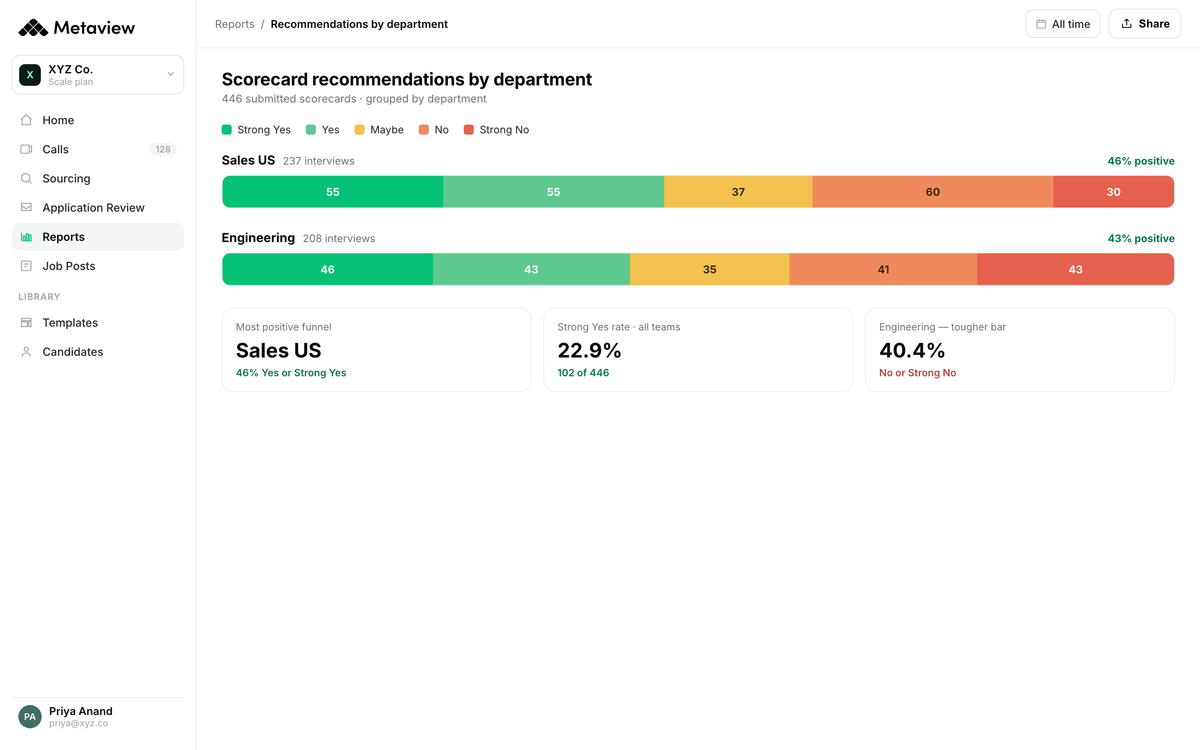
- 1The spread of recommendations behind a team’s submitted scorecards, instead of a single headline verdict.
- 2One function holding a tougher bar than another. Worth knowing before you read a split room as a disagreement about the candidate.
Three gaps reach round two often enough to plan for. Two of them are easy to spot. A split room, where two interviewers rated the same conversation differently and the debrief moved on without settling why. A competency left unexplored, sitting on the scorecard because everyone assumed someone else would cover it. The third is the one that gets missed: an untested claim. The candidate said they rebuilt the reporting pipeline. The interviewer wrote it down and did not ask what that involved.
Read the first conversation before you write the second.
A second-round question list written by someone who never saw your first interview can only be generic. It tests the territory the screen already covered, and confirmation is the usual result.
The alternative takes about ten minutes. Open the record of the first conversation and answer three questions before you write anything. Which competencies got evidence? Which got a rating but no example? What did the candidate assert that went unexamined? The answers are your question set.
- Re-tests territory the screen already settled
- The competency that split the panel goes unexamined
- Two impressions of one candidate, no way to compare them
- The first conversation is read before anyone drafts
- Competencies with a rating but no example are listed
- Round two starts from what round one recorded
Coverage is easy to misjudge. A competency can carry a rating on every scorecard in the loop without having been explored properly in any of them, because a rating is cheap to give and evidence is expensive to gather.
The four questions a first interview earns.
Four shapes are a useful starting point for what a first conversation leaves behind. Each one starts from something specific that happened in round one, which is what stops it reading as a stock question.
| What round one left | What you ask next | What you’re scoring |
|---|---|---|
| A competency scored with no example behind it | “Walk me through the last time you had to do that without any support. What did you try first?” | Whether a real episode exists |
| A split room on ownership | “Tell me what you owned on that project and what you handed to someone else.” | The boundary of their contribution |
| A claim that went untested | “You mentioned rebuilding it. What did you decide to leave broken, and why was that the right call?” | Judgment under a real constraint |
| A requirement they haven’t done before | “This role needs that, and your background doesn’t show it. How would you get up to speed here?” | How they close a gap they can see |
The fourth one is worth defending, because it feels unkind and isn’t. Naming a gap out loud gives a candidate the chance to answer it, and the alternative is a panel privately discounting them for something it never raised.
Stop the second interview repeating the first.
The second interviewer repeats the first because nothing told them what was covered. Asking about background is the safe opening when you are walking in blind.
Three moves close it. Send the panel the notes from the first conversation, and send them in full instead of a summary line in the calendar invite. Assign competencies explicitly, so two people don’t independently pick the same one. Write down what is settled, so round two spends no time confirming it.
If you change one thing before round two, hold the score back. Order can enter a hiring decision in several ways, and handing someone a verdict before they have formed one is the most direct of them.
Where the evidence lives between rounds.
All of this depends on the first conversation still existing in a usable form when you sit down to plan the second. Handwritten notes get lost, and a scorecard rating without the evidence underneath it gives the next interviewer nothing to work from.
Interviewers should note things they wish they could contribute to or what they would need to know to have a more confident opinion to evaluate candidates, but didn’t have the time.”

Metaview’s Notetaker joins the interview as a visible participant, captures every spoken word, and turns the conversation into structured notes, so round one is still there in round two. Recording happens only where consent has been given, and that process belongs to your team, so it is worth settling before you build a method on top of it.
Talent Acquisition Systems and Sourcing Specialist Katie Hill of Elara Caring named what that record is for: “You can’t always go back and say, yes, I verbatim asked this question. So it’s really helpful to have that.” Elara’s recruiters run their phone screens through Metaview, and the case study reports what that changed for the next people in the process: “Hiring managers receive detailed, structured summaries at the top of every single interview questionnaire.”
In the case study’s video, Katie Hill describes what a transcript to go back to changed for Elara’s recruiters.
Multi-source notes combine several conversations and documents, a resume or a job description included, into one synthesized view of a candidate.
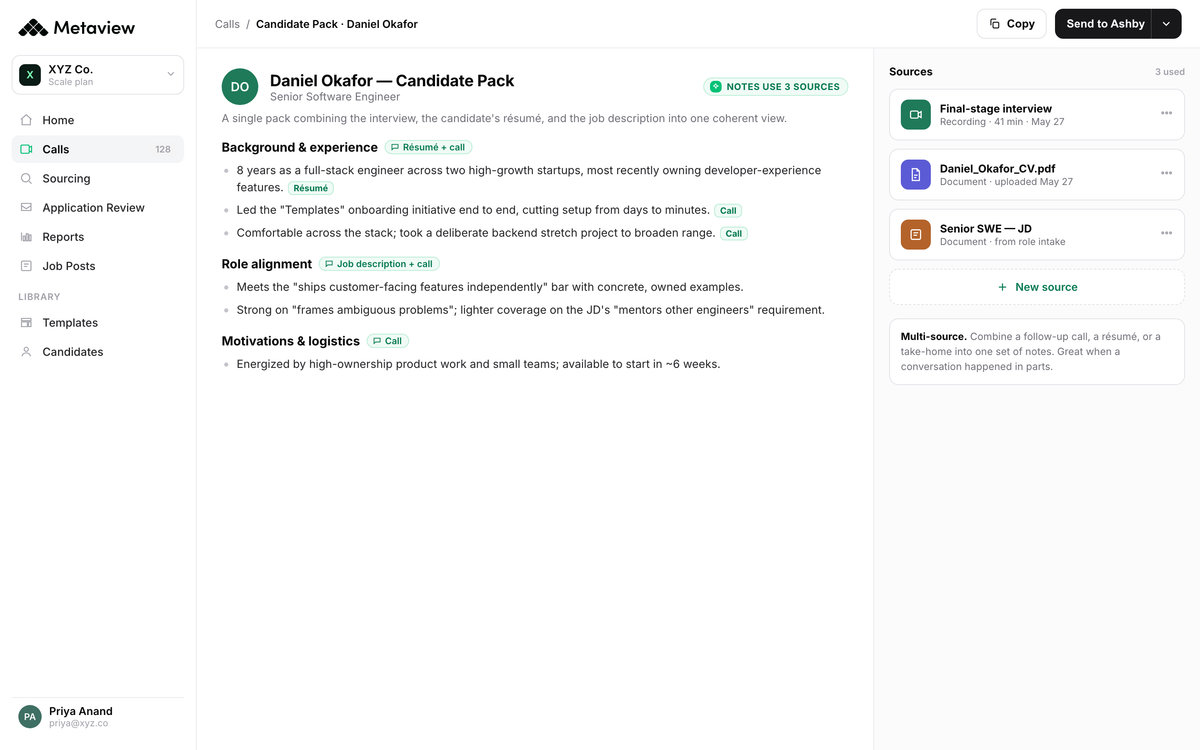
Metaview does not make the call. It gives the interviewer the record to make it from, which is also what turns the debrief afterwards into a comparison instead of a negotiation.
What a second interview cannot settle.
There is a tempting version of this argument that goes further than the evidence does. It says early verdicts are unreliable, so the fix is to screen harder and trust round one less.
The figures here cannot carry that. A scorecard counts as advanced only where the candidate reached a later round, so someone hired straight out of that round counts the same as someone turned down. That makes 6.2% a floor rather than a measure of how often an objection gets overruled. And an objection that gets overruled is not evidence that overruling it was wrong. A disagreement rate is not an error rate.
What survives is narrower and more useful. A first verdict is provisional. Round two exists to make it less so, by gathering the evidence the first conversation didn’t reach, and that holds whether or not the first interviewer did a good job.
Two more limits worth stating plainly. A second interview cannot tell you how the hire will work out, and Metaview’s data cannot either, because it stops when a candidate moves to the next round. It never sees the offer, and it never sees what happened after. And it can’t repair a first interview that captured nothing. If round one produced a rating and no record, round two starts over with less time than the first one had.
Within those limits the method is small enough to adopt this week. Read the first conversation for what it didn’t reach, and ask about that.
Bring Metaview into your hiring stack.
The Notetaker turns every round into structured notes, so each interview builds on the one before.
Frequently asked.
Who should run the second interview?
Whoever owns the competency that is still open. If the gap is technical depth, that’s a senior engineer. If it’s how the person handles being overruled, it’s usually the hiring manager. Choosing by seniority, when the open question should decide it, is how a loop ends up with several people assessing the same strength.
Is it bad to ask the same question in both interviews?
Deliberately repeating one question can be useful, because a story that changes shape between tellings is worth noticing. Repeating it by accident costs you the only hour you had for the questions round one left open. The test is whether you chose the repetition. The within-answer version of the same discipline, hearing what a single answer left out, is a separate skill, and it is the one that makes each of these questions land once you are in the room.
What should you send the panel before a second interview?
The notes from the first conversation, with the competencies each person is covering and the questions still open. Hold back the first round’s rating until the second interviewer has formed their own view, so the score doesn’t arrive before the evidence does.
How do you compare a first and second interview run by different people?
Only through a shared definition of what a strong answer looks like for each competency. The questions can differ and usually should. If the standard differs too, the two ratings aren’t measuring the same thing and the debrief has nothing it can reconcile.
What if the candidate asks why they are being interviewed again?
Tell them. Naming the specific area you want to explore beats a vague next step, and it gives them a chance to prepare an example instead of improvising one. It also signals that the process has a structure behind it.
Sources.
The advance-rate figures and the share of advancing candidates with a dissenting scorecard come from an analysis of interviews captured on Metaview, covering scorecards grouped by their recommendation, with data pulled June 2026. Figures are aggregated and anonymized. The analysis records whether a candidate reached a later round, and nothing about what was said in between.
Shahriar Tajbakhsh, in How to write an impactful interview scorecard on the Metaview blog.
The Elara Caring case study, quoting Talent Acquisition Systems and Sourcing Specialist Katie Hill.
