
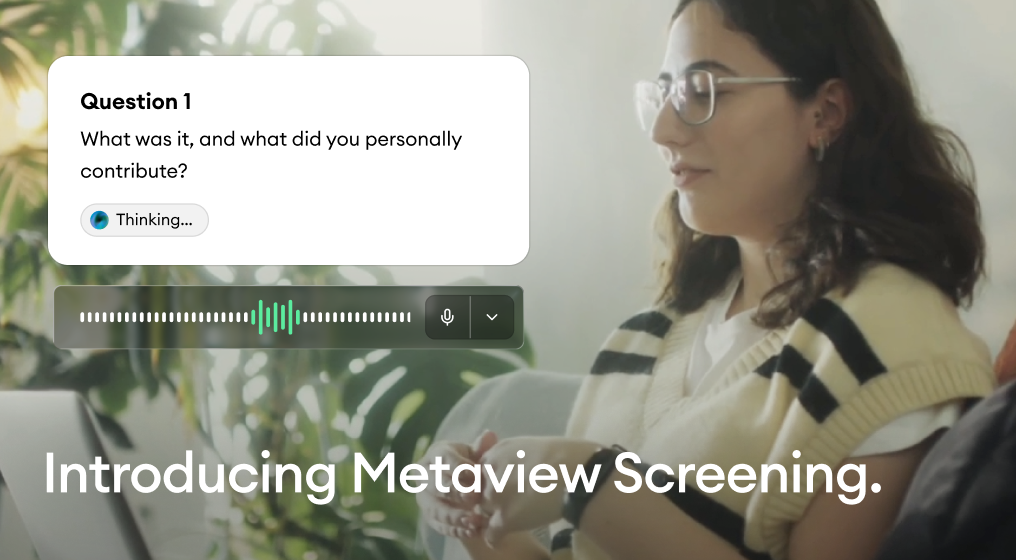
Hiring teams make some of their biggest decisions with surprisingly little information.
At the top of the funnel, that information is usually a resume and an application. From there, recruiters have to decide who deserves more of their time.
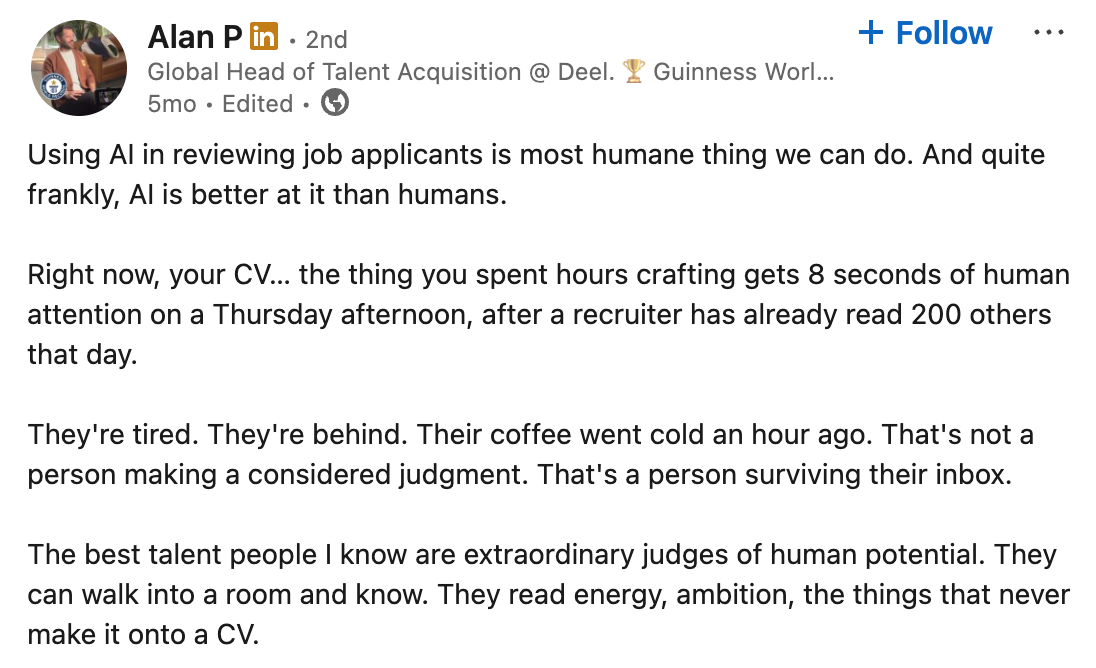
A resume tells you where someone worked and what they did. It can't tell you how they think, why they (truly) want the job, how they communicate, or whether they'll show up when they say they will.
The only way to answer those questions is to meet and speak with people.
But recruiters only have so many hours in the day. And with application volumes exploding (applications per recruiter have increased 412%), there’s a slim chance most candidates get seen at all, let alone get time for a screening call.
Every role is now receiving hundreds of applications, and the fakes are getting out of hand. We were getting weekly requests from Metaview clients who needed a solution.
So the key question became: how can we give our customers the leverage they need AND make the candidate experience better, not worse?
AI models have become fast enough to run real-time conversations and offer candidates the high quality of experience they deserve. Instead of using AI to make faster decisions from thin information, we can use it to gather better information from more people.
Candidates get more opportunities to show who they really are. Recruiters get better signals and can judge where their efforts will have the most impact.
That's the idea behind the screening agent we've built at Metaview.
AI made job applications easy. But also hard to distinguish.
AI has made applying for jobs fast and simple. Every AI-polished resume now looks like a 10/10 fit, crafted, tailored and submitted within minutes of a job description going live. Recruiters are dealing with a vast flood of quality (at least at first glance) candidates.
What’s worse: it's becoming harder to know what's real.
Candidate fraud is rising since AI makes fake applications trivial to create. Recruiters are spending more of their limited time filtering out fake or misleading applications, while genuine candidates have to fight harder to stand out from the noise.
Recruiters have to review more candidates with less information they can trust. Meanwhile candidates have more ways to apply, but it’s almost impossible to stand out.
So what do we do? Set extremely narrow filters and leave little traps to catch generic applications? I don't think the answer to an information problem is making decisions with even less information.
The better answer is to create stronger signals.
If AI can make it possible to hear from more candidates without requiring more recruiter hours, we can give hiring teams a much richer basis for deciding who moves forward.
And we can give more real candidates a fair shot at proving they're more than what’s written on paper.
What if AI agents didn’t suck at screening?
There are parts of recruiting that AI is uniquely well suited to:
- Agents are available right away, so candidates don’t have to wait a week (or more) just for a screening call.
- They’re flexible on timing so candidates can take their screening call when it’s convenient for them, instead of squeezing it in between meetings or a busy work schedule.
- They can have hundreds of conversations without getting tired. Again, no issue of recruiter burnout or scheduling bottlenecks.
- They remember exactly what a hiring team wants to know, ask relevant follow ups, capture everything, and prepare detailed debriefs to guide the go or no go next step.
- They’re consistent, and make sure every conversation is evaluated against the same criteria.
And more than anything, they ensure every candidate gets a fair chance to introduce and sell themselves. That’s simply not possible under the status quo.
Screening should have solved this already. It didn't.
A screening call gives candidates the chance to add context that doesn't fit neatly onto a resume. But if 500 people apply for a role, a recruiter can't have 500 conversations. So they first have to decide who gets a conversation, based on that same limited CV information.
The first generation of automated screening addressed the capacity problem, but often made everything else worse. Candidates answer a fixed list of questions, either talking to an avatar reading a rigid script, or a digital brick wall.
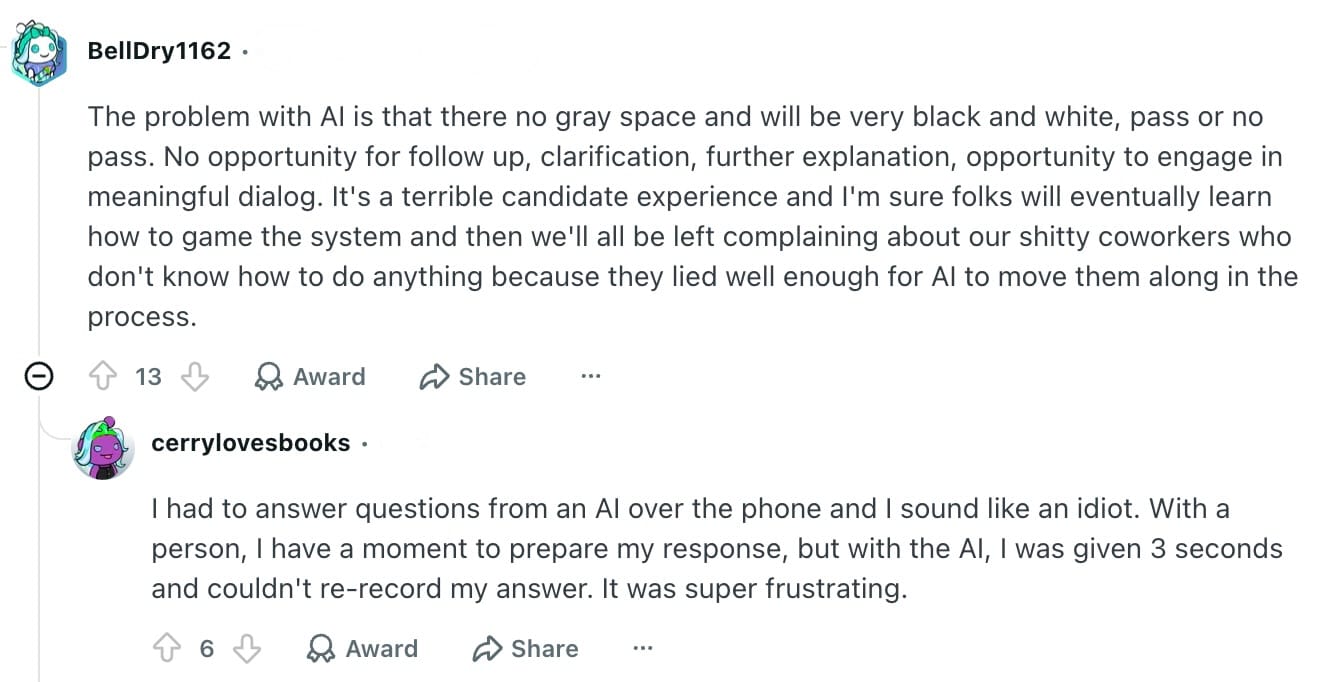
There's no real dialogue, no interesting follow up, and very little sense that they’re actually being heard.
It’s a terrible, impersonal candidate experience. And it doesn't produce great information for recruiters either.
Automating a mediocre interview doesn't help anyone.
What makes Metaview Screening different?
This is emphatically not another one-way automated interview process.
- There's no AI avatar pretending to be a person. The experience is voice-first and transparent about what it is.
- Our agent adapts to each candidate and the role they’re applying for.
- It asks smart follow-up questions based on what the candidate says and creates a real dialogue.
- It speaks 18 languages.
- It can conduct situational and behavioral scenarios. This is not just a canned list of questions.
- It’s flexible with candidates, but consistent on scoring. It ensures every call is reviewed against the same rubric, matched to what matters for your TA team.
- It’s self-improving, based on who the recruiter advances or rejects.
Crucially, the screening agent provides the signal, but a human always makes the decision on who to advance or reject.
In the review step, recruiters can click in as much as they need to on each call. Starting with a call overview, they can generate custom summaries, review responses to specific questions, or watch back the full screening interview.
Meanwhile, candidates control part of the process. They can take the call at home, in the morning or evening, on their phone or computer, whenever they feel ready to present the best version of themselves.
The proof is in the experience, with one candidate telling us, "It went great. I love the idea of this and feeling the pressure removed from an interview. Being able to be comfortable and just speak as myself is genuinely helpful."
We're seeing the positive impact in early feedback. Candidates currently rate the Metaview Screening experience 4.7/5 (CSAT).
There's no point designing an incredibly efficient hiring system that candidates hate using.
The goal isn't to replace the human connection.
We didn't build our screening agent to be a digital recruiter. We wanted AI to do the work it's suited for so recruiters have more time for the work they're uniquely good at.
And there are the parts of recruiting which are distinctly human:
- Understanding someone's motivations.
- Building trust.
- Getting an exceptional candidate excited about taking a risk on your company.
- Helping hiring managers understand what they actually need.
- Navigating nuance and exercising judgment when the answer isn't obvious.
Those are the moments where great recruiters change hiring outcomes. But too many don’t get to flex these talents because they’re bogged down in resume review and call scheduling.
TA leaders have always known about this problem, and now we have a solution.
Give every candidate the chance to shine.
A resume was never a complete representation of a person. Now that AI can help anyone create an immaculate application, the resume is becoming an even weaker signal when it stands on its own.
I don't think the answer is to make faster yes/no decisions from increasingly imperfect information. We should be creating opportunities for more informed decision making.
AI makes screening available to more candidates, whenever they're ready. It can make every conversation responsive while keeping evaluation consistent. And it can give recruiters richer evidence about the people in their pipeline without consuming the time they need for everything that comes next.
That's the future of human + AI recruiting that we're building toward.
Recruiter time is scarce. We should spend it where human intelligence, empathy, judgment, and persuasion actually change the outcome. Not on repetitive work simply because, historically, there was nobody else to do it.
Find the hiring signals only a conversation can reveal.
Screening is the voice agent that speaks with every candidate and scores each call against your rubric. For every completed call, a recruiter decides who moves forward.
