
Talent acquisition is being rebuilt in real time. AI is reshaping sourcing, and automation is now essential in screening. Meanwhile, economic pressure is forcing leaner teams to deliver higher-quality hires, faster. And then to prove their impact with data.
For HR leaders, this creates a new challenge: how do you scale recruiter capability without simply adding more headcount? And for recruiters, it raises a different question: how do you stay ahead as workflows become increasingly technical?
A new role may be the answer to both.
The talent engineer is the person inside TA who treats hiring like an engineering problem. Not by replacing recruiters or by micromanaging execution. But by building systems that make every recruiter better.
In 2026, the highest-performing TA teams have someone engineering the system itself. This guide explores exactly what that looks like.
3 key takeaways
- Talent engineers scale recruiter capability. They design AI layers, automation, and structured systems that elevate the entire TA team.
- This role sits at the intersection of recruiting and systems thinking. A talent acquisition engineer doesn’t just manage tools, they conceptualize and build workflows that drive measurable impact.
- HR leaders who invest in this role unlock leverage. From stronger hiring manager alignment to cleaner data and faster experimentation, the impact compounds across the organization.
What is a talent engineer?
A talent engineer is a specialist within the talent acquisition team whose primary responsibility is to build systems that increase recruiter performance. (They’re sometimes called a talent acquisition engineer or talent acquisition systems specialist.)
They don’t simply manage the ATS, and they don’t just enforce processes. They design the infrastructure that makes hiring smarter.
At its core, the role blends:
- Hands-on recruiting experience
- Technical fluency
- Systems and workflow design
- AI and automation experimentation
They’re akin to a product manager for your TA processes. A talent acquisition engineer looks at hiring as a system with defined inputs, outputs, and feedback loops.
 Joe Atkinson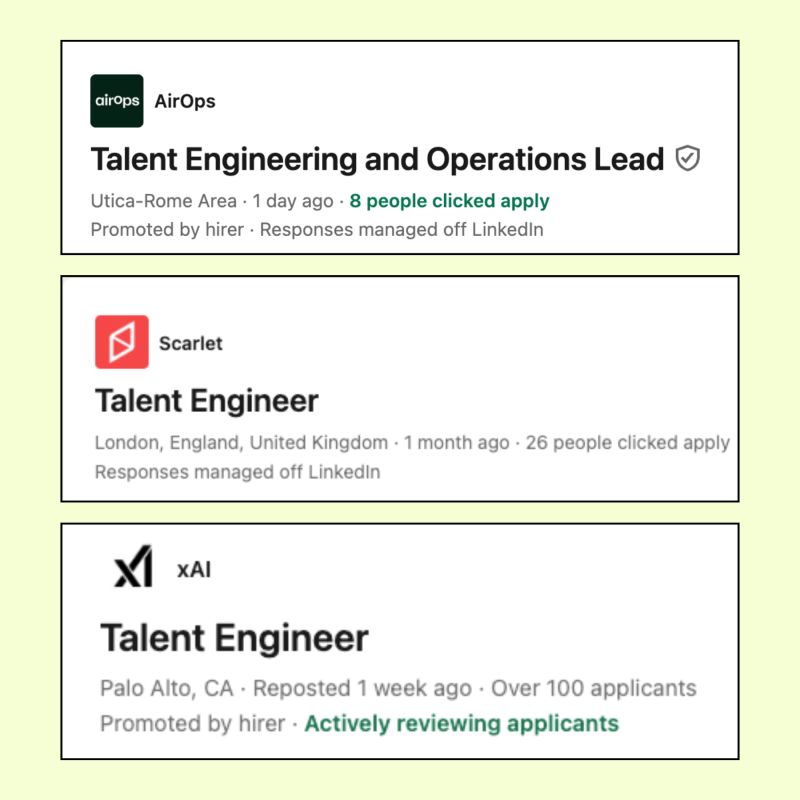
Joe Atkinson of PromptMates breaks down the talent engineer role in brief
They ask questions like:
- Where does signal get lost in our interviews?
- What repetitive work can be automated safely?
- How can we surface top candidates without manual triage?
- How do we measure whether our AI tools are improving quality or just speed?
Importantly, this person doesn’t need to be a trained computer scientist or full-time software engineer. But they do need to be comfortable collaborating with IT and engineering teams.
They should:
- Understand APIs, automation logic, and system architecture at a working level
- Speak enough of the technical language to design viable solutions
- Know fluently the recruiter’s language, goals, and challenges
- Be deeply curious about how tools connect behind the scenes
- Care about making complex systems usable for frontline recruiters
They’re translators and builders, working between recruiting, operations, and engineering to make it all coherent.
 Viet Nguyen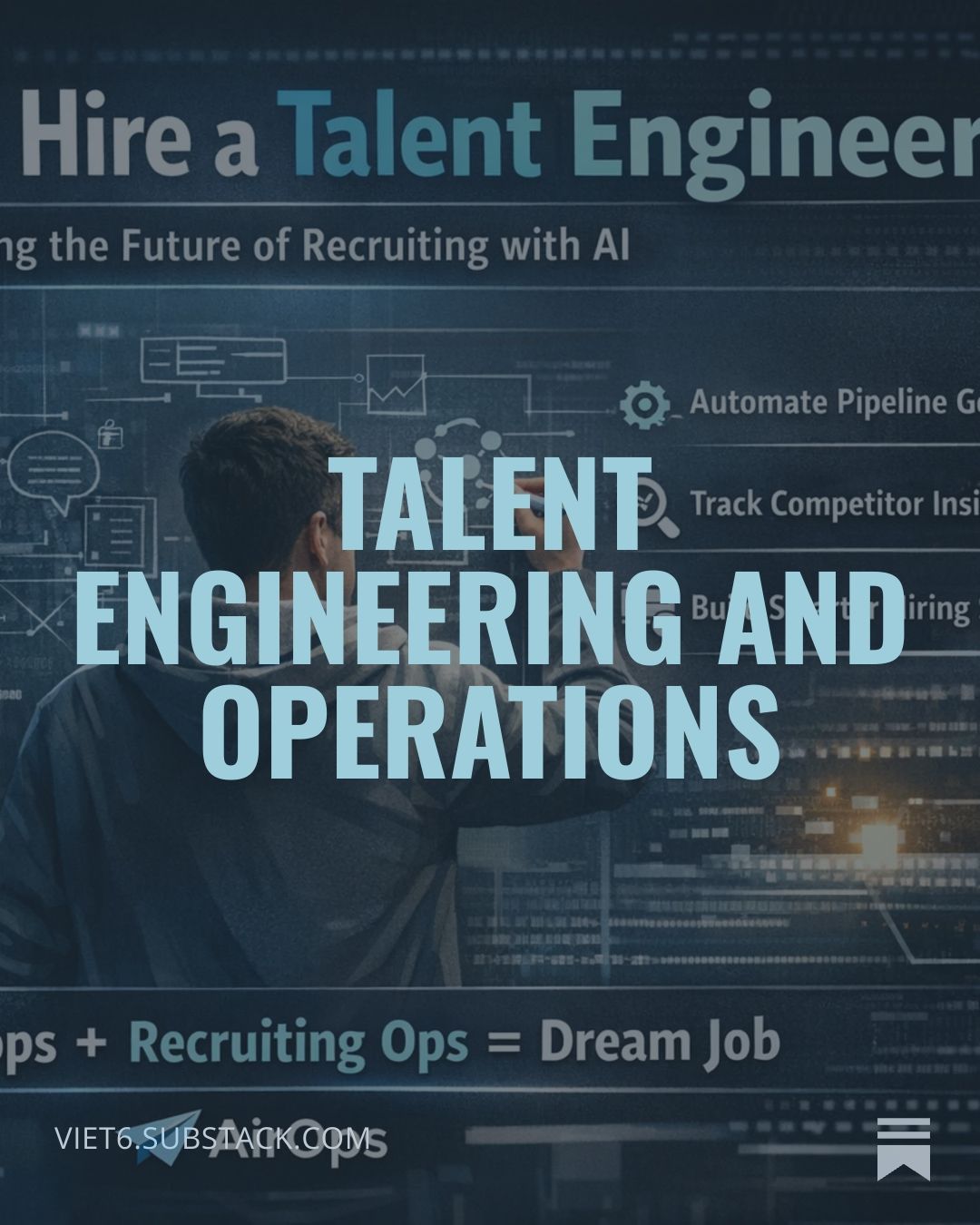
A call for talent engineers from Viet Nguyen, Head of TA at AirOps
What is a talent engineer not?
“Talent engineer” can easily be mistaken for a rebranded recruiting ops manager or a highly technical ATS administrator. But that framing undersells the strategic intent of the role.
A talent engineer is not:
- An ATS administrator focused solely on configuration
- A reporting analyst who only builds dashboards
- A traditional recruiting operations manager concerned primarily with compliance
- A disconnected technologist building tools without recruiter context
Their mandate is performance: improving the capability of the TA function through smarter architecture.
This role is also not in opposition to talent ops. In fact, the two often work closely together. While talent ops ensures reliability and consistency, the talent acquisition engineer pushes experimentation, automation, and system evolution forward. Both are valuable—they just optimize for different outcomes.
The three-track TA model
As talent acquisition matures, many organizations are implicitly moving toward a three-track structure. The pressure to hire better, move faster, and adopt AI responsibly makes it difficult for one role to cover everything well.
Not every company will formalize these tracks explicitly, but understanding them helps clarify where a talent engineer fits.
1. Talent partner
This is the human-facing core of recruiting. Talent partners build trust with hiring managers, shape role definitions, guide interview panels, and close candidates. Their work is deeply human and highly contextual, focused on:
- Relationship-building
- Hiring manager influence
- Candidate closing
- Stakeholder alignment
Success depends on influence, judgment, and communication. Talent partners translate business needs into hiring strategies, and ensure candidates feel understood and engaged throughout the process.
2. Talent ops
This team ensures systems are configured correctly, processes are documented, data is clean, and reporting is accurate. They reduce chaos and create consistency.
In many organizations, talent ops owns the ATS, manages vendor relationships, maintains compliance standards, and produces leadership reporting. They keep the machine running smoothly, with responsibility over:
- Process governance
- Systems administration
- Data integrity
- Reporting and compliance
Without strong ops, recruiting becomes fragmented. But ops alone doesn’t necessarily drive innovation. Which is where the next track comes in.
3. Talent engineer
The talent engineer works to optimize talent processes and strategy. They look at the same systems talent ops maintains, and ask how they can be reimagined, connected, or automated.
This role focuses on capability building. How can AI assist sourcing? How can structured evaluation improve interview signal? How can automation reduce manual triage? And how can data be turned into real-time feedback loops?
Their job is to design:
- AI and automation layers
- Workflow architecture
- Signal optimization
- Experimentation and performance measurement
Recruiting excellence in 2026 requires systems that continuously improve both relationships and process efficiency. And that’s where the talent engineer thrives.
What are the core responsibilities?
If talent partners are responsible for outcomes and talent ops is responsible for reliability, the talent engineer is responsible for capability.
A strong talent acquisition engineer looks across the entire hiring lifecycle—from sourcing to offer—and asks: where is friction highest, signal weakest, and leverage greatest?
Their responsibilities typically fall into four broad areas.
1. Designing AI-powered hiring systems
AI tools are everywhere in recruiting. But without thoughtful design, they’re just disconnected point solutions.
A talent engineer builds structured, intentional AI layers into the hiring workflow. That might mean incorporating AI sourcing assistants that generate qualified pipeline, creating reusable prompt libraries tied to real recruiter workflows, or embedding AI-assisted screening to improve consistency.
They don’t just deploy tools. They define how those tools should be used, where human judgment must intervene, and how impact will be measured.
The goal isn’t process automation for its own sake, but measurable improvements in speed, signal, and quality of hire.
2. Automating high-friction workflows
Every TA team has invisible bottlenecks: manual inbound triage, repetitive candidate prep, disjointed outreach, inconsistent interviewer preparation, messy data clean up.
A talent acquisition systems specialist identifies and smooths out these friction points.
They might connect ATS data to automation layers that surface high-priority candidates automatically. They might build structured prep packets that trigger when interviews are scheduled. They might create referral-mapping systems that surface warm introductions across the company’s network.
They might also identify interview scorecards that aren't fit for purpose, or hiring managers giving vague, inconsistent notes. And then they find smart solutions to these common issues.
The common thread: they remove repetitive manual effort so recruiters can focus on judgment, relationships, and closing.
3. Engineering recruiting infrastructure
Beyond automation, talent engineers think in terms of architecture. How do sourcing systems connect to interview data? How does outreach performance tie back to hiring quality metrics? And how do hiring managers get real-time clarity without asking for ad hoc reports?
This often involves building dashboards that reflect meaningful inputs and outputs at each stage, implementing exception reporting to protect data integrity, and ensuring that systems are connected rather than siloed.
They approach TA infrastructure the way a product team approaches technical debt: proactively, systematically, and with long-term scalability in mind.
4. Running experiments and measuring impact
Perhaps the definitive responsibility is experimentation. A talent engineer doesn’t assume the hiring process is fixed. They treat it as an evolving system.
Tangibly, talent engineers:
- Define measurable inputs and outputs for each hiring stage
- Test new sourcing strategies
- Measure the impact of AI-assisted screening
- Compare structured versus unstructured interviews
- Tack whether automation improves not just speed, but quality.
In short, they introduce an engineering mindset to talent acquisition: hypothesize, build, test, measure, iterate. Over time, this experimentation turns recruiting from a reactive function into a continuously improving system.
 Samantha Price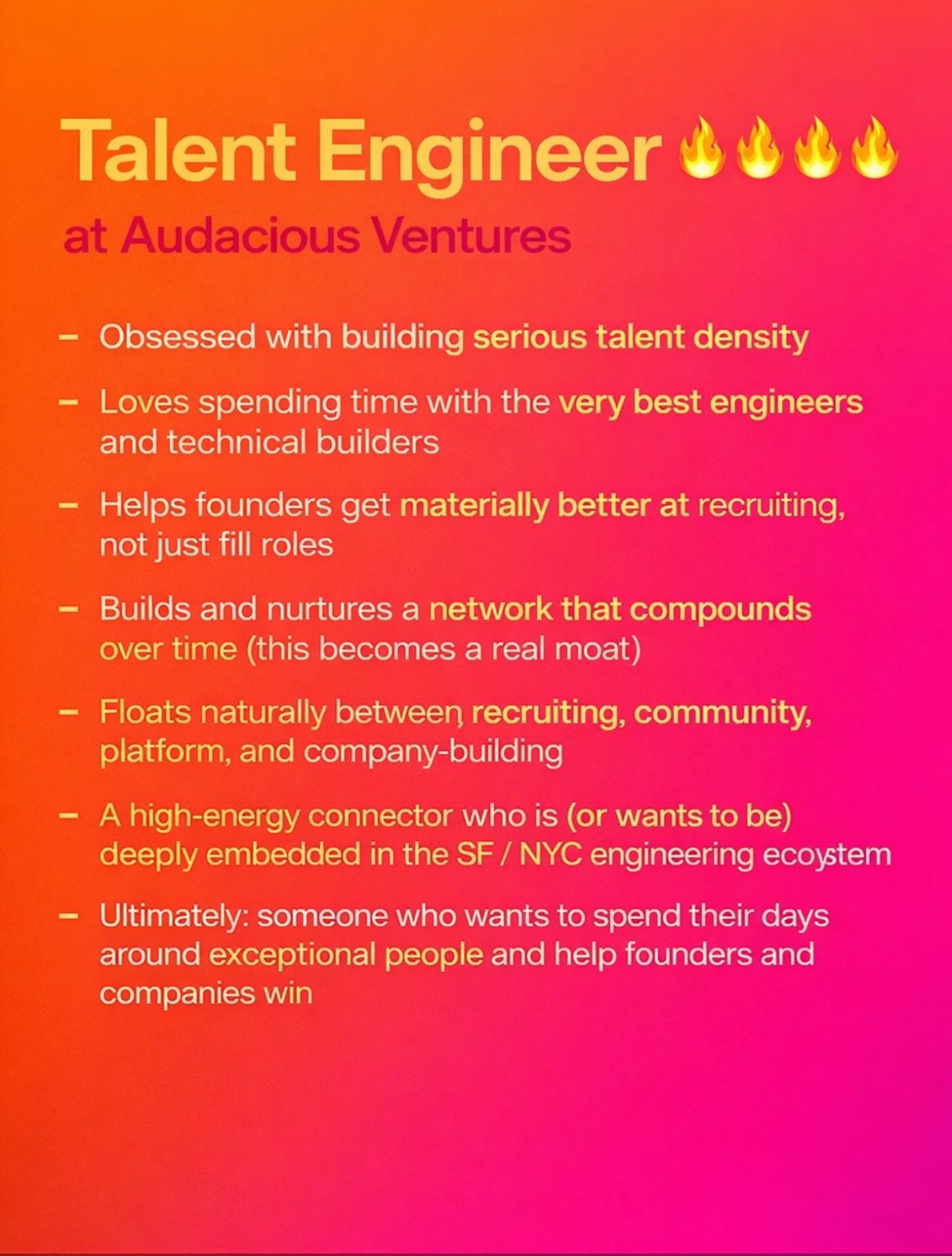
A talent engineer role posted by Sam Price, Founder at Audacious Ventures
Why is this role so important in TA teams?
As hiring becomes more technical and more scrutinized, TA teams are adopting AI tools, layering on automation, and expanding their tech stacks. But without someone explicitly responsible for designing how those pieces fit together, complexity increases faster than capability.
The talent engineer closes that gap. Here’s how that impact plays out.
For TA leaders
For most HR and TA leaders, the biggest challenge is proving that hiring quality and process design directly support business outcomes. A talent engineer helps make that possible.
By structuring workflows, instrumenting systems, and defining measurable inputs and outputs, they create visibility. Leaders can see where signal improves, where bottlenecks exist, and how process changes affect speed and quality.
This also reduces dependency on external vendors for innovation. Rather than layering tool upon tool, TA leaders can build and connect internal systems tailored to their specific hiring needs.
The result is higher recruiter productivity, clearer performance data, and a TA function that operates more like a product organization.
For frontline recruiters
From the recruiter’s perspective, the impact is immediate and practical. Recruiters are often expected to master AI tools, optimize sourcing, manage stakeholder relationships, and maintain process discipline, all while carrying full req loads. Without thoughtful system design, this becomes overwhelming.
A talent acquisition engineer acts as a force multiplier. They build reusable frameworks, automate repetitive tasks, and embed AI in ways that are accessible and intuitive. Instead of every recruiter experimenting alone, the learning becomes centralized and shared.
That means:
- Less manual triage
- Clearer evaluation criteria
- Better interviewer preparation
- More time spent on high-value conversations
The recruiter’s role becomes more strategic—not more technical—because the technical layer is well designed underneath them.
For the candidate experience
Candidates may never know a talent engineer exists. But they can feel the effects. When systems are engineered well, candidates experience:
- Faster response times
- Clearer communication
- More structured and consistent interviews
- Better-prepared interviewers
- Fewer administrative errors
Automation shouldn’t make hiring feel robotic. In fact, when designed thoughtfully, it removes friction and creates more space for genuine human interaction. Talent engineers ensure that operational tools and processes present as human. Because that’s still essential to successful recruitment.
When should you hire your first talent engineer?
Not every company needs a dedicated talent engineer on day one. But there are clear signals that the role may be overdue.
If your TA team is experimenting with AI tools but struggling to connect them, that’s a sign. If recruiters are building ad hoc automations in isolation, that’s another. If leadership is asking for deeper insight into hiring quality and process impact, the need becomes even clearer. Especially if the data isn’t there.
Typically, this role becomes most valuable when:
- Hiring volume is high enough to justify system optimization
- The tech stack is growing in complexity
- AI is becoming embedded in daily workflows
- TA leaders want to move from reactive reporting to proactive experimentation
In earlier-stage companies, the role may be combined with talent ops or sit within a broader recruiting operations mandate. In larger organizations, it may evolve into a distinct career path with increasing specialization.
The key inflection point is system complexity. When hiring starts to feel like a collection of tools rather than a coherent machine, it’s time for someone to engineer it properly.
- Viet Nguyen, Head of TA, AirOps
How AI accelerates the need for this role
AI isn’t just another tool in your recruiting stack. It’s a structural shift, and every smart talent team is jumping in.
Sourcing agents can now generate pipeline at scale. Generative models can draft outreach, summarize interviews, and even simulate candidate responses. Automation platforms can connect data across systems in ways that were previously impossible without engineering support.
But AI adoption without architecture creates chaos.
When every recruiter experiments independently, you get inconsistent prompting, uneven quality, duplicate workflows, and unclear measurement. Tools multiply, but signal quality just gets messier.
This is where the talent engineer becomes critical.
They define guardrails, create reusable prompt libraries, connect automation to ATS data, and measure whether AI is improving outcomes or just creating noise.
As AI becomes embedded in recruiting, the question shifts from “Should we use it?” to “How do we use it intelligently?” The talent engineer is the person who answers that question at a systems level.
How Metaview supports talent engineers
If the talent engineer’s job is to increase signal and build measurable systems, they need infrastructure that supports that goal. More importantly, they need to give recruiters the tools that unlock their true talents.
Metaview’s AI recruiting tools automate and overhaul the most time-consuming, distracting parts of hiring:
- Long sourcing searches now take mere minutes
- Endless candidates lists full of fake or irrelevant applications become tailored, curated shortlists
- Interview notetaking is fully automated, with smart summaries and contextual feedback
- Interviewers are prompted with the right questions to asked, and reminded if they miss a key detail
- Quality of hire reporting takes seconds
For a talent acquisition systems specialist, reliable sourcing and interview data is like clean production data in software engineering. It allows for iteration, optimization, and continuous improvement.
Metaview removes the biggest hurdles, distractions, and excuses for recruiting teams. So talent engineers can truly unlock the very best in their recruiting partners.

A talent engineer may be your next essential hire
Talent acquisition is now firmly a systems function. As AI reshapes workflows and business leaders demand clearer ROI from hiring, the teams that succeed will be the ones that deliberately and deeply engineer how recruiting works.
For HR leaders, the talent engineer role builds leverage: better recruiter performance, stronger hiring manager alignment, cleaner data, and measurable improvement over time. For recruiters and systems-minded builders, it opens a new career path at the intersection of people, technology, and strategy.
Titles will vary. But the capability will increasingly define high-performing TA organizations.
In 2026 and beyond, competitive advantage in hiring won’t come from adopting more tools. It will come from engineering them well.
Talent engineer FAQs
Is a talent engineer the same as a recruiting operations manager?
Not necessarily. While there may be overlap, recruiting ops typically focuses on process governance, reporting, and system reliability. A talent engineer focuses more heavily on AI integration, automation design, experimentation, and increasing recruiter capability.
Does this role replace external recruiting technology vendors?
No, but it changes how you use them. A talent acquisition engineer ensures tools are connected, measured, and optimized internally rather than layered on in isolation.
How do you measure the impact of a talent engineer?
Impact can be measured through improvements in recruiter productivity, interview signal quality, time-to-decision, automation efficiency, and clearer attribution between hiring processes and business outcomes.
What background is ideal for a talent engineer?
Many come from recruiting or sourcing backgrounds with a strong curiosity about systems and AI. Experience experimenting with automation, building internal tools, or collaborating closely with IT and engineering teams is often a strong signal.
Is this role only relevant for highly technical hiring environments?
No. While technical organizations may adopt it first, any company using multiple hiring systems, AI tools, or structured interview frameworks can benefit from someone explicitly responsible for system design and optimization.
