

It is Monday morning. A regional TA manager opens the queue: 1,400 new applications across 80 stores, plus 60 store-manager screens already on their calendars. Auto-screen-out clears 600 obvious mismatches. The remaining 800 still need a 2-minute phone screen, then a store visit, then a manager interview. By Friday, 12 candidates have ghosted, 8 have accepted offers down the street, and 14 store managers have not entered feedback yet.
The instinctive diagnosis is always the same: more applicants, more recruiters, more ATS automation. That is the wrong diagnosis. Retail recruiting does not fail at the top of the funnel where applicants are abundant. It fails at the signal layer, where 80 store managers run 80 different versions of the same interview and the recruiter never sees what was actually said.
This guide rebuilds retail talent acquisition strategy around that signal layer. Six places hiring leaks at store scale, what changes when every screen produces structured data the moment it ends, and a 7-day audit you can run on Monday. The frame: retail recruiting is a coordination problem, not a volume problem. Solve the coordination, the volume mostly takes care of itself.
What retail talent acquisition actually means in 2026.
Retail talent acquisition is the high-volume hiring engine for store-floor, fulfillment, hourly, and frontline roles across a distributed footprint, often multi-store, multi-region, and sometimes multi-country. The 2026 retail hiring environment has three structural features the rest of recruiting does not share.
Volume baseline that never drops below 5x corporate. A 500-store chain backfills hundreds of roles every month, before seasonal peaks land in October and again in April.
Decentralized hiring authority. District and store managers run their own screens and final interviews. The recruiter is often a coordinator and screener, not the decision-maker. That changes what your TA stack actually needs to do.
Speed pressure on a daily clock. Retail roles compete with three other retailers and two gig platforms in the same ZIP code. According to Metaview's 2026 AI & Hiring Alignment Report - surveying 505 recruiting leaders and hiring managers across North America and EMEA - 67% of teams lose qualified candidates to faster-moving competitors every month. In retail that number is higher, because the candidate has a job offer at the next store by Friday.
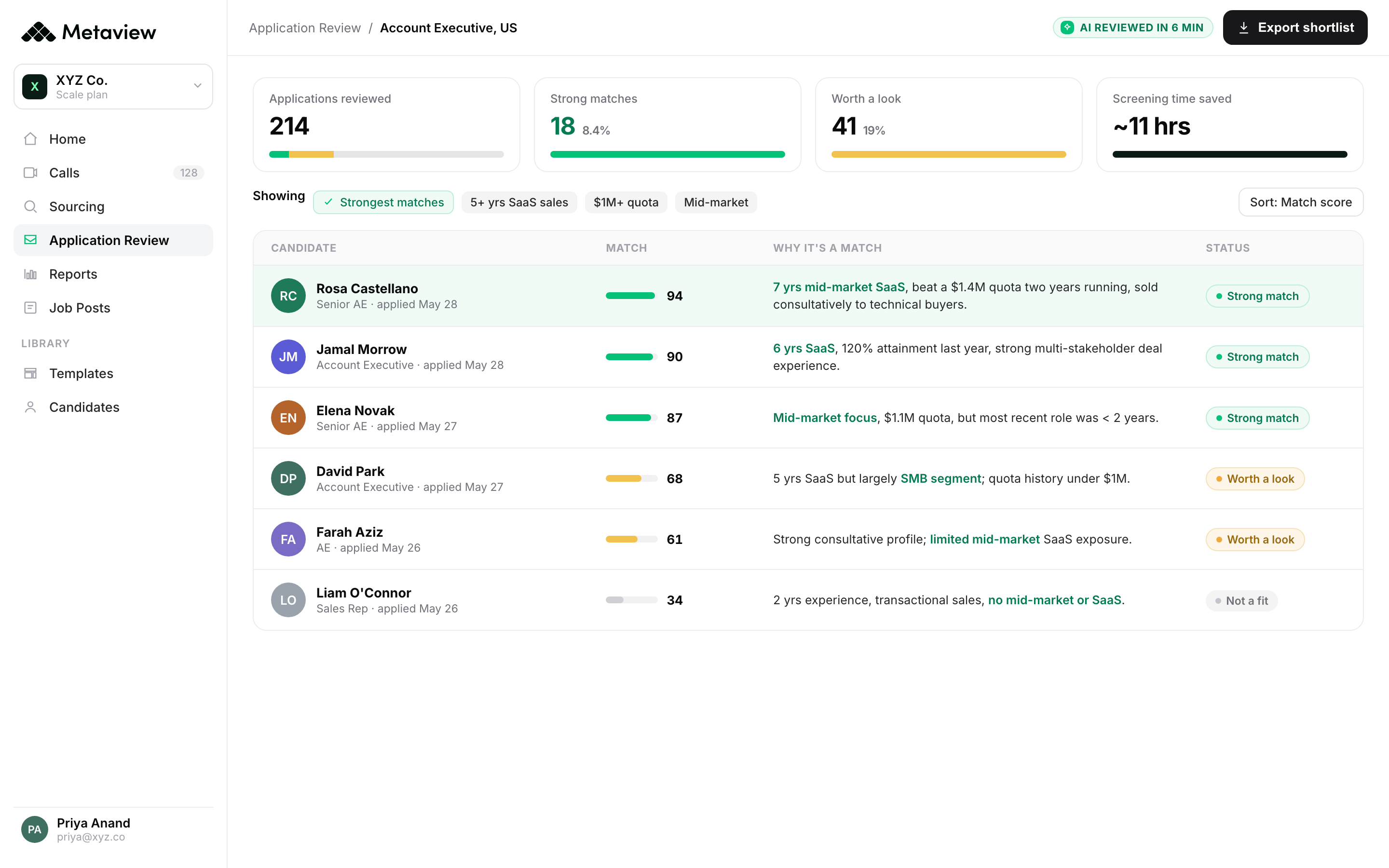
That structure means traditional TA playbooks (build a pipeline, post jobs, screen carefully) do not transplant cleanly to retail. What needs to change is the signal layer underneath.
The custom templates give us a consistent and rigorous way to compare apples with apples across a large number of individuals. They’re driving efficiency and consistency in the way we’re interviewing candidates, and in the outputs we’re generating for clients.”

The 6 places retail hiring actually leaks.
If you map retail TA against a generic funnel, you find leakage in the same six places every time. Each one looks like a recruiter problem or a hiring-manager problem in isolation. In reality they are all symptoms of one root cause: the signal layer underneath the funnel is missing.
1. Screening volume drowns the recruiter.
Peak season can push 1,200 applications per requisition. Around 70% miss basic availability or right-to-work. Auto-screen handles that cleanly. The remaining 30% still need a 2-minute screen, which is the moment the recruiter loses the day. By application 80 of 100, attention is gone, and the candidate notices. They ghost the next step.
2. Decentralized panels ask 6 different questions for the same role.
Eighty store managers, 80 different versions of "tell me about your last job." No rubric. No calibration. The same role gets staffed inconsistently across stores. Top-quartile stores hire 1.8x better than bottom-quartile stores, and nobody at HQ can say why because nobody can see the interviews.
3. Untrained store managers wing the interview.
Most store managers are operators, not recruiters. They were promoted from senior associate. Nobody taught them how to interview, so they ask the questions they wish they had been asked. The result is legally exposed, structurally unfair to candidates, and unable to scale calibration across the chain.
4. Feedback lag kills the offer window.
Candidate interviews Tuesday at 4pm. The manager has a Wednesday inventory count, a Thursday district meeting, and three new applicants to interview Friday. By the time feedback lands, it is the following Tuesday. The candidate started somewhere else Monday.
5. No-show rate compounds invisibly.
Retail interview no-show often sits at 30 to 50%. Most TA teams do not track which stores have the worst rate, because the interview leaves no trail. Store managers blame the market. The market is fine; the candidate experience is the problem, and you cannot fix what you cannot see.
6. Candidate experience drops off after the store visit.
The application is slick. The store visit is friendly. The 5-day silent gap after the visit is what breaks it. The candidate is also a customer; the brand damage compounds for years after the rejection. Most retailers cannot quantify it, so they ignore it.
The signal layer: what changes when every store screen is captured.
The single intervention that compresses all six leaks is structural, not motivational: capture every screen and every store-manager interview as structured data the moment it ends. The recruiter and store manager dial into the screen exactly as they do today. A capture tool joins the call, transcribes the conversation, identifies which competency was asked about, and produces a rubric-aligned scorecard within minutes.
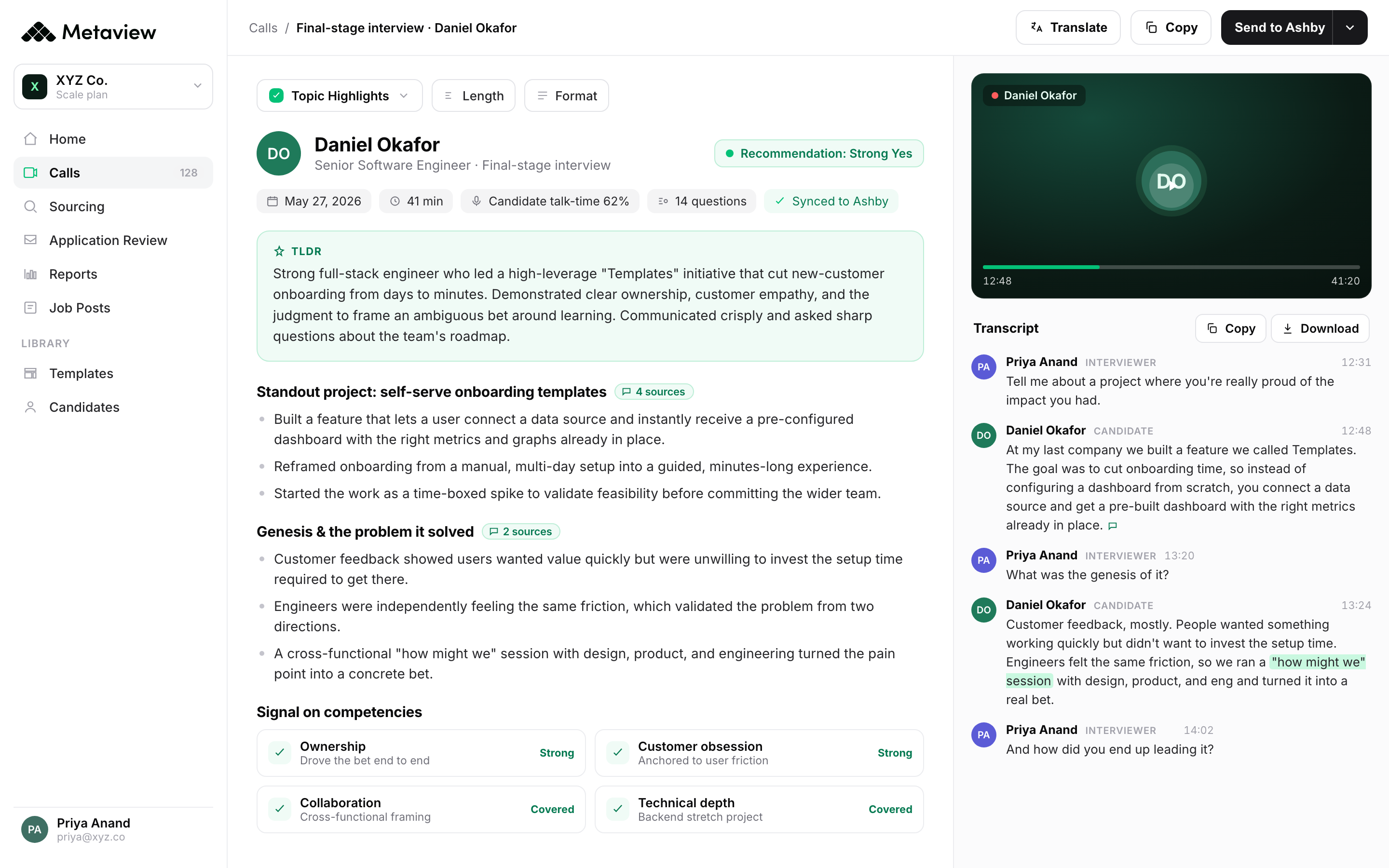
Two things change immediately. First, the recruiter gets a coverage check at the network level: did the manager ask about all six competencies on the rubric? Did they ask the same question across all 80 stores? Where are the gaps? Second, the hiring-manager debrief collapses from 15 minutes to 1. The manager opens the auto-summary, pushes approve, and the candidate moves.
The leak this closes: store managers can stay operators, not professional recruiters, and still produce a consistent interview output. One recruiter coordinates an 80-store network instead of fielding the same calibration call eight times a week.
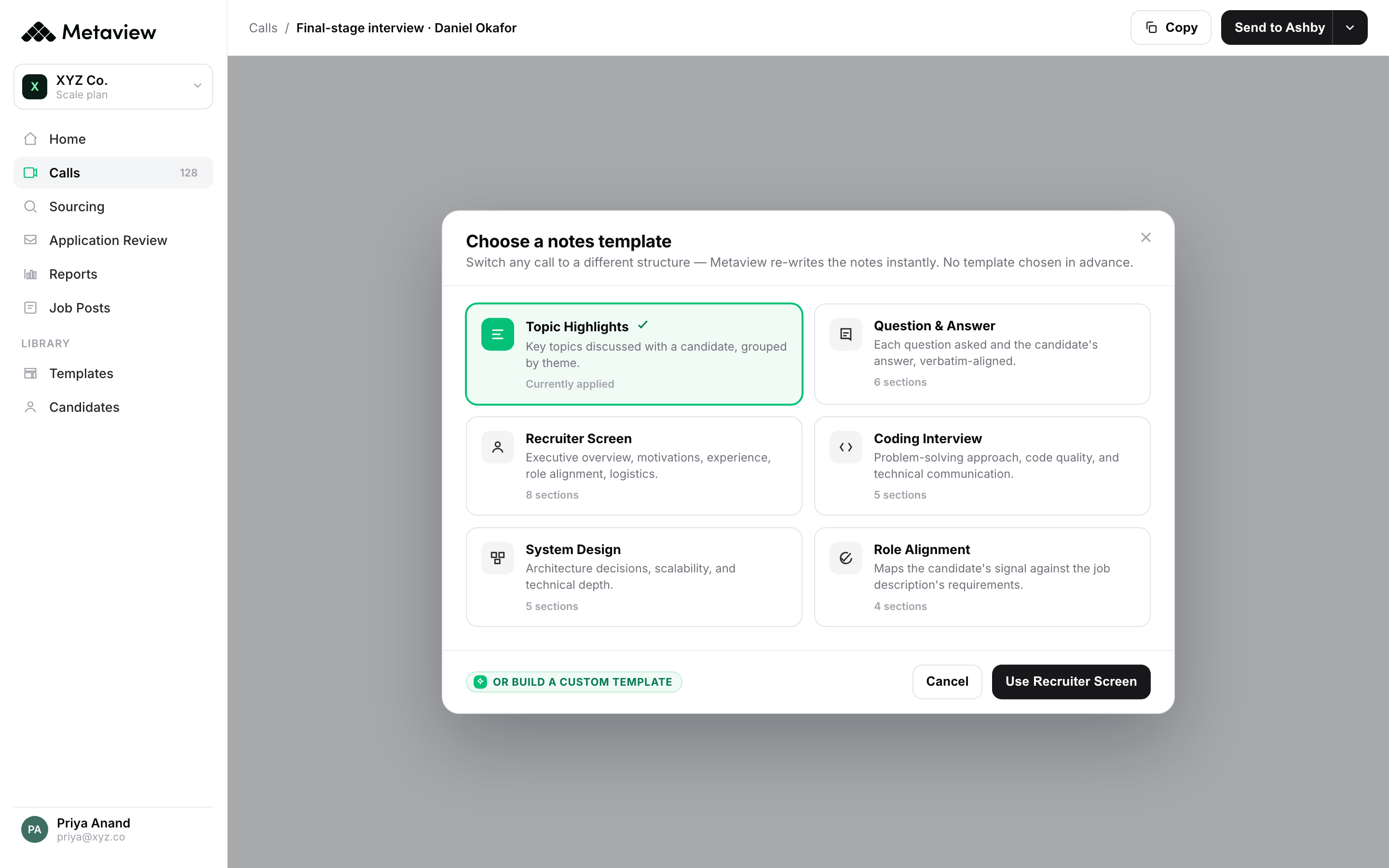
A retail-grade hiring stack: Manual vs Generic AI vs Metaview.
A retail TA stack has to do five jobs the rest of recruiting does not need to do at the same intensity. Here is how each layer holds up under store-scale demand.
| Dimension | Manual | Generic AI notetaker | Metaview |
|---|---|---|---|
| Screen capture | Manager scribbles on paper; recruiter takes notes during or after the call. | Generic transcript dumped into a doc, no rubric mapping. | Live capture mapped to per-role competency rubric in real time. |
| Cross-store consistency | None. Each store interviews its own way. | None. The notetaker does not know what good looks like. | Templated rubric per role; every store interviewer sees the same prompt. |
| Feedback turnaround | 3 to 7 days; sometimes never. | Same day, but unstructured prose. | Under 1 minute; auto-scorecard ready the moment the call ends. |
| Pattern detection across stores | Quarterly QBR slide built by hand. | None at the tool layer. | Reports surface which stores miss which competencies and where signal varies. |
| ATS sync | Manual paste, often skipped under volume. | Manual export. | Notes and scorecards write back to the ATS automatically. |
How structured signal stops the most expensive retail mis-hires.
The mis-hire that breaks retail is not the candidate who quits on day 30. It is the candidate who hires their friends, runs the floor poorly for 18 months, and quietly inflates turnover by 12 points before anyone connects the dots. Manual screens cannot catch this kind of mis-hire because the signal lives in what was asked and how the candidate responded, not in tenure data.
When screens are captured, three patterns become visible at the network level. The recruiter sees that the same competency (conflict de-escalation under customer pressure, for example) is being asked very differently in stores 18 and 41, ships a 90-second video showing the right way to phrase it, and variance collapses inside a week. The TA leader spots that no-show rate is 4x higher at three specific stores, checks the screen recordings, realizes those stores confirm interview times by voicemail, switches to SMS confirmations, and watches no-shows fall 60%. The hiring manager sees a candidate who answered four competencies strongly but flatlined on coachability and has a defensible auto-reject reason on the record.
None of this requires a behavior change from store managers. The structure of the signal does the work, not the discipline of 80 individual operators.
We were making hiring decisions blind, advancing candidates without structured evaluations, risking bad hires, and losing exceptional talent along the way.”

 Fleur Melkert
The 7-day retail recruiting audit you can run on Monday.
You do not need a new system to start. You need a week of disciplined audit, a single rubric for your highest-volume role, and the willingness to listen to the 5 ugliest screens from last week. Run this as written. By Day 7 you will know which stores need calibration, which managers need coaching, and which leak to close first.
- Day 1 (Monday). Pull every interview from last week. Tag by store, role, and interviewer. Find the 10 with the worst time-to-feedback. Those are your starting point.
- Day 2. Capture the next 5 store screens. Listen to them end-to-end. Count how many of the 6 role competencies were actually asked. Most teams get 2 to 3.
- Day 3. Talk to two store managers with the worst time-to-feedback. Do not blame them. Ask one question: what stops them from entering it in the first 24 hours?
- Day 4. Build a one-page rubric for the highest-volume role. Six competencies, three questions per competency, what "good" sounds like for each. Keep it on one page.
- Day 5. Pilot the rubric with two stores. Run all screens with capture on. Measure variance vs the bottom-quartile baseline you already have.
- Day 6. Audit candidate experience. Pull the candidates who ghosted last week. Send them a 1-line SMS: "What stopped you from coming back?" You will get a response rate of 15 to 25%, and the responses are worth their weight in coaching.
- Day 7. Score the week. Time-to-feedback delta? Variance reduction? Ghosted-candidate response rate? Pick the single biggest leak you can close in two weeks. Scale on Monday.
- Recurring (every Friday). 15-minute review with district managers. One report, one variance chart, one decision per store. Compounding starts here.
Bring Metaview into your hiring stack.
Live notes, structured scorecards, and ATS sync - set up in under 10 minutes.
Frequently asked questions.
How can I quickly hire for seasonal retail roles without sacrificing quality?
Build a single role rubric, capture every screen automatically, and review the first 20 candidates manually to calibrate. Once the rubric stabilizes, you can let store managers run screens at volume because the signal is already structured. Speed comes from removing the post-interview write-up and the feedback lag, not from cutting interview length.
How do I keep hiring standards consistent across multiple stores when I am not in the room?
Standardize the question set per role (six competencies, three questions each), give every store manager the same one-page rubric, and capture every screen so you can audit which stores ask which questions. Inconsistency is fixable. Invisible inconsistency is not.
Can AI replace human recruiters for retail screens?
No, and it should not try. AI does well removing the post-screen write-up, mapping responses to a rubric, and surfacing pattern variance across stores. Humans still make the hire or no-hire call. Where AI helps is letting one recruiter coordinate 80 store managers instead of 8.
What is a realistic retail time-to-fill in 2026?
For hourly store roles, 7 to 12 days from application to first shift is realistic if screens are captured and feedback is structured. Teams running unstructured screens often sit at 18 to 25 days for the same role. The gap is the feedback layer, not the recruiter's hustle.
How do I prove ROI on a retail recruiting tech investment to my VP of Operations?
Pick three metrics your VP already tracks: time-to-first-shift, 90-day attrition, and store-manager hours-on-hiring. Run a 60-day pilot in two stores. Compare against the bottom-quartile baseline you already have. The conversation moves from "another tool" to "operational lever" once variance reduction is on a slide.
