
Every recruiter knows the search box returns 10,000 profiles in seconds. Access to candidates isn't the bottleneck. Reviewing them is.
By Wednesday you've scrolled past 400 candidates and still don't have a shortlist worth a hiring manager's time. The work has shifted from finding profiles to filtering them.
This is the 5-step playbook for narrowing 10,000 results into a high-signal shortlist, and the Metaview AI Sourcing agents that run those disciplines continuously so your next role doesn't start with a cold search.
The qualification problem is filtering, not volume.
Open LinkedIn Recruiter, run a search, and you'll get thousands of profiles in seconds. That's not the bottleneck for in-house teams or executive search agencies. The bottleneck is precision: candidates who match the role's actual scope, not just keyword overlap.
Qualified isn't a job-title match. It isn't a skills section that lists the right buzzwords. Qualified means aligned with the level of ownership the role demands, the kind of problems solved at the right company stage, and the trajectory the next step calls for.
A "Senior Product Manager" at a 20-person startup operates differently from one at a public enterprise. The keyword search returns both. The qualification work happens after that, and most teams have no system for it.
That's where this playbook starts: with the upstream talent map already in place, and a clear filter for what aligned looks like at the per-candidate level.
Where qualified candidates cluster.
Most recruiters live inside LinkedIn Recruiter and its filters. It's table stakes. But the candidates with the highest signal density rarely sit in one channel; they cluster differently by role profile. The signal-density per channel changes the channel choice itself.
| Role profile | Where qualified candidates cluster | Typical signal density |
|---|---|---|
| Senior IC technical | Open-source platforms, GitHub repos, niche engineering communities | High. Public commits, code review history, and talk records all carry real work |
| Senior IC business | LinkedIn, peer networks, industry-specific Slack groups | Medium. Titles and tenure scan well, but scope evidence needs verification |
| Early-career generalist | LinkedIn, university alumni networks, portfolio platforms | Low to medium. Limited record, so trajectory and learning signals matter more than tenure |
| Niche specialist | Domain-specific platforms, professional associations, conference speakers | High. Narrow audience, published work, and association membership all signal real expertise |
| Executive search | Second-degree networks, hiring-manager referrals, board introductions | Very high. Warm context plus verified track record cuts the qualification work in half |
| Re-engaging silver medalists | Your own ATS, past pipelines, previously sourced lists | High. Already vetted, often more experienced now, with lower outreach friction |
The table is a starting point, not a rule. The reason channel choice matters is that the qualification work compounds: a higher-signal channel means less filtering downstream.
If you're hiring engineers and you're not also looking at open-source platforms, you're paying the qualification tax on every profile.
The biggest under-used channel is your own recruitment database. Silver medalists and previously sourced candidates often match new roles better than external prospects, and the qualification work is already partly done.
The 5-step playbook for narrowing 10,000 results.
Five disciplines turn a search result set into a ranked shortlist. Each one runs upstream of the AI layer; the AI layer multiplies the lift once the disciplines are already in place.
Step 1. Define the non-negotiables before the search.
Open the role with three to five signals that are genuinely non-negotiable, and three to five that are context-dependent. Non-negotiables first, preferences second.
Translate the JD into specific evidence: not "five years of Python," but "shipped a production data pipeline at greater than 10k QPS." Specific evidence filters; generic skills don't.
Most searches inherit the JD's full requirement stack as if everything were a must-have. When everything is a must-have, the search filters out candidates who are qualified but don't mirror the spec perfectly.
Separating signal from preference is the upstream move that makes the rest of the playbook work.
Step 2. Search beyond LinkedIn.
LinkedIn is the default and remains useful, especially for business-side roles. But the table above is real: signal density varies by channel.
Engineers active on GitHub, designers showing work in portfolio communities, and niche specialists in industry-specific platforms all carry richer evidence than the LinkedIn-only crawl returns.
Add at least one off-LinkedIn channel per role. For executive search, lean on referrals and second-degree networks. For specialist roles, lean on domain platforms. For everyone, mine your internal candidate database before the external search opens.
Step 3. Rank by signal density.
Most searches return too many candidates for manual review at the volume hiring teams run. Rather than reviewing every profile equally, rank by density: which candidates carry the most signal per minute of review time? Four signals do most of the work.
- Career progression. Increasing scope, ownership, or tenure across roles, with the trajectory itself as the signal.
- Scope evidence. Named teams, named products, named outcomes. Concrete proof beats title inflation.
- Measurable outcomes. Specific numbers attached to delivered work: revenue, latency, retention, conversion.
- Context match. Right company stage, right industry domain, right kind of problem space.
Low-signal profiles lean on generic descriptions and buzzwords. High-signal profiles read like a record of real work. Train your eye for the difference, and you'll find qualified candidates faster even in large result sets. The strongest candidates increasingly approach LinkedIn profile optimization with this in mind, replacing keyword polish with the scope, outcomes, and progression this step rewards.
Step 4. Move from keyword to semantic matching.
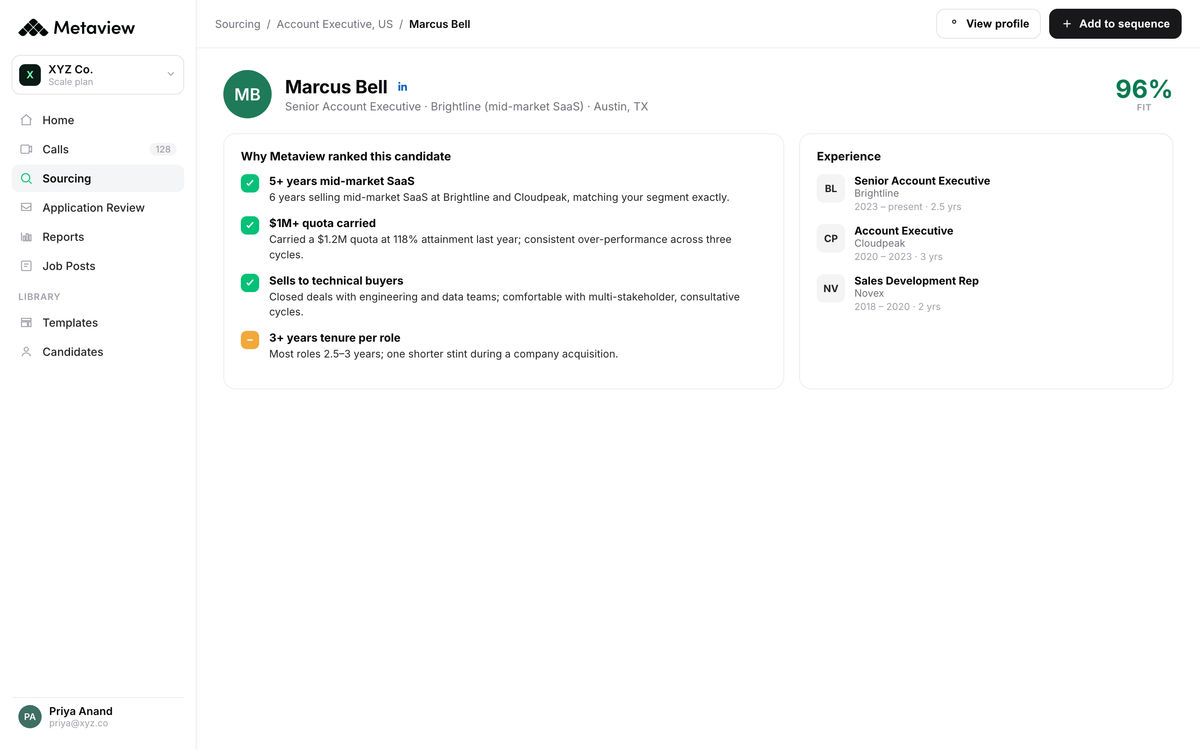
Boolean search struggles with nuance. It can't recognize that internal-tools experience may align with a product engineering role, or that a regulated-industry background translates across verticals.
Context, not keywords. Semantic matching reads the intent of the role and finds the candidates whose evidence aligns, even when their titles don't.
Our AI matching grounds the candidate evaluation in what the hiring manager needs at the per-role level: the scope, the problem space, and the operating context, not the verbatim JD.
Over time it learns from interview feedback what "qualified" looks like for your specific team. The shift away from boolean precision toward semantic precision is where the qualification noise drops.
Step 5. Run sourcing continuously.
Traditional sourcing is reactive. Open a req, run a search, scroll, repeat. The next req opens, you run a different search, scroll, repeat.
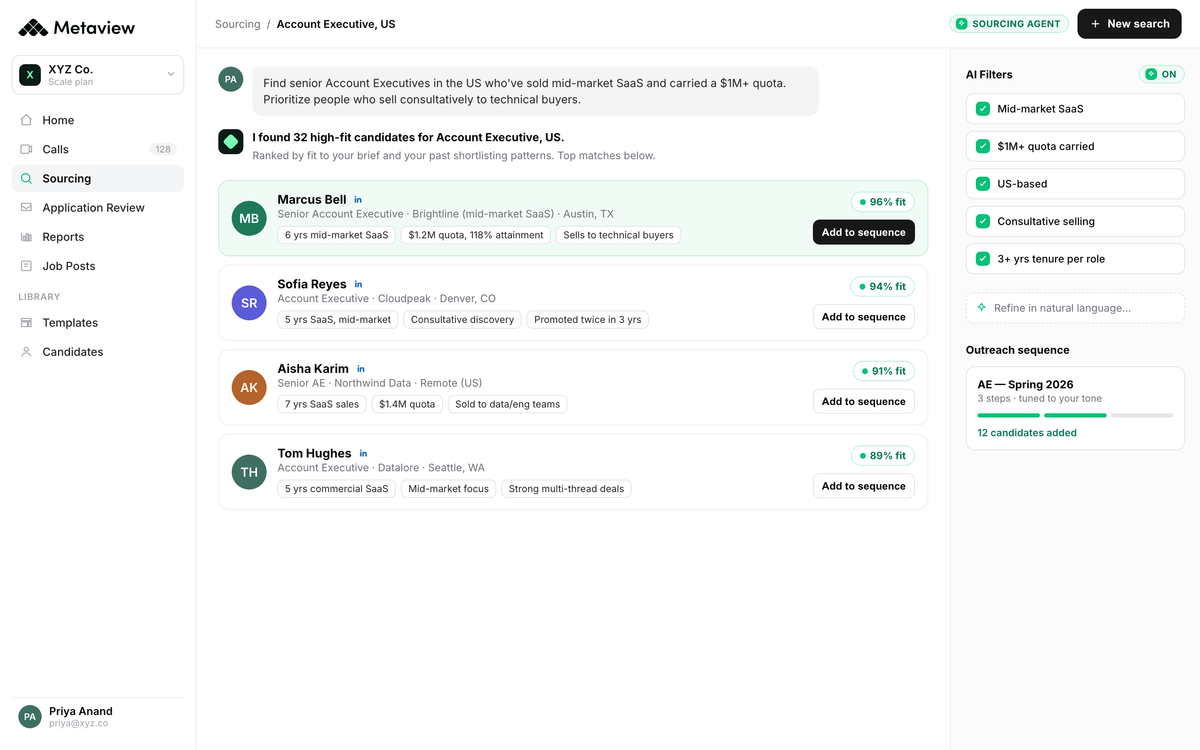
Continuous, not search-by-search. The shift is from initiating every search manually to running sourcing agents that update rankings as new data emerges across all your open roles.
Our AI Sourcing agents keep working in the background. They scan against your defined criteria, surface aligned candidates as the talent pool changes, and feed every recruiter and hiring manager decision back into the matching layer.
Each "yes, this candidate is a fit" or "no, they're not" sharpens the next round of recommendations. That feedback loop is what closes the time gap between opening a req and the first qualified screening call.
What the ranking shift produces.
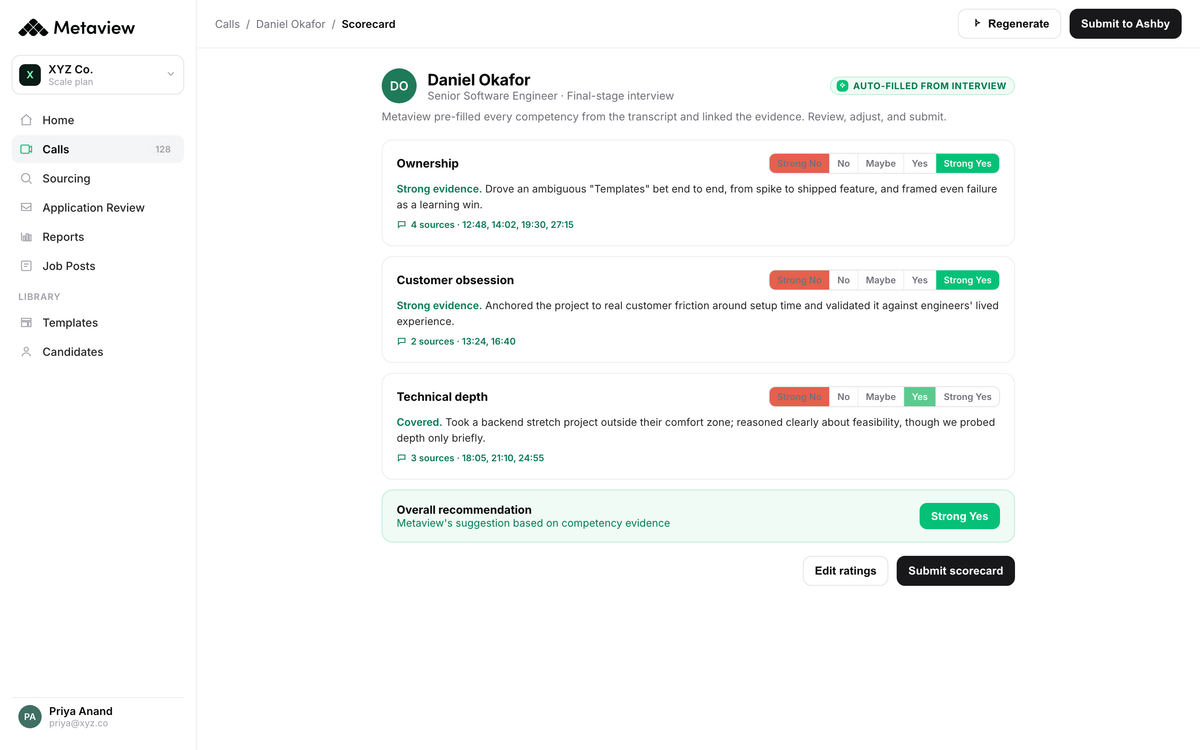
The ranking discipline plus a semantic matching layer changes the per-recruiter math. Less time spent scrolling, more time spent on qualified conversations. The proof shows up on screening cycles first.
It's reduced my screening time by up to 50%. Both strong and weak profiles are reviewed within a couple of seconds.”

The cumulative effect lands further upstream: when the ranking layer is doing the qualification work, the recruiter's hour shifts from triage to outreach, from cold scroll to warm conversation. That's the qualification moment moving from a daily scroll to a daily decision.
Precision starts with how you define qualified, deepens with the ranking discipline, and stacks when the AI layer runs continuously against your criteria. The five steps stack; each one earns its place by what it lets you stop doing.
If you want to search for candidates without sifting through endless profiles, and instead focus on high-quality conversations, the move is structural: define qualified once, rank by density, layer semantic matching on top, and run the loop continuously.
Bring Metaview into your hiring stack.
Live notes, structured scorecards, and ATS sync - set up in under 10 minutes.
Frequently asked.
Why do I get so many irrelevant results when I search?
The most common cause is preference inflation in the upstream JD: every "nice to have" gets encoded as if it were a must-have, and the search inherits the inflation. Strip the JD down to the three to five non-negotiable signals before opening the search box, and the noise drops upstream of any filter or ranking layer.
How do I know if a candidate is truly qualified beyond their resume?
When the four signals conflict (and they do), weight career progression and measurable outcomes above the others for step-up roles, and outcomes plus context match for lateral moves. A candidate progressing fast with smaller outcomes is often a stronger bet than a candidate plateaued at bigger ones.
Can AI sourcing replace LinkedIn Recruiter entirely?
The two aren't substitutes; they're stack layers. LinkedIn carries the broadest professional database, AI sourcing adds the ranking and matching layer on top. Use both: LinkedIn for surface area, AI sourcing for the discipline that turns the result set into a shortlist.
How does Metaview's matching learn from interview data?
Every interview outcome (pass, reject, hire, no-hire at the offer stage) feeds back into the matching criteria. Over time the system learns which signals correlate with hires on your specific team, and the ranking sharpens to your hiring bar rather than a generic one. It's the calibration loop that closes between sourcing and interviewing.
How quickly can a team see results from AI candidate sourcing?
First ranked shortlists land within hours of setup once your ICP criteria are defined. Meaningful pattern-learning kicks in after the first thirty hires of feedback, which most teams reach inside a quarter. The qualification noise drops first; the calibration sharpening compounds after.
