
Most retention problems are hiring problems wearing a different name tag. The hire who quits at 90 days was almost always going to quit at 90 days; the signal was in the interview loop, and nobody acted on it. Hiring for retention is not a separate workflow. It is a sharper version of the interview loop you already run.
The teams that crack the retention problem stop treating it as an HR problem at the back end and start treating it as an interview problem at the front end. They capture the signals that predict 90-day, 6-month, and 18-month stay. They calibrate against those signals every loop. They stop hiring the people whose body language at month four was already in the interview transcript.
This piece breaks down why the retention-vs-hiring framing is a false split, which interview signals actually predict stay, why most loops miss them, and how AI finally makes the leading indicators trivial to capture.
Retention problems are hiring problems
The standard retention playbook treats stay as a downstream HR problem. Manager training, perks, comp adjustments, engagement surveys. None of it works at the rate retention investments imply, because the decision that drives stay was made at the interview stage, not at month four.
The hire who quits at 90 days almost always told you why in the loop. They sounded uncertain about the actual day-to-day work. They were vague about their growth motivations. They asked questions that revealed they were optimizing for a different kind of role. The loop heard it, scored them anyway, and the offer went out because the technical bar was met and the timing pressure was real.
Most teams treat retention as an HR problem to solve at month four. The fix is almost always at the interview stage at week one. The bar you set in the loop is the retention you get a year later.”

- 90-day quitter triggers a postmortem in HR. The interview transcript was never captured; the signal is gone.
- Perks budget, manager training, engagement surveys. Investments that arrive after the wrong hire is already on payroll.
- Same interviewers keep producing 90-day quitters because nobody traced the gap back to which questions they asked.
- Retention curve flat. Cost per backfill compounds every quarter.
- Three retention signals scored on every loop: intrinsic motivation match, role-clarity comprehension, growth-runway honesty.
- Interview transcript captured automatically. The 30/90/180-day review compares the predicted signal against the actual outcome.
- Retention curve segmented by interviewer cohort. The coaches close the gap with named, evidence-backed feedback.
- 90-day attrition drops 20-30% inside two quarters. No perk budget required.
The 90-day cliff
The retention data has a sharp shape. The first 90 days is where the largest cohort of mis-hires self-eject. Then a smaller cliff at 6 months, then another at 18-24 months. Each cliff is a different kind of mis-hire, and each one was visible at a different point in the interview loop.
The 90-day quitters usually misunderstood the role. The 6-month quitters usually misunderstood the company. The 18-24-month quitters usually misunderstood their own growth trajectory. The first two are pure interview-loop misses. The third is a calibration problem with the offer-stage conversation, which the loop also touches.
Teams that publish their retention curve segmented by hire month and interviewer cohort find the pattern fast. The interviewers who consistently produce 90-day quitters are usually the ones running the loop on autopilot. The interviewers who produce 18-month stayers are the ones asking the questions that match the work.
The three signals that predict stay
Across hundreds of post-hire retention analyses, three interview signals come out as the highest-use predictors of stay. None of them is a credential. All of them are observable in 60 minutes of conversation if the interviewer knows what to listen for.
Signal one: intrinsic motivation match. Does the candidate's stated motivation for the role match the actual day-to-day work? "I want to build things customers love" is a strong signal for a product-engineering role; it is a weak signal for a maintenance-engineering role. Mismatched motivations are the largest predictor of 90-day attrition.
Signal two: role-clarity comprehension. Does the candidate describe the role back to you accurately, with the unglamorous parts intact? Candidates who describe the polished version of the role usually quit when they meet the unpolished version. Candidates who name the messy parts and lean in are the ones who stay.
Signal three: growth-runway honesty. When you ask where they want to be in three years, does the answer match the runway the role actually provides? "I want to be a manager in 18 months" is a fine answer; in a role with no management runway for 24 months, it is a 24-month attrition prediction.
Retention is a 12-month metric of a 60-minute conversation. The interview is where the stayer-versus-quitter call gets made; the engagement survey is just the receipt nine months later.”
Why most loops miss the signals
Most interview loops are designed to screen for credentials and competencies. Both matter. Neither predicts stay. The signals that predict stay live in the open-ended parts of the conversation that the standard rubric does not score.
The interviewer hears the motivation mismatch, registers it implicitly, then defaults back to the rubric they were asked to score. The hiring manager skims the scorecard for the technical signal and approves the offer. The retention signal was captured, recognized, and discarded, all in the same loop.
The fix is rubric-level, not interviewer-level. Add the three retention signals to the scorecard explicitly. Make them mandatory fields. Force a reconciliation when the technical score is high but the retention score is low. Good Interviewer/Bad Interviewer covers the behavioral patterns interviewers should listen for; the rubric is how you make sure the patterns get scored.
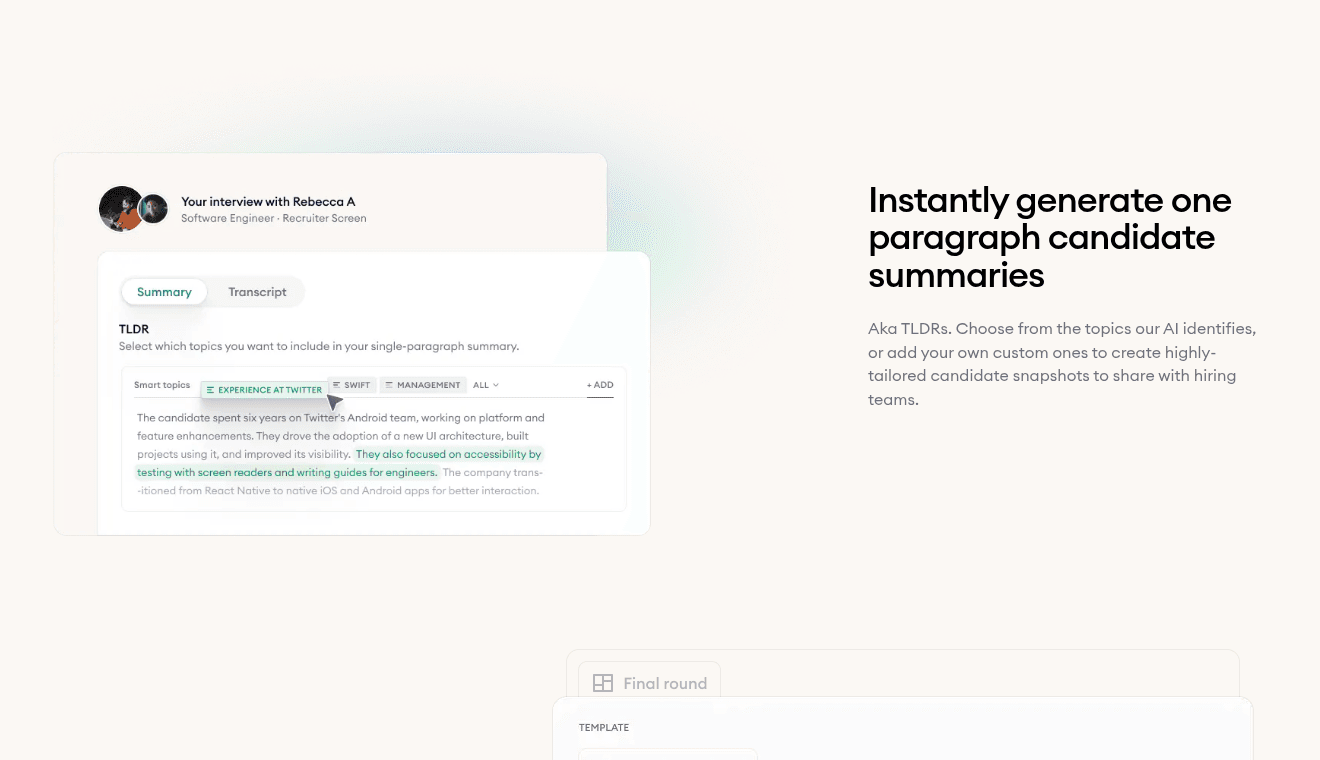
- 1Every interview lands here as captured evidence. The retention signal is now preserved, not lost the moment the loop ends.
- 2The Q-and-A template makes the three retention signals (motivation match, role-clarity, growth-runway) into scorable fields, not afterthoughts.
- 3The TLDR is what the hiring manager reads at month 3 when the post-hire review runs. The pre-offer prediction sits next to the actual outcome.
The reverse-engineer move
The fastest way to install retention signals into your loop is to reverse-engineer them from the people who stayed and won. Pull the 30 most successful tenured hires from the past 24 months. Look at their interview transcripts (if you captured them) or their scorecards. Find the signal patterns the successful hires share. Bake those patterns into the rubric for the next 30 reqs.
The pattern usually surfaces in 60 minutes of review. Stayers tend to describe the role's hard parts unprompted. They tend to ask second-order questions about the team's actual operating tempo. They tend to push back on the role description in specific, productive ways. None of this scores in a standard rubric; all of it predicts stay.
Once the patterns are documented, the rubric updates roll out to every interviewer in the next training cycle, and the post-hire retention data shifts inside 6-9 months. The teams that run this loop systematically report 20-30% drops in 90-day attrition without changing a single perk or comp band.
Where AI gives recruiting teams use

Means the recruiter's hours go to candidates whose intent and role-match are likely from the prompt-sourcing intake itself, raising the retention floor before the loop even starts.

Frees the senior recruiter time to spend on the open-ended conversations where retention signals actually surface, instead of CV triage.

Captures every interview verbatim so the three retention signals are preserved as evidence, not lost to memory. The data layer that makes proactive retention possible.

Closes the loop by matching pre-offer interview signals to 30/90/180-day performance reviews and surfacing the patterns. The retention curve becomes legible by cohort and by interviewer.
The retention-signal-capture problem was unsolvable at scale until interviews became captured by default. AI is the layer that finally makes the leading indicators trivial to extract, score, and feed back into the rubric.
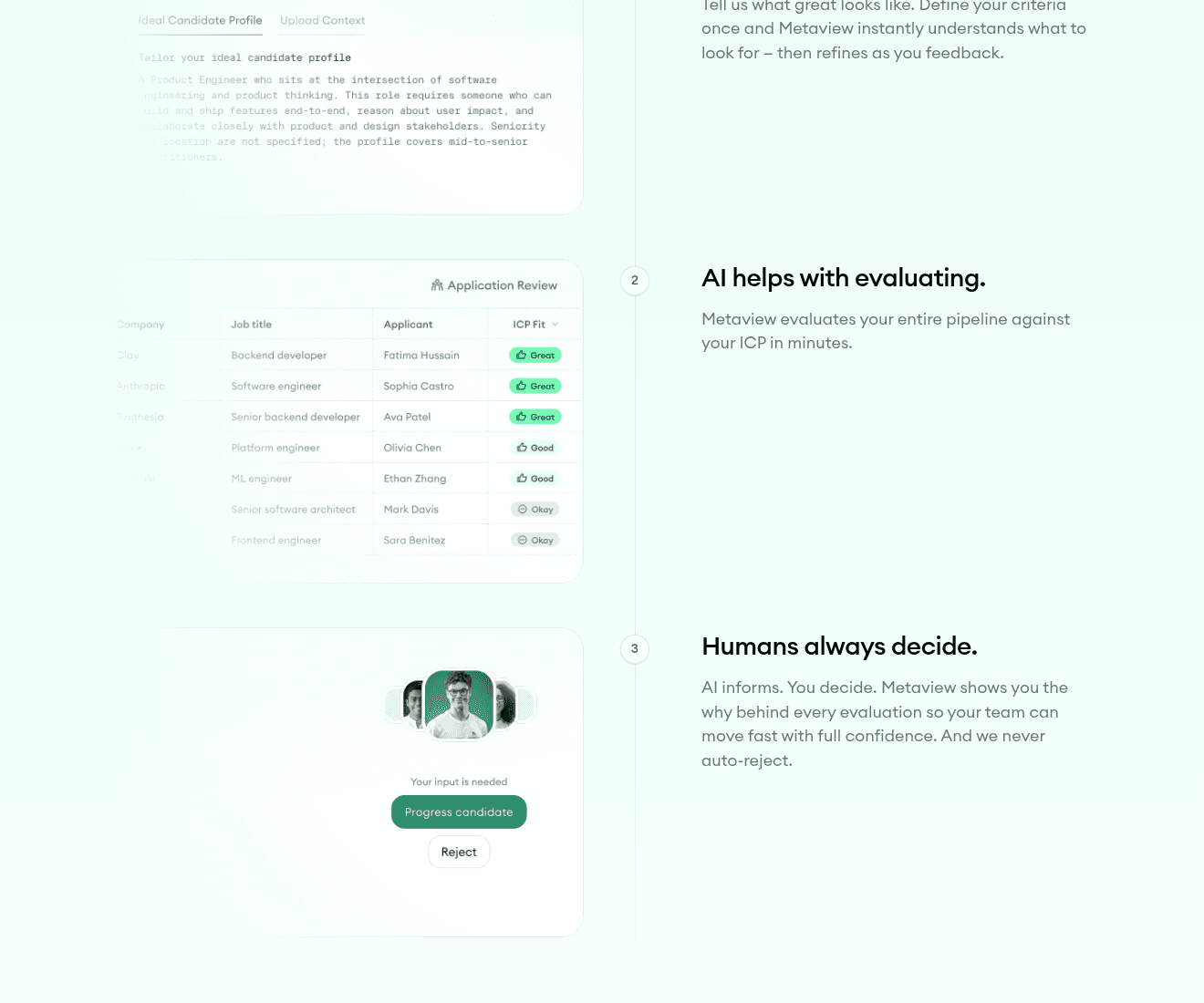
- 1The ICP panel is where role-clarity and motivation-match get encoded as scorable signals, not afterthought notes.
- 2Every candidate is read against the retention rubric at the volume end. Strong-on-credentials but weak-on-stay gets flagged before the offer goes out.
- 3Progress or Reject is the recruiter's call, with the retention signal alongside the technical one. The 90-day quitter stops being a surprise at month four.
Metaview Notetaker captures every interview verbatim so the retention signals are preserved as evidence, not memory. Reports closes the loop by matching pre-offer interview signals to 30/90/180-day performance reviews and surfacing the patterns. Application Review frees the senior recruiter time to spend on the conversations where retention signals actually surface. AI Sourcing means the recruiter's hours go to candidates whose intent and role-match are likely. For the AI-augmented-recruiter angle, see Claude for recruiters.
Numbers from the 2026 AI & Hiring Alignment Report, surveying 505 recruiting leaders and hiring managers across North America and EMEA. Candidate loss is just retention with a shorter tail. The 50% vs 80% split is the most relevant to the retention thesis: the teams that capture interview signal cut both the pre-hire loss to faster competitors and the post-hire loss to mis-fits.
The operating shift
Three concrete moves for any TA leader trying to fix retention at the interview stage instead of at month four:
One: add the three retention signals to your scorecard. Intrinsic motivation match, role-clarity comprehension, growth-runway honesty. Mandatory fields, not optional notes. Force interviewers to score them. Force the hiring manager to reconcile when the technical score and the retention score diverge.
Two: reverse-engineer your stayers. Pull the 30 most successful tenured hires from the past 24 months. Find the signal patterns they share. Bake those patterns into the rubric for every req. The patterns are usually obvious once you look; the work is forcing yourself to look.
Three: publish the retention curve segmented by interviewer. The interviewers consistently producing 90-day quitters need different coaching than the interviewers producing 18-month stayers. Make the data visible. Coach the gap.
The teams that internalize these three moves get retention numbers that the engagement-survey crowd cannot match. The teams that do not get retention numbers that no perk budget can fix. That is the operating shift.
Bring Metaview into your hiring stack.
Live notes, structured scorecards, and ATS sync - set up in under 10 minutes.
Frequently asked questions
Why are most retention problems actually hiring problems?
Because the hire who quits at 90 days almost always flagged themselves in the interview loop. The signals were there (motivation mismatch, role misunderstanding, runway misalignment) and the loop scored the technical bar and discarded the retention signal. Fixing retention at month four is far more expensive than catching the signal at week one.
What are the three interview signals that predict stay?
Intrinsic motivation match (does the candidate's stated motivation match the actual day-to-day work), role-clarity comprehension (does the candidate describe the role accurately including the unglamorous parts), and growth-runway honesty (does the three-year ambition match the runway the role provides).
Why do most interview loops miss retention signals?
Because standard rubrics score credentials and competencies, both of which predict capability but neither of which predicts stay. The retention signals live in the open-ended parts of the conversation the rubric does not score. The fix is rubric-level: add the three signals as mandatory scorecard fields.
How big is the retention impact of fixing the interview loop?
Teams that systematically capture retention signals and feed them back into the rubric typically report 20-30% drops in 90-day attrition within 6-9 months. The impact compounds at 6-month and 18-month checkpoints. The retention investment that perks and engagement surveys never delivered shows up when the signals are caught upstream.
How do you reverse-engineer retention signals from past hires?
Pull the 30 most successful tenured hires from the past 24 months. Review their interview transcripts (if captured) or scorecards. Find the signal patterns the stayers share (unprompted mention of role's hard parts, second-order team-tempo questions, productive pushback on the role description). Document the patterns. Bake them into the rubric for the next 30 reqs.
