
Most recruiter-productivity playbooks treat the metric as an effort problem. Send more emails. Run more screens. Move faster through the pipeline. The advice is correct in the same way "do more reps" is correct advice for a runner with a torn hamstring. It produces motion. It does not produce output. It is also why recruiters who follow it tend to plateau at exactly the level the live system allows, no matter how disciplined the effort gets.
The teams who break through that plateau treat productivity as a system output. They look at the five admin tasks that quietly consume recruiter capacity, live note capture, scorecard write-up, debrief synthesis, ATS write-back, and cross-panel candidate Q&A, and they redesign the signal layer underneath. Quora's recruiting team got 10 hours per recruiter per week back by collapsing days-long feedback cycles to 10 minutes, and Automattic's team is now reclaiming 53 hours a month by routing the same five tasks through a structured signal layer rather than each recruiter's notes app.
This piece is for talent leaders who are about to greenlight another effort-side push, more recruiters, more interviews, more reminders, and want to see the system-design alternative first. The argument is simple: every productivity metric you care about, submissions-per-recruiter, time-to-interview, candidate-touches-per-hire, hiring-manager turnaround, compounds when the signal layer is in place and plateaus when it is not. The next 2,500 words show where the five admin leaks happen, what the productive end-state looks like, and how to install it without re-orging the team.
Recruiter productivity is a system output, not an effort input.
Walk into any TA org and ask the question this way: what would happen if every recruiter on the team had two extra hours every workday, but no new tools, no new hires, no process changes? You'll get the same answer: more candidate conversations, faster turnaround, better outcomes. Now reverse the question. Where did those two hours go? Almost always the answer is the same five tasks. They are not the work, they are the residue of the work, and most TA teams accept them as the cost of doing business.
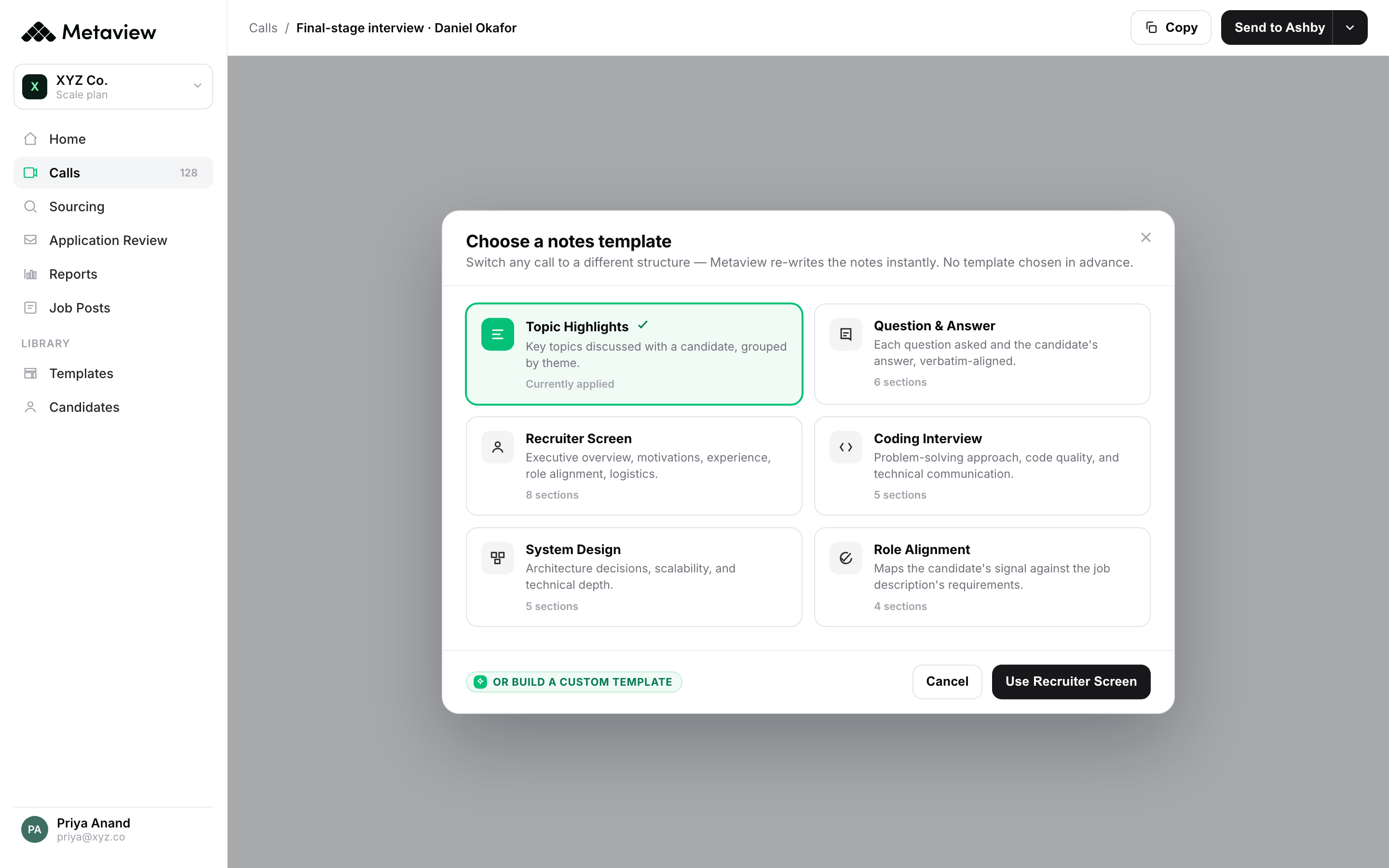
That acceptance is the productivity ceiling. Recruiters can sprint at it, but they cannot break through it without changing the system. Productive recruiting orgs are not the ones with the fastest individuals; they are the ones whose system absorbs the residue automatically. The capture layer writes the live notes. The summary layer drafts the scorecard. The integration layer pushes the structured signal back into the ATS. The recruiter does the work that only a recruiter can do, and the residue stops being the recruiter's problem.
This is also where the 2026 Alignment Report data lands. Eighty-five percent of the companies that exceeded their hiring goals last year had AI at the core of how they hire, according to Metaview's 2026 AI & Hiring Alignment Report - surveying 505 recruiting leaders and hiring managers across North America and EMEA. Not bolt-on copilots. Not occasional use. AI as the way the team works. The productivity difference between those teams and their effort-side peers is not five percent. It is a different operating model, and once it is installed, the productivity numbers stop being a topic in QBRs.
Everyone is trying to go faster on time-to-hire. Great. You're probably also fastest to attrition. Probably not great.”

The 5 admin tasks that quietly eat capacity.
Before redesigning anything, name the five admin tasks. Not every team has all five at full intensity, but every team has at least three. Each one shows up in the daily recruiter routine as a small, justified expense; each one quietly compounds into the productivity ceiling the team accepts as normal. Below is what each task looks like in practice and the Metaview surface that absorbs it.
Live note capture.
During every interview, the recruiter (or the hiring manager) is paying attention to the candidate, capturing what was said, and trying to score it against the rubric, in parallel. Two of the three of those tasks will get done badly; usually the score gets postponed and the notes stay in shorthand. Metaview's Notetaker runs the live capture automatically, in the meeting tool the team already uses, and produces a structured transcript and AI-summarized notes the moment the call ends. The recruiter never re-types what was just said.
Scorecard write-up.
After the call, the recruiter (or the hiring manager) opens the ATS, finds the right scorecard, and writes the rubric responses from memory and shorthand. This task is the single largest source of debrief delay and the single largest source of "why did we hire this person" amnesia six weeks later. Metaview's scorecard autofill drafts the per-rubric responses from the structured transcript at the moment of capture, and the interviewer reviews and edits rather than starts from a blank field.
Debrief synthesis.
At the panel debrief, four interviewers have to compare four sets of notes, find the agreements and disagreements, and converge on a hire / no-hire. Without a shared structured-signal layer, the conversation runs on memory and gut. Metaview's multi-source summaries roll up the entire panel's signal into one cross-panel view, so the debrief starts from "here is what the panel actually said" rather than "let me try to remember".
ATS write-back.
Whatever the recruiter produces, structured notes, scorecard, panel summary, eventually needs to land in the ATS so it is queryable for reports, audits, and rejection / advance decisions. Manual write-back is a re-typing task; it is also the moment most context gets lost. Metaview's ATS integrations push the structured signal back automatically on supported ATSes (Greenhouse, Ashby, Lever, Workable, SmartRecruiters, Teamtailor, and more), so the recruiter does not need to be a translator between conversation and database.
Cross-panel candidate Q&A.
Inevitably, a hiring manager pings the recruiter mid-cycle: "did the candidate ever mention X in the screen?" or "who on the panel asked about Y?" The honest answer for most teams is "let me check my notes and get back to you", which itself takes time and breaks flow. Metaview's natural-language search across the panel transcript answers that question in seconds, and the recruiter responds in-thread rather than scheduling a follow-up call to discuss what was already discussed.
What changes when interviews structure themselves.
Once the five admin tasks are absorbed by the signal layer, the productivity numbers start moving in directions that look surprising at first. The recruiters do not get faster at the individual tasks, because the tasks no longer exist as recruiter work. What gets faster is the system. Hiring managers turn around feedback in 10 to 20 minutes instead of two days. Panel debriefs open with a one-screen view of the structured signal. Submission-to-hire ratios compress because fewer candidates get progressed on weak signal and fewer strong candidates fall through the recruiter's attention queue.
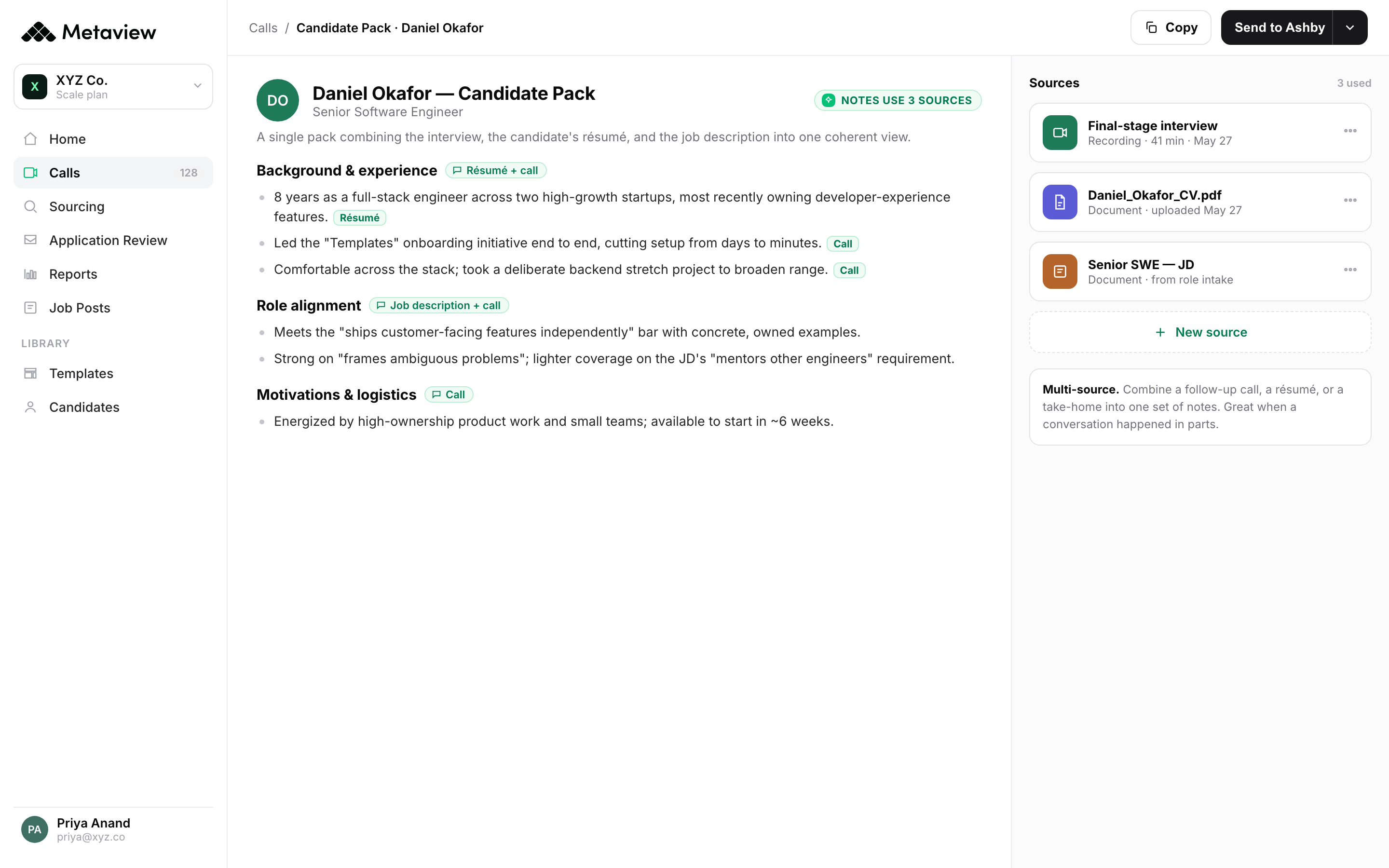
The compound math is the part most TA teams underestimate. If a recruiter saves 20 minutes per interview from wrangling notes and scorecards (a per-interview number Metaview customers consistently report), and the team runs 200 interviews a month, that is 67 hours a month back across the team. Automattic's recruiting team measured 53 hours a month saved across their team with that exact mechanism. The hours themselves are not the point; what those hours unlock is. Free recruiter capacity goes back into the highest-leverage parts of the funnel: better intakes, deeper screens, and faster candidate Q&A, which compounds quality at every downstream stage.
There is also the cross-functional payoff, which is harder to see on a productivity dashboard but shows up everywhere else. Teams where AI is core to hiring are 3.8 times more likely to rate their cross-functional relationship as excellent, according to Metaview's 2026 AI & Hiring Alignment Report - surveying 505 recruiting leaders and hiring managers across North America and EMEA, and forty percent more likely to start each search with high alignment at kickoff. That is not a soft outcome. It is the difference between recruiters losing a week per requisition to re-calibration and recruiters opening the search already on the same page as the hiring manager.
Manual vs Generic AI vs Metaview on the 5 productivity tasks.
It helps to make the contrast explicit, because most TA leaders are not choosing between Manual and Metaview. They are choosing between Manual, Generic AI (a generic notetaker bolted onto Zoom / Google Meet, with no recruiting-specific structure), and Metaview's recruiting-specific capture-to-signal layer. The table below maps each of the 5 admin tasks across all three states of the world.
| Task | Manual | Generic AI | Metaview |
|---|---|---|---|
| Live note capture | Recruiter types during the call or scribbles after. Coverage is partial. | Generic transcript dumps. No recruiter-specific structure. | Live capture in the meeting tool the team already uses, structured per the interview plan. |
| Scorecard write-up | Manual rubric write-up from memory and shorthand. Delayed, partial. | Optional summary that does not map to the team's scorecard fields. | Per-rubric scorecard autofill drafted at capture time. Interviewer edits, not authors. |
| Debrief synthesis | Four sets of notes compared by hand. Convergence by gut. | Four generic summaries side-by-side. No cross-panel signal. | Multi-source summaries roll up the panel into one cross-panel view. |
| ATS write-back | Recruiter re-types into the ATS after the panel. Context lost. | Manual paste of generic summary. Loses rubric structure. | Native ATS write-back on Greenhouse, Ashby, Lever, Workable, SmartRecruiters, Teamtailor, and more. |
| Cross-panel Q&A | Recruiter checks their own notes, asks panelists, follows up next day. | Recruiter searches a generic transcript. No rubric awareness. | Natural-language search across the structured panel transcript. Answered in seconds. |
The TA leader's operating model: capacity as compounding asset.
Once the five tasks are absorbed, the TA leader's operating model changes shape. Capacity stops being a planning lever pulled once a quarter ("do we need to hire another recruiter for Q3?") and starts being a compounding asset on the team's balance sheet. Polar Analytics saw a 30% decrease in interviews per hire after running the capture-to-signal layer for six months, which means each requisition closes with one fewer interview round on average. Multiply that by a year of requisitions and the savings show up in the team's headline numbers.
The video below is Luke Hextall, Head of People & Talent at Polar Analytics, walking through what changed in their hiring rhythm. The detail to listen for is not the 30% number itself, it is what happened to the rest of the time the team got back. The free capacity did not get re-allocated to admin; it went into intake quality and candidate touches, which is exactly where the next round of compounding lives.
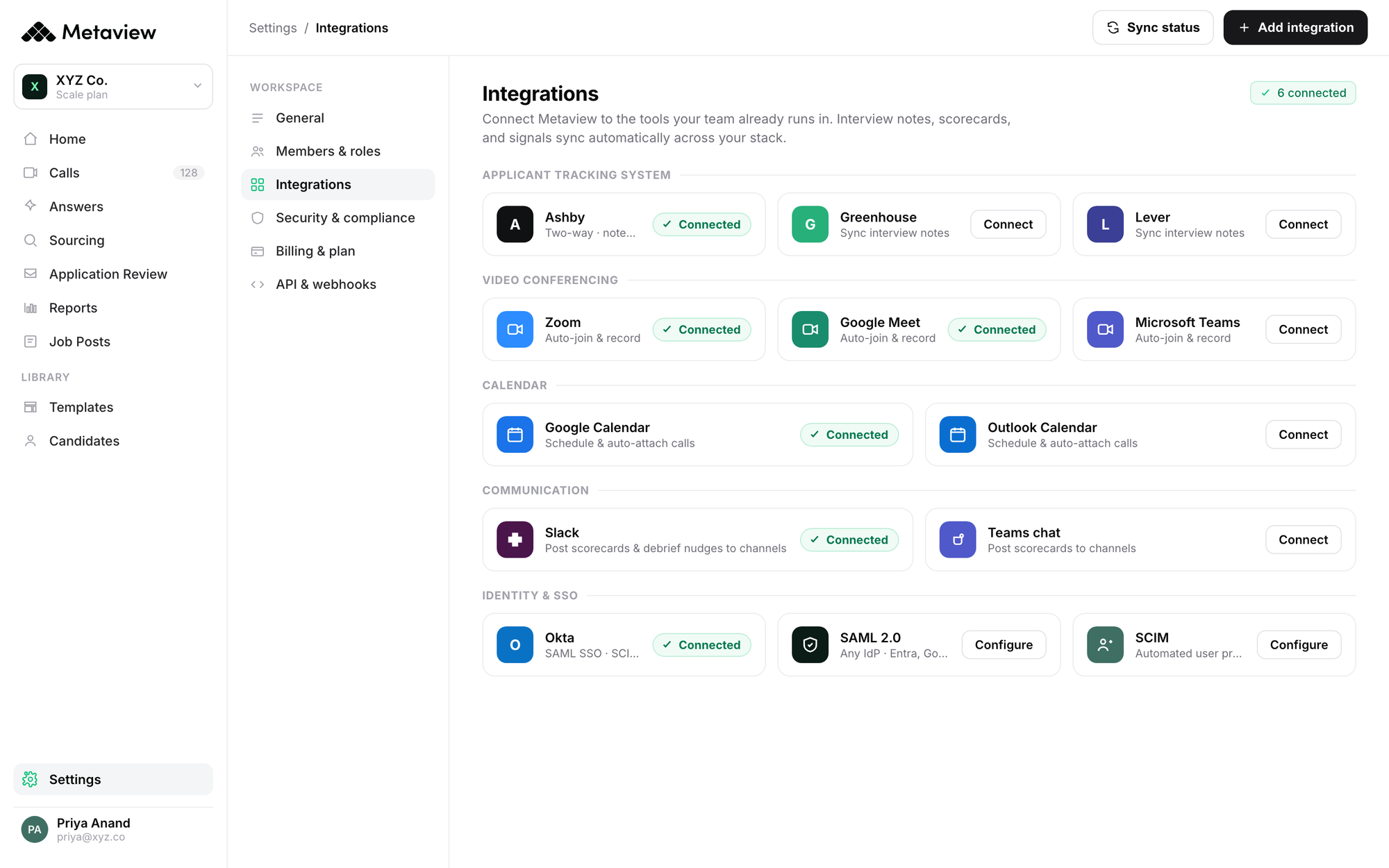
On the TA leader's side, the ATS integration grid does most of the structural work. Metaview's writes go to Greenhouse, Ashby, Lever, Workable, SmartRecruiters, Teamtailor, and a growing list of partners; the structured signal that came out of the interview goes back where the rest of the org already lives. That single decision, treating the ATS as the system of record and routing all structured signal back to it automatically, is what makes the productivity payoff compound. Without it, every productivity gain leaks back out as re-typing or re-syncing work the recruiter still has to do.
Metaview saves me so much time! I can focus on the conversation instead of taking notes, my interviews don't last too long (which creates a more positive candidate experience), and I can do more interviews in a day because my attention span is longer.”
The 30-day install plan.
The install plan is shorter than most TA leaders expect. The 30 days below assume Metaview is running on the existing meeting tool and ATS; no re-platform, no re-org, no contract renegotiation. The point of the plan is not to bring everything online at once, it is to install one of the five admin absorptions a week and let the productivity numbers compound visibly.
- Week 1, live note capture and scorecard autofill: turn on Metaview's Notetaker for one team's interviews (start with the highest-volume requisition). Wire the scorecard autofill to the existing rubric. Goal: zero recruiter time on live note capture or post-call write-up by Friday.
- Week 2, debrief synthesis and ATS write-back: route the structured per-interview signal into the panel debrief and the ATS automatically. Goal: every debrief opens with the cross-panel summary, every decision lands back in the ATS without a recruiter re-type.
- Week 3, cross-panel Q&A: train the team on natural-language search across the panel transcript. Goal: hiring-manager mid-cycle questions get answered in-thread, in seconds, with citations to the actual interview moment.
- Week 4, capacity allocation: review where the reclaimed hours went. If they went back into intake quality and candidate touches, the install is healthy. If they went into more admin elsewhere, the diagnostic in the callout above applies, and the team needs to repoint the freed capacity, not add more requisitions.
Below is Siadhal Magos (Metaview co-founder) on why the productivity-as-system-output frame matters more than the per-task time savings. The line that anchors the install plan is at the bottom of the post: AI's job in recruiting is to make hiring more human and less admin, not to make admin more efficient.
 Siadhal Magos
See how Notetaker, autofill scorecards, multi-source summaries, and ATS write-back work end-to-end on a real interview.
Frequently asked questions.
What is recruiter productivity, really?
Recruiter productivity is the output your team's hiring system produces per unit of recruiter effort. It is measured downstream as submissions-per-recruiter, time-to-interview, hiring-manager turnaround, and candidate-touches-per-hire, but it is determined upstream by how much of the 5 admin tasks (live note capture, scorecard write-up, debrief synthesis, ATS write-back, cross-panel Q&A) the system absorbs for the recruiter automatically.
Which metrics should we actually track?
Submissions-per-recruiter and hiring-manager turnaround are the cleanest leading indicators because they move within weeks of installing the signal layer. Time-to-interview and interviews-per-hire are slower to move but compound across a quarter. Quality-of-hire is the trailing indicator that confirms the productivity gain did not come from rushing weak signal through the pipeline.
How long does it take to see productivity gains after installing the signal layer?
Most teams see live-note and scorecard-write-up time fall to near zero in week 1. Debrief turnaround compresses in week 2 as cross-panel summaries become the debrief opener. By week 4, hiring-manager turnaround usually drops from days to minutes (Quora went from days to 10 to 20 minutes), and submissions-per-recruiter starts to climb because the freed capacity goes into intake and candidate touches.
Does this require us to re-platform our ATS?
No. Metaview integrates natively with Greenhouse, Ashby, Lever, Workable, SmartRecruiters, Teamtailor and more, so the structured signal writes back into your existing system of record. The install plan above assumes Metaview running on top of your current meeting tool and ATS, no re-platform, no re-org.
How is this different from a generic AI notetaker?
A generic notetaker captures audio and produces a transcript. It does not map to your scorecard rubric, it does not roll up a cross-panel summary, and it does not write structured signal back to your ATS. The productivity payoff in this article comes from those three steps happening automatically, which is what "capture-to-signal" means in practice and what separates a recruiting-specific layer from a meeting-recording tool.
What if the freed recruiter capacity does not turn into more output?
That is the diagnostic flagged in the "Heads up" callout above. If the productivity numbers do not move after install, look at where the reclaimed hours went in week 2. Most often, the time got re-absorbed by other admin (sourcing list cleanup, calendar Tetris) elsewhere in the workflow. The fix is to repoint capacity into intake quality and candidate touches, not to add more requisitions to the team's plate.
