

On a purple squirrel brief, you’re searching for a candidate with a rare mix of skills or experience. Each requirement would usually be a whole search on its own. Put them together and the search returns people who match most of the list, while the hiring manager waits for someone who matches all of it. When that drags on, the brief tends to change anyway, one exception at a time, without anyone deciding which requirement to give up.
I’d start by finding the requirement that’s hardest to match. Search for every requirement on the brief at once, and count the profiles that come back. Then run the search again, leaving out one requirement at a time. The biggest jump in the count shows you which requirement that is. Take it to the hiring manager before you message anyone, and agree in writing which requirement they’d give up first.
This guide shows how to run the count and agree what to give up. It then covers where to search, how to find people who could learn the one skill they’re missing, and what to change if the search stalls, with a cybersecurity brief as the example.
What is a purple squirrel in recruiting?
Recruiters call a candidate a purple squirrel when a role asks for a mix of skills and circumstances that few people hold all at once. A few recruiting firms also use the name, but in this guide it means the candidate.
The example in this guide is a brief for a senior security engineer. The role is remote anywhere in Europe, on a team based in Berlin, and it asks for someone who:
- has led incident response
- writes detection rules for a cloud environment
- has worked under healthcare compliance rules
- speaks German
Each of those lines is an ordinary search on its own. The role is rare because it needs all four in one person, so a search for the whole brief returns very few profiles.
Find the requirement that makes the role rare.
Start by finding out which requirement makes the role so hard to fill. You do this with a few searches in your usual sourcing tool. The job description tells you what to search for, and each search tells you how many profiles match. Compare the counts, and you’ll see which requirement shrinks the list the most. That’s the one to raise with the hiring manager.
Write each requirement in the words people put on their profiles, such as job titles and tool names. Then run a leave-one-out count:
- Search the full brief, with the full mix of requirements, in the market the role can hire from. Then write down how many profiles come back.
- Take one requirement out, run the search again, and write down that count. Put the requirement back and do the same for the next one.
- Mark the requirement whose removal brings back the most profiles. That’s the one making the role rare.
In the security brief, imagine that leaving out speaks German brings back far more profiles than leaving out anything else. Then German is the rare requirement, and it’s the first one to discuss with the hiring manager.
The count won’t always single one requirement out. If leaving out each one brings back only a few more profiles, the role is rare because several requirements are each a little rare. Then try a wider location or a different level before you drop any of them, because those changes keep every requirement in the brief.
Two things can make a count wrong, so check both before you trust it:
- First, some requirements don’t show up as keywords. Few profiles say “has led incident response,” so search for job titles that usually involve it, and confirm the experience on the first call.
- Second, a requirement can also look rare if people leave it off their profiles. Before you call German rare, open a handful of profiles from the search without it. If several show a German employer or a German university, those people probably speak German but don’t list it, so ask about it in the first message. If none do, German is probably rare.
The count is a small version of the market research behind a talent map. Our guide to talent mapping covers how to research candidate availability across a whole market.
Agree the must-haves and priorities with the hiring manager.
Take the counts into your intake meeting with the hiring manager and go through the brief line by line. Ask two questions about each requirement:
- Could the job run in the first months without it?
- If it could, can the team teach it, with someone covering that part of the work while the new hire learns?
A requirement the job can’t run without in the first months is a must-have. One the job can wait for and the team can teach is a nice-to-have, and it ranks candidates instead of ruling them out. If the job can wait for a requirement but the team can’t teach it, it still rules people out, because the new hire has to arrive with it.
Here’s my take on the security brief:
| Requirement | My call, and why |
|---|---|
| Has led incident response. | Must-have. The hire leads the response from the first incident, and people learn it only by handling real incidents, which no team can schedule. |
| Writes detection rules for a cloud environment. | Must-have if this hire would be the only one writing them. If a teammate already does, it’s a skill a peer can teach. |
| Has worked under healthcare compliance rules. | Nice-to-have. The compliance team can teach the rules that apply to this company. |
| Speaks German. | Ask what the German is for. If the people this hire works with every day speak German, it’s a must-have. If the team works in English, it’s a nice-to-have and the first requirement to trade. |
Then agree on the priorities in writing: which requirement the hiring manager would give up first if the search falls short, and which second. Do this before the first message goes out, while the hiring manager is still judging the brief and hasn’t met any candidates yet.
Our guide to writing a hiring brief covers how to write the trade-offs down so anyone running the search can follow them.
The other questions worth settling in that meeting are covered in a separate piece on the recruiter intake meeting.
Look where purple squirrels show up.
Before you search for people, list the employers and projects whose work needs the whole combination. Two skills that seldom go together were usually learned in one job that needed both. The people you want most likely work there now, or used to.
For the security brief, that points to security teams at health-data companies that sell into German-speaking markets, and to consultancies that audit health data for German clients. Search the people who work there now and the people who used to.
A language works differently, because people learn it where they live or study. For German, also search for people who studied at a German university or worked for a German employer.
Specialists also put their work in public, under their own names:
- talks at security conferences
- published write-ups of incidents and research
- open-source security tools and the people who maintain them
For engineering roles, read public code history too. Our guide to technical sourcing explains what to look for in it.
Last, search your own applicant tracking system (ATS). A candidate who reached a late stage for a similar role may hold most of the combination, and your team has already met them. Our guide to talent rediscovery in your ATS covers what to check before you decide it holds no one for the role.
Search for near-matches who can learn the missing skill.
From the first day, run a second search next to the main one. This one looks for near-matches: people who hold every must-have but are missing one requirement the team can teach. In our example, that might be an incident responder at a bank in Munich who writes cloud detection rules and speaks German, with no healthcare background.
Every near-match still holds the must-haves, so this second search widens the pool without lowering the bar. Our guide to finding qualified candidates shows how to widen or narrow a search while the bar stays where it is.
On each near-match’s profile, look for proof they’ve learned something similar on the job before, such as a move from on-premises systems to the cloud or a switch of industry. Until you’ve spoken to them, that’s the best evidence you have that they can learn the missing skill too.
Name the missing skill in your first message. Tell them what the role would teach them, such as the healthcare compliance rules, and who on the team would help. I’d rather they hear about the gap from you than find it in an interview.
The skill a near-match seems to lack may also be one their profile leaves out, and that happens in hard roles well beyond security. In this episode of the 10x Recruiting podcast, Nolan Church and Siadhal Magos talk about why senior recruiter roles fill slowly even in a market full of candidates. They also talk about where the missing skills show up when a resume leaves them out: in references, and in the story a candidate tells about a real hire.
Use your first call with a near-match to test how they learn. Ask them to walk you through the last thing they had to learn on the job. Listen for how long it took and who helped, because that’s what your team would be signing up to repeat.
Decide what to trade when the search comes back thin.
When the search comes back thin, try the changes that keep every requirement before you trade one away. Here are those changes, and when I’d make each one:
| What you change | When I’d change it |
|---|---|
| Location. | When the combination exists, but somewhere else. Widen the location or offer relocation before anything else, because it keeps every requirement. |
| Pay. | When the people exist and earn more than the range. Raise the range before you shorten the brief. |
| Level. | When the people who hold the combination sit a level below the role. Hire one level down if a senior teammate can carry the senior part of the work for a while. |
| The shape of the role. | When one person can’t hold it. Split it into two hires, or cover the rarest skill with a contractor while the search goes on. |
| The timeline. | When every requirement has to stay. Agree how long the search runs before the next change, and put the date in the brief. |
If none of those works, make the first trade in the order the hiring manager agreed. Hire the near-match, and name someone on the team to cover the missing part of the work while they learn it.
In the security brief, if this hire’s colleagues need German every day, German stays. I’d trade healthcare compliance first and hire the incident responder from the bank.
But before you make that first trade, make sure the role survives it. Some roles exist only because two skills overlap; the combination is the job. To check, take either skill away and ask the hiring manager whether they’d still open the role. If the answer is no, keep every requirement, write down what that costs in pay, location, level, or time, and get the hiring manager to agree to that cost.
Much of what’s written about purple squirrels asks whether the hunt is worth it at all. For a role like that, I’d keep hunting.
Where Metaview fits in a rare-skill search.
Two parts of this method take the most searching: finding out whether anyone holds the combination at all, and running the near-match search next to the main one. Metaview’s artificial intelligence (AI) agent for finding candidates, AI Sourcing, helps with both.
For the first, it has a market-mapping mode called Deep Research. You ask it a question about the market, such as where a company you name has been hiring engineers from, and it answers with reports and sets of profiles. I’d run it next to the leave-one-out count, to see whether the profile exists and which employers to search first.
For the near-match search, describe the must-haves in plain language. Or let it start from your intake meeting, if you recorded that meeting with Metaview. AI Sourcing searches the web, your connected ATS, and your team’s past Metaview conversations. It returns each candidate with the reasoning behind the match.
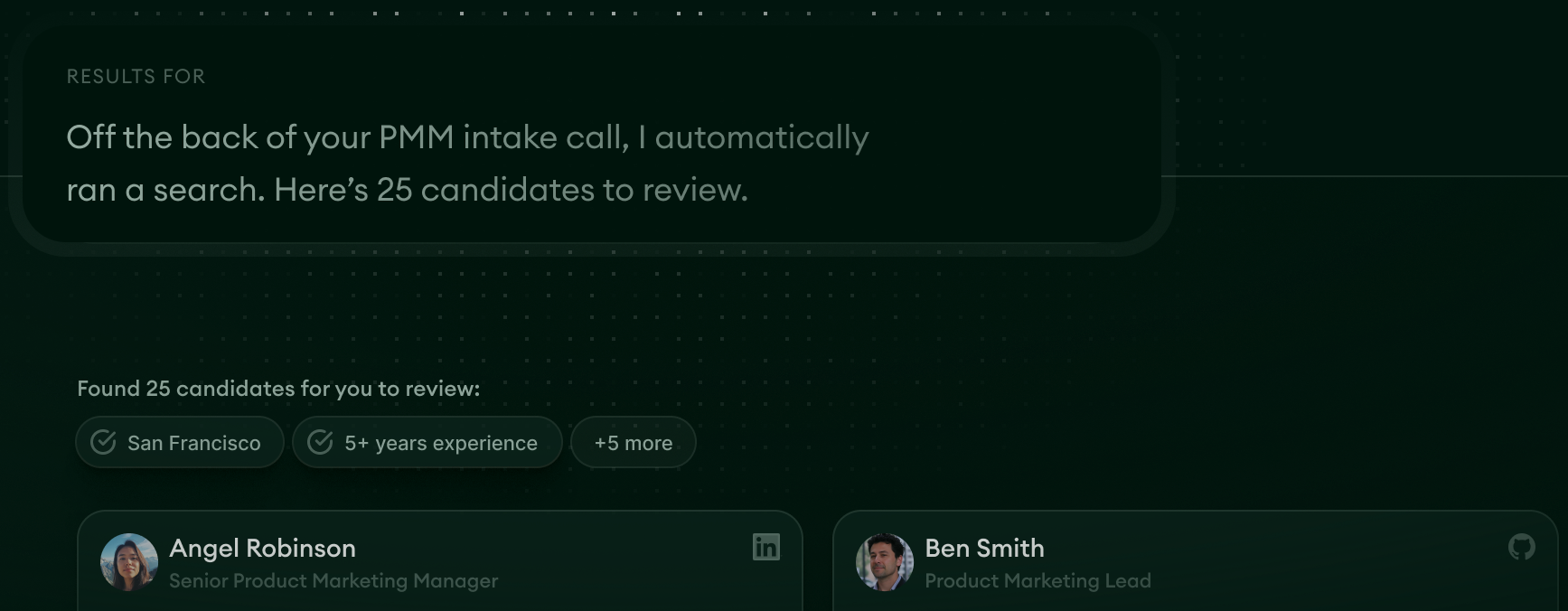
Read each near-match’s reasoning before you take them to the hiring manager, so you know what each one is missing.
AI Sourcing finds and explains candidates, but it doesn’t contact or assess them. You decide which near-matches hear from you and what the message says about the missing skill. Once you’ve chosen, Metaview’s Outreach can send your message as an automated email sequence.
I don’t think the answer to an information problem is making decisions with even less information.”

Siadhal Magos wrote that in a September 2026 post about AI screening, and a thin search is an information problem too: the hiring manager can’t see who the near-matches are or what each one lacks. Put each near-match’s reasons in front of them before anyone decides what to trade.
You agree on the priorities in the intake meeting. If you record that meeting with Metaview’s Notetaker, Metaview captures every spoken word. When the search stalls, the priorities the hiring manager agreed to are there in their own words.
Four checks on a search that has stalled.
Run these on any search for a rare role that isn’t finding candidates the hiring manager wants to meet:
- Name the requirement that makes the role rare. If you can’t, run the count from the full brief before sending anything else.
- Find the order of priorities in the brief. If it isn’t written down, agree it with the hiring manager now, before the search runs any longer.
- Check where the outreach list came from. If it came only from keyword searches, add people from the employers and projects whose work needs the whole combination.
- Read the last five messages you sent to near-matches. If none names the gap, rewrite the template so each one does.
For a role almost no one fits, the first thing I’d do is run the leave-one-out count, before any message goes out. Then I’d take the result straight to the hiring manager. A thin search usually ends with someone asking which requirement to give up first. The count lets you settle that before the search starts, instead of after it stalls.
Source a rare role with each candidate’s reasons in view.
See how Metaview’s sourcing agent answers a hard brief with candidates and the reasoning beside each, so the hiring manager can decide what to trade.
Frequently asked.
Should a purple squirrel role go to an agency?
It can, once you know which requirement makes the role rare and the hiring manager has agreed on the priorities. Give the agency both, so it works the brief you agreed and brings back near-matches you can compare with your own.
How should I write the job post for a role like this?
List the must-haves as required and the rest as a plus. A post that makes every line required asks near-matches to rule themselves out, and a near-match is who this method sets out to find.
What if the hiring manager adds a requirement after the search starts?
Run the count again with the new line in, and take the result to the hiring manager before you change the outreach. Then agree where the new requirement sits in the priorities.
What if the hiring manager rejects every near-match?
Ask which requirement each one is missing, and check it against the must-haves you agreed. If the hiring manager turns people down for missing a nice-to-have, that requirement has become a must-have. Agree the must-haves and priorities again before the search goes on.
How do I show the counts to a hiring manager who doesn’t trust them?
Show the profiles behind each count as well as the numbers: a few from the full brief and a few from the run without the rare requirement. A hiring manager who reads them can see the trade for themselves.
