
A board director search goes wrong when people suggest names before anyone has written down what the board needs. The board agrees it wants an independent director, and someone asks the founders and the lead investor who they’d suggest.
Soon there’s a short list of people they’ve worked with, and nothing written down about the gap the seat should fill.
A list built that way tends to bring back the strengths the board already has. The seat goes to another operator, or to someone who sees the company the way its investors already do. An independent director is there to bring a view from outside the room, adding to the people already at the board table. That’s hard to do when the room picks the director.
I’d run it in the opposite order: write the gap down first, then build a longlist wider than the founders’ and investors’ contacts. This article shows you how to guide the boardroom as a recruiter, to find an independent director who brings something new and needed to the table.
How is a board director search different from an executive hire?
The search still runs from a brief to an offer, but a board seat differs in who decides and what the candidate gives. A committee recommends instead of a hiring manager choosing, and the person you want keeps their day job and only lends the board part of their time.
| Part of the search | An executive hire | A board director search |
|---|---|---|
| Who decides | The hiring manager, with the interviewers’ input. | A committee recommends a nominee, and the company’s own rules say who approves. |
| What the spec is | A job description. | What the current board lacks. |
| What the candidate gives | Their full working week. | Part of their time, beside a job or other boards. |
| What gets checked | References and background checks. | Independence and conflicts of interest. Also their time, and any other checks counsel asks for. |
| Who gives references | Former managers and colleagues. | People who have seen them in a boardroom. |
| What the offer is | Salary and equity. | A cash retainer, equity, or both, set by the board. |
In an executive hire, you write the role down before anyone is approached. A board search should define the seat in writing in the same way. For a board seat, that means writing down what’s missing at present.
Identify the gap in the board’s skills matrix.
An open board seat exists to cover something the board can’t do today. So the search starts by finding that gap on paper. A skills matrix is one place to find it: a grid with the skills the board needs down one side and the current directors across the top, each cell marked where a director brings that skill.
Ask the board chair for the current matrix. If no matrix exists, draft one with the board chair from each director’s background. Then ask each director to correct their own column, since people know their own experience better than a bio does.
Two kinds of gap point to a new seat:
- A skill the company’s next stage needs that no director has, such as reporting as a public company or selling into a market the company is about to enter.
- A committee with no one to chair it, such as an audit committee that needs a chair with a finance background.
Not every gap needs a seat. If the company needs a skill for one project, an advisor may cover it.
Put the gap in writing.
Write out the gap in one or two sentences the committee could actually disagree about. “Financial expertise” is too wide for anyone to object to. So it’s useless.
“A former public-company chief financial officer who has chaired an audit committee” is narrow enough to argue with, and a director who thinks the board needs something else can say so before the search starts.
Without that sentence, the search has no way to say no. Every name the room suggests sounds plausible.
Some seats are about balance more than skill, such as an independent director whom the founders and the investors both accept, there to break ties. An investor agreement may already say who picks that person.
Write down the gap anyway, because it still tells everyone which of the acceptable people to choose.
Agree on who owns the search and who decides.
Founders, the lead investor, and the board chair can all feel they own a board search. Two of them might even promise the seat to different people. Settle who owns it, and who approves the appointment, before anyone is approached.
Where the board has a nominating committee, that committee owns the search and recommends a candidate. Where there’s no such committee, choose one owner and put the choice in writing.
In some companies the board appoints a director, and in others the shareholders or an investor agreement decide. Ask whether the company’s rules require independent directors to make the nomination.
Before the first approach, write down four things and send them to everyone involved:
- Who signs off on the brief.
- Who meets the candidates after you, and in what order.
- Who recommends a candidate.
- Who approves the appointment, and when.
You run the process for the owner. None of those decisions is ultimately yours, but the timeline is. Put the approval date in it before the first approach and plan back from that date, because a finalist kept waiting may take another board’s seat in the meantime.
If the seat is held by a sitting director who hasn’t been told they’re being replaced, run it as a confidential search instead. That changes how you approach people and what you can tell them.
Write a brief the committee approves.
A strong brief turns the gap into something you can search on and a candidate can read. Keep it to a page, and get the brief signed off in writing before you build the longlist.
It should cover:
- The gap, in the sentences the committee agreed on.
- The committee seat, if there is one, and whether the director would chair it.
- The time commitment: board meetings, committee work, and the reading required before each one.
- The company’s stage, and what the board expects to face in the next two years.
- What counsel will ask about independence, so candidates expect it.
- Whether a first-time director is welcome.
On first-time directors, I’d take a side. A former operator who has never sat on a board can still bring exactly what the matrix lacks. I’d welcome first-time directors with the demonstrated skills to fill the gap.
I’d want prior board service where the new director will chair a committee from their first meeting. I’d also ask for it where the gap is something like public-company reporting. For that gap, board experience is part of the skill.
If a retained search firm runs the search, give it this brief before the kickoff call, since the firm’s intake starts from it. A separate post covers how retained search firms run intake.
Build a longlist that reaches past the room.
The longlist decides who the committee gets to consider. Start it with people who already have the missing skill, and add personal contacts last.
For the audit committee gap in the example above, look in four places:
- Finance leaders at public companies, current and former, including those who left after their company was acquired.
- Directors who chair an audit committee at a company a stage or two ahead of yours.
- Executives your company has already met for its own senior roles, whose background fits the gap.
- The founders’ and investors’ suggestions, added last.
Label every name with where it came from: the search, a past candidate, or a named person’s suggestion. The committee can then see how much of the list came from the room.
If every label reads “suggested by,” the search hasn’t reached past the room yet.
The search tells you who to approach. Once a name is on the list, look for someone the board, the investors, or the executive team knows who can introduce you.
Check independence and conflicts before the committee meets anyone.
This seat is meant for an independent director, so a candidate who doesn’t qualify as independent can’t fill it, however strong they are. A conflict of interest can rule someone out too. The board makes both calls with counsel’s advice. Your role is to collect the facts early, so a finalist isn’t lost late to a question no one asked.
A listed company will have a definition of independence to meet its exchange’s standards. Under Item 407 of the Securities and Exchange Commission’s Regulation S-K, the company has to name, in its filings, each director who is independent under that definition. It also has to describe the relationships the board weighed in deciding who is independent. Counsel will want each finalist’s relationships well before that decision.
For a private company, ask counsel what the financing and governance documents say about this seat, including who has to agree to the choice. Ask before the brief goes out, because the answer can narrow the list.
| Check | Who decides | What you collect from each finalist |
|---|---|---|
| Independence | The board, on counsel’s advice. | Every past and present relationship with the company, its executives, and its investors. |
| Conflicts | The board, on counsel’s advice. | The other boards they sit on, and any stake in a competitor, customer, or supplier. |
| Time | The committee. | Their day job, their other boards, and whether their employer allows another seat. |
Ask about time plainly on the first call. A candidate with a full-time executive role and two other boards may want the seat and still not have the hours for it. Their employer may also limit how many outside boards its executives join.
Run the committee conversations and the references.
Once counsel has seen the finalists’ relationships, the committee’s conversations decide who it recommends. Have every member who votes meet every finalist, so no vote rests on someone else’s account of a candidate.
Use the conversations to test the skills gap. If the new director will chair the audit committee, ask each candidate to walk through a disagreement they had with the auditors and how it ended. Ask every candidate about a time they disagreed with a chief executive from the board side, and what they did next.
After each conversation, have every member write a short note on two points: how the candidate covers the gap, and what concerns, if any, they’d raise with counsel.
Then take references from people who have watched the candidate in a boardroom. For a first-time director, ask for a chief executive or board chair they reported to, who has seen them work with a board from the other side of the table.
Add one backchannel reference: someone the candidate didn’t name. A director’s work happens in closed meetings, and a reference the candidate didn’t choose is the nearest you’ll get to sitting in one. Tell the candidate first, and leave out anyone at their current employer or on a board they still sit on unless they agree.
For more on reference checks.
In the episode below, Nolan Church, host of the 10x Recruiting podcast, talks references with Siadhal Magos, Metaview’s chief executive. They argue over whether references are the most useful evidence in hiring or a trap, and when to use front-door references, the ones a candidate names, against backchannel ones.
Once the notes and references are in, the committee makes its recommendation, and the approval happens on the date you planned.
Make the offer in the board’s terms.
The board, or its compensation committee, sets what a director is paid, so settle the terms first and have the board chair make the offer. Director pay can be a cash retainer, equity, or both. A cash retainer is a fixed fee for the year, and chairing a committee can carry more.
Before the offer call, ask counsel for a one-page summary of the insurance and indemnification that protect the company’s directors. The candidate will have questions about personal liability.
Once the new director has joined, ask the board chair to send them the recent board minutes and the charter of the committee they’ll sit on, so their first meeting isn’t the first time they see either.
Where Metaview fits in a board director search.
Building the longlist depends on reaching past the people the room already knows. Metaview’s AI Sourcing agent runs this search to build a genuinely valuable longlist.
Give it the brief in plain language, with the gap as the committee wrote it. It looks across the web, the candidates in your applicant tracking system, and the conversations your team has already had in Metaview. Every person it brings back arrives with the reason they’re on the list.
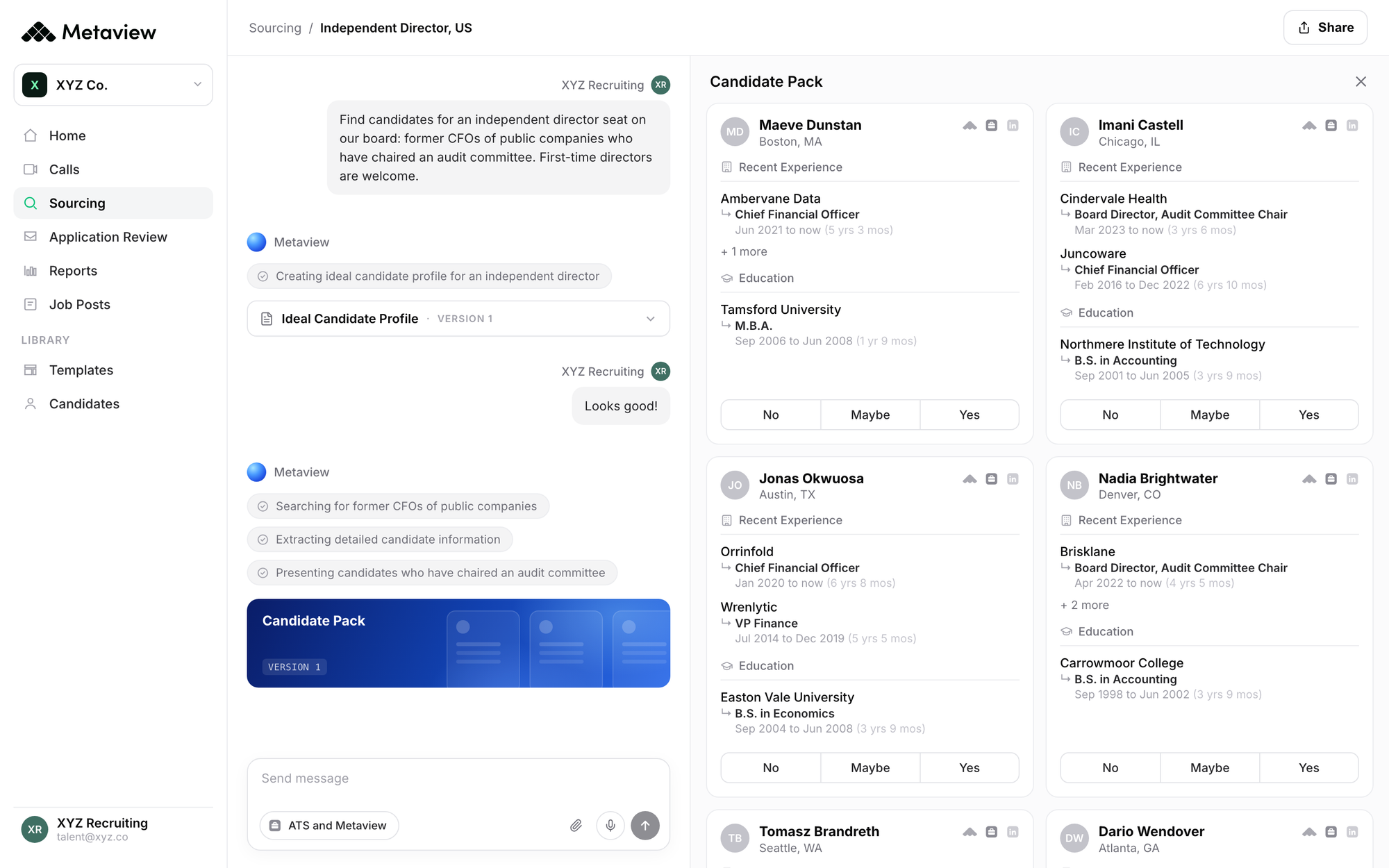
- 1The brief, written from the board’s gap, with first-time directors welcome.
- 2The sources this search ran on: the connected applicant tracking system and past Metaview conversations.
- 3The recruiter’s “No,” “Maybe,” and “Yes” on each candidate.
A committee can only use the list if it can see why each name is there. On a board search, that work lands first on whoever builds the longlist, and later on the committee if a name no one can explain reaches the final list. A reason beside each name gives the recruiter something to check before the name goes forward, and gives the committee something specific to question.
If results aren’t reliable, AI doesn’t reduce work. It just moves it, and recruiters end up validating, correcting, and second-guessing the output.”

Metaview captures every spoken word of the conversations your team records with it, and AI Sourcing can search those conversations. So if your team met an executive for a senior role in an earlier search and their background fits the board’s gap, they can come back in the longlist.
AI Sourcing contacts no one and doesn’t assess or vet the people it finds, and it doesn’t check their independence. Counsel advises on the checks, and the board decides.
Four checks before the seat is filled.
Run these on the search you have open, or on the last one your board ran:
- Find the written gap. If the committee never signed off on a sentence or two about what the board lacks, stop adding names and write them first.
- Read the source labels on the final list. If every finalist came from a founder’s or investor’s suggestion, run the search on the brief before the committee meets another finalist.
- Ask counsel whether they have each finalist’s relationships and other boards. If any are missing, collect them before the committee spends another meeting.
- Read the committee’s notes. If a voting member hasn’t met a finalist, or met one without asking about the gap, book that conversation before the recommendation.
Under any deadline, I’d keep the order: the gap before the names. When the gap is written first, it tells you where to look, and it hands the committee the questions to put to every finalist while counsel checks the rest.
Find directors beyond the people your board already knows.
See how Metaview’s AI Sourcing turns a board’s written skills gap into a longlist with the reasoning for each name, while the board makes every decision.
Frequently asked.
Should we use a retained search firm for a board seat?
Use one when the committee can’t give the search the hours it needs. Use one too when the people you want are hard to reach through anyone you know, such as sitting audit committee chairs at larger companies. Either way, the board writes the gap and owns the decision, and the firm searches from the brief you give it.
What if a founder already has someone in mind?
Put the name on the longlist with its label and run it through the same steps. If the person covers the gap and clears counsel’s checks, the founder’s choice has passed the same test as everyone else’s, and the committee can say so to the rest of the board.
Can someone our investors know be the independent director?
Knowing an investor doesn’t settle it either way. Whether a relationship affects independence is the board’s call, made with counsel’s advice against the definition that applies to your company, so give counsel the facts of how the candidate knows the investor.
How do we approach a director who doesn’t know the company?
Look for an introduction first. Without one, write briefly to say which gap the board is filling and why their experience fits it, and ask for a conversation with the board chair.
Should the chief executive meet the candidates?
Yes, before the committee’s last conversations. A director works closely with the chief executive, and the candidate will want to meet them before saying yes. Treat the chief executive’s view as one input to the committee’s recommendation, so the seat stays independent of the person the board oversees.
