

You run a search for a role, and some of the best matches have titles bigger than the job, lead larger teams, or manage budgets the role won’t have. Their skills fit, but on paper they look too senior.
There are two easy ways to get outreach to overqualified candidates wrong:
- One is not to write at all: you drop these profiles on the assumption the person will get bored.
- The other is to send them the pitch everyone else gets: so they don’t learn how small the job is, or what it pays, until the offer.
I’d write to them, and I’d say it’s a smaller job right after naming the role, before any compliment. A senior candidate can judge a smaller role for themselves, but only if they know its size from the start.
What should outreach to overqualified candidates say?
Open with one line that names the role and the work it’s built around.
Then write three lines, in this order:
- How big the job is.
- One reason the role could suit someone at their level
- Where pay stands.
Close with one line that invites a reply, and stop there. The company story, the benefits, and anything else can wait for the call. The example near the end of the pay section puts all five lines together.
What “overqualified” tells you, and what it doesn’t.
By overqualified, I mean a profile whose title, team size, or past responsibilities are bigger than the role needs. That tells you about the profile, but not what the person wants next, such as more hands-on work, an earlier-stage company, a different city, or more predictable hours. A profile rarely shows which, so your message offers the one reason your role can back up. The section on naming one reason, below, shows how to pick it.
Leave “overqualified” out of the message. To a candidate, the word says you’ve already guessed they’d get bored, wouldn’t get paid enough, or worse, would be skipped. Describe the job instead, and let them judge whether it fits.
Decide which senior profiles to write to.
Not every senior-looking candidate should get a message like this, so sort by the work: look at what they do now before you look at their title.
Write to anyone who still does the hands-on work your role needs, even if they also lead a team. Someone with a senior title who hasn’t done the hands-on work in years probably isn’t a fit for a role built around it. If you drop a senior profile because of its title, you’ve made the candidate’s decision for them when you know the least about them.
To see whether someone still does the hands-on work:
- Read the description under their current job as well as the title: Verbs like “built,” “wrote,” “designed,” or “sold” point to hands-on work, while a description that only says “led,” “oversaw,” or “managed” points away from it.
- Check the dates on their earlier jobs: If the last one with hands-on work in its description ended years ago, they’ve probably moved away from that work.
- Look for recent work you can see for yourself, such as a portfolio, published writing, talks, or public code: It shows what they’ve done lately, which a title can’t.
- When the profile doesn’t make it clear either way, write to them: Your first message will say how big the job is, so they can rule themselves out.
Give the profiles you keep their own first message, separate from the standard pitch you send everyone else.
When most matches look too senior, check the requisition.
If most of the profiles that fit the role look too senior, the requisition may describe two levels at once. Sometimes that’s on purpose: a title like “Software Engineer, Mid-Level or Senior” lets the hiring manager hire at either level, and your senior profiles may fit the senior version. Other times the title and pay are for one level, but the requirements describe the level above, so the search keeps finding people from that level.
Either way, fix the requisition before you write to anyone. Give each level its own role and requirements, or bring the requirements down to the level the role pays for. How to split an ideal candidate profile by level walks through the first fix.
Say how big the job is, in the first two sentences.
If a candidate reads praise for their career and then learns the role is a level below their current one, they could suspect you’re baiting.
The sentence that states the job’s size is your scope sentence. It carries four facts, and the table shows what to write for each and what to avoid:
| The fact | What to write | What to avoid |
|---|---|---|
| Title and level | The title as it’ll read on the offer, and the level if your company uses levels | “Leadership opportunity” for a role with no reports |
| Who they report to | The manager’s role, by its real title | A line about working closely with the founder when they’d report to someone else |
| Team | Whether they’d manage anyone, and how many people | “Room to build a team” unless the headcount is approved |
| What they won’t own | Something a senior person usually owns that this role doesn’t, such as a budget or a hiring plan | Leaving it out and saying you’ll explain on the first call |
I’d put the most weight on the last row, because it tells the candidate what they’d give up. Here’s a scope sentence for a role whose title is already in your opening line:
The last clause clearly says it’s a step down. If a smaller job doesn’t suit them, they can tell you in a one-line reply, and neither of you spends a call finding out.
Name one reason a smaller role could suit them.
A senior candidate needs a reason to consider a smaller job.
These are the reasons I’d look for:
- Focus: more of the hands-on work and less of the managing.
- Stage: an earlier-stage company, where one person’s work is easy to see.
- Location: the city they want to live in, or an easier commute than the one they have now.
- Hours: a week that’s shorter or more predictable than the one they work today.
Ask the hiring manager which of these is most true of this role, and use only that one reason. Write it as a fact the candidate could check: “there’s no weekend work” tells them something, and “great work-life balance” doesn’t.
Four reasons in one message read like a sales script, and a reason the role can’t back up becomes the first awkward question on your first call. If none of them can be confirmed, ask the hiring manager what the role offers someone at that level before you write to anyone.
Don’t promise growth the role doesn’t have, such as a quick path to managing the team. The written offer shows the title and pay, not the promise, and a senior candidate will notice what’s missing.
Ted Maguire, the founder of Opal Partners and a former executive recruiter at Uber and Khosla Ventures, goes further. In episode 45 of the 10x Recruiting podcast, he argues that recruiters should stop trying to sell candidates. I’d still give the one reason, because a fact about the job gives the candidate what they need to weigh the role.
You won’t know the candidate’s own reason, and you don’t have to guess it. Leave room for it with one line, such as “If a role this size fits what you want next, I’d like to hear what you’re looking for.”
Settle whether pay can move before your first message.
A senior candidate will ask about pay sooner or later, so settle it with the hiring manager before the first message goes out. Ask one question: if someone a level above this role is interested, can the pay move?
The hiring manager can give one of three answers, and each one changes a line in your message:
- It’s fixed: Give the range for the role’s level and say it’s set, so the candidate can rule the role in or out before a call.
- It can move: Ask how far base pay or equity can go, or whether the hours can change instead, so you know your limits before the first call. Then keep the range in the message and say there’s room, without saying how much, because whatever extra you name in writing becomes what the candidate expects.
- It isn’t decided: Hold the message until it is. If you send it anyway, the first real pay conversation comes after the candidate has spent hours in interviews and the hiring manager has chosen them. A gap on pay at that stage wastes all of that time.
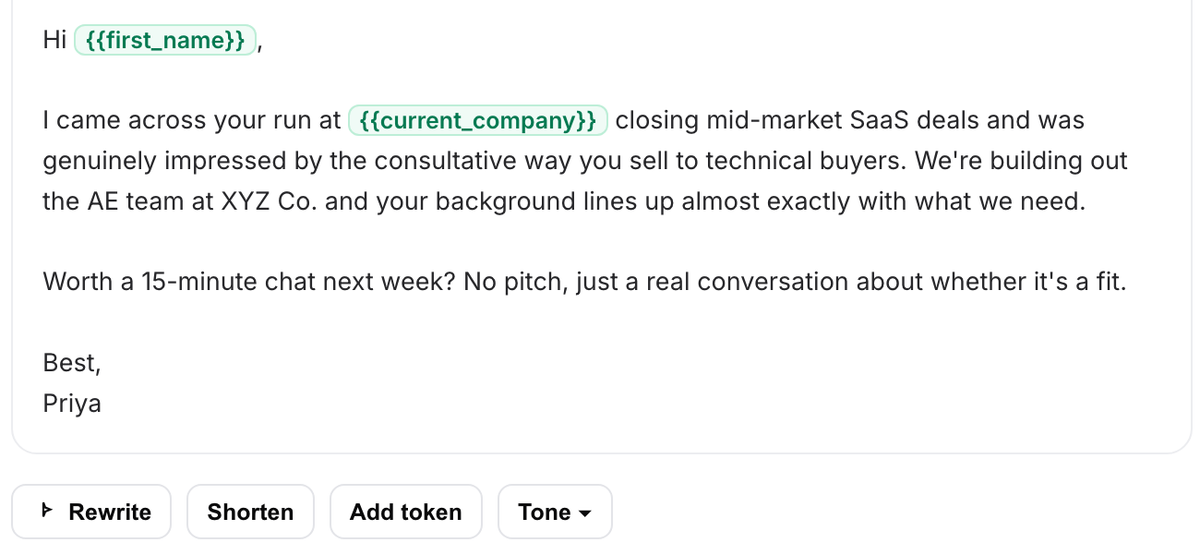
For a role whose pay is fixed, here’s the whole first message: the opening line, then the job’s size, the one reason, the pay, and a line that invites a reply. Replace each part in curly braces with what the hiring manager confirmed:
If pay can move, keep the range and change “and that’s fixed” to “and there’s some room on {base pay, equity, or the hours}.” Leave out how far it can move.
Where Metaview fits in senior outreach.
A tool that writes to senior profiles for you can only work from what you give it. Before it sends anything, give it the size, reason, and pay the hiring manager confirmed.
Metaview Outreach runs automated email sequences and personalizes each email for the candidate. One sequence can carry this role’s first message to every senior profile you kept.
Metaview also has an artificial intelligence (AI) sourcing agent, AI Sourcing. It searches from a plain-language brief and returns candidates with the reasoning for each, so you can see why a senior-looking profile came up.
Siadhal Magos, Metaview’s co-founder and chief executive officer, made this point about screening candidates, and it holds for reading that reasoning before you set a senior profile aside:
I don’t think the answer to an information problem is making decisions with even less information.”

Where you’d rather not write each message yourself, there’s fillmore, Metaview’s autonomous outbound co-worker. It works from a job description or example profiles, finds candidates, writes each outreach message from scratch for the person it goes to, and books screening calls with the ones who are interested. You approve each meeting before it lands on your calendar, and a weekly digest shows the pipeline across your open roles.
Go back to the first call when you draft the offer.
On the first call, a senior candidate will want to talk about the level and the pay. Where you have the recording consent your process needs, Metaview captures every spoken word of that call, so whoever drafts the offer can go back to the candidate’s exact words.
Use candidates’ replies to find which part of your message isn’t working.
Once replies come in, they show where the first message, or your intake meeting with the hiring manager, fell short. These are the four signs I’d watch for, each with the first fix to try:
- Candidates reply asking what level the role is. Check first whether the scope sentence is missing or buried, and move it up to the second sentence.
- Candidates drop out when pay comes up. Check whether the message gave the range and said whether there was room on it, as agreed with the hiring manager. If it didn’t, settle pay with the hiring manager before you write to the next candidate.
- A hiring manager turns down a senior candidate after the first call as “likely to get bored.” That’s the “bored” guess again, now used as a reason to say no, and the steps after this list show how to answer it.
- Candidates reply as if the job is bigger than it is. Check the title and the line giving the reason. Rewrite whichever one promises more than the job has, using the hiring manager’s own description of the job.
When a hiring manager says a senior candidate will get bored, take these steps:
- At your next intake meeting, ask the hiring manager what a senior candidate would need to say to show they want a smaller role, such as wanting more hands-on work or steadier hours. That turns the guess into something you can ask about.
- On your first call with each senior candidate, ask about exactly that, and keep the question on the work: “What do you want your day-to-day to look like in your next role?” Asking about the work, not their reasons for leaving, keeps their personal circumstances out of it.
- Take their answer back to the hiring manager in the candidate’s own words, so the decision rests on what the candidate said rather than on their profile.
- If the hiring manager still says no, ask them to write down a reason that’s about the job itself, such as a skill the role needs that the candidate lacks. You can check a reason about the job against the role itself.
If I could keep one rule, it’d be to state level and pay up front, before any interview, so neither comes as news at the offer. A smaller role pitched honestly may lose some replies at the first message, and I’d take that over losing the candidate after weeks of interviews.
Pitch the smaller role honestly to the senior profiles that fit.
See how Metaview Outreach sends a personalized email sequence to each candidate you choose.
Frequently asked.
What do I say if a candidate asks whether they’re overqualified?
Don’t answer yes or no. Ask what they want from their next role, then tell them where this job matches that and where it doesn’t. Their answer tells you more about the fit than the label does.
What if the hiring manager won’t answer the pay question before you send the first message?
Bring them one real senior profile from your search and ask the question about that person. A real candidate is easier to decide on than a hypothetical one, and the answer for that person tells you what to say to the rest.
Can I offer a bigger title to make the role more appealing?
Only if the hiring manager agrees the title describes the work. A title the job doesn’t support makes your scope sentence wrong, and the candidate sees the gap when the offer arrives.
How should I follow up with a senior candidate who doesn’t reply?
Follow up the same number of times as you would with anyone else you wrote to. In the follow-up, repeat the scope sentence rather than adding praise. For more on writing the follow-up itself, read this guide to candidate outreach.
Can screening out overqualified candidates create a fairness problem?
It can, because the label can stand in for age, which a hiring decision shouldn’t rest on. Ask your legal or people team what your company’s guidance is, and write down the job-related reason whenever you decide not to contact someone. A separate guide to interview phrases that introduce bias covers other labels like this one.
