
There's no concrete evidence that internal candidates interview better. The closest large study found no evidence of a pre-hire assessment score difference among managers one restaurant chain had hired.
The twist came after hiring.
Insiders performed better on several measures, even after the researchers controlled for assessment scores, and studies at other companies found an early advantage too.
An interview won’t reveal that measured edge but a structured interview can give both candidates the same questions and scoring standard, so you know whether you’re looking at a tie or a genuine gap.
Nobody has compared their interview scores.
Researchers haven’t established who interviews better. They haven’t compared interview scores for internal and external candidates competing for the same role, and most studies comparing internal and external hires in the same jobs come from a single company or health system.
The closest evidence comes from Hardy’s restaurant-chain study. It found no evidence of a difference in pre-hire assessment scores among the 11,072 managers the company eventually hired.
In a 2018 study of teacher applications in one school district, Martinková and colleagues found that external applicants scored, on average, more than 3 points below internal applicants on a 54-point written screening rubric. A significant gap remained after accounting for experience, licensure scores or estimated teacher value added. Raters also agreed less about the external applicants.
That study couldn’t establish the cause. Familiarity is one possible explanation, and interviewer bias is worth watching for. A manager’s prior knowledge still needs to be written against the role’s criteria, especially when unstructured conversations enter the process.
The insider edge appears after hiring.
At one US investment bank, promoted workers performed better during their first two years and left less. Outside hires arrived with more experience and education, were initially paid around 18% more, and earned promotions faster. Their performance caught up within about three years.
In Bidwell’s study of internal hiring, the insider ratings gap was slightly larger for traders and salespeople, whose results are easy to measure through profit and revenue. That pattern is the opposite of what rater bias would predict.
The restaurant-chain research points in the same direction across several outcomes. Internally sourced managers received higher ratings, drew fewer customer complaints, generated more weekly sales, and had lower subordinate turnover after assessment scores were controlled. During the Great Resignation, an external manager had about four times the odds of quitting within 180 days of starting compared with an internal manager.
A large US retailer adds a more mixed result. Internal and external management trainees performed similarly in their first year, while 20.9% of internal hires left during the study period compared with 33.5% of external hires. The Arnold study followed one role inside one company.
All of these studies contain selection effects. Managers promoted people whose work someone had already watched, so some of the advantage may reflect information gathered before the formal process. Supervisor ratings carry the same halo risk as interviews, while sales, complaints, and employee departures point in the same direction without relying solely on a manager’s opinion.
A longer resume offers surprisingly little reassurance. Across 44 studies, pre-hire experience correlated .06 with later job performance, where 0 represents no relationship and 1 represents a perfect relationship. Van Iddekinge’s meta-analysis described experience measures as generally poor predictors of performance and turnover.
The kind of move tells you more than the industry.
No study ranks industries. The available evidence comes from banking, restaurants, retail, health care, teaching, and sales, so the useful distinction is the kind of move you’re asking someone to make.
| Situation | What the research found | Lean |
|---|---|---|
| A promotion within the same area | Promoted workers had stronger early performance than outside hires in Bidwell, 2011. | Internal |
| A promotion plus a move into a different area | Internal movers changing area had the weakest performance in Bidwell’s study. | Treat like an outside hire |
| Store or restaurant manager roles at a large operator | Internal managers showed stronger outcomes in Hardy, 2025 and lower turnover in Arnold. | Internal |
| Clinical roles in a system that trains its own doctors | VA-trained physicians reached full visit productivity sooner in Li, 2025. | Internal |
| Promoting a top individual contributor into management | Across 131 firms, stronger sales before promotion were associated with weaker management results in Benson, Li, and Shue, 2019. | Test management skill |
| Knowledge the company doesn’t have | Firms learned most from distant engineering expertise under the conditions studied in Song, Almeida, and Wu, 2003. | Outside, with indirect support |
| A star hire who comes without their team | Star analysts declined for at least five years unless they moved with their team or joined a stronger firm in Groysberg, Lee, and Nanda, 2008. | Expect a dip |
| Senior leadership | Karaevli, 2007 found no main performance effect from CEO outsider status. Separately, SHRM’s 2025 report said small and medium organizations rely almost exclusively on external sources for executive roles. | Depends on your bench |
For a scaling software company, the rows about promotions, cross-functional moves, and first-time managers travel best. They describe how far the person is moving from proven work, which you can examine through lateral hiring and a current market map.
The favored insider and the rejected insider need different handling.
Some internal searches begin with a manager approaching someone they know. In LinkedIn’s 2020 Global Talent Trends survey of talent professionals, 50% said hiring managers reaching out to employees they know was a typical way their company identified internal candidates. Employees finding roles through an internal job board was the most common answer.
How that person enters the process is worth recording. At one health-services firm, internal employees hired through an open posting received higher performance ratings and salaries and were less likely to leave than employees placed directly into a role. Keller’s posting study suggests that posting widens the pool and disciplines the information managers use.
The second situation starts when an internal candidate loses. A Cornell summary reported that rejected applicants were nearly two times as likely to leave as employees who won an internal role or hadn’t applied.
Inside one large firm, rejected employees were less likely to leave when they had interviewed with the hiring manager than when they were rejected earlier. They were also less likely to leave after losing to another insider than after losing to an external candidate. People reaching the hiring-manager stage may differ from people rejected earlier, so the result is an association.
When an employee enters a hiring from within process, the hiring manager should interview them before making the decision. That gives the manager direct evidence to discuss with the employee who remains on the team.
A tie requires two written scorecards.
Calling a tie requires the same scorecard for both people. When interviewers ask different questions for the same role, the insider and outsider may have faced different tests altogether.
After bringing in Metaview, we were able to see that for the same role, we had interviewers asking very different questions. While some variety is good, it was to an extreme where the candidate experience heavily depended on the interviewer.”
For interviews it captures, Metaview Notetaker records and transcribes the conversation, then turns it into structured notes and an AI-generated scorecard. The interviewer reviews, rates, and submits the scorecard. The Notetaker doesn’t choose a candidate or remove familiarity bias.
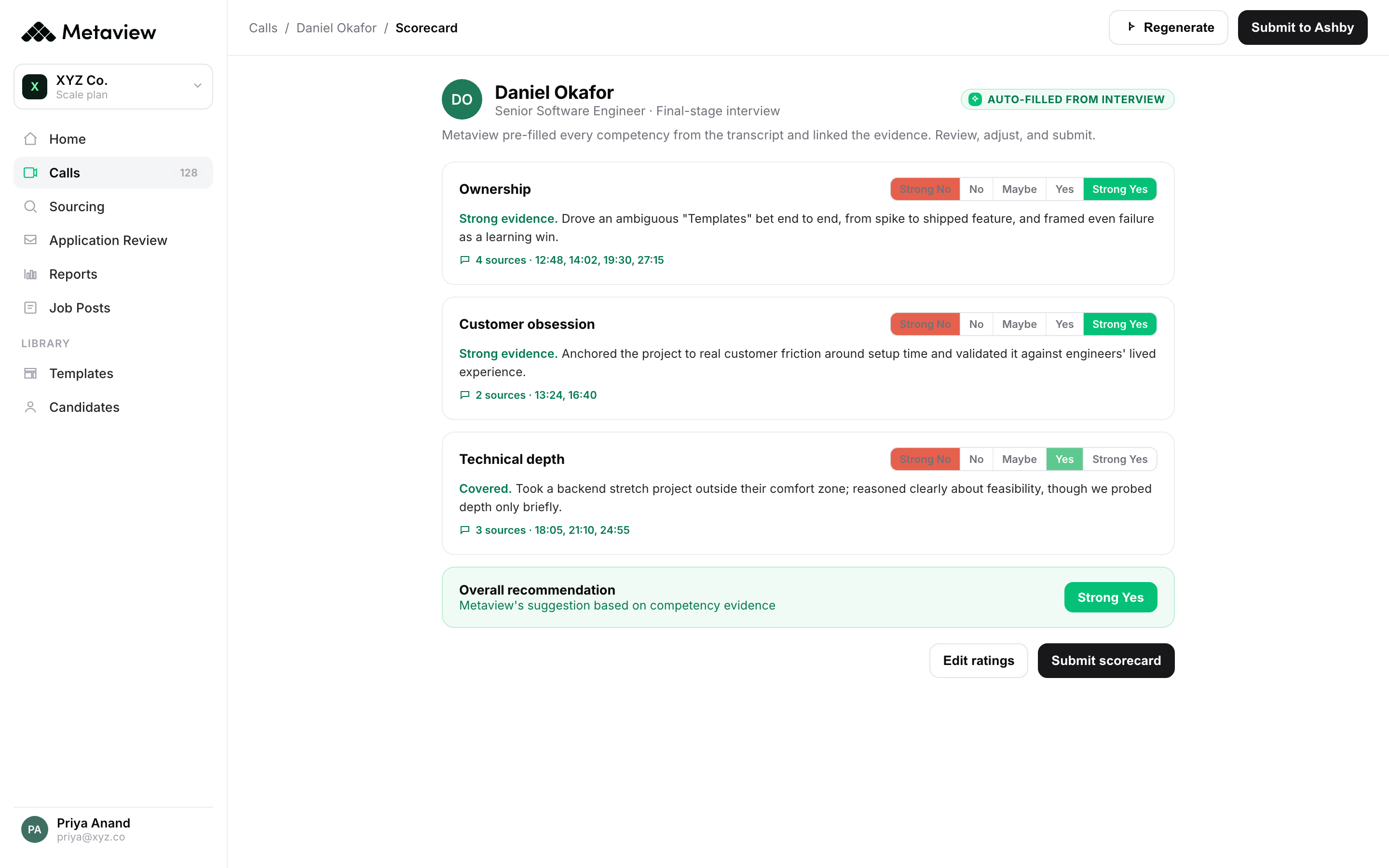
- 1The badge identifies content pre-filled from the interview transcript.
- 2The Ownership competency links evidence to interview timestamps.
- 3The interviewer can edit ratings and submit the scorecard.
Going outside is normal, until an insider is already in view.
For hiring overall, the outside road is standard. SHRM’s recruiting benchmark, based on reports from over 4,600 organizations, puts the typical share of nonexecutive roles filled externally at 97%.
Once a manager has an employee in mind, an outside search brings the starting-pay and early-ramp costs described above. It also runs against competing employers. According to Metaview’s 2026 AI & Hiring Alignment Report, surveying 505 recruiting leaders and hiring managers across North America and EMEA, 67% of teams lose qualified candidates to competitors who move faster every month.
No study measures whether that work pushes teams toward an insider. A thin outside slate can still make the employee everyone knows feel safer than the market evidence supports.
When people get desperate because their pipeline is sparse, they tend to make bad decisions. They tend to push the hire they know they shouldn’t make. They lower the bar too much.”
Metaview’s AI Sourcing takes a plain-language brief, searches the web, a connected ATS, and past Metaview conversations, then returns candidates with its reasoning. Contacting a candidate remains a separate step.
In our analysis of 26,356 AI Sourcing searches that started from an intake call, half produced a first shortlist within 17.6 minutes of the call ending. Recruiters accepted 41.5% of the AI-surfaced candidates they rated yes or no, so people still review what comes back. Metaview Outreach lets a recruiter build and personalize email sequences with automatic follow-ups.
We also have recently launched fillmore! It researches prospective candidates, builds target lists, and handles personalized outreach from a role brief, working with recruiters and hiring managers in Slack. It never assesses, scores, ranks, or decides on a candidate.
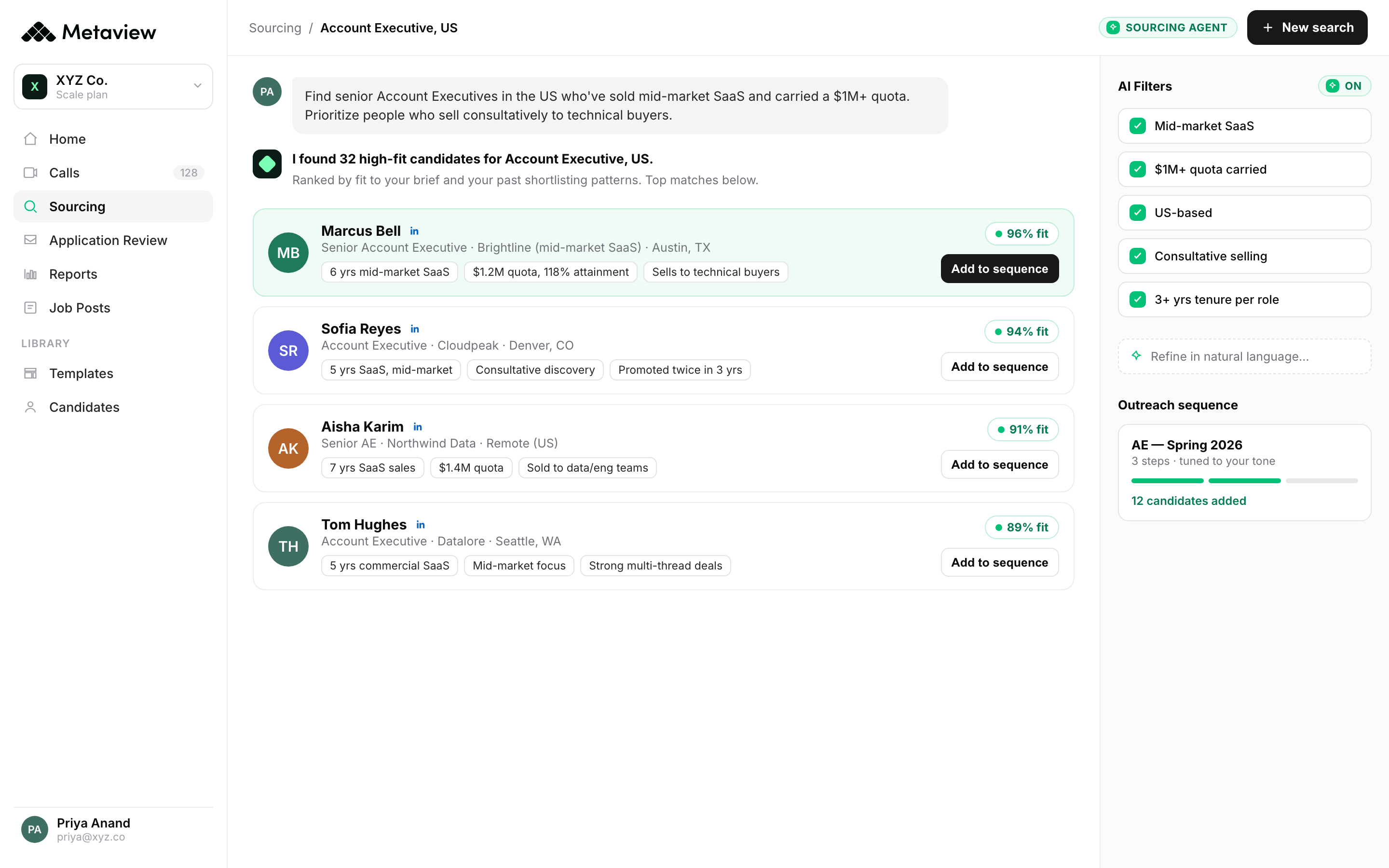
- 1The recruiter describes the Account Executive search in plain language.
- 2The candidate card shows background tags related to the brief.
- 3Add to sequence starts the separate outreach step.
Use the shared scorecard to make the call.
Define a tie before the debrief: both candidates are level on the same competencies, using the same structured scorecard, with neither ahead on the must-haves. This is stricter than saying both candidates passed.
Structured interviews were the strongest predictor of later job performance among the methods reviewed by Sackett and colleagues, with a correlation of .42 compared with .19 for unstructured interviews. On that scale, 0 means no relationship. The analysis wasn’t a comparison of internal and external candidates.
When the scorecard shows a genuine tie, choosing the insider is reasonable for work that depends on company knowledge. The research locates the insider advantage after hiring, including in results that controlled for pre-hire assessment scores.
A clear outsider lead should stand unless the insider’s documented work against those same competencies closes the gap. Give the outsider a parallel source of evidence through a work sample or reference checks, then record the final hire decision.
An insider who won only an informal conversation still needs the structured comparison. When the company lacks the required knowledge, search outside and plan for the higher starting salary and slower first stretch found in the research.
Before closing the req, check that each candidate has evidence against every must-have and that the hiring manager interviewed any internal employee who reached the process.
Bring Metaview into your hiring stack.
Live notes, structured scorecards, and ATS sync.
Frequently asked
Are employee referrals internal or external candidates?
A referral is an external candidate with an internal connection, such as a current employee recommending someone from outside. Burks and colleagues studied nine large firms and found similar skill characteristics among referred and nonreferred applicants, with referred workers less likely to quit.
Why do internal candidates get overlooked for open roles?
Managers may resist losing strong people from their teams. In LinkedIn’s 2020 Global Talent Trends survey, 70% of talent professionals cited managers’ reluctance to let go of good talent as an obstacle to internal recruiting. In an October 2024 Gartner survey, 51% of managers agreed that they asked recruiters to focus only on internal employees with every desired skill.
How many companies use an internal talent marketplace?
In SHRM’s 2025 State of Recruiting report, 35% of organizations surveyed reported using an internal talent marketplace, up from 25% in 2024.
Do rehired former employees perform like internal or external hires?
The studies disagree. Arnold and colleagues found that management trainees rehired by one large US retailer performed similarly to internal and external hires in their first year, although the other groups improved more over time and 36.6% of rehires left during the study period. Keller and colleagues found that rehires at one large health care organization initially outperformed new outside hires, with a larger advantage in jobs requiring more internal coordination.
What’s the difference between internal recruitment and internal mobility?
Internal recruitment fills an open role with a current employee. Internal mobility is broader and includes promotions, transfers, temporary assignments, and other moves within the organization.
