
Most candidate engagement strategies fail at the second touchpoint.
The recruiter sends a sharp first message. Gets a reply. Then drops the candidate into a 5-day silence while the panel debriefs. By the time the next interview is scheduled, the candidate has accepted somewhere else.
The 7 strategies below close the gaps where strong candidates leak out of the funnel. Each one removes a specific friction point.
All 7 strategies at a glance.
| # | Strategy | Where it works |
|---|---|---|
| 1 | Personalize the first touch | Cold outreach reply rate |
| 2 | Automate status comms | Silence between stages |
| 3 | Shorten time-to-feedback | Mid-funnel attrition |
| 4 | Brief interviewers | In-interview engagement |
| 5 | Use async video | Standing out at senior level |
| 6 | Close with conversation | Offer-stage acceptance |
| 7 | Post-decision loop | Alumni and re-engagement |
1. Personalize the first touch.
Real personalization pulls one specific candidate detail (a project, a talk, a posted thread) into the first 12 words. Same template, candidate-specific opener. Reply rates rise from 4-8% to 15-20%.
2. Automate status communications.
The biggest drag on engagement is silence between stages. Three triggered emails (received, status, decision) cover 80% of the silence problem with zero recruiter time.
3. Shorten time-to-feedback.
Days between interview and the next update is where strong candidates accept elsewhere. Pre-populated structured scorecards collapse feedback time from days to minutes.
4. Brief interviewers before every round.
A 3-sentence interviewer brief 24 hours before each round prevents the "so tell me about yourself" opener that signals nobody prepared.
5. Use async video to humanize.
A 45-second Loom intro in a senior cold outreach pulls 2-3x the reply rate of a templated email at the same effort cost.
6. Close with conversation, not paperwork.
Three weeks of careful conversation followed by a PDF in an email kills offer acceptance. A real call at offer (recruiter walking through numbers, naming specifics) does the opposite.
7. Build a post-decision loop.
The candidate you don't hire today is the referrer or the rehire tomorrow. A "stay in touch" alumni list with real follow-up (not auto-mail) compounds over years.
How Metaview helps.
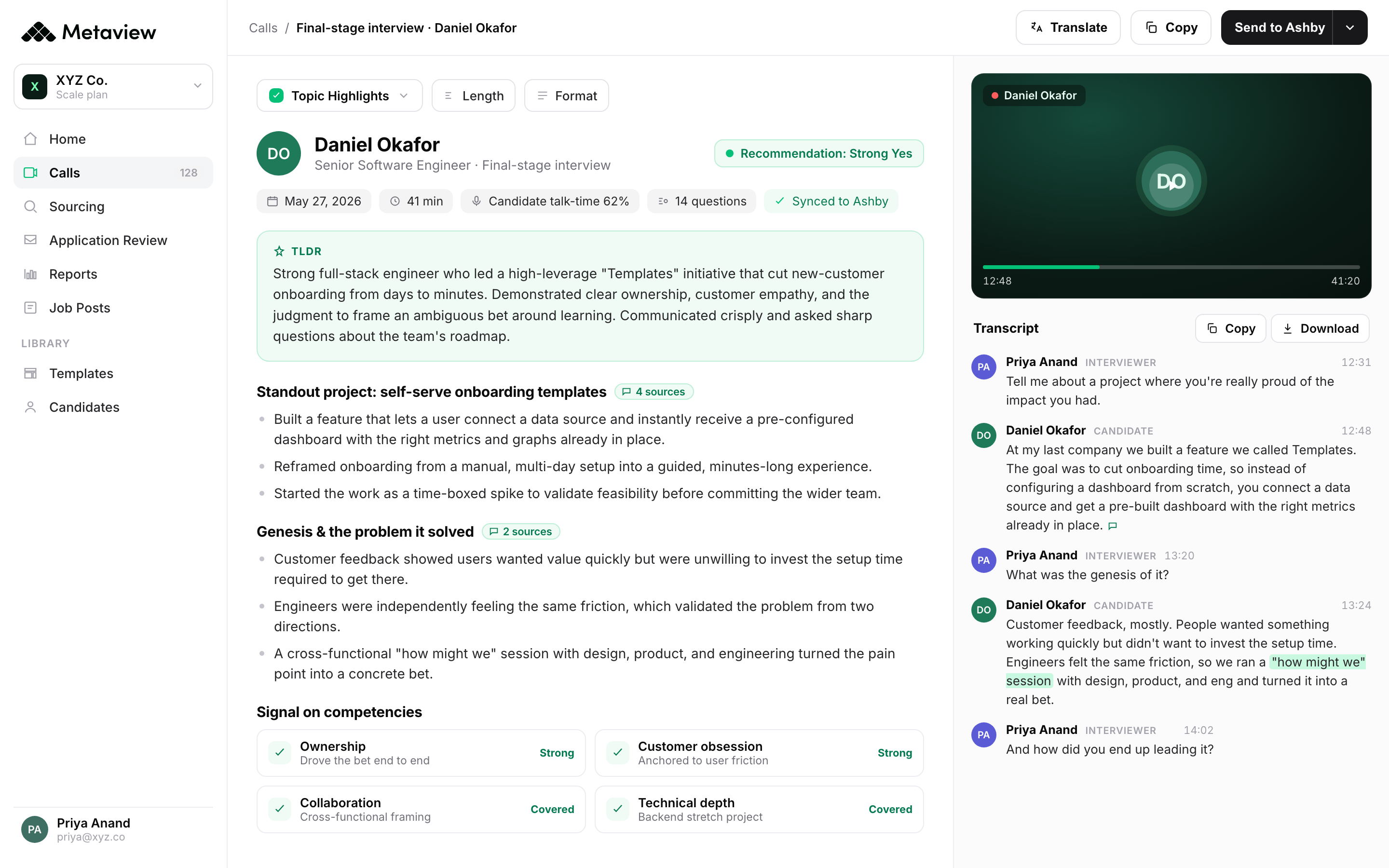
The two most-leveraged engagement strategies (shorter time-to-feedback and briefed interviewers) both depend on captured interview data.
Metaview records every interview across Zoom, Google Meet, Microsoft Teams, and phone, maps answers to your rubric, and writes the scorecard back to your ATS.
Hiring managers fill in a partial scorecard faster than a blank one. Recruiters get the material to brief the next interviewer in 60 seconds.
4,000+ organizations now run hiring on Metaview, including Brex, emnify, Quora, Workleap, Lightspeed, Catawiki, and Automattic.
Bring Metaview into your hiring stack.
Live notes, structured scorecards, and ATS sync, set up in under 10 minutes.
Frequently asked.
What's the biggest engagement killer?
Silence between stages. Days where the candidate doesn't know whether they're moving forward erode trust faster than any other operational mistake.
How do I improve candidate engagement without slowing hiring?
Most engagement improvements actually speed hiring rather than slow it. Interview capture cuts time-to-feedback; self-serve scheduling cuts coordinator hours.
How do I measure candidate engagement?
Three metrics: reply rate to first touch, drop-off rate between interview stages, post-process candidate satisfaction score. The first two are leading; the third is outcome.
What's a good reply rate on cold outreach in 2026?
15-20% for personalized senior outreach. Templated outreach lives around 4-8%. The first 12 words of the message drive most of the difference.
Should I use video in outreach?
For senior or specialized roles, yes. A 45-second Loom intro pulls 2-3x reply rate at the same effort cost. For high-volume top-of-funnel, the time investment doesn't pay back.
How do I keep rejected candidates engaged?
A clear "we'd like to keep you in mind for X next quarter" when you mean it. Vague "stay in touch" reads templated and gets ignored.
