

Hudl is a sports performance analytics company founded in 2006, headquartered in Lincoln, Nebraska. Today the company serves 180,000 sports teams worldwide.
As Hudl scaled past 1,700 employees across 20 countries, the recruiting team realized something. Hudl spent every day helping its customers identify where they were dropping the ball on game strategy.
But they didn’t have the same visibility on their own interview process.
They needed to know who was running a rigorous interview, who wasn’t, and how to fix it without putting 1,700 people through a workshop.
This is what Metaview was built for, and this is how we helped them.
What Hudl needed
Hudl’s interviewer panel was bigger than any single team could directly coach.
With 1,700+ employees and 20 country offices, even small variance in interviewer technique compounded into real outcomes: poor role fit, increased turnover, and a negative candidate experience.
The recruiting team had a gut feel for which interviewers were strong and which weren’t. What they didn’t have was the data to back it up, or a way to coach at scale.
Metaview is the best way to coach and develop interviewers on the team, and gives us the data we need in order to know if we’re running a fair and rigorous process.”
Hudl needed three things from their interview process.
- Visibility into what was actually happening in every interview, across 20 countries.
- A way to identify the specific patterns that were hurting interview quality, at the interviewer level.
- A way to deliver personalized coaching to the interviewers who needed it, without running workshops.
What they had to work with:
- An existing tech stack on Zoom, Greenhouse, and Okta.
- A growing interviewer pool, including newer engineers and managers running their first panels.
- A People team that owned the standard but couldn’t physically observe every interview.
How they used Metaview
Hudl rolled out the program in four moves. Each one cleared a specific bottleneck, and each one compounded on the last.
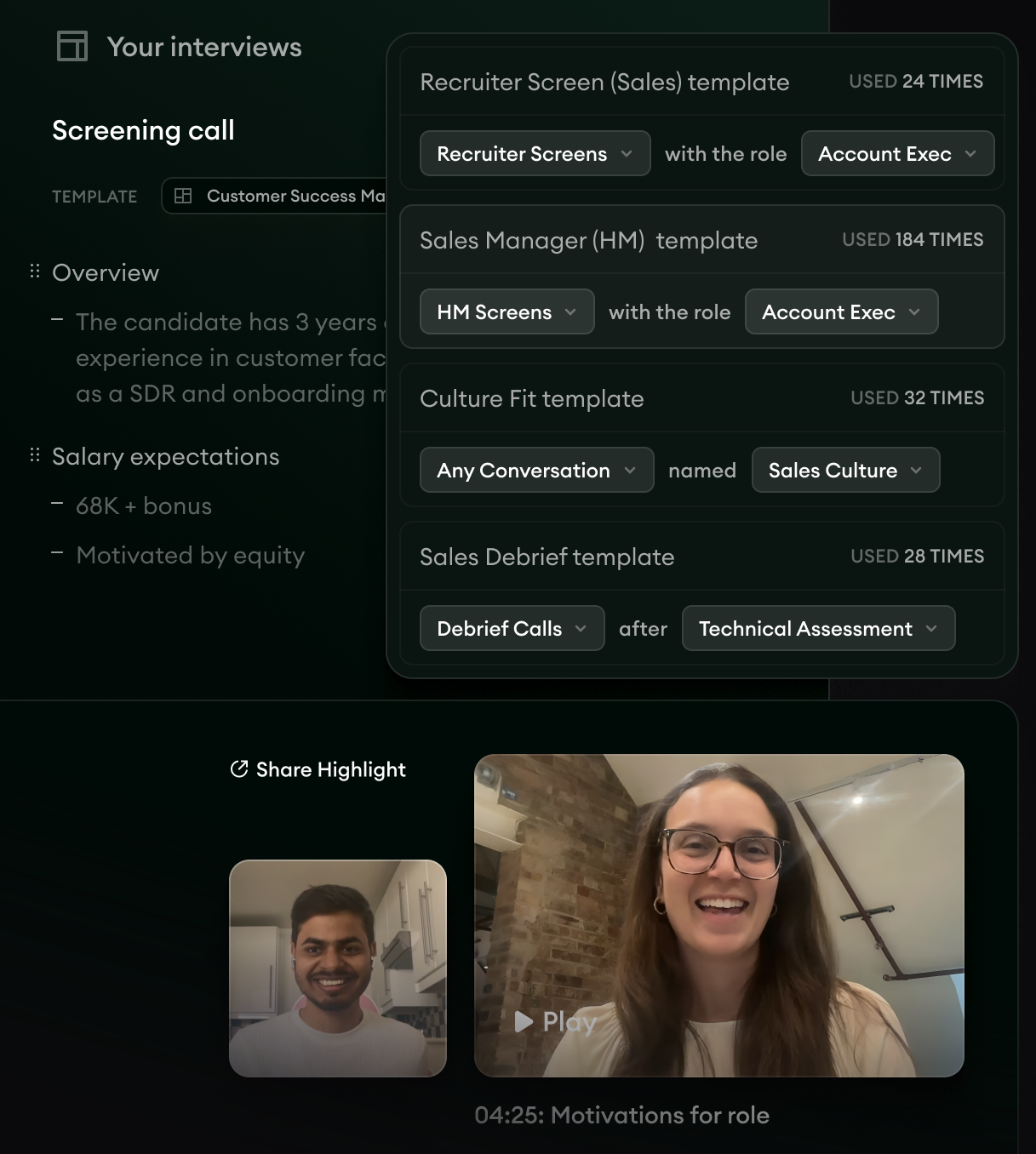
Capture every interview
Notetaker joined every Hudl interview as a silent participant.
It captured the full conversation, transcribed every question and answer, and attached the panel’s scorecard notes to the same record.
Over time, this built up into a corpus of more than 2,000 interviews from 467 interviewers, the dataset everything else in the rollout would run on.
Identify the patterns hurting interview quality
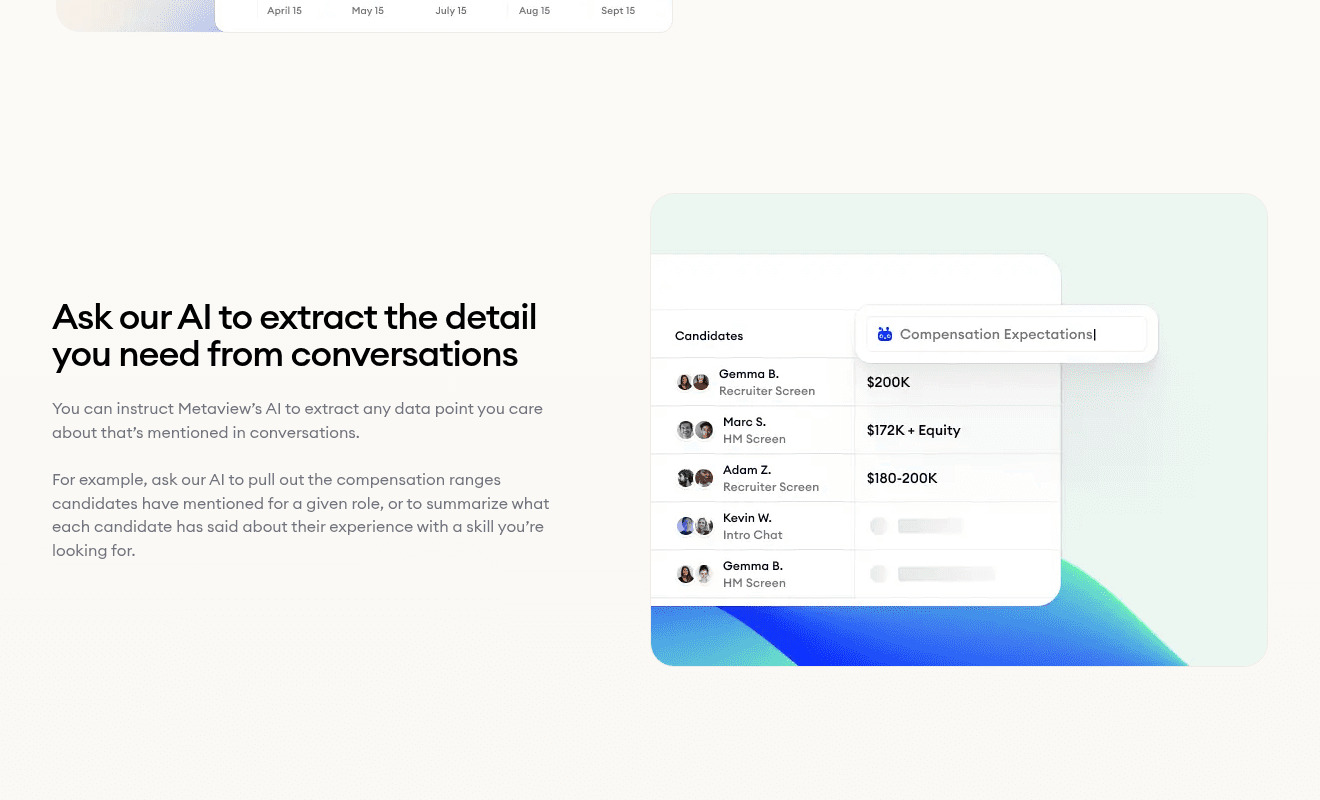
AI Reports ran across the 2,000-interview corpus and surfaced three specific patterns that were dragging down rigor.
- Low-question interviews: some interviewers were regularly asking fewer than six questions in their interviews.
- Closed-question reliance: some interviewers leaned on yes/no questions, which capped how much insight they could get on a topic.
- Stacked questions: some asked multiple questions at once instead of asking one and following up.
Hudl didn’t need to guess at the problem. The analysis pointed to exactly which behaviors to coach, and exactly which interviewers were exhibiting them.
Surface which interviewers needed coaching
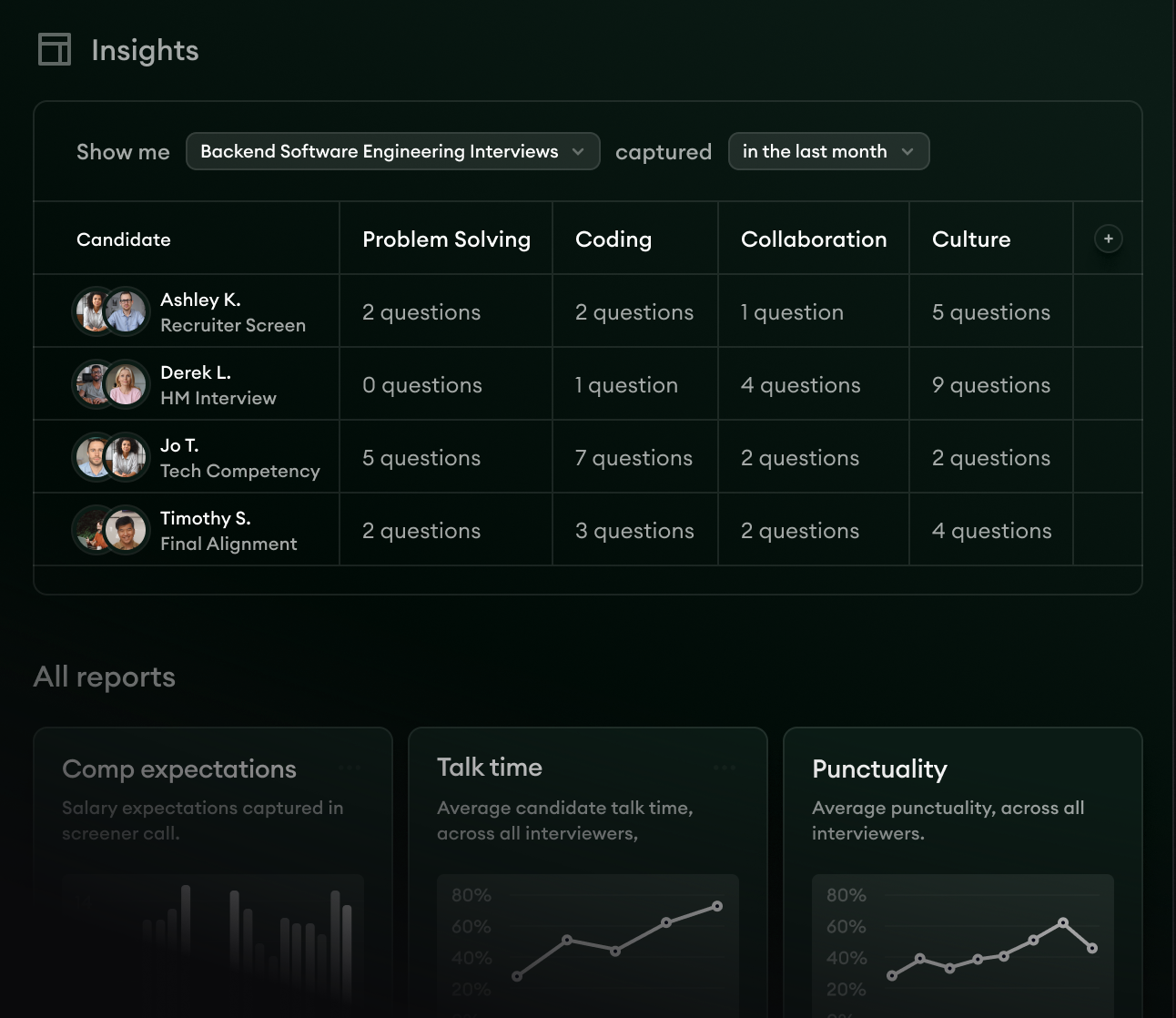
The same analysis pinpointed which interviewers were exhibiting the patterns and how often.
Of the 467 interviewers in the corpus, 25% needed coaching on at least one of the three patterns.
Hudl now had a coaching list with names, behaviors, and concrete examples from real interviews. The People team could prioritize who to coach first and what to focus on.
Deliver personalized coaching at scale
Each interviewer who needed coaching got feedback specific to their patterns.
Not generic “run better interviews” advice. Specific notes: this interviewer asks too few questions, this one stacks them, this one closes too early on yes/no questions.
The feedback referenced real moments from the interviewer’s own recorded calls, so the coaching was concrete from day one.
The result
Standardizing interviewer technique at Hudl produced four measurable shifts.
- Interview rigor up. After coaching, Hudl saw a 75% reduction in interviews with fewer than six questions. The low-rigor pattern essentially went away.
- Candidates talking more. By reducing closed yes/no questions, Hudl doubled the average candidate monologue length. Interviews surfaced richer, more descriptive responses.
- Time-to-hire down. A 14% decrease in time-to-hire across the org, with hiring velocity at its fastest pace since 2016.
- Consistency across 20 countries. The same standard now applies in every Hudl office, replacing the geography-by-geography variance that had crept in as the company scaled.
Why this matters if you use Metaview
Most recruiting teams can name a few interviewers who probably need coaching.
What they usually can’t name is what specifically those interviewers are doing wrong, or who else in the panel has the same problem without anyone noticing.
Metaview can help you change that.
- No visibility into what interviewers were actually asking in the room
- Low-rigor interviews going undetected across 20 countries
- Coaching delivered as generic workshops, not individual feedback
- No way to tell who was running a fair and rigorous process and who wasn’t
- Every interview captured, transcribed, and queryable across the org
- Specific patterns identified: interview rigor, closed questions, stacked questions
- Personalized coaching delivered to the 25% of interviewers who needed it
- Interviewer-level dashboards show who is meeting the bar and who needs coaching
Every interview you capture in Metaview becomes part of the dataset you coach against.
The more interviews you run, the more specific the coaching gets, and the smaller the gap between your strongest and weakest interviewers.
Lessons from the Hudl rollout
- Audit before you coach. Hudl’s first move was to capture the existing interview corpus and analyze it. The audit told them exactly which interviewers needed help and which behaviors to focus on.
- Specificity beats generality. Generic “run better interviews” training rarely changes behavior. Telling an interviewer that they ask too few questions, or that they stack questions, gives them something they can act on tomorrow.
- Coaching beats replacing. Most interviewers who looked weak in the corpus weren’t bad at interviewing. They were running 2-3 specific patterns that were hurting their rigor. A targeted nudge fixed it.
Frequently asked
What is interviewer training at scale?
Interviewer training at scale is the practice of improving how every interviewer runs interviews across a large, distributed organization, without relying on workshops or one-on-one coaching sessions that don’t scale past a few hundred people. Data-driven approaches like Hudl’s use the interview corpus itself to identify which interviewers need coaching and what specifically to coach them on.
How do you identify interviewers who need coaching?
Capture every interview and run an analysis across the corpus. Look for patterns: interviewers who ask too few questions, interviewers who lean on closed (yes/no) questions, interviewers who stack questions instead of asking follow-ups. Hudl found that 25% of its interviewers needed coaching on at least one of these patterns.
What does interview rigor mean?
Interview rigor is the depth and breadth of questioning in an interview. Hudl used a working definition of fewer than six questions as a low-rigor interview. The thinking is simple: with only a handful of questions, there isn’t enough surface area to surface real behavioral evidence.
What Metaview features did Hudl use?
Notetaker for the live capture, AI Reports and AI Filters for the cross-interview analysis that surfaced patterns at the interviewer level, and personalized feedback delivered through interviewer-level dashboards in Reports to each interviewer who needed it.
Can other companies replicate Hudl’s 14% time-to-hire decrease?
The 14% number is Hudl’s. The mechanism is transferable. Standardizing interviewer technique reduces redo-rounds, second-opinion calls, and panel-debrief debates, all of which add days to time-to-hire. Any company running into similar patterns can expect directional improvements, though the exact number will vary with starting baseline and rollout depth.
Bring Metaview into your hiring stack.
Live notes, structured scorecards, and ATS sync - set up in under 10 minutes.
