
Recruiters are getting fed up. The inbound is louder than it has ever been, but the signal-to-noise ratio is the worst it's ever been.
The people paying for it are the real candidates waiting on the other side of the queue. The rise of fake candidates, often generated or amplified by AI, has turned what should be the highest-signal part of hiring into the lowest.
Fake job applications don't just waste time. They slow down hiring, drain recruiter energy, and push genuine candidates further from the thoughtful, human experience they deserve.
This post breaks the problem into the parts you can act on this quarter. The categories of fake apps and the clusters of signals that flag them. The four-move top-of-funnel approach, backstopped by Application Review fraud detection and AI Sourcing.
The cost lands on real candidates. Every recruiter hour spent on a fake is an hour the real candidate doesn't get back.
The gap between teams winning the inbound battle and teams losing it tracks back to how much AI they put in the funnel. The numbers below come from Metaview's 2026 AI Hiring Alignment Report, surveying 505 recruiting leaders and hiring managers across North America and EMEA.
Common types of fake job applications.
Fake job applications cluster into a few recognizable categories. Knowing the categories means the recruiter doesn't have to figure out what's going on every time something feels off.
Worth distinguishing fakes from simply unqualified applicants. Plenty of people apply optimistically or stretch their experience.
Fake applications are different. Intentionally misleading, often at scale, designed to exploit weaknesses in modern workflows rather than engage honestly with the role. Sometimes the goal isn't even employment, it's spamming.
The categories that cluster into recognizable patterns, alongside the Application Review signals that catch each at intake:
| Category | What to look for | How Application Review catches it |
|---|---|---|
| AI-generated or fabricated resumes | Polished and keyword-optimized, lacking real depth | Bot-pattern signals flag at intake; the rationale exposes generic responses |
| Identity misuse or impersonation | The person interviewing isn't the person on the resume | Surfaces ICP-fit gaps and pairs with interview-side capture for cross-check |
| Resume stuffing and keyword spam | Built to pass automated screening, not reflect real experience | ICP scoring weights specific match over keyword density |
| Scam-driven candidates | Attempting to gain access to internal systems or sensitive information | Routes suspicious rows to the top of the queue with reasoning |
| Interview no-shows or unstable candidates | Repeatedly reschedule, disappear, or behave inconsistently once interviews begin | Surfaces no-show pattern in Reports; ATS sync preserves the history |
Signs of a fake job application.
Fake applications rarely hinge on a single red flag. The strongest signal comes from clusters across resume, behavior, interview.
A polished resume on its own isn't suspicious. A polished resume plus inconsistent timelines plus evasive written responses plus camera avoidance is.
- Overly generic or “perfect” resumes, with broad claims and little role-specific detail.
- Inconsistencies in timelines, job titles, or locations that don't hold up under basic review.
- Unusually high application volume or speed, suggesting mass submission over genuine interest.
- Vague, evasive, or scripted written responses that don't engage with specific questions.
- Unusual communication patterns, like pushing conversations off official channels or avoiding follow-up questions.
Any one of these on its own is weak. Two or three together is the pattern to flag.
Signs of a fake interview.
Fake applications often become much easier to spot once interviews begin. Nerves and communication differences are normal. Fake interviews show consistent patterns that go beyond typical candidate behavior.
- Scripted or overly polished answers that don't adapt to follow-up questions.
- Inability to explain past work in detail, despite strong claims on the resume.
- Mismatch between resume experience and real-time responses, especially on technical or role-specific topics.
- Repeated requests to change interview formats or reschedule, often at the last minute.
- Camera avoidance or unusual technical constraints, like refusing video for non-disclosed reasons.
Our CEO Siadhal Magos has been hearing this from larger customers in particular. The person who turns up for the interview is not the person who shows up on the first day of the job.
The frequency is highest at well-resourced organizations, because the upside for the attacker (insider access, IP, customer data) is largest there. For the deeper interview-side tactical guide, see our deepfake interviews post.
One in-call technique that works today: ask the candidate to tilt the camera, look hard left, look hard right, or wave a hand across their face. Current-generation AI avatars struggle with sudden gestures and unexpected angle changes.
The test feels a little awkward, and it should. The point is to confirm the person on the call is the person whose resume is on the screen. The window before next-gen avatars solve it is roughly six months, so treat the test as a floor, not a moat.
The four-move top-of-funnel playbook.
The most effective way to deal with fake applications is to stop as many as possible before they reach your hiring process. Thoughtful, candidate-friendly friction filters noise without alienating candidates.
The four moves below sit at the top of the funnel and run in sequence. Each ends with a "what to do this week" beat, so the moves stay operational, not theoretical.
1. Write clear, specific job descriptions.
Vague job posts attract mass applications because they're easy to target at scale. Naming the actual problems the role works on, the tools used day to day, and the team it joins discourages generic resumes.
2. Add role-specific application questions.
Generic application forms are easy to game. Adding one or two thoughtful, role-specific questions introduces light friction that reveals intent and authenticity.
The questions should focus on real experience or decisions, not trick prompts. Asking how a candidate solved a particular problem the role would face is far more revealing than "tell us about yourself."
3. Be intentional with easy-apply workflows.
One-click apply dramatically increases volume, but it also makes mass-submission trivial. Removing easy-apply entirely isn't always the right call. Using it selectively often is.
Some teams reserve easy-apply for trusted sources, or pair it with an additional verification step. That keeps the process fast for the real candidates and slower for the bots.
4. Set expectations early about interviews and verification.
Fake candidates rely on ambiguity to stay in the funnel. Clearly stating interview formats, identity verification steps, and communication norms up front reduces that ambiguity.
When the expectations are explicit, real candidates feel respected. Irrelevant ones tend to opt out before wasting recruiter time. The page candidates land on after applying should name the format of round one, the identity-check moment if any, and the channel for follow-up.
Inside the funnel, Application Review is where the pattern detection lands. Every application gets assessed against the role's ICP plus identity-deception and bot-pattern signals, and the row carries the verdict the recruiter sees:
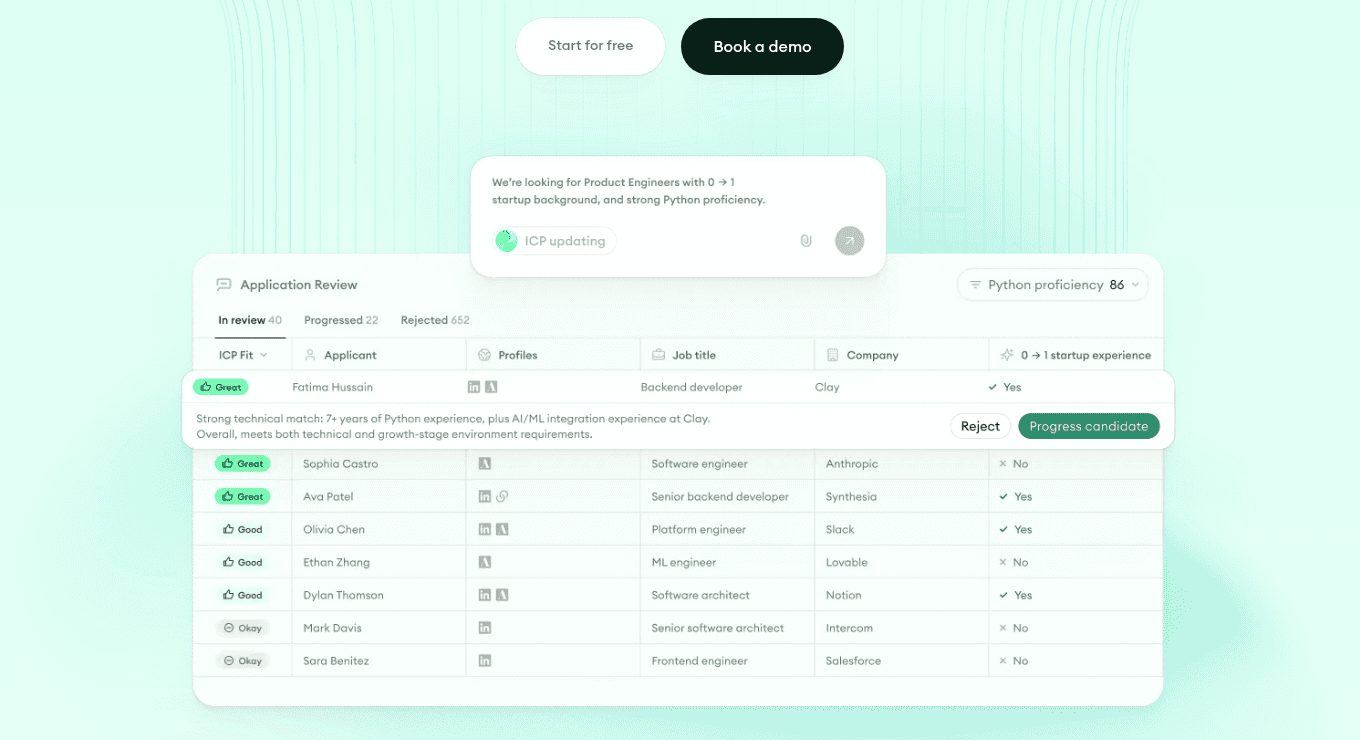
- 1Every application gets a Great / Good / Okay verdict against the role's ICP. Mass-applied AI resumes cluster at the lower tier, so the recruiter audits them in bulk.
- 2The one-sentence rationale exposes the pattern. "Generic responses across multiple criteria" reads differently from "deep specific match on three of five."
- 3Progress or Reject is a single click. The recruiter still owns the call. Application Review just compresses time-to-decision and surfaces the suspicious rows first.
How Metaview fights fake applications.
The four moves are the methodology. The product is where they run. Our stack covers three funnel layers: AI Sourcing reduces inbound dependency, Application Review handles intake-layer fraud signals, and Notetaker closes the interview-side detection loop.
The interview signal is where the deepest detection lives. Metaview's AI Notetaker captures every interview verbatim. The post-meeting structured summary surfaces inconsistencies between what a candidate claimed on paper and what they explained in the room:
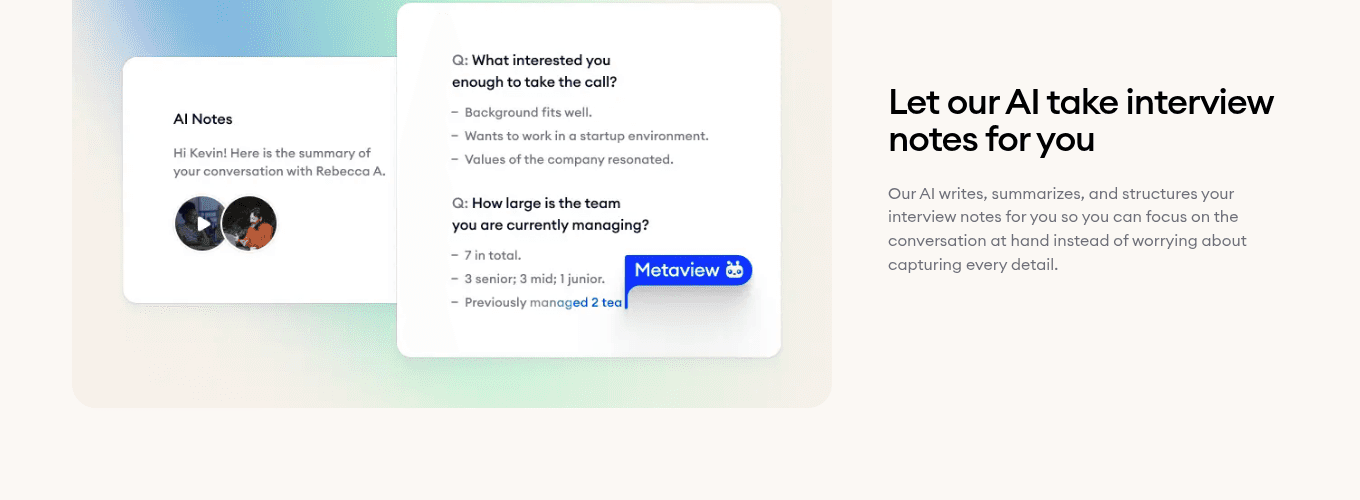
- 1Topic chips structure what was covered. Specific claims on the resume that never come up in the interview show up as gaps.
- 2Q&A summary holds the candidate's explanations verbatim, so the next reviewer can compare what they said in the room with what's on the page.
The interview itself auto-classifies at the point of capture, so the right template loads before the recruiter joins. Coding interviews get the coding rubric. Screening calls get the screening rubric:
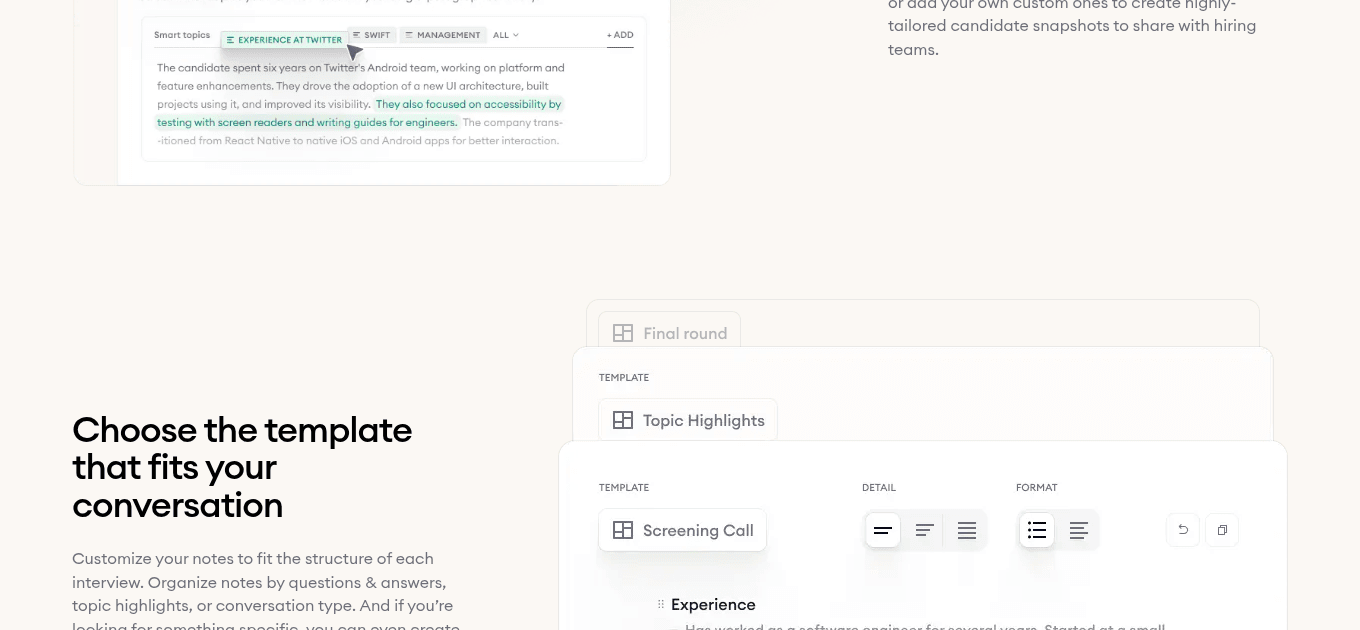
- 1Meeting type auto-detects from the calendar invite. Screening Call vs Final Round vs Detail loads a different rubric and a different set of expected questions.
- 2Format flips between Q&A and prose by interviewer preference, so the captured artifact matches how the team debriefs.
What the join looks like at the funnel level, in one binary:
- Inbound volume reads healthy. Conversion to real interviews keeps dropping.
- Recruiters spend hours on AI-generated resumes that were never going to convert.
- Real candidates leak to faster-moving competitors while the team chases noise.
- Fraud surfaces post-offer, post-onboarding, post-breach.
- Application Review surfaces ICP and fraud signals at intake. Volume layer is filtered.
- Recruiter time goes to the rows with real signal. The scroll is shorter.
- AI Sourcing fills the pipeline with verified-relevant candidates, so inbound isn't the only lever.
- Notetaker holds the interview signal so resume-vs-reality gaps surface at the debrief, not at the breach.
The operating shift.
Fake job applications aren't a temporary spike. They're now a persistent part of modern recruiting. Left unchecked, they drain recruiter time and make it harder to give real candidates the experience they deserve.
We've watched this pattern compound across our customer base over the last year. The teams handling it best aren't the ones spending more on tools. They're the ones treating trust as the new bottleneck and giving recruiters the guide and product to defend it.
Recruiters don't have to choose between efficiency and empathy. The four moves run on every requisition. Application Review and Notetaker carry the rest.
Frequently asked.
How common are fake job applications?
Estimates vary by role and industry, but Gartner has projected that one in four candidates worldwide could be fake by 2028. The pattern is most pronounced in remote and high-volume roles, where identity verification is harder and easy-apply volumes are highest.
What's the fastest top-of-funnel move I can deploy this week?
Add one role-specific application question to every open requisition by Friday. It's the smallest move that surfaces intent and authenticity without burning candidate experience, and it works across every ATS without a vendor change.
Can AI reliably detect fake candidates on its own?
No. AI surfaces patterns at scale, but the call still belongs to the recruiter. Treat AI as a flagging layer that compresses time-to-decision, and treat the rejection itself as a judgment call you defend with documented signals from Application Review and Notetaker.
Is the camera-tilt test for deepfake interviews still useful?
Yes today, but with a short window. The camera-tilt and look-direction tactic exposes current-generation avatar limitations. The window is roughly six months before next-gen tools close the gap. Pair it with the longer tactical guide in our deepfake interviews post, and treat the test as a floor, not a moat.
What's the protocol when we suspect a fake application or interview?
Flag the application in Application Review with the reason field populated so the next reviewer sees the context. Capture the interview signal in Notetaker so the structured summary holds the evidence. Then debrief with the hiring manager using that summary, so the decision is documented, evidence-based, and not personality-driven.
Bring Metaview into your hiring stack.
Live notes, structured scorecards, and ATS sync - set up in under 10 minutes.
