

Two of the tools on this page publish their reach. SeekOut says its search covers more than a billion profiles; StarHunt says it has 275,000+ developer profiles indexed. Both figures are the makers’ own, and neither of them tells you which tool will find the backend engineer you are briefed on this quarter.
Developer sourcing tools for technical recruiters are told apart by the signal each one reads. Some index the developer communities where engineers are already visible. Others start from the repositories themselves, from a sentence you type, or from the hiring your own team has already done.
The figure I keep coming back to is the spread behind a single search. Across 138,224 sourcing searches, Metaview’s agent has surfaced 9,124,692 distinct candidates, about 66 per search. At that volume the constraint stops being how many profiles a tool can reach, and starts being whether the thing it reads is the thing your requisition turns on.
What follows is six tools grouped by the signal each one says it reads. Every entry for a tool we did not build quotes that maker’s own pages, captured on September 21, 2026. We make one of the six and it goes first, so the numbering is an order of appearance rather than a ranking.
All six tools at a glance.
The right-hand column is the maker’s own wording, so you can see where a description is ours and where it is theirs.
| Tool | The signal it reads | In the maker’s words |
|---|---|---|
| Metaview | Your connected ATS and your team’s own past interviews, from one plain-language prompt | Searches the web, the connected ATS and past Metaview conversations, and returns candidates with the reasoning for each |
| AmazingHiring | Code hosts and developer communities | “source candidates across GitHub, StackOverflow, Kaggle, LinkedIn, and more” |
| SeekOut | Code hosts, plus published and patented work | “surface hidden talent from patents, GitHub, publications, and signals that indicate real expertise” |
| StarHunt | The repositories themselves, and who merged code into them | “Most sourcing tools search profiles. StarHunt starts from repositories.” |
| Juicebox | A description you type, read across its own sources | “Search for top talent in natural language” |
| hireEZ | A description you type, read across the open web and your ATS | “Automate candidate sourcing across the open web and your ATS.” |
The four signals a developer sourcing tool can read.
Every tool here starts from something a person left behind, and the four somethings are different enough to change which search you should run.
Code hosts and communities means profiles and activity on GitHub, Stack Overflow, Kaggle, and the sites next to them. It finds people who participate in public developer spaces.
Reading the repositories themselves goes one step further in. Rather than starting from a person’s profile, the tool starts from a project and asks who merged code into it.
A plain-language description reads your sentence rather than the candidate’s artifacts, and matches it against whatever sources that vendor indexes.
Your own hiring history reads the interviews and the ATS records your team already produced. It is the only one of the four that knows what a strong hire looked like at your company.
1. Metaview.
We build Metaview, so treat this entry as the one written by an interested party. Its sourcing agent searches the web, the connected ATS and your organization’s own past Metaview conversations from one natural-language prompt, and returns candidates with the reasoning for each. It surfaces and explains those candidates; it does not contact them and it does not assess them.
The past-interview half of that is possible because Metaview captures every spoken word of the interviews it joins, and recording only happens if consent is given. It reads the conversations your team already had and the records already in your ATS.
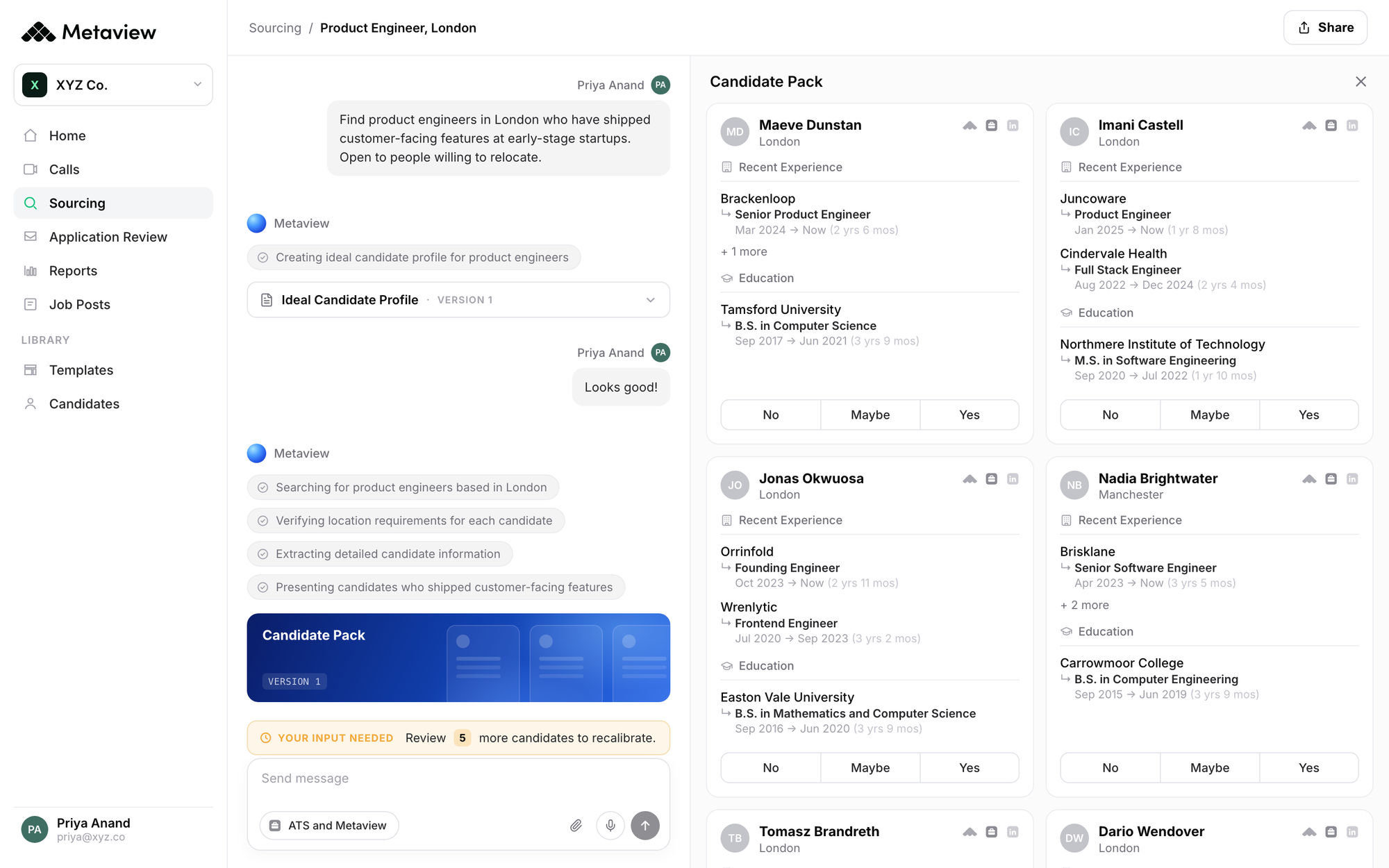
Deep Research, the market-mapping mode, answers questions about an engineering market with charts, tables, reports, and profile sets rather than a candidate list. We keep the detail on that in the talent mapping guide instead of repeating it here.
When recruiters rate the candidates the agent surfaces, they say yes to 41.5% of the ones they decide on, which is the test of whether the signal it reads matches the brief.
Eneba’s technical recruiting runs this way round. In their case study, Sara Machado describes building the profile out of the hiring already done: “I’ve hired seven or eight backend engineers since I started. So there’s a profile.”
Worth testing: run a search against your own ATS and past interviews for a role you have already filled, and see whether the people it brings back resemble the ones your team advanced.
2. AmazingHiring.
AmazingHiring describes itself as “an all-in-one talent sourcing platform” and puts the developer communities at the front of what it searches.
What it says it reads: the product page says you can “source candidates across GitHub, StackOverflow, Kaggle, LinkedIn, and more with just a few clicks,” and “Filter by skills, experience, open-to-work status, location, and more.” The company describes “advanced search across 50+ networks, contact info, outreach campaigns, messaging, and analytics.”
Where it sits: its Chrome extension, in the company’s words, “activates on the candidate’s profile and displays links to all their social media accounts.”
Worth testing: take an engineer your team already hired, and check how much of their public footprint the aggregated profile reassembles.
3. SeekOut.
SeekOut is a broad talent platform, and the part relevant to a developer requisition is what its Intelligent Search says it looks at.
What it says it reads: “SeekOut’s Intelligent Search goes beyond keywords to surface hidden talent from patents, GitHub, publications, and signals that indicate real expertise.” The page also lists “30+ smart filters for precision targeting.”
Patents and publications are the part of that list a code-host search will not give you, which makes it a different question from the one AmazingHiring answers, rather than a bigger version of it.
Worth testing: a search for a research-adjacent engineering role, where published or patented work is part of what you are looking for.
4. StarHunt.
StarHunt’s own title line reads “find engineers by what they build on GitHub”, and it calls itself “a GitHub sourcing tool for technical recruiters”. Its framing against the rest of the category is “Most sourcing tools search profiles. StarHunt starts from repositories.”
The method it publishes starts from a reference repo rather than a person. It “fetches the contributors of each reference repo, the people who merged code into it”, then returns results “ordered by evidence of real work: contributions over the last twelve months, the languages in their own repositories, how widely their projects are used, and how recently they shipped.”
The scale it publishes is “275,000+ developer profiles indexed”, a small number next to a billion, and that is the whole point of the design.
It is worth pointing at a requisition where the hiring manager keeps naming specific projects or frameworks, since a repository-first search starts from exactly those.
5. Juicebox.
Juicebox, whose search product is known as PeopleGPT, reads your description rather than a code host. Its own line is “Search for top talent in natural language”, across what it describes as “30+ real-time data sources”.
Its agents take that same input further back into the process. “Your Agent pulls context from the job description, your intake call, and every past hire the moment a req opens,” the company says, which puts the weight on how the role was described in the first place.
Try the same requirement two ways, once as the job description and once as a sentence about the person you are picturing, and compare what comes back. The gap between the two results measures your own writing more than the index behind it, which is why recruiters who work this way tend to keep one prompt and refine it rather than retyping a new one each quarter.
I think of AI as an assistant, a technical assistant, a teammate. I created my own GPT specifically for sourcing, put in a JD, get gaps, candidate questions, archetypes, Boolean strings, all in one go.”
6. hireEZ.
hireEZ sits in the same group, and its current pages describe the sources rather than the networks.
What it says it reads: “Automate candidate sourcing across the open web and your ATS.” Its homepage puts the reach at “a billion-plus profiles, 45+ platforms”.
Worth knowing if you are working from an older roundup: hireEZ’s live pages no longer name GitHub or Stack Overflow among its sources. We checked the homepage, the AI Sourcing page and the platform page on September 21, 2026, and quoted what is there now.
Worth testing: whether the ATS half of that search reaches the candidates your team already rejected for a different role.
How technical recruiters can choose developer sourcing tools.
Start from the requisition rather than the tool, and the choice narrows quickly.
If the evidence you trust is public contribution, a code-host search gets you there, and a repository-first search gets you there more directly when the hiring manager keeps naming projects. If it is published or patented work, you need a tool that indexes those, because a code host does not hold them.
If you cannot describe the person in filters but can describe them in a sentence, a plain-language search is the shorter route. And if the best evidence you have is the hiring your team has already done, that lives in your ATS and your interview records, and only a tool connected to both can read it.
We have written separately on spotting technical signal beyond standard search terms and on treating technical sourcing as a calibration problem, for the strategy underneath the tooling. Most technical recruiters end up running two of these rather than one, because a search for who is visible in public and a search for who your company already met are different searches.
Point a sourcing search at your own hiring history.
See AI Sourcing read your connected ATS and your team’s past Metaview interviews from one prompt.
Frequently asked.
What is a developer sourcing tool?
It is a search tool aimed at engineering candidates rather than candidates in general. The useful distinction between them is the signal each one indexes: developer community profiles, the repositories themselves, a description you write, or your own hiring records.
Does Metaview search GitHub?
It does not. Code hosts are what the tools in the first group on this page are built to read, and Metaview’s agent is pointed at your own side of the process instead. One limit is worth knowing across all six: each of them reads either what a developer published or what your company wrote down, so a candidate whose strongest work sits in a private repository at a previous employer will look thin in any of these searches, and the only route to that work is asking them about it.
Do I need more than one developer sourcing tool?
Often, yes. Run the ATS-connected search first on a role you have already filled, because it is the only one you can check against the hires your team has already made, then add one outward-facing tool for the profiles your own records cannot reach. Budget the trial in requisitions rather than in license fees: one role you have already closed, run through both searches, settles more than a demo will.
Is a bigger candidate index better for engineering roles?
Not on its own. A general index of a billion profiles and a developer-only index of a few hundred thousand answer different questions, and on a requisition that turns on shipped code the narrower index can be the one that holds the evidence.
Which signal should I start with on a hard-to-fill engineering role?
When the intake call produces adjectives rather than projects, ask the hiring manager for two engineers already on the team they would hire again, and work from what those two have in common. If the shared thing is public, something they built or something they published, one of the outward-facing tools will reach it. If it only shows up in how they answered questions, that pattern lives in your own interview records and nowhere else.
