
Sourcing usually starts when a req opens, runs in a burst for six to eight hours per role, and goes quiet again once the shortlist is sent over. The cycle repeats every time the next requisition lands.
Each burst means hours of Boolean strings, manual profile review, and outreach sequences that lose context the moment the role is filled. None of it compounds.
The team that spent forty hours sourcing for last quarter's senior engineer search has nothing to show for it when the next senior engineer role opens, except a candidate spreadsheet that went stale within a week.
Sourcing the other way carries between roles. It treats the brief as something the system holds onto, the agent as a teammate that searches continuously against that brief, and the interview signal as data that keeps the brief sharper after every hire.
Three layers, one continuous loop. What's left to do is the recruiter's work: relationships, calibration, judgment.
Why sourcing breaks in burst mode.
Burst-mode sourcing fails by design, not by effort. The model itself doesn't carry context between roles, so every requisition starts cold and the recruiter starts the Boolean strings from scratch.
The pain shows up in four recurring patterns. Hiring managers hand over briefs that don't survive the first calibration call. Candidate pools turn into vast unfiltered lists.
Fake and outdated profiles bleed time. And by the time the shortlist lands, the strongest candidates have already accepted offers somewhere else.
When the model stays burst, every cold start brings back the four problems. The longer a team runs sourcing this way, the further behind the pipeline gets relative to the hiring volume the business needs to support.
The four failure modes are listed in the takeaways. They're worth unpacking once before getting to the system that fixes them.
- Unclear briefs from hiring managers. Roles described in fuzzy nouns ("senior engineer who can hit the ground running") without naming the framework, scope, or compensation band the recruiter can source against. The brief doesn't survive the first calibration call.
- Volume overwhelm in the pool. Several hundred profiles per Boolean search. Most teams need very specific skill sets that show up in maybe one in fifty profiles, but the filter still runs over all fifty before surfacing the one.
- Fake or outdated profiles. Inflated titles, stale tenure, AI-generated CVs. Each one burns a slot in the shortlist and an hour of follow-up. Gartner has projected that one in four candidates worldwide could be fake by 2028.
- Competitors moving faster. Strong candidates are in three to five conversations at any given moment. Burst-mode teams come in third or fourth, after the candidate has mentally committed somewhere else.
What burst-mode sourcing costs.
The cost shows up in the data. According to Metaview's 2026 AI Hiring Alignment Report, surveying 505 recruiting leaders and hiring managers across North America and EMEA, the alignment gap widens the more teams lean on disconnected tools.
The 19-point alignment gap is the difference between sourcing that builds across roles and sourcing that resets every Monday. Teams running AI at the core start the call aligned on what they're looking for, and the alignment shows up in the relationship for the rest of the quarter.
The friction isn't fixable by hiring better recruiters or better hiring managers.
This data shows that hiring managers and recruiters don't fully trust each other's judgment. This creates friction that tools alone cannot solve. The orgs that recognize this and help individuals collaborate more effectively will see dramatically better outcomes.”

That signal carries into the next set of searches. When recruiters and hiring managers leave the intake call aligned, the brief AI Sourcing runs against is sharper, and so is the shortlist that lands the following day.
The three-layer system.
The teams that don't run sourcing in burst mode build it on three layers: brief, agent, signal. Each layer is something the recruiter sets up once and the system carries forward.
The brief defines what good looks like. The agent searches continuously against that definition. The signal, captured from interviews, keeps the definition sharper after every hire. Without all three, the system collapses back into burst mode.
1. The brief: what the system needs to carry.
Layer one is the brief. The intake call between recruiter and hiring manager is the moment when the system either gets sharp or stays fuzzy for the rest of the cycle.
Capturing the call as structured data, including competencies, scope, dealbreakers, and calibration profiles, turns the brief from a Slack thread into something the rest of the system can run against.
Sharper briefs cheapen everything downstream. The agent searches against a precise spec, not a hopeful one. The hiring manager calibrates against named criteria, not gut. The interview signal you capture later anchors back to the same competencies the intake locked in.
2. The agent: continuous search against the brief.
Layer two is the agent. As soon as the intake call ends, AI Sourcing starts scanning the open web against the captured brief. It doesn't wait for a recruiter to write a Boolean string. It evaluates profiles against the same competencies the intake call locked in.
The agent runs continuously in the background. New profiles arrive overnight. Calibration loops sharpen the search after every recruiter review. Pipeline depth carries across roles instead of resetting each time a new req opens.
3. The signal: interview data that feeds back.
Layer three is the captured interview signal. Every interview a candidate goes through produces structured notes that feed back into the brief. AI Notes captures what the candidate said, against which competency, with what evidence.
The next sourcing brief inherits all of it. When the team opens a similar role six months later, Reports shows which competencies hit hardest in the panels that produced successful hires, and the agent searches for those signals first.
The loop closes here. Brief sharpens the agent. Agent surfaces candidates. Interviews capture signal. Signal sharpens the next brief. For the full playbook on building each layer, see the strategy in detail.
- Brief lives in a Slack thread or kickoff doc that goes stale within a week
- Recruiter writes a new Boolean string every time a similar role opens
- Candidate pipeline resets to zero each requisition
- Profile review burns six to eight hours per role with nothing to carry over
- Interview feedback stays in scorecards that never feed back into sourcing
- Brief is captured from the intake call as structured data the system carries forward
- AI Sourcing runs against the brief continuously, no Boolean rewrite needed
- Pipeline depth carries across roles as the agent learns from every calibration
- Recruiter spends saved hours on relationships, calibration, and judgment
- Interview signal feeds back into the brief so the next search starts sharper
How Metaview's sourcing surfaces fit together.
The three layers run on three Metaview surfaces, plus the integrations layer that wires them into the team's ATS. The customer outcomes back the system pattern, not the feature recital.
The captured-intake-to-agent loop runs through the Metaview app. The recruiter opens the intake-call structured notes, and the same window is where AI Sourcing surfaces the daily candidate set against the brief.
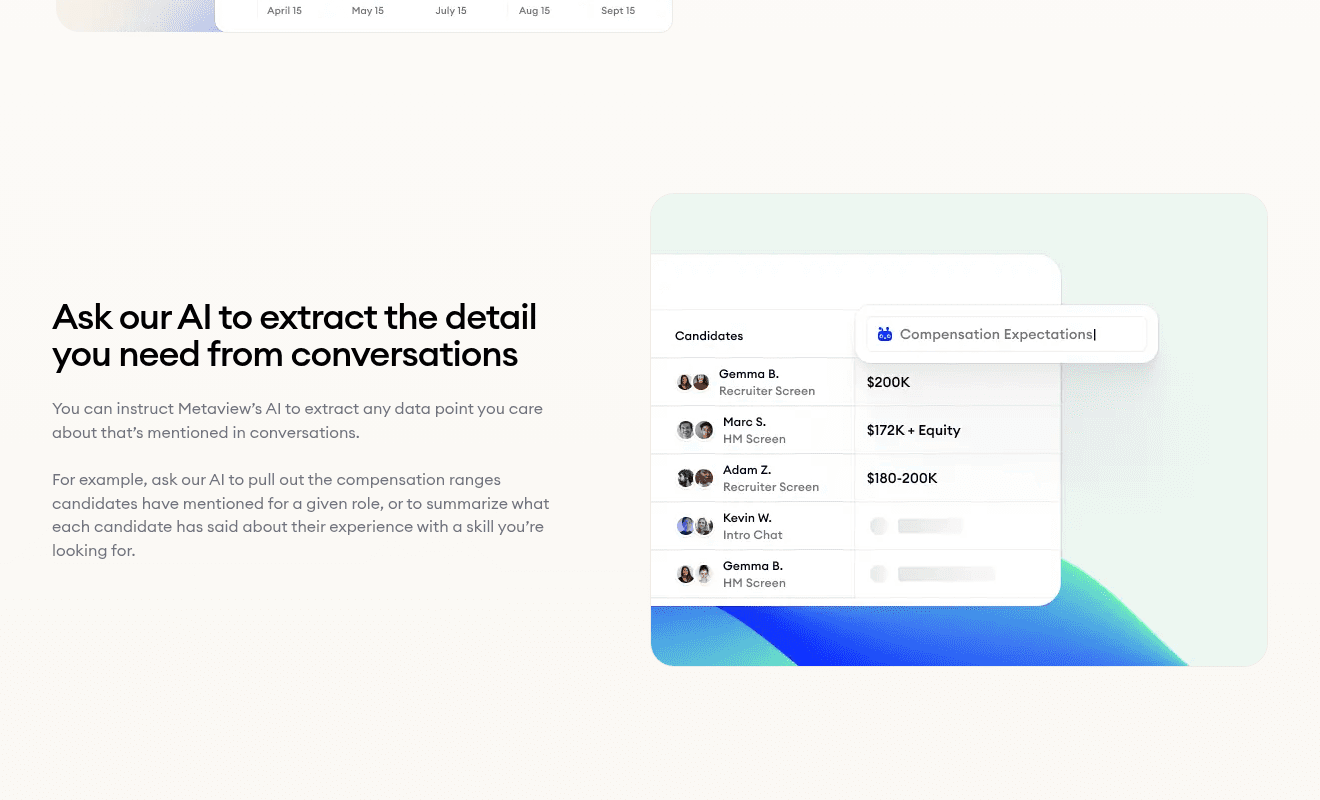
- 1Natural-language query inherits the competencies the intake call locked in.
- 2Ranked candidate set updates daily, no Boolean rewrite needed.
- 3Calibration loop on each reviewed profile sharpens the next pass.
Once interviews start, every captured note adds up in Reports. The team can ask the data which signals correlated with successful hires last quarter, and the next sourcing brief inherits the answer.
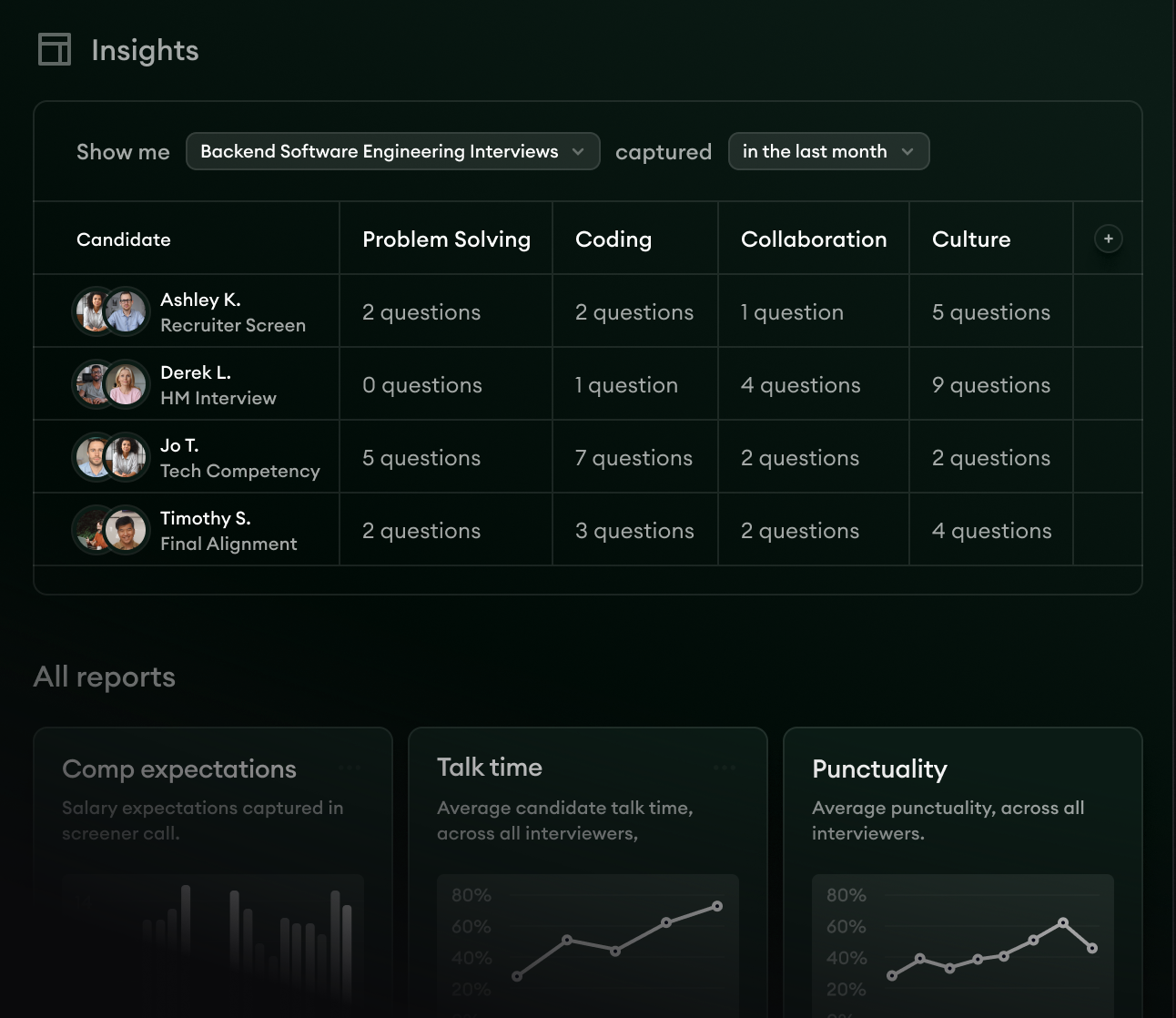
- 1Interview signal stacked across past hires becomes the input the next sourcing brief inherits.
- 2Filters surface which competency signals correlated with successful hires last quarter.
- 3The agent re-calibrates against those signals before the next search runs.
For solo recruiters and small teams, the time-back effect shows up fastest. The agent is the second pair of hands they don't have.
For solo recruiters especially, this creates what I call having 'a team working for me.' The tool runs continuously in the background, sourcing candidates even when I'm focused on other tasks. By the next day, new profiles are waiting for review.”

The system pattern is the same for a 50-person TA team as it is for a one-recruiter founder. Brief sharpens the agent, agent surfaces candidates, signal sharpens the next brief.
Bring continuous sourcing to your next req.
Run one role end-to-end through the system before scaling. Capture the intake call as structured data, hand it to AI Sourcing, and watch how the interview signal from the first three candidates sharpens what the agent looks for next.
The lift shows up by the second role. The brief inherits what the first call surfaced. The agent searches against a sharper spec. The relationship work is what's left to do, and the recruiter's calendar opens up for it.
Bring Metaview into your hiring stack.
Live notes, structured scorecards, and ATS sync - set up in under 10 minutes.
Frequently asked.
What's the difference between sourcing and recruiting?
Sourcing is the proactive upstream step that runs before recruiting. It finds and qualifies candidates the system can build a pipeline around. Recruiting then picks up at the application stage and runs through to offer. Teams that rely only on inbound applications usually see the strongest candidates accept offers elsewhere before the panel even forms.
How long does it take to fill a role with sourcing?
A typical role with manual sourcing runs 35 to 65 days. The three-layer system compresses that into 18 to 30 days because the agent surfaces qualified candidates within the first 48 hours and the captured signal from past interviews sharpens the screening pass. The fastest hires happen on roles where a prior search already trained the brief.
Which ATSes does Metaview AI Sourcing support?
Setup is self-serve via the Admin Panel for most integrations. New ATSes ship monthly, so the live list on the integrations page is the source of truth. If your team's ATS is not yet listed, ask your Metaview contact about the roadmap.
Is candidate sourcing the same as cold outreach?
Sourcing is the upstream search-and-evaluate step. Outreach is the downstream contact step that runs against the sourced list. The two are coupled but distinct, and outreach quality depends on sourcing quality. A vague brief produces a noisy pool, which produces low-response cold outreach. A sharp brief produces a tight pool, which earns reply rates that justify a longer sequence.
How does AI Sourcing handle confidential and niche roles?
The agent runs against the captured intake brief, which means confidential roles work the same as public ones. The agent doesn't post the role anywhere, so visibility is not the constraint. Niche roles where Boolean searches return thin pools benefit even more from the agent's continuous off-list search and its ability to evaluate competency signals across less-obvious profile patterns.
