
Workleap's recruiting team was reviewing 200 to 300 candidates per role at 30 to 45 seconds each. That's two and a half hours per req, multiplied across every open role. Doable. Until it isn't.
In our 2026 AI & Hiring Alignment Report we surveyed 505 recruiting leaders and hiring managers across North America and EMEA. Four numbers stood out:
The candidate isn't lost at the offer stage. They're lost in the inbound pile, before a recruiter ever opens the application.
The fix isn't more recruiters. It's a triage layer that decides what gets a human look in the first 30 seconds.
This is the 3-bucket playbook TA teams run inside our Application Review. Workleap cut screening time 50% running this. Here's how to set it up on your next req.
Why three buckets, not eight.
I've seen TA teams try this with five, six, eight buckets. Each new bucket adds a routing rule the recruiter has to maintain. Pretty soon the system is the problem.
Three is enough. Reject. Review. Priority. Anything past that is sorting for the sake of sorting.
The triage isn't a sort. It's a routing decision per candidate in the first 30 seconds after the application lands, telling the recruiter what to do next.
The 3-bucket playbook.
| Bucket | Criteria | Application Review action |
|---|---|---|
| Reject | Missing hard requirements (location, work authorization, role-level mismatch). No ambiguity. | Templated rejection with the specific reason, sent inside an hour. Candidate stays in your pool for related roles. |
| Review | Meets hard requirements. Signal on soft criteria is partial. The "I'd want a human to look at this" pile. | Queued with a 60-second summary. Which criteria hit. Which miss. Which to cross-check on the phone screen. |
| Priority | Meets hard requirements and has strong signal on the soft criteria the team has historically hired against. | Flagged for outreach inside 24 hours, with a draft message referencing the strongest signal in the resume. |
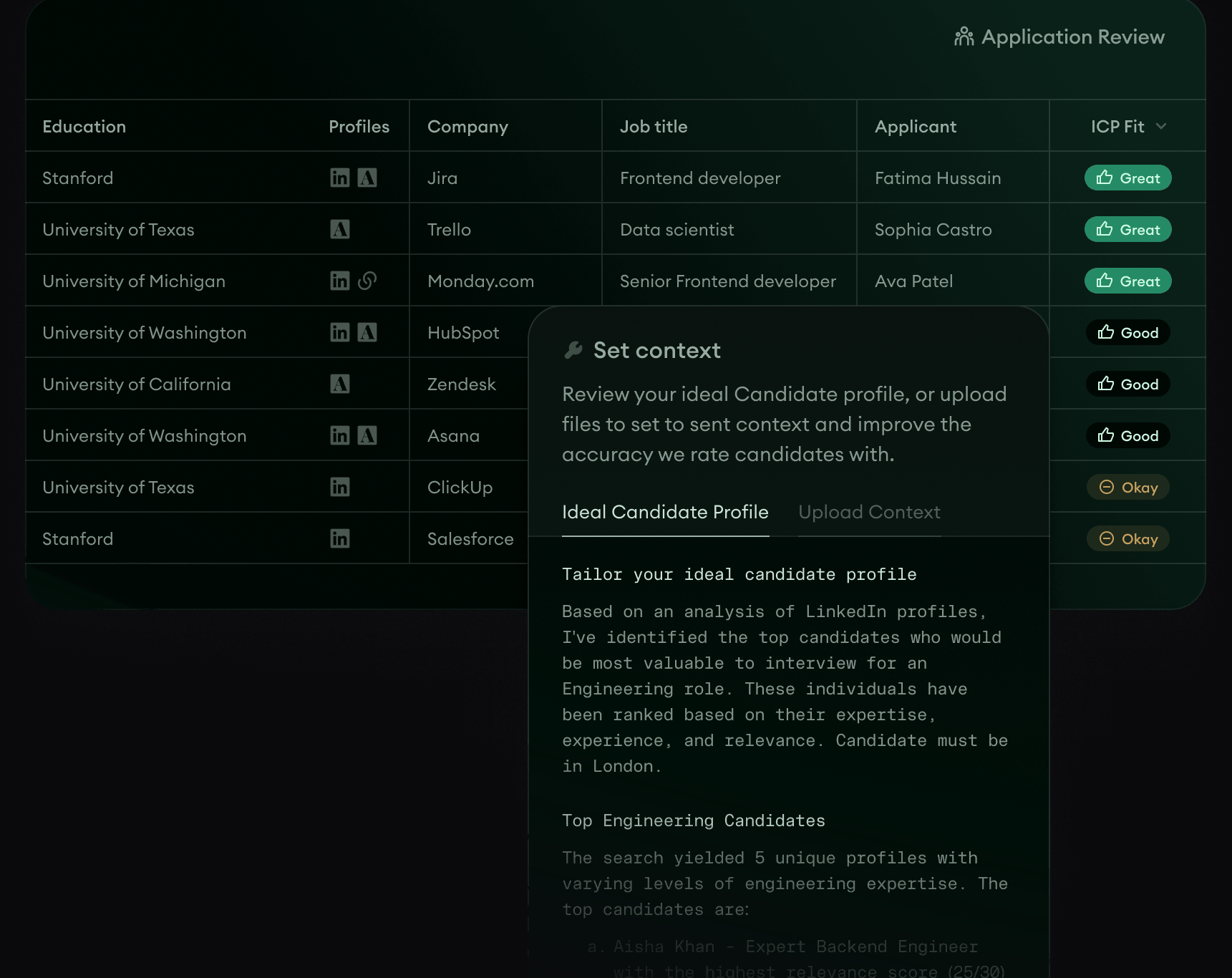
The 3-bucket model only works if you can write down what "good" looks like. Application Review pulls the criteria from the job spec, the scorecard, and your last 10 hires. Then it asks you to confirm before it starts sorting.
The trick is treating that confirmation step like a calibration moment. Look at what it pulled. Strike anything that's wrong. Add what's missing. The first req takes an extra 10 minutes. Every req after that takes 10 seconds.
If you can't write down what "good" looks like for the role, the triage layer can't help you yet. That's a candidate quality signals problem upstream of triage.
What changes when the recruiter opens the queue.
- Recruiter opens applications in submission order
- Strong and weak profiles get the same 90 seconds
- Reject reasons are generic; candidate goodwill leaks
- Top candidates wait 5 to 7 days for first outreach
- Recruiter opens priority bucket first, then review bucket
- Weak profiles auto-rejected with specific reasons in under an hour
- Priority candidates flagged for outreach inside 24 hours
- Recruiter time goes to the candidates most likely to hire
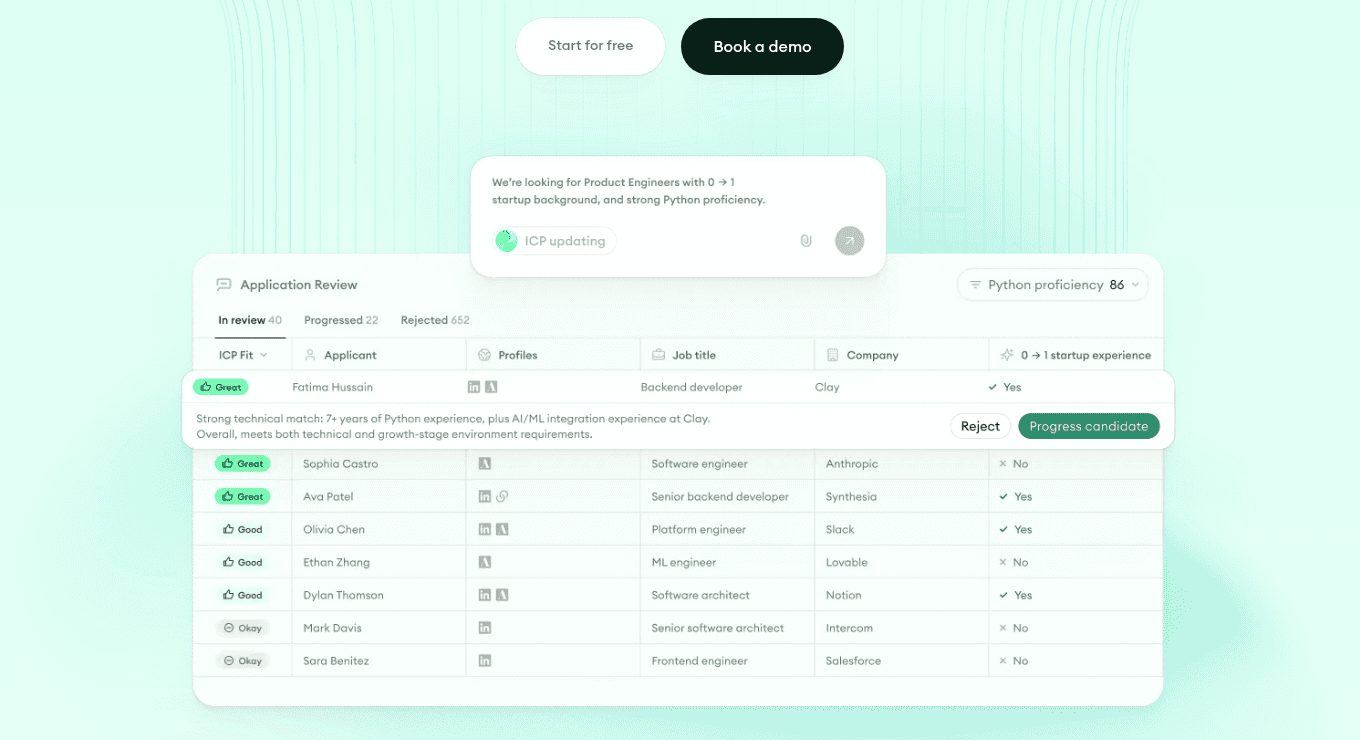
The other shift is what the recruiter reads. Not the resume. A 60-second summary that names which criteria hit, which miss, and which warrant a follow-up question.
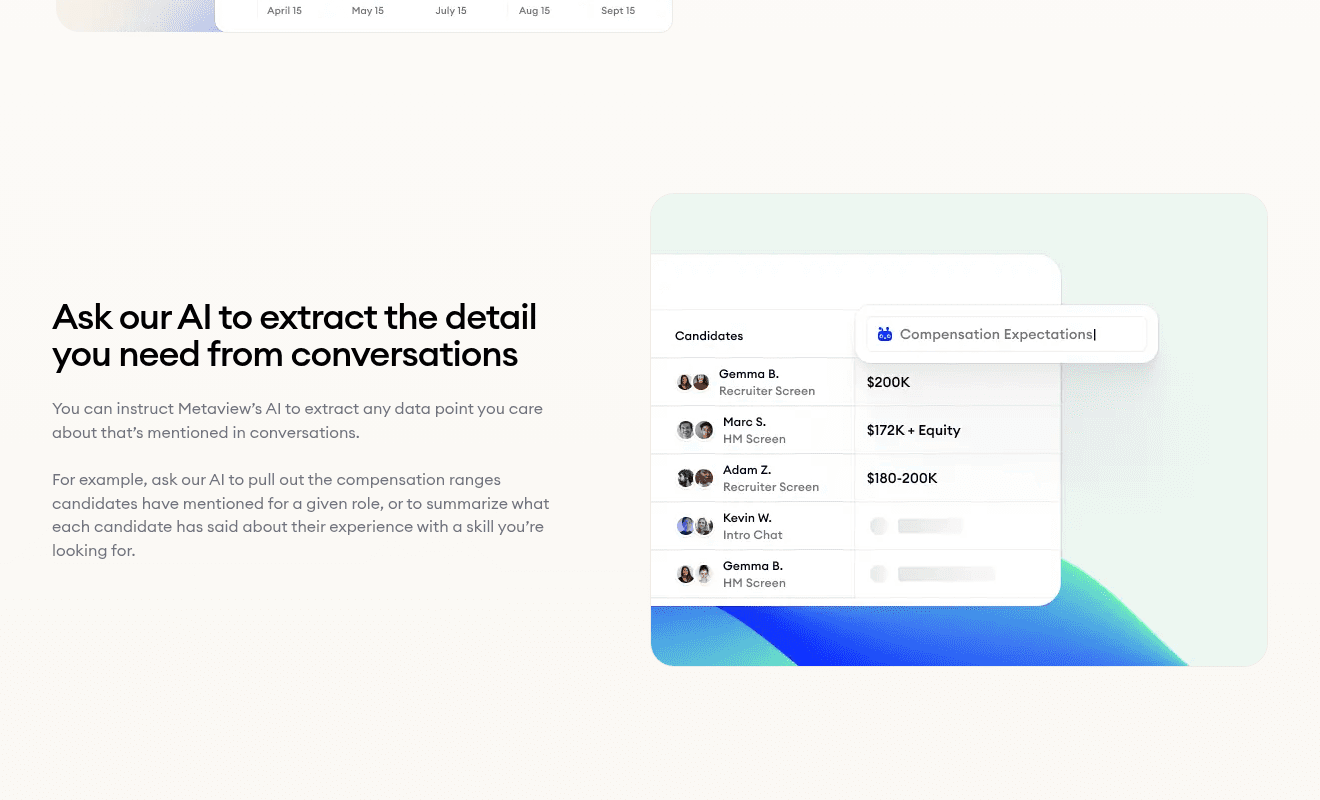
That's the moat working. We capture every spoken word in the calls you're already running, then feed the patterns back into the way Application Review reasons about the next candidate.
Scorecards calibrate against the questions that got asked last time. The reasoning behind every routing decision sits inline. The recruiter sees what the score is based on before they touch the queue.
The recruiter starts the phone screen knowing what to clarify, not guessing where to begin. Same idea as the coding interview playbook: score signals in the room, not from memory two hours later.
What this looked like at Workleap.
Workleap moved from a 5-day screening average to a 60-second triage decision per inbound application. They rolled Application Review into the inbound flow and the throughput change wasn't theoretical.
It's a 50% reduction in screening time and a step-change in time-to-fill on the roles where the inbound is the bottleneck.
It's reduced my screening time by up to 50%. Both strong and weak profiles are reviewed within a couple of seconds."

Frequently asked.
What's the AI doing, and what is the recruiter still doing?
Application Review reads the application, scores it against your criteria, and routes it into one of three buckets with the specific evidence. The recruiter reviews the routing, opens the priority bucket first, and decides who to advance. AI reviews and sorts. Humans decide.
How do you keep AI candidate screening fair across candidates?
Two things. First, the scoring criteria are explicit and visible, pulled from your job spec and confirmed scorecard, not a black-box model. Second, every routing decision shows the evidence the score is based on, so a recruiter can override it and see the trail.
Does AI candidate screening integrate with Greenhouse, Ashby, or Workday?
Yes. Application Review reads the application directly from your ATS, writes the score and the routing back to the candidate record, and triggers the auto-rejection or outreach action through the same workflow your recruiters already use. See the full integration list.
What happens to the candidates we auto-reject?
Auto-rejection ships a specific reason within an hour. The candidate stays in your talent pool for related roles. Application Review surfaces them again when a relevant req opens, so a strong candidate for the wrong role doesn't disappear.
How quickly can AI candidate screening be set up on a live req?
Connect us to your ATS, point Application Review at an open req, confirm the criteria it pulls from the spec, and you're triaging applications inside the same workspace. Most teams have the first req live inside an hour.
Run it on your next 100 applications.
Connect us to your ATS. Point Application Review at an open req. Confirm the criteria it pulls from the spec.
You're triaging inside the same workspace your recruiters already work in. Most teams have the first req live inside an hour.
AI takes the queue. You take the call.
Bring Metaview into your hiring stack.
Live notes, structured scorecards, and ATS sync - set up in under 10 minutes.
