
Most talent teams in 2026 run some version of the same stack. A notetaker sits on the interviews, a sourcing app lives in another tab, a screening bot runs inside the ATS, and every recruiter has their own copilot.
Everyone's a little faster, and the team is no more coordinated than it was before any of it arrived. We've been calling this AI recruiting for two years, and most of it has been a pile of copilots, each making one person quicker at one task.
An agentic recruiting platform is built differently, and the word agentic earns its place here. It means agents that act on their own, under guardrails you set, reading from one shared layer of context instead of ten private ones.
Buying every recruiter a copilot makes each person faster at their own task. It does nothing to keep sourcing, screening, and interviews working from the same read of the role, and that is the problem that decides whether your hiring process holds together.
That distinction stays abstract until Monday morning, when it stops being a slide and starts being your calendar. One clarification first, because agentic gets thrown around loosely: the line that matters is which decisions a human still owns.
An agent can start a search on its own after an intake call, a low-risk step you can always walk back. It shouldn't advance or reject a candidate without a person approving that call. Agentic means the low-stakes actions run without you, and the consequential ones still wait for your sign-off.
What agentic actually means
Most of what gets sold as AI in recruiting is reactive. You open a tool, type a prompt, read the answer, and then do the next thing yourself. That's useful, and it's also just a faster keyboard.
Agentic sets a higher bar, and the part vendors skip is the shared context. Start there.
They read from one shared context layer
Your job requirements, interview history, team preferences, and company knowledge sit in one place, and every agent reads the same copy. No agent keeps a private version.
That shared copy is what lets the agents move together. It's also what makes them fail together when it's wrong, and you should know that before you buy.
They act without waiting for you
An agent takes the next step from instructions you set up once, without waiting for you to press go. The sourcing agent starts searching the moment your intake call ends, working from the requirements you just discussed. You don't have to kick it off, and the work is already moving by the time you're back at your desk.
They act inside your guardrails
Autonomy only works when it's bounded. You decide what each agent can and can't do, you get alerted when something looks off, and every action leaves a record of the reasoning behind it.
The agent works inside the lines you draw, and you can always move the lines.
A copilot does none of that. It waits for a prompt, and it forgets the role the moment you close the tab. The distinction is worth being strict about before you spend money.
The difference between a copilot and an agent
Buying ten copilots fails in a way that's easy to miss, because every individual number looks good. Each recruiter really does get faster at drafting outreach or summarizing a call, and the process around them gets slower and messier anyway.
Ten people moving quickly off ten private versions of the role don't add up to a team moving quickly. Everyone has their own prompts, their own notes, their own read on what the role needs, and none of it lines up.
A shared context layer moves the unit of work from the person to the team. Every agent reads the same definition of the role, so when your best recruiter sharpens that definition, all of them inherit it at once.
That's the upside, and it's half the story. The same wiring that spreads a good correction spreads a bad assumption exactly as well, which is the half most pitches leave out.
Charles Guillemet, Head of TA at Lovable, made the point plainly in Metaview's 2026 AI and Hiring Alignment Report.
Hiring problems are rarely about talent. The best teams win because recruiting, hiring managers, and leadership stay aligned, move quickly, and remove friction with the right systems, increasingly powered by AI.”

What it changes Monday morning
Strip away the category language and an agentic platform is a list of jobs that used to sit in a queue waiting for a human. Here's the same hiring week done by hand, then done by agents reading from one shared context.
| The work | By hand today | Metaview agents |
|---|---|---|
| Sourcing | You craft a Boolean string and dig through profiles after the intake call. | After intake, the sourcing agent starts on its own, searches your ATS and the web against the role, and surfaces a shortlist with the reasoning for each candidate. |
| Job posts | Someone rewrites the same job post from a blank page for every role. | Job Posts drafts from the role intake, in your brand voice, ready to edit and publish. |
| Application review | A person works down the stack until the calendar runs out, and the bottom never gets seen. | Application Review reads every inbound application against your profile and ranks by fit, overnight. |
| Reporting | You export to a spreadsheet and hope someone finds time to analyze it. | Reports answers your funnel in plain language and learns from every decision your team makes. |
All of it starts with capture, because that's where the context comes from. Every screening call and panel lands in one place, transcribed and structured, so nothing a candidate said is stuck in someone's half-remembered notes.
Every other agent reads from that record, so its quality sets the ceiling on everything after it.
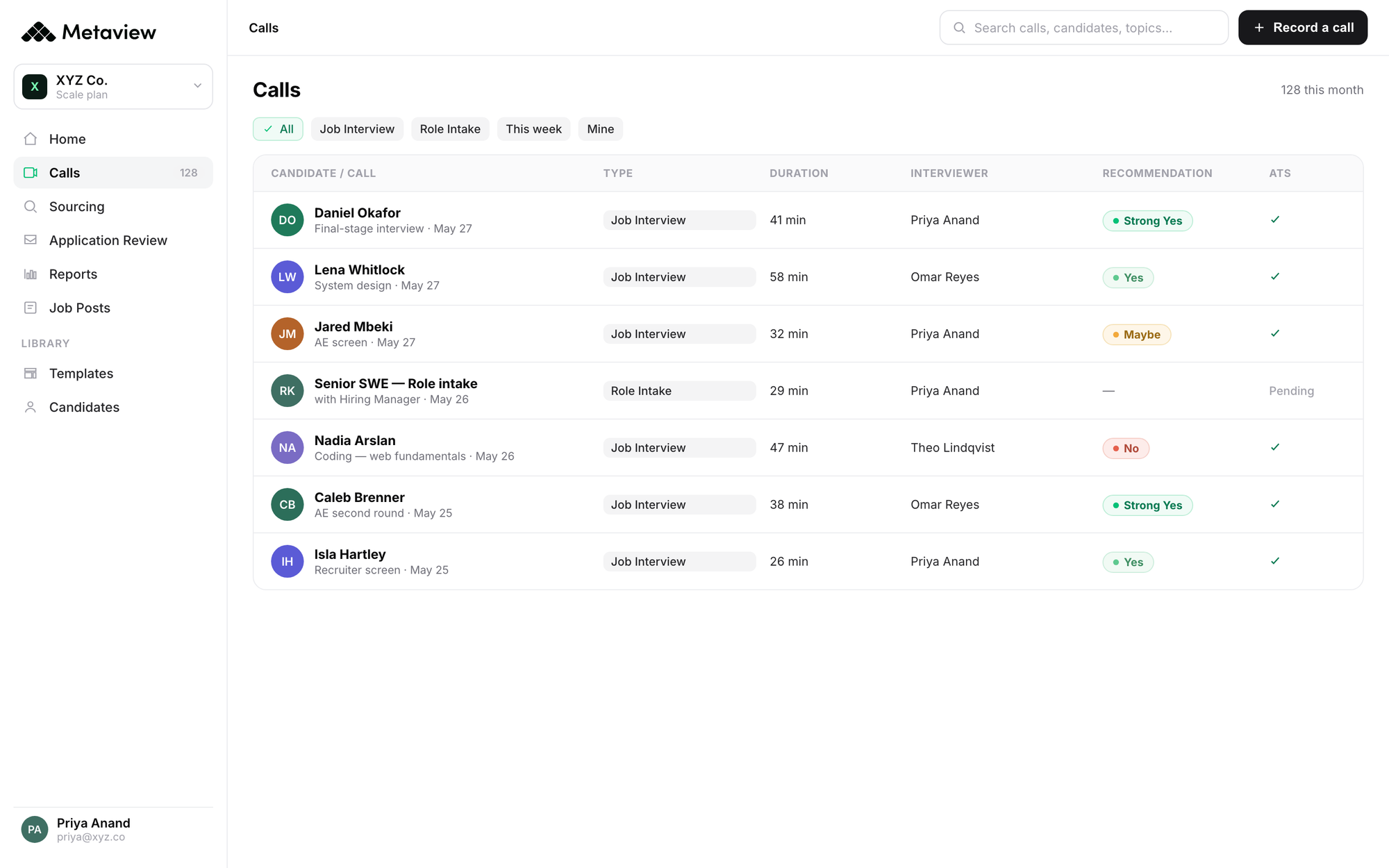
By the time you open your laptop, the low-risk work has already moved. The sourcing agent has a shortlist running from this morning's intake, and the job post is written off that same intake, in your brand voice, ready for you to edit.
The inbound that piled up overnight has been read against your Ideal Candidate Profile and ranked by fit, with the reasoning attached to each one.
You open a short, explained list instead of the whole overnight stack, and the calls that matter, who advances and who does not, are still yours to make.
The real trade-off: shared context cuts both ways
A shared context layer that only saved a few minutes per task wouldn't be worth restructuring your hiring around. It matters, and it needs handling with care, for the same reason: every agent reads from one source, so their output is coupled.
Get the context right and the coupling works for you. Get it wrong and it works against you just as fast.
Say the role intake recorded a requirement that was subtly off, or two hiring managers meant different things by senior and it never got reconciled. That error stays local when you have ten separate copilots: one recruiter works from a slightly wrong picture and the others don't.
Give the sourcing agent, the job post, the application ranking, and the reports one shared context and they all inherit the same wrong picture, looking perfectly consistent the whole time.
Isolated tools fail in different directions, so the mess is obvious. Coordinated agents fail in the same direction, and it reads like agreement.
A shared context passes along whatever it was handed, so someone has to correct it. That means recruiters pushing back on what the agents get wrong, and settling the cases where two people described the role differently.
The teams that get the most out of this own the shared context and maintain it, the way you'd maintain any record the whole team depends on. Do that work and everyone argues from the same record instead of from memory.
Hiring managers now see our recruiting team as strategic partners rather than people filling roles. When a hire takes longer than expected, everyone understands why, based on the data, which builds trust and sets appropriate expectations.”

What this changes for how you build the team
For a founder, the hours saved on any one task matter less than what a shared context does to the shape of your team.
Your best recruiter stops being measured by resumes processed once the agents handle the mechanical work off one context layer, and starts being measured by how sharply they define the role and how fast they catch the agents when they're wrong. The job moves from doing the work to steering it, and that's what you should hire and promote for.
An agent is only as good as the context it reads, and that is the limitation everything above rests on. Most of what anyone truly knows about a candidate gets said out loud in an interview and then lost.
Closing that gap is the reason Metaview exists. The Notetaker captures what was actually said in each interview, so the shared context carries a candidate's own words and doesn't lean on a form someone half-filled, and native integrations keep that record with the candidate as they move through your stack.
Capturing the context is the easy half, and keeping it honest is where the effort goes. A shared layer will carry a wrong assumption as faithfully as a right one.
So the work that never goes away, the part a platform can't do for you, is deciding what good looks like and correcting the agents when they drift from it. That judgment is the job, and the agents make sure the whole team is finally working from the same version of it.
Give your team an agentic platform rather than another copilot.
Set the guardrails, point the agents at a live role, and let sourcing, review, interviews, and reporting work from one shared understanding of what great looks like.
Frequently asked questions
What is an agentic recruiting platform?
An agentic recruiting platform is a recruiting system where AI agents act on their own, under guardrails you set, off one shared layer of context, across sourcing, application review, interviews, and reporting. An ATS with AI features attached still stores records and waits for a person to act on them. An agent takes the next step from instructions set once, and reads the same understanding of the role that every other agent reads.
Does an agentic platform replace our ATS?
Metaview sits alongside your ATS rather than replacing it. Candidates sync from the ATS into Metaview, which is its own surface, so the agents do not run inside your ATS interface. Accept and reject decisions made in Metaview push back to Ashby, Greenhouse, Lever, and SmartRecruiters; the other supported integrations are sync-in only, so those decisions get recorded in the ATS by hand. Application Review also supports a shorter list of ATSs than the platform does overall, so check yours before you plan a rollout around it.
Do the agents act without human approval?
They start low-risk steps on their own, like beginning a search after an intake call, and the consequential decisions stay with you. Setting that up means deciding, agent by agent, what it can do unprompted, which actions should raise an alert, and which have to stop and wait for a person. Metaview never auto-rejects a candidate, every output can be reviewed, edited, or overridden, and every action leaves an audit trail of the reasoning behind it. A human always makes the final call on who moves forward.
Who on the team owns correcting the agents?
In practice it is whoever owns the role definition, usually the recruiter on the req, with the hiring manager settling disagreements about what a requirement actually means. The correcting happens inside the normal work: overriding a fit call the agent got wrong, editing the Ideal Candidate Profile as the role sharpens, and reconciling two different readings of the same requirement. Name that person when the role opens. If a role has no named owner, the shared context drifts and every agent drifts with it.
What happens to the shared context when a role reopens months later?
The record stays with the role rather than being rebuilt from a blank page. The sourcing agent searches your connected ATS and your team's own past Metaview conversations alongside the web, so the people you interviewed the first time are still in scope, with what they actually said attached. One thing to do before you reopen: update the Ideal Candidate Profile first, because Application Review assesses each application when the candidate is added and does not go back and re-assess candidates already in the system after the profile changes.
Which agent should a team turn on first?
Every user gets access to the full platform but only uses and pays for the agents they need, so this is a sequencing question rather than a licensing one. Most teams start with the Notetaker, because every other agent reads from what it captures and starting there means the shared context already exists when sourcing or Application Review comes next. Teams whose bottleneck is inbound volume often start with Application Review instead, and accept that its first passes work from a thinner context until the interview record fills in.
