
Most recruiting teams in 2026 have an AI tool problem and no AI strategy problem to match. There's a notetaker on every call. A Chrome extension that drafts every outreach message. A GPT that summarizes intake notes. A separate one that scores resumes. The individual workflows feel faster. The function still feels stuck. Offers don't close any quicker, hiring managers still ask the same calibration questions in week six that they asked in week one, and leadership still gets the same vibe-check answers when they ask what the hiring data says.
That gap has a name. The crawl-walk-run framing Metaview popularized two years ago was useful as a starting prompt, but the real ladder is sharper. AI in recruiting moves through three rungs: automate, standardize, instrument. Automate is where most stacks live. Standardize is the bridge most teams skip. Instrument is the rung that compounds. The teams pulling away in 2026 are the ones who treated the bottom rung as a starting point, not a finish line.
According to Metaview's 2026 AI & Hiring Alignment Report, surveying 505 recruiting leaders and hiring managers across North America and EMEA, 85% of companies exceeding their hiring goals use AI in hiring. The catch in the same dataset: only 21% of teams who use AI occasionally rate their hiring relationships as excellent, vs 55% of teams who put AI at the core. The 2026 difference is not whether you adopted AI. It's where on the ladder you stopped.
Rung 1: Automate (where most AI recruiting stacks plateau).
Automate is the rung every team can climb to in a sprint. A recruiter installs a notetaker. The hiring manager adds a Chrome extension that drafts a take-home prompt. Sourcers run their own custom GPT for Boolean strings. The individual productivity lift is real and immediate, which is why this rung is sticky. The trouble is what it does NOT change.
Captured signal stays trapped at the individual level. The recruiter who runs the best intake call captures a great structured note, which gets pasted into the ATS, which nobody else reads. The hiring manager who debriefs cleanest writes a careful scorecard that the next interviewer in the chain never sees. Each recruiter's automation is its own private archipelago. The TA function as a whole inherits none of it.
That's the plateau. The team is using AI. The team is genuinely faster on per-recruiter throughput. The team also gets identical answers to the same calibration question across six different hiring managers, ships offers at the same interview-to-offer ratio it had a year ago, and tells leadership the same anecdotes when asked why a search is slipping. Automate moves the individual. It does not move the team.
The diagnostic is simple. If your team uses AI heavily but a hiring manager in another business unit can't see the structured notes your recruiter took on the same role last month, you are on the automate rung. The signal exists. It is just stranded.
Talent 1.0 is advice. Talent 2.0 is doing.”
Rung 2: Standardize (the bridge most teams skip).
The second rung is where the signal stops being personal. Standardize is the bridge from individual copilots to a shared layer. It is also the rung most teams skip because the gains are less visible per-recruiter and the work is unglamorous. The leverage shows up at the function level, on the next manager-recruiter pairing, on the next search you don't run yet. Four shifts have to happen for a team to actually leave automate behind.
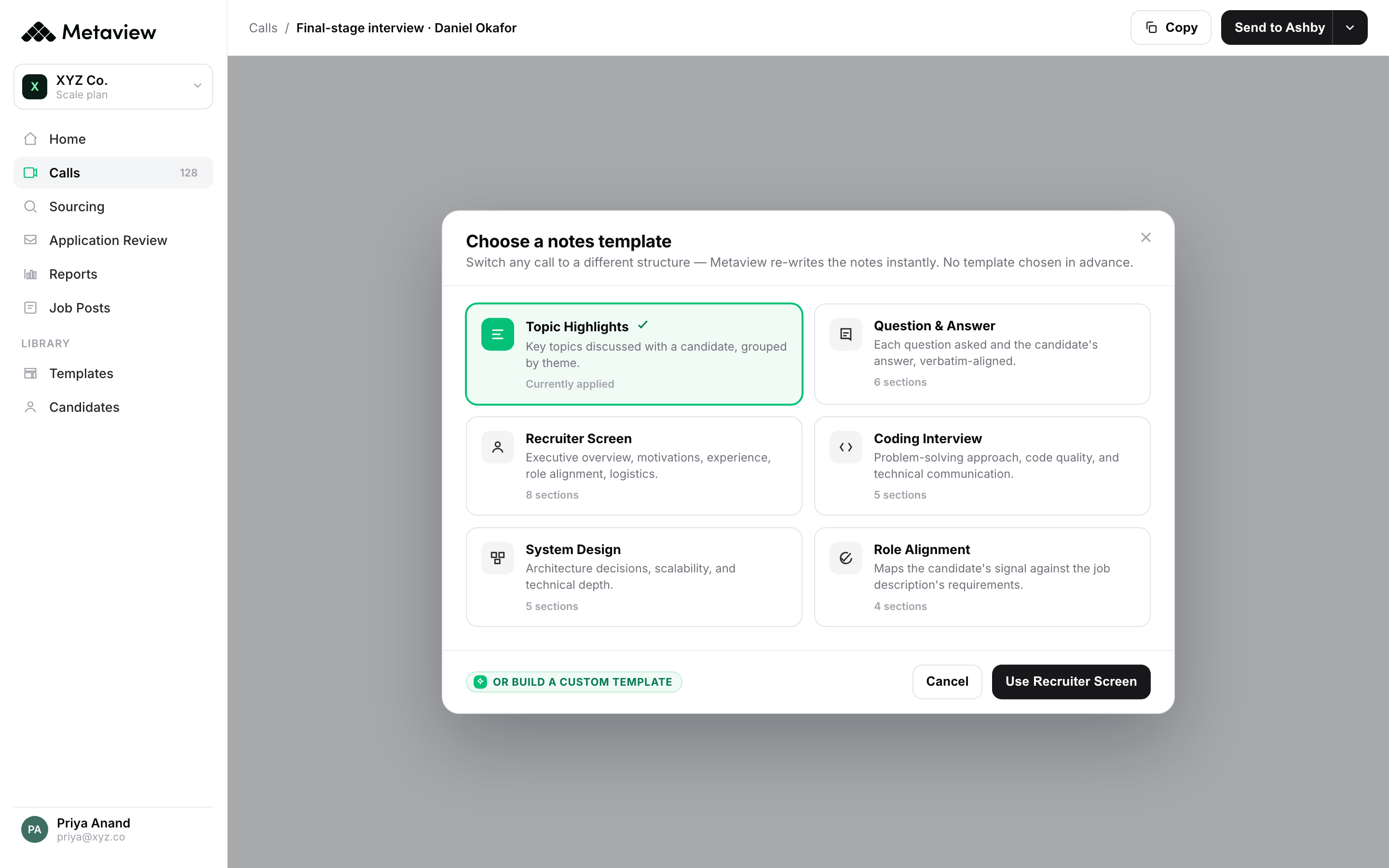
Templated capture across every recruiter, on every call.
Standardize starts by killing the recruiter-by-recruiter format. The intake template, the screening rubric, the debrief structure: same shape on every call across the function. The tool changes from a per-user notetaker to a shared capture layer. That shift is what lets a search the senior recruiter starts in week one actually be handed off to a junior recruiter in week six without losing the thread.
Scorecards that interviewers don't fill in manually.
If interviewers still type their scorecards from memory after every panel, you are still on rung one. The standardize move is auto-populated scorecards that draft themselves from the structured capture of the actual interview. The interviewer reviews, edits, submits in two minutes. The scorecard now reflects what happened, not what the interviewer remembered three hours later. Scorecard submission rate goes up. Inter-panel calibration drift goes down.
Cross-panel transcripts your whole team can read.
A hiring manager should be able to read what was said in the values interview before they walk into the technical debrief. The next recruiter on the role should be able to read what the candidate said about compensation expectations on the screening call before the offer conversation. None of that requires watching interviews back. It requires the transcripts to live in one searchable place that every panelist can open.
ATS write-back that closes the loop.
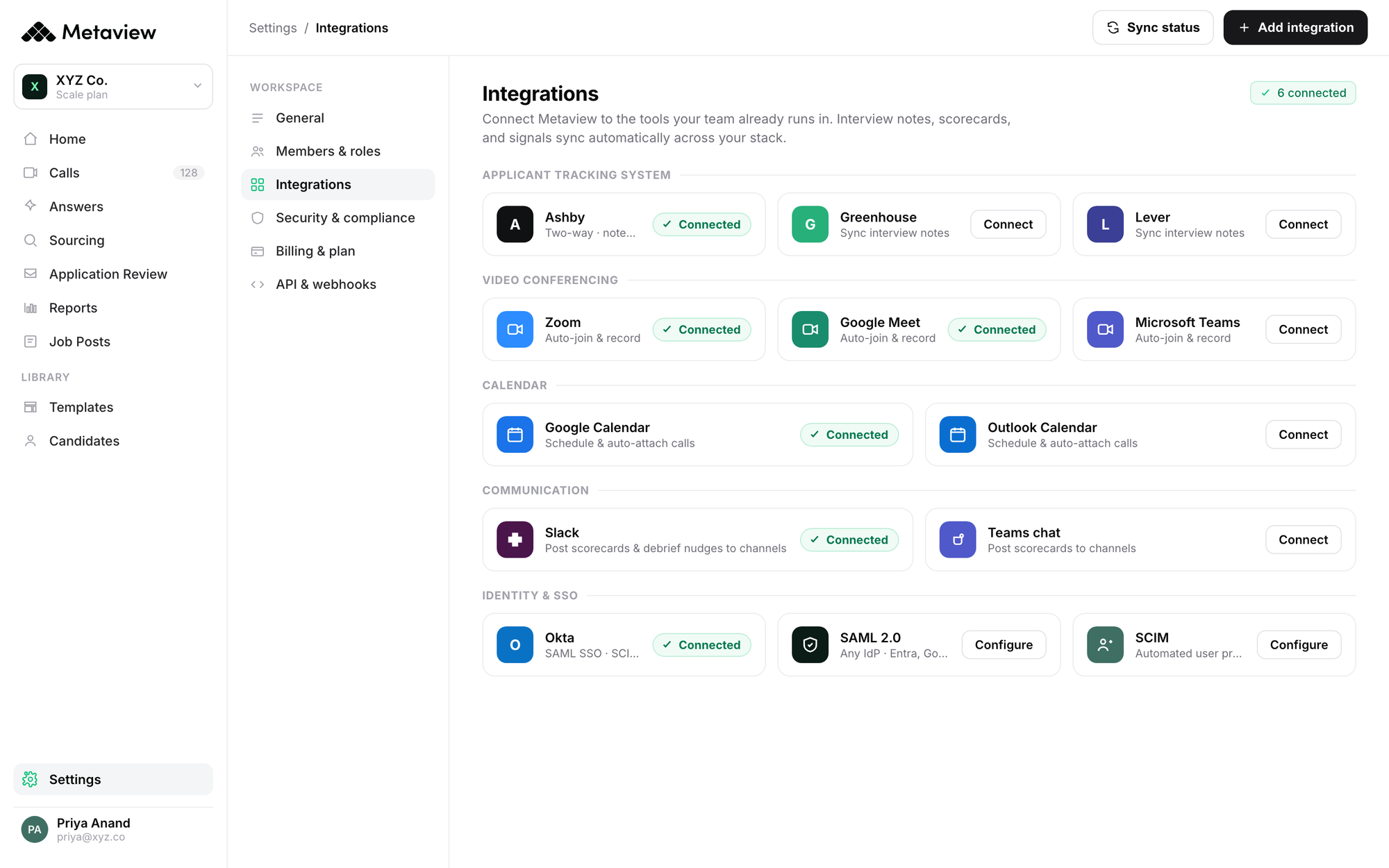
If your standardized capture and your structured scorecards live in a separate tool from the system of record, every recruiter spends 10 minutes per candidate copying fields. The standardize rung means the structured data flows back into Ashby, Greenhouse, Workday, or Lever automatically. Hiring stages advance from real signal, not from manual data entry. Vendor count drops. The data layer collapses from many to one.
Rung 3: Instrument (the layer no copilot can reach).
The third rung is the one no copilot can reach because the unit of work changes. Automate is about saving an individual recruiter time. Standardize is about making one team's signal shared. Instrument is about turning the whole pool of captured signal into queryable hiring intelligence the business can act on.
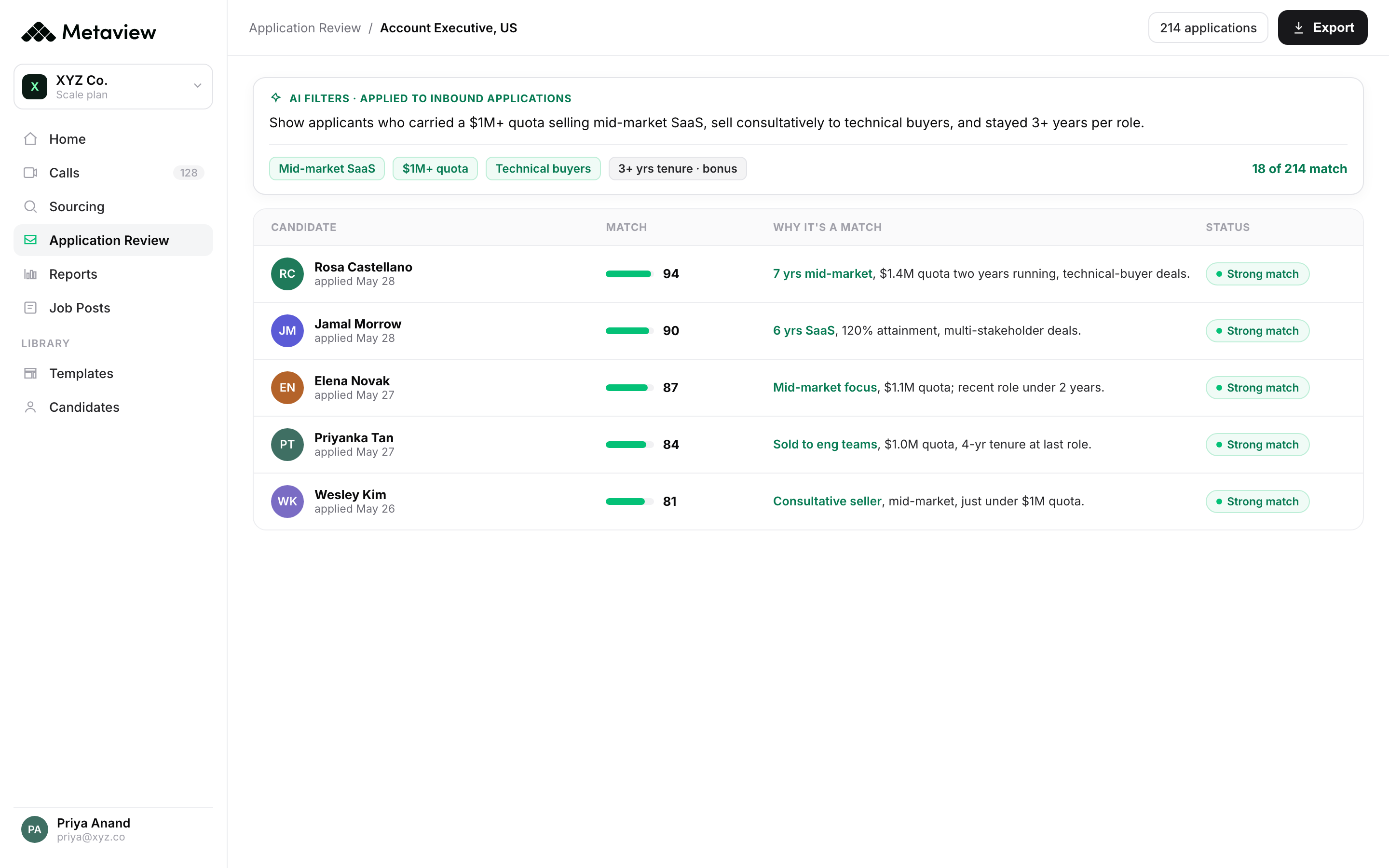
On the instrument rung you stop asking who took the best intake notes on this role and start asking across the last 30 backend engineer interviews, what were the main reasons for rejection, broken out by city and seniority? You stop wondering whether your Lisbon comp band is competitive and start asking the AI assistant to read all 20 conversations you had with Lisbon candidates this month and surface the median expectation. You stop manually auditing which interviewers carry the highest false-positive rate and start querying the captured signal directly. The work that lived in a manager's head, in spreadsheets, in vibe checks, becomes data you can interrogate.
This is the part of the ladder that delivers the auditor-friendly metrics: comp band heatmaps, interviewer-quality dashboards, market-by-market insight cards built from real conversations. Reports become two-click rather than weeks of manual scorecard scraping. The AI Sourcing Agent can search your ATS, your historic transcripts, and the live web in the same query, scoring candidates against an ICP the team agreed on together rather than against a private prompt one recruiter wrote on a Friday night.
Instrument is also where AI stops feeling like a copilot stack and starts feeling like a platform. Recruiters spend less time running the system and more time on the parts of the job that don't compress: closing candidates, calibrating hiring managers, hiring well at the senior end. The signal layer carries the weight that used to sit on individual memory.
The rung-to-fix map: comparing copilot, specialized, and coordinated AI.
| Dimension | Manual | Copilot AI | Specialized AI | Metaview (coordinated) |
|---|---|---|---|---|
| Capture | Recruiter typing into the ATS after the call | Generic notetaker draft, per recruiter, per format | Recruiting-specific notetaker tuned to interview structure | Templated capture, identical across every panelist on every call |
| Scorecards | Written from memory, hours after the panel | AI-drafted from the recruiter's personal notes | Auto-drafted from a transcript, single recruiter | Auto-drafted from structured capture, every interviewer, ATS-synced |
| Cross-panel signal | Whoever talks loudest in debrief | Each recruiter's own summary, private to them | Available if you watch the interview back | Searchable transcript layer every panelist can open before the next round |
| Cross-team query | CSV export, manual pivot, two-day wait | Not possible, signal is stranded | Possible for that vendor's data only | Natural-language query against the full pool, two clicks |
| Vendor count | ATS only | 11+ tools, one per workflow | 3 to 5 recruiting-specific tools | One coordinated platform that owns capture, scorecards, signal |
| What breaks at scale | Everything, recruiter by recruiter | Each recruiter's private archipelago | Tool sprawl, data fragmentation | Nothing inside the platform; data layer compounds |
The 2026 buying mistake: paying for AI that is actually copilot mode.
The buying mistake in 2026 is treating every line on the recruiting tech roadmap as if it were equivalent. They are not. There is a structural difference between paying for AI that sits inside one recruiter's workflow and paying for AI that sits across the team's signal. The first category never crosses the standardize rung. The second is built for it.
Three buying patterns reveal which side of the line a tool sits on. Per-seat copilot SaaS that prices by user and adds capability only to that user. Useful at automate, ceiling at standardize. Generic transcription tools that capture audio but have no structured concept of intake, panel, scorecard, or candidate stage. Hard to lift above rung one because the data has no recruiting grammar. Point solutions per workflow (one tool for sourcing, one for scheduling, one for assessment, one for interview intelligence) where each vendor optimizes its own loop. Tool count keeps climbing, data never converges, the standardize bridge stays uncrossed.
The cleanest test before any AI purchase: does this tool make one person faster, or does it make the team's next decision better? Both can be true. But if only the first is true, you have bought another automate-rung component, not a way off the rung.
The real competitive advantage is effective AI adoption vs. everyone else. The teams doing this well are building alignment at every stage. AI earns its keep when it both strips out the mechanical work and surfaces the signal that helps recruiters actually close. Alignment isn't just a kickoff, it's infrastructure.”

How to upgrade your team's rung in 90 days.
The ladder is not a budget meeting. It's a 12-week sequence with a different decision at each rung. The plan below is what we see working at TA functions of 50 to 500 hires per year. Faster if you start with strong process documentation, slower if your current stack is six copilots that nobody officially owns.
- Weeks 1-4: audit the automate rung. Inventory every AI tool currently in use, who owns it, what it captures, where the output goes. Identify the recruiters who are the strongest individual operators, then ask: would the rest of the team benefit if their intake template were the team default? If yes, you have your standardize candidate.
- Weeks 5-8: install standardize. Pick one shared capture layer. Templated intake, screening, debrief. One scorecard rubric per role family, auto-populated from the structured capture. ATS write-back turned on so the data flows back to the system of record. Sunset the per-recruiter notetakers and Chrome extensions that won the rung one battle but won't carry rung two.
- Weeks 9-12: turn on instrument. Wire up reporting and natural-language query against the now-shared signal layer. Run your first cross-team query: pick a market, a role family, or an interviewer cohort and ask a question you could not ask three months ago. The first instrument-rung query is the moment the rest of the function notices the ladder existed.
- Week 13 and beyond: measure the compounding. Interview-to-offer ratio. Scorecard submission time. Time from intake to first slate. Hiring manager satisfaction score on a quarterly cadence. The instrument-rung outputs become the new baseline you run TA reviews against, replacing vibe checks with queryable answers.
 Metaview Technologies
Watch how a coordinated AI platform replaces the copilot archipelago, end-to-end, in under three minutes.
Frequently asked questions.
What is the difference between automate, standardize, and instrument AI in recruiting?
Automate AI saves an individual recruiter time, typically via a notetaker, GPT, or per-seat copilot. Standardize AI turns that captured signal into a shared layer across the team via templated capture, auto-populated scorecards, and ATS write-back. Instrument AI lets the whole team query the pool of captured signal in natural language: comp bands, interviewer quality, market insights, candidate sentiment. Most teams have automate. Few cross to standardize. The instrument rung is where the compounding lives.
How do I tell which rung my team is currently on?
Ask one question across the team: can a hiring manager in another business unit read the structured notes a recruiter took on the same role last month? If no, you are still on automate, even if every recruiter uses AI. If yes but the data is not queryable across roles, markets, or interviewers, you are on standardize. If a TA leader can ask the AI assistant 'across the last 30 backend conversations, what were the main rejection reasons' and get a real answer in two clicks, you are on instrument.
What is the simplest standardize move a TA team can make this quarter?
Pick one shared capture template (intake, screening, or debrief) and make it the default across every recruiter, with ATS write-back turned on. That single move forces the team off the per-recruiter notetaker archipelago and into a shared signal layer. Within four to six weeks, scorecard submission times shorten, cross-panel debriefs reference the same source of truth, and the data layer collapses from many private formats into one queryable one.
Can a recruiting team skip rung 2 and go straight from automate to instrument?
Not really. Instrument-rung queries depend on the pool of captured signal being consistent enough to interrogate. If five recruiters captured the same intake call in five different formats, no amount of AI sitting on top can produce a clean comp-band query. The instrument rung delivers compounding only when the standardize rung has cleaned up the underlying data layer. You can install the tools in parallel, but the compounding only kicks in once the signal is shared.
Where does Metaview sit in the AI adoption ladder?
Metaview is built as a coordinated platform that covers all three rungs from one capture layer. Templated intake, screening, and debrief replace per-recruiter notetakers (automate, standardized as a side-effect). Auto-populated scorecards and ATS write-back close the standardize rung. AI Filters, Reports, and the AI Sourcing Agent unlock the instrument rung against the shared signal layer. Teams typically move from rung one to rung three in the same 90-day install rather than running three separate vendor evaluations.
