
Most recruiting leaders try to scale by lowering the bar a little when the volume gets high. Greg Garrison built the opposite muscle at Google (1,000+ recruiters hired without dropping productivity) and brought the same operating model to Coinbase. The throughline is talent density, defended top-down, every hire.
Greg Garrison (VP of Talent at Coinbase, formerly the architect of Google's Austin recruiting operation) joined Nolan Church on 10x Recruiting (more episodes on the 10x Recruiting hub) . The conversation walks through the operating system behind a 10x talent culture: how to scale a recruiting team without sacrificing quality, and what separates elite recruiters from average ones. It also gets into why the CEO has to review every offer, and how Coinbase uses work trials as the highest-signal hiring move.
This recap covers Greg's mental model for spotting top recruiters and the leaderboard play that nudged Google's Austin team into the top quartile. It walks through the five-component talent density system at Coinbase, the CEO-approval forcing function, and where AI fits into all of it.
100 recruiters in 90 days, without dropping the bar.
Google centralized its North American recruiting in Austin and gave Greg an impossible-sounding mandate: hire 100 recruiters in 90 days, and make sure their productivity per recruiter matches or beats the existing operations. The default playbook would have lowered the bar to hit the headcount target. Greg did the opposite.
The first move was internal recruiting. Before hiring a single external recruiter, Greg surveyed the existing Google bench for the strongest leaders he could pull into the new site. A small founding team of high performers, then scale around them. Top recruiters attract top recruiters; mediocre recruiters attract mediocre recruiters. Founding-team quality dictates ceiling for the next 24 months of hiring.
The Austin operation hit the productivity bar within the first year and stayed there. The lesson: when scale and quality look like they're in tension, the answer is never "lower the bar." It is "start with a smaller core of the right people and let the multiplier compound."
The mental model for spotting elite recruiters.
After hiring thousands of recruiters across Google and Coinbase, Greg has converged on three signals that separate the top quartile from the rest.
Signal one: a college degree, anywhere. Not about prestige (Harvard or state school both work) but as a baseline indicator of work ethic and intellectual capacity. The Google data showed clear top-right separation between degree and non-degree recruiter performance.
Signal two: agency recruiting background. Agencies invest heavily in teaching the craft, and the commission-tied performance loop builds resilience. Recruiters who survived agency life arrive with hustle already wired in.
Signal three: a competitive background. This is the one most leaders under-weight.
I love to hire recruiters who grew up in a competitive environment. It's the will to win. I want someone with a strong drive to succeed.”

Greg has hired Olympic athletes, college sports captains, and a former competitive ballroom dancer who became one of his best recruiters. The unifying trait: people who internalized a scoreboard early in life. They self-correct, they hate losing, and they treat every quarter as a contest. This separates the "thrivers" from the "drivers" (solid but not elite) and the "survivors" (just keeping up).
The leaderboard play.
Greg's cultural artifact from the Austin Google build: a weekly leaderboard, posted publicly every Monday morning, naming the top 25% of recruiters by the team's core productivity metric.
The original version posted the whole ranked list. Greg killed that early. The point of the leaderboard is to surface excellence, not to shame the bottom decile. Posting only the top 25% kept morale high while creating an aspirational target everyone in the office walked past on Monday.
The leaderboard separated two kinds of recruiters: the ones who never looked at it (typically mid-pack performers content with their numbers) and the ones who stood outside Greg's office on Monday morning to see if they made the list. The second group was the future leadership bench. The simple act of making excellence visible compounded over time.
Talent density: the Coinbase operating system.
When Greg moved to Coinbase, he layered the Google scaling lessons on top of an explicit talent density initiative. Every team filled with top-tier talent, no exceptions. Five components support the system:
Cognitive assessments (not pass/fail, used as one data point with benchmarks by job family). Cultural assessments (signal alignment with Coinbase's operating values). Technical evaluations (skill-specific). Executive offer approval (CEO + President sign every offer). Internships as work trials (the highest-signal way to evaluate any candidate, junior or senior).
You get out of it what you put into it. If you're taking up a seat while I'm trying to find the next Michael Jordan to join the team, you need to earn that seat.”
The cognitive assessment is the most polarizing piece, and that polarization is the feature. Candidates who opt out are typically not aligned with the Coinbase operating model anyway. The candidates who lean into the assessments are the ones who self-select into the culture. The system filters as much by candidate willingness as by candidate score.
Work trials are the part Greg believes carries the most signal. A real business problem, two to three days, the candidate ships a solution and presents it to the team. Structured interviewing still matters, but the work trial reveals problem-solving, written communication, presentation skill, and feedback handling all in one pass.
My opinion is we get the greatest signal from these work trials. More so than structured interviewing.”
CEO approval as the forcing function.
The single most consequential piece of the Coinbase talent density system is the executive offer review. Brian Armstrong (CEO) and Emilie Choi (President) review every offer packet before it gets sent.
If I know every hire is going to Brian and Emily, it fundamentally changes how my recruiters operate and who they engage.”
The forcing function is psychological as much as procedural. Recruiters and hiring managers know the packet has to clear two of the most demanding readers in the company, so the slate gets sharper before it ever leaves the hiring team. Bar enforcement migrates from a recruiting-team problem to a CEO-level commitment, and that single shift is what makes the system durable.
Greg's blunt advice to other TA leaders: if you care more about talent quality than your CEO does, you will lose every battle that matters. Start by getting the executive commitment in writing and visible, or do not try to run a talent density playbook at all.
Where AI gives recruiting teams use.
The Coinbase operating model relies on disciplined, evidence-based decisions at every interview stage. AI is what makes that depth tractable when the volume is real. The infrastructure to do this is already built.
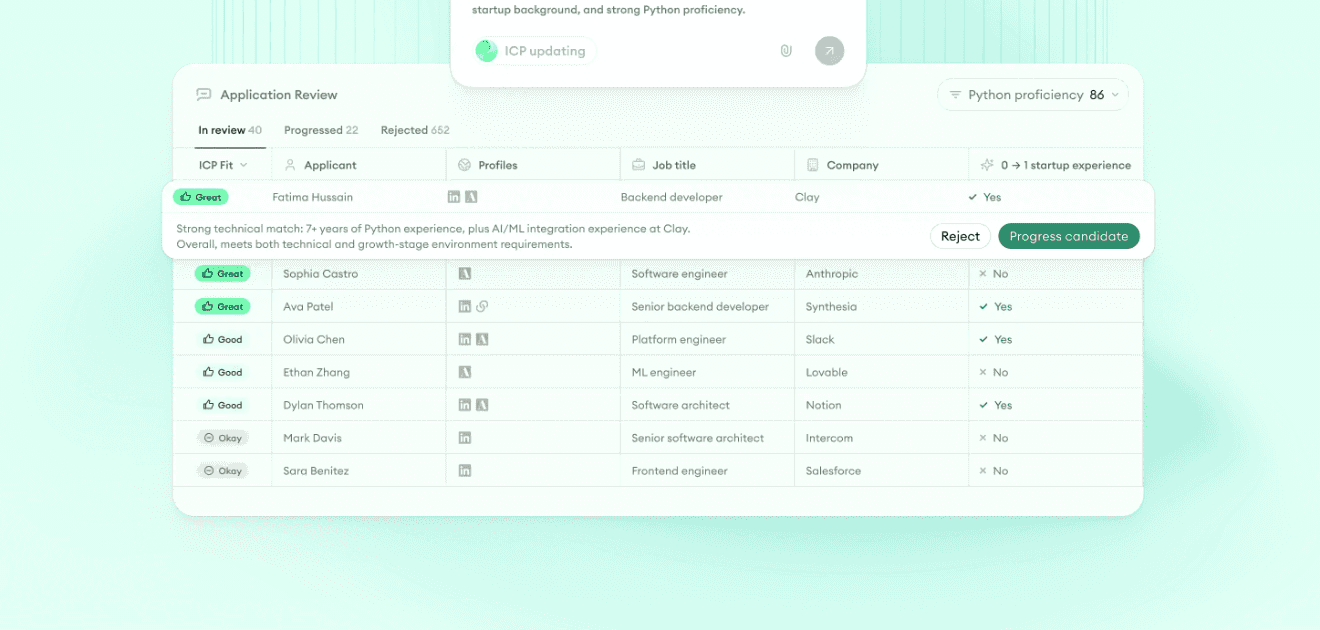
Metaview Notetaker captures every interview verbatim, so the executive offer review packet is backed by actual evidence instead of recall. Application Review handles the inbound volume so the senior recruiter hours go to the candidates who need real conversation. Reports tracks whether the hires you made are still performing 12 to 18 months in, closing the loop on whether the bar was actually set right. For the AI-augmented-recruiter angle on this shift, see claude-for-recruiters.
Numbers from the 2026 AI & Hiring Alignment Report, based on surveying 505 recruiting leaders and hiring managers across North America and EMEA. The 79% business-outcomes stat maps directly to Greg's talent density thesis: AI captures the evidence that lets the CEO offer review actually function with data, not memory.
Heads up: The 79% business-outcomes figure comes from TA leaders who have deployed AI across at least one structured hiring stage. Teams using AI only for sourcing see significantly lower downstream impact — the use compounds when it runs through screening, notes, and offer review together.
The operating shift.
Three concrete moves from Greg's playbook for any team trying to install a real talent density system:
One: get the CEO commitment in writing before you touch anything else. Without it, every contested hire becomes an exception, and the exceptions become the rule. With it, the bar holds even when the timeline gets uncomfortable.
Two: rewrite your recruiter screening to weight grit alongside experience. Add competitive-background questions to the interview loop. Track which recruiters with which backgrounds outperform; let the data validate the framework before you scale it.
Three: replace one structured interview with a work trial on your next senior hire. Pick a real business challenge, two to three days, present-back to the team. Compare the signal to your existing process. Once you see the depth difference, you will stop running the old loop.
The teams that build talent density into the operating model will out-hire the ones still treating it as a slogan. That is the operating shift.




Bring Metaview into your hiring stack.
Live notes, structured scorecards, and ATS sync - set up in under 10 minutes.
Frequently asked questions.
How did Greg hire 100 recruiters in 90 days without dropping the bar?
By starting with internal recruiting at Google to assemble a small founding team of proven high performers, then scaling around them. Top recruiters attract top recruiters; the founding-team quality set the ceiling for everything that followed. Productivity per recruiter matched or beat existing operations within the first year.
What three signals does Greg use to spot elite recruiter candidates?
College degree (any school, signals work ethic), agency recruiting background (builds resilience and hustle), and competitive history (Olympic athletes, college sports captains, even a competitive ballroom dancer). The competitive trait is the one most leaders under-weight; it separates the thrivers from the drivers and survivors.
Why does Coinbase have the CEO review every offer?
Because bar enforcement only holds when ownership lives at the top. When recruiters and hiring managers know Brian Armstrong and Emilie Choi will read every offer packet, the slate gets sharper before it ever leaves the hiring team. Without that forcing function, exceptions accumulate and the bar drifts down.
How do work trials at Coinbase actually run?
A real business problem, presented to the candidate, with two to three days to ship a solution. The candidate then presents back to the hiring team. The format surfaces problem-solving, written communication, presentation, and feedback handling in a single pass. Greg considers work trials a higher-signal evaluation than any structured interview loop.
What happens to recruiters who opt out of cognitive assessments?
They self-select out of the process, which Greg considers a feature, not a bug. The assessments are polarizing on purpose. Candidates who lean in tend to be aligned with the Coinbase operating model; candidates who opt out tend not to be. The filter works as much by willingness as by score.
