
Some job requisitions cover two jobs at once. A title like “Software Engineer, Mid-Level or Senior” lets the hiring manager hire at either level, and the budget covers both. But the requisition still gets one ideal candidate profile for multiple levels, and that profile has to pick one set of requirements.
The problem grows once artificial intelligence (AI) reads the applications, because AI judges each one against the profile you give it. If the profile describes the senior job, strong mid-level applicants look weak. If it describes the mid-level job, you can’t tell who is ready for the senior one.
The mismatch often starts before anyone applies. Metaview’s 2026 AI & Hiring Alignment Report surveyed 505 recruiting leaders and hiring managers. On teams that don’t use AI in hiring, respondents said 49% of searches start with the recruiter and hiring manager aligned on requirements.¹
In the rest, the two weren’t aligned at the start. A requisition that covers two levels gives them even more to disagree about.
This guide shows you when to split one requisition into separate roles, each with its own profile. You’ll get four questions to ask before AI reads an application. A table turns each answer into a decision, and three checks cover requisitions that are already open.
My rule is short: split when a requirement differs, and for nothing else.
What is an ideal candidate profile?
An ideal candidate profile is a written description of who the role needs. It lists the must-haves, the non-negotiables an application has to show, and the preferences that make a strong application stronger.
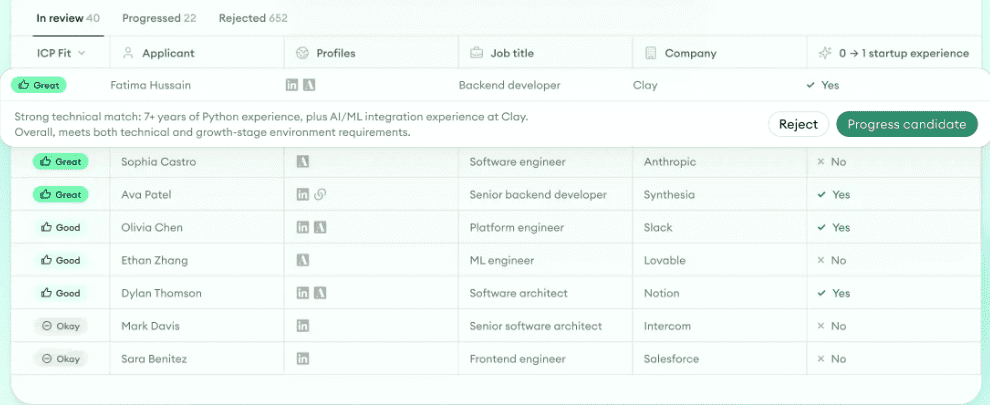
In Metaview, the profile is what Application Review works from. That AI agent reads each application against the profile and places it in a fit bucket, “Great,” “Good,” “Okay,” or “Poor,” with its reasoning beside it.
A person approves the profile before anything is read against it. After that, a recruiter makes every accept and reject decision.
A profile describes one job well. Point it at two levels, and it goes wrong in one of two ways.
- Written for the mid-level job, it holds senior applicants to requirements they all clear. Mid-level applicants who lack a senior-only skill can land in “Great” beside them, so you can’t see who is ready for the senior role.
- Written for the senior job, it asks mid-level applicants for experience their job never needed. The strongest of them can land in “Okay” or “Poor” for missing something that was never theirs to meet.
Either way, someone on your team ends up reading past the label to find the right people.
When to split an ideal candidate profile for multiple levels.
Splitting means opening separate roles or job posts in your applicant tracking system (ATS), one for each version of the job. Each role then gets its own profile. Ask these four questions before the requisition opens.
- Do the requirements differ between the levels?
- Does one location bring its own requirement?
- Will a different hiring manager sign off on each version?
- Will each version run a different interview loop?
The first question decides it, and the other three help you find a requirement difference that no one has said out loud. Here’s what each answer means for the requisition.
| What you find | Requisition decision | Why |
|---|---|---|
| A requirement differs between the levels | Split into separate roles, each with its own profile | One profile can hold one list of requirements |
| One location needs its own requirement, such as a working language | Split by location | It’s a requirement only one country has |
| Locations differ, but the requirements match | Keep one role and one profile | Add the location as one requirement in the profile |
| Two hiring managers agree on every requirement | Keep one role and one profile | A split would protect agreement they already have |
| Two hiring managers can’t agree on the requirements | Settle the requirements before the role opens; split only if they’re hiring for different jobs | A disagreement about one job needs calibration, and a second pipeline won’t settle it |
| Different interview loops, same requirements | Keep one profile | The loop starts after the profile has done its job |
| Only the title or the pay band differs | Keep one profile | Nothing the profile reads has changed |
Every split in that table comes back to one different requirement. A different interview loop can be a sign of one, so ask the first question again when the loops differ.
Settling this before the search starts is a habit some talent leaders enforce. Lucy Lynn, Head of Talent at Cleo, won’t let her team start a search without the right documentation. On 10x Recruiting, she explains why.
Two hiring managers, one requisition.
This question is easy to skip when the working relationship feels fine. In the same report, 90% of respondents rated their relationship with their counterpart as “good” or “excellent.”¹ That’s good news, but it doesn’t mean the two agree on the job. The survey asked about the relationship and about requirements as two different questions.
Here’s a tempting reading of the survey. Where AI is core to hiring, 68% of searches start with the recruiter and the hiring manager aligned on requirements.¹ It’s easy to give AI the credit.
I wouldn’t. The survey compares groups, and teams that put AI at the center of hiring may already run tighter intake calls. The gap shows the groups differ, and it can’t say why.
Siadhal Magos is Metaview’s Co-Founder and Chief Executive Officer. On the HR Heretics podcast in October 2025, he described the recruiter’s job this way: “Your job is to make sure you’re sort of calibrated with the hiring manager and know what ‘great’ looks like.”
Two hiring managers on one requisition can mean two versions of great.
Metaview captures every spoken word of the intake call. So if two hiring managers describe the role in different terms, you have both versions in their own words before anyone writes a requirement down.
Ask ten people what makes a “great hire,” and you’ll get ten different answers.”

One role, several countries.
Location can hide a requirement. A role open in two countries needs two profiles only when one country adds a requirement the other doesn’t. A working language the local team uses every day is a common example.
If the requirements match, list the location once inside a single profile. Splitting would only divide your applicant pool.
Why overrides are the wrong fix.
When the buckets look wrong, the quick fix is right in front of the recruiter. They advance the applicant the profile placed too low and move on. With two levels in play, that fix keeps coming back, because every applicant from the other level meets requirements written for someone else.
The corrections also go somewhere. Application Review’s profile learns from your “accept” and “reject” decisions. On a two-level requisition, those decisions describe two jobs, and I wouldn’t ask one profile to learn both.
The reasoning behind each placement is where a wrong profile shows first. Workleap, a people management company, uses Application Review to read its applications, and what stood out to its team was the reasoning.
Johnny Drexhage, Senior Recruiter at Workleap, says Application Review “explains why a candidate is a good or a bad fit.” The case study quotes him on the outcome: “It’s reduced my screening time by up to 50%.”
When one requisition covers two levels, the reasoning is also where the other level’s requirement shows up by name.
So the fix belongs in the requisition, before the first application arrives. Fixing the criteria beats overriding the same bucket every week. The profile also works best when it’s captured from the hiring manager in the first place. Only a profile of its own gives each level the right requirements.
Keep one profile when the requirements match.
Splitting has a price, which is why I’d split on requirements alone. Two profiles mean two pipelines, each smaller than the one they replace. The hiring manager also calibrates twice. And some candidates apply to both roles, which needs a process of its own.
Check the result of a split, too. If the two profiles come out identical, the requirements never differed, and your applicants are now spread across two lists. Weighing one requirement against a preference inside a profile is a separate subject, and it comes after you know how many profiles you need.
How to tell a profile is covering two jobs.
You can run these three checks on any open requisition this week. Each one ends with the fix I’d make first.
- Read the reasoning on applications in “Poor.” If it keeps naming a requirement from the other level, split the requisition before you read another one.
- Compare the buckets by level. If one level fills “Great” while the other sits in “Okay” and “Poor,” the profile fits only one of them. Give the other level a role of its own.
- List the applicants your team progressed despite a “Poor” placement last month. If they share a requirement from the other level, the profile is wrong for that group. Fix it in the requisition.
All three checks lead back to the question the requisition should have answered before it opened. When the applicants your team keeps rescuing share the other level’s requirement, that’s the week to split. Next time, the four questions catch it before AI reads a single application.
Give each level the profile it needs.
Application Review reads each application against the profile for its own role, and your recruiters make every call.
Frequently asked.
Can one ATS job hold two ideal candidate profiles?
Plan on one profile per role. If two levels need different requirements, open them as separate roles or job posts in your ATS and give each one its own profile.
Where do applicants go after you split a requisition?
New applicants apply to whichever role they choose. Anyone already in the old requisition needs a recruiter to place them in one of the new roles. Anyone who applies to both roles needs one owner. Agree on both before the new roles open.
What if the hiring manager wants to see both levels in one list?
Ask which requirements they would drop for the mid-level version. If the answer is none, one profile is right. If they name one, that requirement is the reason for two roles, and the hiring manager can still compare the two shortlists side by side.
Who should approve each profile after a split?
A person approves every profile before any application is read against it. After a split, I’d have each role’s hiring manager approve their own. The intake questions that surface a requirement give them something concrete to approve.
Sources.
¹ Metaview, 2026 AI & Hiring Alignment Report: a 19-question survey of 505 recruiting leaders and hiring managers at companies with 200 or more employees in North America and Europe, the Middle East, and Africa, run with Cint.
