

One hiring process is easy to run when one person applies for one role. When the same person applies for three, the process can fall into one of two traps. Teams let the first team’s answer stand for all three roles, or they run three separate processes that never talk to each other.
This guide covers multiple job applications from the same candidate: who decides each one, and what happens to the rest after a “no.”
Inside are a routing table for the three situations that come up and four checks to run on your own pipeline. Both work whether a recruiter or artificial intelligence (AI) reads each application first.
The second trap is the slow one, and slow processes lose people. Metaview’s 2026 AI & Hiring Alignment Report surveyed 505 recruiting leaders and hiring managers. Of them, 67% said their team loses qualified candidates every month to competitors who move faster.¹
That figure covers all hiring. Still, a candidate left waiting on three teams is easy for a faster company to reach first.
My fix has two parts. Give each application its own decision, made by that role’s recruiter and hiring manager. And give the person one named owner: a recruiter who keeps them informed across every role. A “no” on one role then closes that application and nothing else.
Can one candidate apply to several of your roles at once?
Yes. Nothing stops a person from applying to two or three of your open roles. Each one is a separate application for a separate job. The hard part is what your team does next.
The first recruiter to read an application says “no,” and that “no” closes all of the person’s applications. That’s the first failure, the blanket reject.
Say the person applied for a sales role and a customer success role. The sales team’s “no” is a finding about sales. The customer success hiring manager, whose role asks for different things, never saw the application.
The opposite failure is a process with no one in charge. Each application lands with a different recruiter who runs their own screen. The candidate explains their background three times, to people who never compare notes. They can get a rejection and an interview invitation in the same week.
Both failures have one fix. Each role’s hiring team, meaning its recruiter and hiring manager, decides its own application against that role’s written profile. One recruiter, the owner, looks after the person across every role.
The routing table at a glance.
Three situations come up when one person has several live applications. The table sets out who does what in each, whatever software your team uses.
| Situation | Who owns the candidate | Who decides each application | Where the team records it |
|---|---|---|---|
| Applications arrive together | The recruiter on the application that arrived first, named that day | Each role’s recruiter and hiring manager, against its own profile | On each application, one decision per role |
| Rejected on one role, others still open | Stays with the current owner | The rejecting team for its own role only, while the other teams keep reviewing | On the rejected application only, with the others left open |
| Advancing on one role, others under review | The recruiter on the role the candidate wants most, once they say which | Each team still decides its own, and the advancing role does not wait for them | On each application as its own team decides |
What the candidate hears follows from the owner column. They get one thread from one person, and every message in it names the role it’s about.
When the same candidate sends multiple job applications, who looks after them?
Start by catching the repeat. Before screening a new application, the recruiter searches the applicant tracking system (ATS) for the candidate’s name and email. A match is the moment to name one owner.
In aggregated ATS data, roles opened in 2026 drew a median of 45 applications each.²
A person who applies to three roles sits in three piles of dozens, read by three different people. Without that name and email search, the three recruiters can finish a whole process without finding each other.
The owner, a recruiter, coordinates. They do four things:
- Tell each hiring team that the person has applied to other roles, too.
- Speak to the candidate about every role, so the person hears from one recruiter.
- Keep one running note of where each application stands.
- Pass on what the candidate has already said, so no hiring manager asks the same first questions twice.
The owner decides nothing outside their own role. If they also recruit for one of the roles, they decide that application with its hiring manager, like any other. Every other application stays with its own team.
I’d write that line into the process. An owner who starts deciding for other roles is the blanket reject with a friendlier job title.
To pick the owner, I start with the recruiter on the application that arrived first. When the candidate says which role they want most, that role’s recruiter takes over and gets the running note.
The owner’s other job is keeping each hiring manager informed. The Alignment Report links strong recruiter and hiring manager partnerships with fewer lost candidates.
Of the teams that rated their recruiter and hiring manager partnership excellent, 50% said they lose candidates to faster competitors. For teams that rated it good or below, it was 80%.¹
That’s an association from a survey, so it can’t show the partnership causes the gap. I still read it as a reason to give one person the job of keeping several hiring managers informed. A candidate with three applications needs three of those relationships working at once.
Each application gets its own decision against its own role.
This only works when each role has its own profile written down before applications arrive. Each hiring team then judges its application against its own role’s profile. A “no” from another team counts as context, never as the verdict.
A written profile lets sales and customer success each judge against something they agreed on. Without one, the first hiring manager to read the application ends up setting the bar for all three roles.
Weighing the criteria inside one profile is a separate question, and another role’s result shouldn’t settle it.
Metaview’s Application Review sorts each application into a fit bucket against its own role’s profile and shows why. That role’s recruiter still makes the accept or reject call. Metaview Co-Founder, Shahriar Tajbakhsh, wrote a line about interviewers that fits the blanket reject, too:
Good interviewers know they are contributing to a hiring decision. Bad interviewers believe they are making a hiring decision.”

A team that rejects one application and expects that “no” to close the other two is deciding for two roles that aren’t its own.
Does one rejection close the other applications?
No. A reject closes that application only, and the others stay open until their own teams decide.
Other hiring teams hear from the owner that a reject happened. I’d share the reason only if it would apply to any role. A reason written against the sales profile reads like a verdict on the person once it leaves the sales team.
Every application closes together in two cases. The candidate withdraws from all of them, or the candidate accepts an offer for one role and agrees to close the rest. Even then, record a separate decision on each application, with the reason, so the ATS shows why each one closed.
The candidate hears about a reject from the owner, in a message that names the role. The same message says the other applications are still under review, so the candidate has something to plan around.
Someone rejected for every role who applies again months later is a different case. The evidence on rejected candidates who reapply covers it.
Advancing on one role while the others are still under review.
When one hiring team moves the candidate forward, the other teams keep going at their own pace. The owner tells them the same day, so no team’s review runs on old news.
Before a second team books its own first interview, the owner asks the candidate which role they want most. That answer decides which process leads and who owns the candidate from then on. It also spares the candidate the same first conversation twice.
Metaview’s Chief Executive Officer and Co-Founder, Siadhal Magos, has argued that teams should keep what candidates say. “We’re getting into a world where you’re almost irresponsible if you’re not capturing this data.”
Metaview captures every spoken word of the interview. So the second role’s hiring manager can read what the candidate told the first team, instead of that team’s rating. Their own first call can then focus on what their role needs.
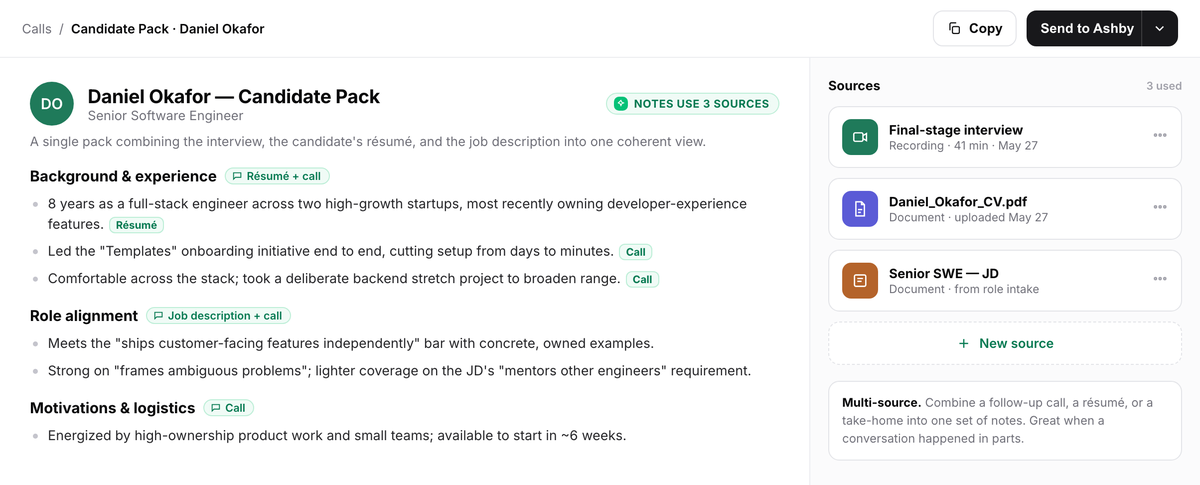
The handover only helps if the first team’s feedback arrives fast. Quora, whose whole team works remotely, found slow feedback loops were holding up its hiring. Its case study reports a 48-hour improvement in time to receive feedback.
In a three-role process, feedback that arrives two days sooner is two days less for the candidate to wait.
Hannah Wardle, Quora’s Global Head of Recruiting, described the change: “I feel so much more relaxed with Metaview. Even if I don’t 100% remember something that the candidate said, it will be conveyed to the hiring manager. And it gives that candidate the absolute best chance at shining.”
Quora’s customer story video is below.
Four checks that show whether your routing works.
Run these four checks on everyone in your pipeline who has applied to two or more open roles. Each one says what to fix first if it fails.
| Check | What good looks like | What to fix first |
|---|---|---|
| A named owner | You can name the owner of every candidate with several open applications without looking it up. | Name owners, starting with the candidates furthest along. |
| One decision per application | Every application has its own recorded decision or is still open. | Reopen any application a reject on another role closed, and send it back to its hiring team. |
| One voice to the candidate | One recruiter has written to the candidate about all of their roles. | Hand the thread to the owner and tell the other recruiters to route questions through them. |
| Teams told the same day | When one application advanced, the other hiring teams heard about it that day. | Make the owner’s same-day note to each hiring team a fixed step. |
The next time one name turns up in two or three of your piles, name the owner that day. Let each hiring team decide its own application against its own profile.
When a reject comes, it goes on the one application it belongs to. The owner tells the candidate the other roles are still open. That’s three fair decisions for one person, and a candidate who knows where each one stands.
Show each hiring team why an application fits its role.
Application Review puts the reasoning next to every fit bucket, and your recruiters make each call.
Frequently asked.
Should candidates be allowed to apply for multiple positions at the same company?
I would allow it. A person who applies to two or three related roles is telling you where they think they fit, and each hiring team can judge that. If you want a limit, put it on the careers page before people apply. Then no application closes under a rule the candidate never saw.
What happens if two hiring managers want the same candidate?
The owner puts both roles in front of the candidate and lets them choose. Both hiring managers hear the outcome at the same time. If two teams settle it without asking the candidate, a strong applicant can end up in the role they wanted least.
Can a rejected candidate be considered for a different role later?
Yes. Read the later application against the new role’s profile, with the earlier notes as background. Teams that keep past candidates searchable can find them again for new roles without waiting for them to reapply.
Is applying to multiple jobs at one company a red flag?
No. On its own, it tells you where the person thinks they could fit, which is worth a question in the first conversation. It is no reason to mark any of their applications down.
Can a candidate apply for two levels of the same job?
Yes. Treat them as two applications with two profiles, one per level, and let each hiring team decide its own. Whether one requisition should carry two levels at all is a question to settle before review starts.
Sources.
¹ The 2026 AI & Hiring Alignment Report, a survey of 505 respondents across North America and Europe, the Middle East, and Africa, run with Cint.
² Aggregated and anonymized applicant tracking system data: median applications per role, for roles opened in 2026, up to the data pull in June.
