

Most interview question banks are long lists of questions with no follow-ups or scoring guidance attached, so each interviewer picks the ones they like and asks them their own way. Two candidates for the same role then answer different questions, and the debrief has little to compare.
I recommend a smaller bank organized by competency. Every question in it comes with its follow-ups and a description of what a strong answer contains. An interviewer who takes a question from that bank knows how to ask it and what to listen for.
This guide is for recruiters and hiring managers building a question bank for their team. It covers what each entry holds, how to organize the bank by competency, how to pull a set of questions for one role, and how to keep the bank current. It also gives a starter question and follow-up for ten competencies.
Decide what each entry in the bank holds.
A question on its own tells the interviewer what to say, but not where to push or what to listen for. Give every entry in the bank the same five parts, so any interviewer can take it and ask it the same way. The table lists the five parts, what each one holds, and why the interviewer needs it:
| Part of the entry | What it holds | Why the interviewer needs it |
|---|---|---|
| Question | One question, usually about a specific past situation, in the words the interviewer says aloud | Interviewers who read the same words ask the same question |
| Competency | The one competency the question assesses | The interviewer knows which part of the role their score covers |
| Follow-ups | Two or three questions that ask what the candidate did and why | First answers are often general, and the follow-ups ask for the specifics |
| Strong answer | What a strong answer contains, described by what the candidate says | Panel interviewers who hear the same answer compare it with the same description |
| History | When the question was added or last changed, and which roles use it | The person who looks after the bank can see which questions are in use and which to retire |
Write most questions about a specific past situation. An answer about something the candidate did has details you can follow up on, while an answer about what they would do describes an intention.
Keep the wording of each question short and direct, so interviewers can read it aloud as written.
Describe the strong answer by what the candidate says, such as “names the decision they made and the reason for it.” A description of the candidate, such as “shows good judgment,” leaves each interviewer to decide what counts.
A separate guide covers how to ask and score behavioral questions, the questions about a past situation that most entries hold.
Organize the interview question bank by competency.
Each role calls for several competencies, and the same competency comes up across many roles. Group the bank by competency, so an interviewer looking for questions on prioritization finds them in one place, whichever role they’re interviewing for.
Start by collecting the questions your interviewers already use from their own docs, and file each one under the competency it assesses. Then fill the gaps for the competencies your roles assess most often. The table gives one starter question and one follow-up for each of ten competencies:
| Competency | Starter question | Follow-up |
|---|---|---|
| Communication skills | Describe a time you had to explain a complex idea to someone outside your field. | What did you change when they didn’t understand it the first time? |
| Problem-solving | Tell me about a time your first approach to a problem didn’t work. | How did you find out, and what did you try next? |
| Leadership | Walk me through a piece of work you led without formal authority. | How did you bring people along without that authority? |
| People management | Tell me about someone on your team you helped improve. | What did you do that made the difference? |
| Ownership | Tell me about a problem you fixed that wasn’t yours to fix. | Why did you take it on? |
| Adaptability | Describe the last time your priorities changed partway through a piece of work. | What did you drop, and how did you decide? |
| Cross-functional collaboration | Tell me about a project that depended on another team. | Where did the two teams disagree, and how was it settled? |
| Prioritization | Tell me about a week when you had more work than time. | What did you decide not to do? |
| Decision-making | Walk me through a decision you made without all the information you wanted. | What did you do to reduce the cost of being wrong? |
| Conflict resolution | Tell me about a disagreement at work that got heated. | What was your part in resolving it? |
Each competency name in the table links to a page with more questions for that competency.
Turn each starter question into a full entry before interviewers use it. Add one or two more follow-ups and a strong-answer description, and put the date in its history.
File each question under one competency only. An interviewer scoring one question for two competencies has to split the follow-ups between them, and neither score gets enough evidence.
Pull a set of questions for each role.
The bank holds more questions than any one interview needs. Before the first interview for a role, pull a small set of questions from the bank and give every interviewer the questions they’ll ask:
- With the hiring manager, choose the three to five competencies the role depends on most. Write one line on why the role needs each one, so the interviewer who covers it knows what to find out.
- Take two or three questions for each of those competencies from the bank.
- Give each interviewer one or two of the competencies, so each interviewer asks different questions.
- Send every interviewer their questions before their interview, with the follow-ups and the strong-answer descriptions included.
The set of questions becomes part of the role’s interview kit, alongside the scorecard and the order of interviews. Another guide walks through building an interview kit for one role.
Keep the set the same for every candidate in the role. If a question changes partway through the search, the candidates before and after the change answered different questions, and their scores are harder to compare.
Keep the bank current.
A bank that only grows becomes too long to read, and interviewers go back to their own favorite questions. Name one person to look after the bank: its editor, usually someone in recruiting, who brings in a hiring manager when a question tests a function’s own skills. Have the editor review the bank each time you fill a role.
For the review, the editor asks the interviewers who worked on that role which questions produced specific answers and which didn’t. The editor then updates the bank from what the interviewers say, in the three ways below.
Retire a question when candidates give rehearsed answers to it, when interviewers keep skipping it, or when it repeats another entry under the same competency.
Add a question when an interviewer suggests one in the review, such as a follow-up of their own that kept producing specific answers. Write it up as a full entry, with all five parts, and check that it asks only about job-related experience, before it goes into the bank.
Rewrite a strong-answer description when two interviewers who heard the same answer, such as two interviewers on a panel, scored it differently. Go through the answer with both interviewers, agree which part of it should decide the score, and add that part to the description.
Keep each competency to a fixed number of questions, such as five to eight, and retire one for each addition. The limit keeps the bank short enough for the editor to review each time you fill a role.
Where Metaview fits.
The editor’s review depends on how each question went in the interview, and interviewers remember only part of what was said. Metaview is the Agentic Recruiting Platform, and for a question bank, the part that helps is a full record of each interview.
Where consent has been given, the Metaview Notetaker records and transcribes an interview, then turns the conversation into structured notes. The recording captures every spoken word, so the editor can read in the transcript how each question was asked and what the candidate said in reply. The editor can also see whether the interviewer asked the entry’s follow-ups or moved on after the first answer.
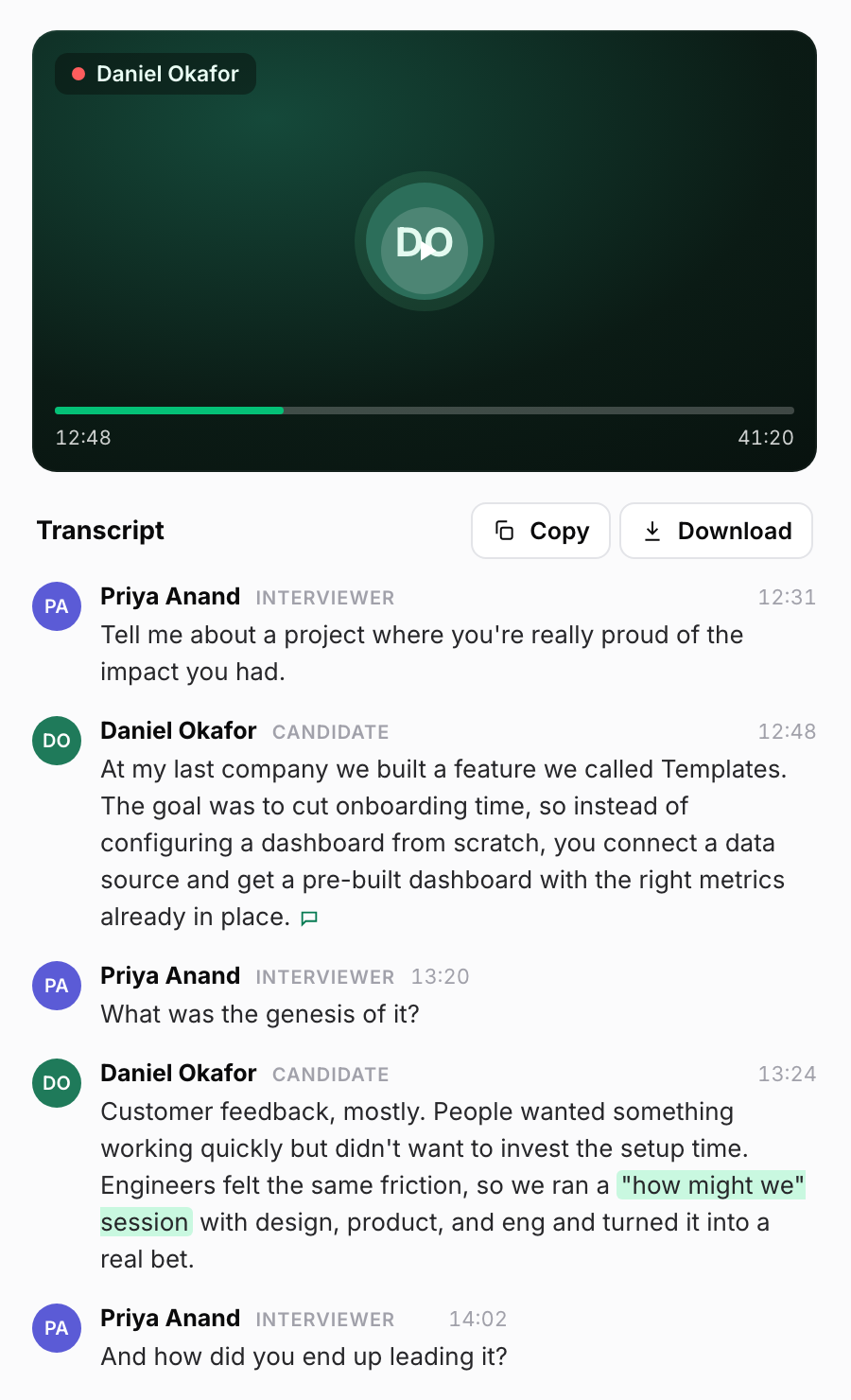
The Notetaker also drafts each interviewer’s scorecard from the same conversation. The interviewer reviews the draft against the entry’s strong-answer description, chooses the score, and submits it.
Each interviewer’s scorecard covers only the competencies they were given, so no single interview carries the hiring decision. Metaview co-founder and chief technology officer Shahriar Tajbakhsh has described how a candidate’s interviews add up:
One interview can’t get all of the signal needed to make a hiring decision, but the collection of all interviews for any given candidate must provide the necessary information.”

That’s why each interviewer gets different competencies from the bank: read together, their scorecards cover what the decision needs.
How to tell whether your question bank is working.
The editor’s review looks at one role at a time. Once the bank has been used across a few hires, step back for a broader check: go back over those interviews with the scorecards and the interviewers, and ask these five questions:
- Do interviewers take their questions from the bank? If they still bring their own, ask why they passed over the bank’s entries. Then rewrite or retire those entries.
- Do interviewers ask the follow-ups? If the scorecards describe only general answers, point interviewers back to the follow-ups in each entry.
- Do interviewers on one panel who heard the same answer give it the same score? If not, rewrite that entry’s strong-answer description with the interviewers who scored it.
- Does every competency in the role’s set have an interviewer? If one had none, fix the split before you pull the set for the next role.
- Is the bank still short enough to read? If a competency holds more questions than its limit, retire the ones interviewers skip.
Run these five broader checks after every few hires, and fix the entries they flag before you pull the set for the next role. That way, interviewers keep taking their questions from the bank, and every candidate in a role answers the same questions.
Review your question bank from what was said.
See how Metaview records interviews where consent has been given, turns them into structured notes, and drafts each scorecard for the interviewer to review and submit.
Frequently asked.
Should you share interview questions with candidates in advance?
Share the competencies the interview covers, which helps candidates choose relevant examples. Keep the exact questions back: candidates who see them in advance can rehearse answers, and the follow-ups then have to do more of the work of getting to specifics.
Should junior and senior candidates get the same questions?
The same question can work at every level if the entry’s strong-answer description says what a strong answer looks like at each level the role is hired at. A strong answer from a senior candidate usually covers a wider scope, such as a decision that affected other teams.
Do situational questions belong in the bank?
A situational question asks what the candidate would do. Keep a few for roles that hire people with little relevant work history, such as early-career roles, mark each entry as situational, and describe a strong answer by the reasoning it gives.
How many questions should the bank hold?
Keep five to eight questions for each competency. That gives two interviewers who cover the same competency different questions, with a few spare.
Can a question bank show which questions find the best hires?
Answering that needs data on how each hire went on to perform, linked back to the questions they were asked. Without that data, judge a question by whether it produces specific answers that interviewers score the same way.
