

Search for the best interview intelligence software and you'll get rankings. Check who published each one and you'll usually find a vendor, an affiliate site paid per click, or a directory that sells the top slot. This page is no exception. Metaview published it, Metaview sells software in this category, and any list we put together will have Metaview near the top of it. So there is no list here.
What is here instead is a test. Take five interviews you've already run, put every tool you're considering through the same five, and read the outputs next to each other. Then check what they wrote against what was actually said. It takes an afternoon, it costs nothing beyond trial access, and it settles in one sitting what a month of demos won't.
The test has one property a ranking cannot have: we can lose it. The last section names the checks where Metaview comes out badly, including the applicant tracking systems it can't push decisions back to. Discount this the way you'd discount anything else a vendor says about its own category, then go and run the test.
Who wrote this, and what it costs the ranking.
Every ranking in this category is written by someone holding a position. Vendors write them to define the category around what they built. Affiliate sites write them to earn a click on a referral link, and analysts write them from vendor briefings. None of that is dishonest by definition. All of it shares one defect: whoever chooses the criteria has already chosen the winner.
Watch how easy that is to do. Add a row called reporting across every interview in the pipeline and Metaview wins the grid. Add one called works on every meeting the company runs and not only interviews and a general notetaker wins instead. Both rows describe a real capability. Neither one is a neutral choice, and a reader can't tell which row was chosen first and which was reverse-engineered from the answer.
So the only useful thing a vendor can publish about its own category is a procedure you run yourself, with the vendor's own answers filled in and its weak spots named. That is what the rest of this is. You'll still find Metaview described in flattering terms in one column of a table further down, because we wrote the table. You only have to take that column on trust for an afternoon.
Why a feature grid cannot settle it either.
A feature grid looks objective because it's a table. Someone still chose the rows, and every vendor in that table has been building against them for years. What a grid ranks is the length of a changelog and the breadth of a marketing site.
A checkmark hides the thing you're buying. Two tools can both claim AI summaries and produce completely different documents from the same conversation. One returns a tidy paragraph that reads well and tells a hiring manager nothing. The other returns the follow-up question the candidate struggled with, tied to the competency that interview was meant to cover. Both get one checkmark.
Grids do earn their place, which most articles attacking grids leave out. A grid is a good elimination filter. Cut anything that can't join your video calls, can't connect to your applicant tracking system, or can't keep data in the region you need. Those are hard constraints, and a table is the fastest way to see them. Use the grid to get down to three or four contenders, then stop using it, because it can't tell you which of those three is any good.
The test: five interviews, every contender.
Pull five interviews from a role you've already closed. A recruiter screen, two or three panel interviews, and one where the debrief was split, because a split debrief is where a weak write-up does the most damage. You already know what each panel concluded and where they disagreed. That is what makes these five an answer key.
Run every contender on the same five. Not on a sample recording the vendor supplies, and not on five different sets each. The same five, so the only variable left is the tool.
Then read the outputs side by side and ask the obvious question of each one: would the hiring manager make a call from this without going back to the recording?
That question is only half the test, and the other half is the part most evaluations skip. Open the recording next to the output and check it line by line. Did it attribute an answer to the right person? Did it drop the moment the candidate actually struggled? Did it state something as fact that nobody in the room said? A write-up a hiring manager will act on and a write-up that is accurate are two separate properties, and only the first one shows up in a demo. The second is the one that costs you when it fails.
Get both right and the debrief changes shape. It stops being a contest of impressions and becomes an argument about the same evidence, which is what the hiring manager wanted in the first place.
Hiring managers want to see data, not feelings.”
The data he's describing in that case study is what a batch of conversations for the same role had in common, read together. That is a different job from writing up a single interview, and it's worth scoring separately.
What to score, zero to two.
Five checks. Score each contender zero, one or two, and add it up. The totals matter less than the disagreements. If two tools tie and you'd only ever roll out one of them, you've found a criterion that matters to you and is missing from this list, and that is worth more than the score.
1. Retrieval across the whole set. Ask each tool to find every place in your five interviews where a candidate mentioned a competing offer. Zero if it can only search inside one transcript at a time. One if it searches across interviews and hands you the file. Two if it returns the line itself with the context around it and takes you to that moment in the recording. Metaview Reports can query your own interview data this way, and it's the check we'd point at first, which is exactly why you should run it yourself instead of taking our word for it.
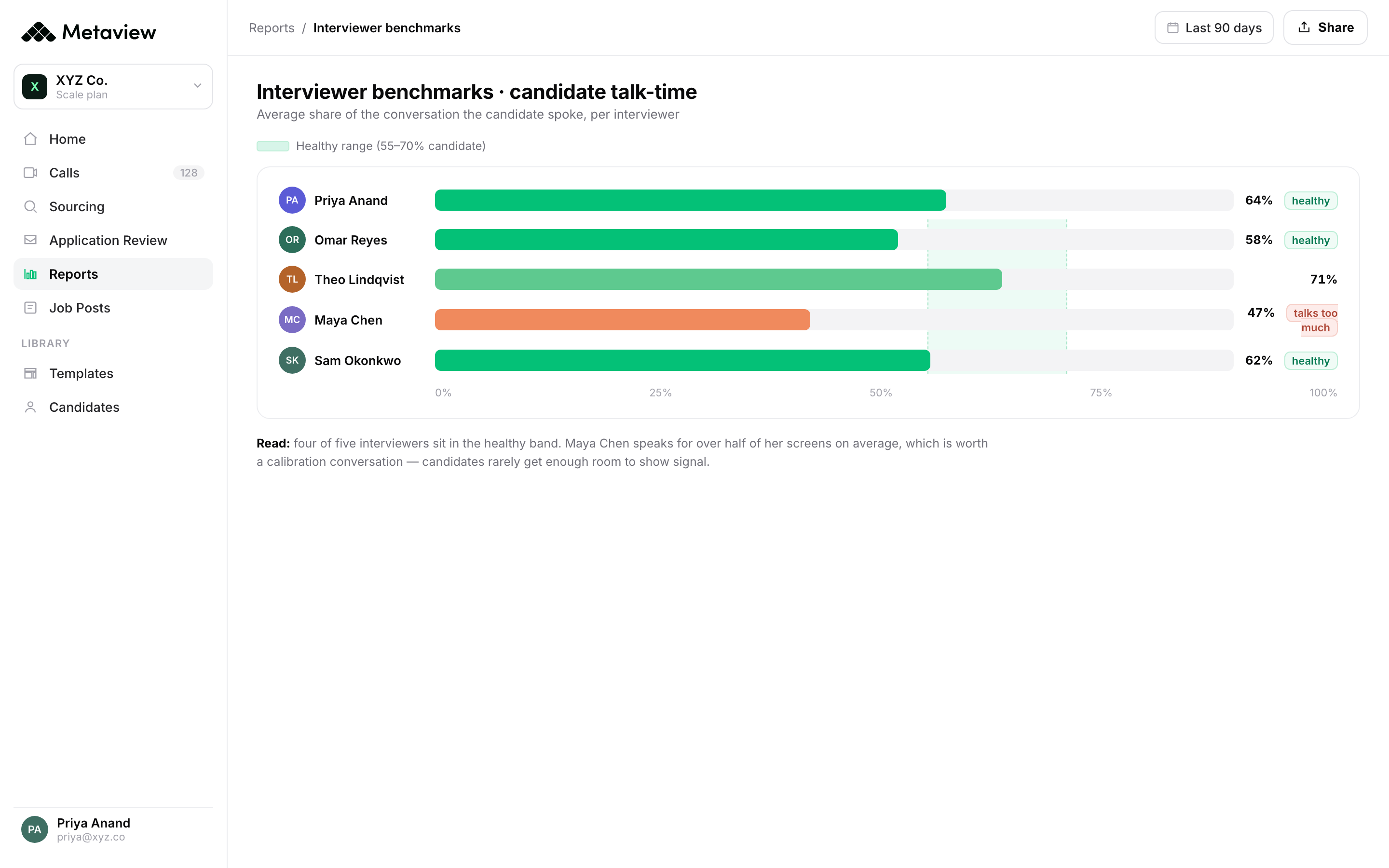
2. The interviewer, and not only the candidate. An honest read on a hiring process includes whether the panel covered the criteria it agreed to cover, and whether one interviewer talked for forty minutes straight. Zero if the tool only ever looks at the candidate. One if it reports on interviewers in aggregate. Two if it shows talk time and criteria coverage per interviewer across the panel, so you can name the person who never lets a candidate finish.
3. The scorecard your team actually submits. A draft summary is worth less than a draft scorecard in the format your team already uses. Zero if someone retypes it. One if it produces a draft you paste. Two if the draft arrives in the scorecard itself for a human to correct and submit. The Metaview Notetaker drafts the scorecard from the conversation, and the interviewer reviews, rates and submits it. Metaview does not submit on the interviewer's behalf.
4. Integrations, by name and by direction. The phrase "it integrates with your ATS" covers everything from a manual CSV export to a live connection in both directions. Ask each vendor, in writing, which of your systems it reads from, which ones it writes to, and what happens on the ones it doesn't. Zero for a verbal yes. One for a named list. Two for a named list that includes the direction and admits the gaps.
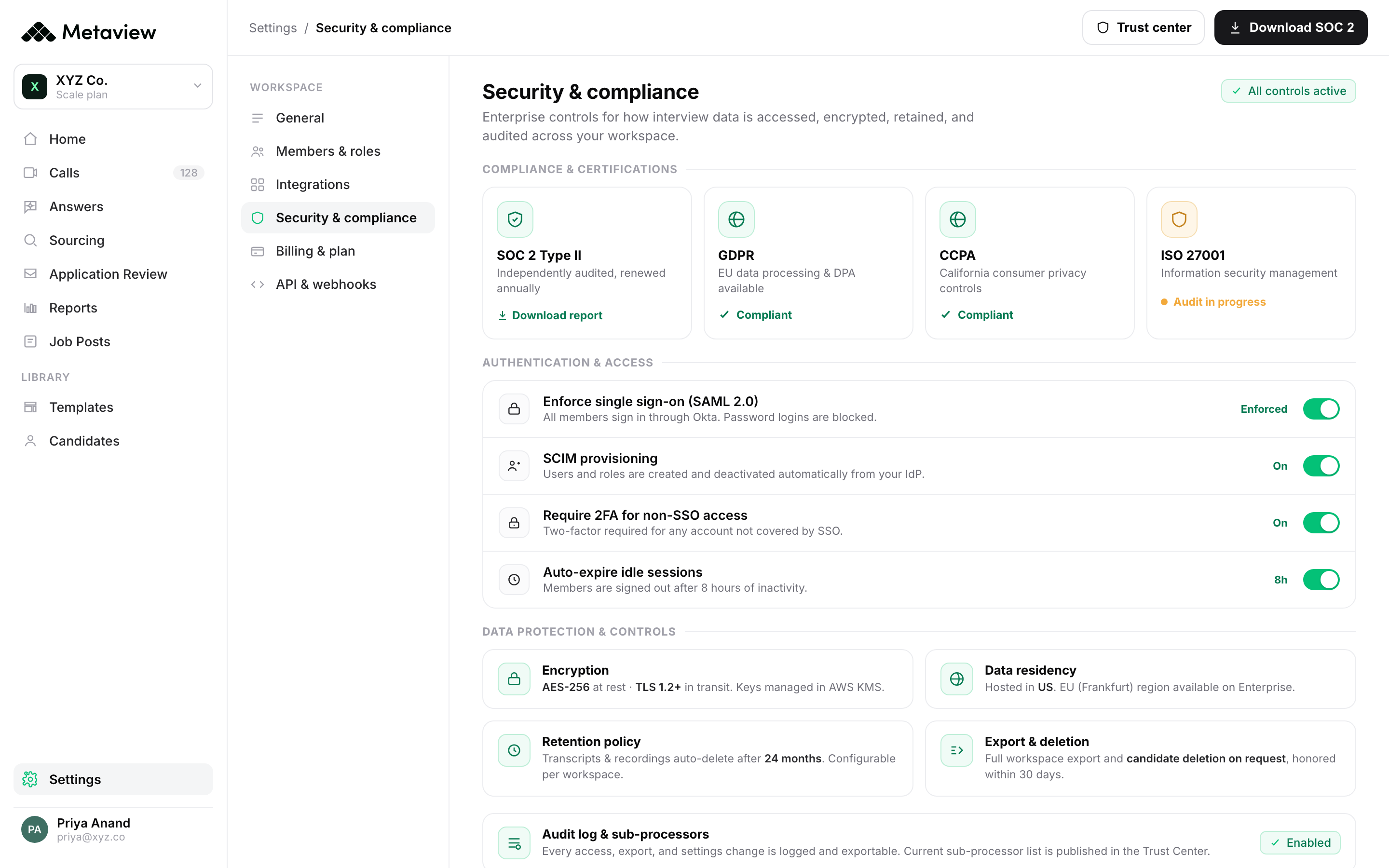
5. Where the data lives. Interview recordings and transcripts are among the most sensitive records a company holds. Ask where they sit, who inside your company can open them, how long they're kept, and what you can export on the day you leave. Zero if the answer is a slide. Two if the answer is a settings page you can open yourself during the trial.
One decision sits underneath all five checks, and it's worth making before you score anything: what are you actually buying? Products in this category sit on a spectrum, and the two ends of it are different purchases with different failure modes.
- The job finishes when the interview is written up, usually across every meeting the company runs
- Cheaper, quicker to roll out, and nothing else in the stack depends on it
- Evidence about a candidate gets carried into the next step by a person
- The interview record is reused by screening, scorecards, reporting and search
- One place where evidence about a candidate accumulates across the process
- More to configure, more to migrate, and more of your process tied to one vendor
Metaview is the right-hand column. That is what we build, which is why that column reads the way it does, and its last line names a real cost. Plenty of teams have a straightforward case for the left-hand column: a handful of interviews a month, evidence that already sits in the applicant tracking system, or a need for one notetaker that covers sales calls and interviews and everything else. Plenty of tools on that side connect to an ATS too, so don't let anyone, including us, tell you the left column means an island.
Where this test goes against Metaview.
Here is the part a ranking would never carry. These are the places where Metaview comes out badly on the checks above. They're also the reason to run the test instead of trusting the article.
Your applicant tracking system decides how much of this you get. Candidates are synced from your ATS into Metaview, and Application Review covers eight of them: Ashby, Gem, Greenhouse, Lever, Pinpoint, SmartRecruiters, Teamtailor and Workable. Accept and reject decisions made in Metaview are pushed back to the ATS for Ashby, Greenhouse, Lever and SmartRecruiters. Gem does not support syncing rejections back, and Pinpoint, Teamtailor and Workable have no documented decision writeback at all. Scorecards submit directly from Metaview on Ashby and Lever. On Greenhouse, someone pastes them across. If your system sits outside those lists, check four should score us low, and we'd rather you found that in a trial than in month three.
Metaview is another window. Candidates sync in from your ATS and your team reviews them in Metaview, which is a real cost if your recruiters already resent opening a second tab. That is a fair thing to hold against us in the test.
Metaview does not make the call. Application Review reads every application against criteria your team approved, sorts candidates into fit buckets, and shows the reasoning behind each one. A human accepts or rejects every candidate. Metaview never auto-rejects and does not make the hiring decision. If you're buying to take people out of the loop, we're the wrong purchase, and you should score us zero for it now instead of finding out later.
Nothing in this test tells you about the hire. Metaview holds no data on what happened after someone started: no performance data, no tenure, nothing at ninety days and nothing at a year. So we can't show you that a tool winning this test produced a stronger outcome once the person was in the job, and no vendor in this category can show you that either. Anyone claiming it is describing something they did not measure. What the test measures is the quality of the record a decision was made from, which is a narrower claim and the only one available.
There's one number an article like this normally reaches for, so here it is with its limits attached. In Metaview's 2026 AI & Hiring Alignment Report, a 19-question survey run with Cint across 505 respondents (252 recruiting leaders and 253 hiring managers at companies with 200 or more employees in North America and EMEA), 85% of companies that exceed their hiring goals use AI in hiring. Read the direction of that carefully. The base is companies already exceeding their goals, and the thing measured is whether they use AI, so it is an association, and it does not show that AI got them there. The study is cross-tabulation and correlation with no causal design, no longitudinal component and no outcome data beyond self-report, and it never asked which products anyone bought or how those products were wired together. It does not settle the question this article is about, and we're not going to pretend it does.
The same report does take a position in its closing chapter. Under "Do's" it lists "shared systems that help teams work from the same reality". Under "Don'ts" it lists "individual copilots that make each person faster in isolation". That is Metaview recommending the shape of product Metaview sells. It's a view we hold, and the survey did not produce it. Treat it as a hypothesis your five interviews can test.
Customer accounts deserve the same handling. Here's one, and it is what a single customer reported, and it is not a platform average:
We've completed over 1,900 calls using this platform, saving 77 full workdays. We're not just automating note-taking, we use the multi-source feature so each interviewer goes in unbiased but informed enough to cover new ground.”

That is one team describing their own volume, in their own words, with no control group anywhere near it. It tells you what they experienced. What your team would experience is the open question, and it's the whole reason the test runs on your interviews.
Our co-founder makes the wider case for where any of this is heading in the video below. Read it the way you should read this article, as an argument from someone with a stake in the answer.
You don't have to replace anything to run this. Keep what you have, give both the same five interviews, and score Metaview alongside whatever you're using now. The test will tell you to walk away if your applicant tracking system sits outside the lists above, or if your volume does not justify a system of record, and you'll have saved a procurement cycle. That is a better result for us than a customer who bought on a grid and worked out in month three what the grid left out.
Score Metaview on your own interviews
Bring five interviews you have already run. We will put Metaview through the same five checks as everything else you are evaluating, including the ones above where it loses.
Frequently asked questions.
What is interview intelligence software?
Interview intelligence software records what's said in interviews and turns it into a structured record a hiring team can search and act on: notes, summaries, scorecards, interviewer benchmarks and trends across the pipeline. The distinction that matters when you're buying is what a product does once the transcript exists, and whether that record is reused anywhere else in your process.
Should I trust a list of the best interview intelligence software?
Not on its own. Almost every ranking in this category is published by a vendor, an affiliate site paid per click, or a directory that sells the top slot, and whoever chooses the criteria has already chosen the winner. This article is published by Metaview, which sells in the category, which is why it gives you an evaluation method to run yourself rather than a ranking.
How do I evaluate interview intelligence tools?
Run a bake-off. Take five real interviews from a role you've already closed, run every contender on the same five, and read the outputs side by side. Then check each output against the recording for accuracy. Score five checks from zero to two and add them up: retrieval across the whole set, whether it reports on interviewers as well as candidates, whether the scorecard arrives in the format your team submits, which of your systems it reads from and writes to, and where your interview data lives.
What is the difference between an AI notetaker and interview intelligence?
It's a spectrum rather than two clean categories. At one end a tool captures the conversation and its job finishes there, usually across every meeting a company runs. At the other end the interview record is reused by screening, scorecards, reporting and search. Plenty of products sit in between, and plenty of capture tools connect to an applicant tracking system, so the honest way to place any product is to ask which of your systems it reads from and writes to, and to get that answer in writing.
Is Metaview an interview intelligence tool?
Yes, built as a recruiting workflow around that record. The Notetaker captures the interview with consent and drafts the scorecard, which a human reviews, rates and submits. Metaview Reports can query your own interview data across every conversation. Application Review reads applications against criteria your team approved and shows the reasoning behind each bucket. The limits are worth knowing before you evaluate it: Application Review covers eight ATS integrations, accept and reject decisions are written back to four of those, and Metaview never auto-rejects and does not make the hiring decision.
Can I evaluate interview intelligence alongside my current tools?
Yes, and it's the cleanest way to do it. Keep your current setup, put the tool you're evaluating next to it, run the same five interviews through both, and compare the outputs before you change anything. A Metaview evaluation starts with a demo, and you can bring your own interviews to it rather than watching a prepared recording.
