
You can find a strong candidate and book the interview. Whether they turn up feels like the one part of hiring that’s out of your hands.
When a candidate ghosts you, there’s no decline and no reason, just an email that never gets a reply or an interview they never join.
So what’s behind candidate ghosting? How much of it can you prevent? And what do you do about the candidates who ghost you anyway?
In aggregated third-party applicant tracking system (ATS) data, a typical role opened in 2022 drew 5 applications. A typical role opened in 2026 had drawn 45 applications by June, when the data was pulled, and those 2026 roles were still taking applications.
That’s a lot of replies to write. The counts don’t show who ghosts, but we think a lot of ghosting starts right there, before the first conversation, while a candidate waits to hear back and someone else gets to them first.
If we’re right, more of it is in your hands than it feels. We’d get to the first conversation sooner, and save booked interview time for candidates who have already finished one.
This guide covers two kinds of fix: the ones you can make with the tools you already have and an AI screening call that needs no booking at all.
By the end of it, you’ll know how to find where your candidates go silent, which gap to close first, and how to tell whether it’s working.
What counts as candidate ghosting?
Candidate ghosting is when a candidate stops replying partway through your hiring process without telling you they’ve dropped out.
An interview no-show is the version you see on your calendar. The interview is booked, and the candidate never joins.
Sometimes that’s a slot they forgot or double-booked. Other times it’s the last sign of a decision they made days earlier.
Ghosting can happen anywhere between the application and the offer, and there’s a wait before each point:
| Where candidates go silent | The wait before it | What shortens it |
|---|---|---|
| After applying | No reply, sometimes for weeks | An answer for every applicant within days, yes or no |
| At the first call | Scheduling emails back and forth, then a slot days away | A screening call that needs no booking, or the soonest slot you have |
| Between interviews | No date for the next step | A date at every handoff |
| After the final round | A decision that’s made but not yet sent | The decision on the day it’s made, with the detail to follow |
A no-show is the only kind of ghosting that leaves an empty slot on someone’s calendar. At the other points, a candidate going silent looks like lost interest, and it’s easy to miss.
Why do candidates ghost?
Our best guesses are that someone else moved faster, the role stopped adding up, or the process asked too much too soon. Candidates who ghost you don’t say which.
Did someone else move faster?
That’s our first guess. For its 2026 AI & Hiring Alignment Report, Metaview asked recruiting leaders and hiring managers how often they lose qualified candidates to competitors who move faster, and 67% said it happens every month.
It measures what the teams surveyed feel, so it can’t tell you where any one silent candidate went.
Did the role stop adding up?
That’s our second guess, and pay is where we’d look. A candidate who learns the pay range late, and finds it doesn’t work, may take the easy exit and stop replying.
Was the process asking too much, too soon?
That’s our third guess. We wouldn’t read an application alone as proof of strong interest, when applying can take a few clicks and AI can write the cover letter.
So every step that asks for their time before giving anything back is a point where they can decide your process isn’t worth it. A week of emails to agree on a slot is one of them.
We can’t put a number on how much ghosting you’ll prevent. But most of the waits in the table above are yours to shorten, and your own numbers will show what that’s worth.
Close the gaps you already own.
We’d start with the wait after someone applies, one of the first candidate experience mistakes people run into. Most of these fixes run on your ATS and your inbox, and each needs someone who owns it.
Answer every applicant within days.
A quick no lets a candidate move on, and a quick yes has a better chance of reaching them before a competitor’s does. So we’d answer everyone within days, even when the answer is no.
This is the fix that takes real work, because every application has to be read before either reply goes out.
At volume, Metaview’s Application Review can take the reading off your plate: it reads every application against the role’s criteria and sorts it by fit with its reasoning, and a recruiter still makes every accept and reject call.
Put the pay range in the job post.
Salary expectations surfaced as a topic of conversation in 34.9% of the interview sessions captured on Metaview where topics were detected, across all interview types. Put the range where candidates can see it, and anyone who sees it won’t work can bow out before applying.
Give a date at every handoff.
We’d bet “You’ll hear from me by Wednesday” holds a candidate better than “We’ll be in touch.” And if Wednesday comes without news, tell them that on Wednesday.
Send the decision the day you make it.
After a final round, a decision that’s made but not sent is one more wait. Tell the candidate the day you decide, and send the detail after.
Give candidates an easy way to say no.
Once someone has moved on, they can tell you or stop replying. Make telling you take almost no effort, with a line at the end of every message.
Send a reminder the day before.
Some no-shows are a slot the candidate forgot, and a reminder the day before can catch those. Our guide to AI scheduling covers how to make the booking itself hold up.
That leaves the first conversation. If it’s a call with a person, you need a time that suits you both, and that time can sit days away.
AI screening: the first conversation with no slot to miss.
With Metaview Screening, an AI agent holds that first conversation over a link, and the candidate takes it when they’re ready. No one has to agree on a time, so once the invitation is out, the candidate can start whenever they like.
On a high-volume role, we’d hand that first call to the agent.
The agent asks the questions you’ve set and probes any answer that comes back thin, and the candidate can ask questions too. It works on a phone or a computer, with no login.
The call still asks for some of the candidate’s time. If it replaces a booked phone screen, it also does away with the scheduling emails that come with one.
Your recruiters’ time goes to the conversations that need a person instead. Shahriar Tajbakhsh, Metaview’s chief technology officer, put it in one line:
The highest-leverage work in recruiting happens when people are talking to people.”

Won’t candidates ghost the agent too?
Some will. Whether more or fewer skip it than skipped your phone screens is for your numbers to say.
Compare the share of invited candidates who finish the screening call with the share of booked candidates who turned up for the phone screen it replaced. Keep in mind that a booked candidate had already agreed to a time.
Either way, a skip leaves no interviewer waiting in a booked slot. It shows up in your start rate instead.
Can an AI screening call spot the serious candidates?
Handing the first conversation to an agent raises fair questions. What will it ask? And who decides what happens next?
No stage of hiring tells you for certain who’s serious. A screening call is an early place to ask, and the decision stays with a recruiter.
What will the agent ask?
Start with why they want the role. A candidate’s reason for applying is one of the few things you can learn about their interest before an interview, and the screening call is a good place to hear it.
Metaview generates the screening questions and their rubrics from the role. Your team can edit them and preview the whole call before any candidate sees it.
Make sure one question asks why the candidate applied, and agree on what a strong answer sounds like.
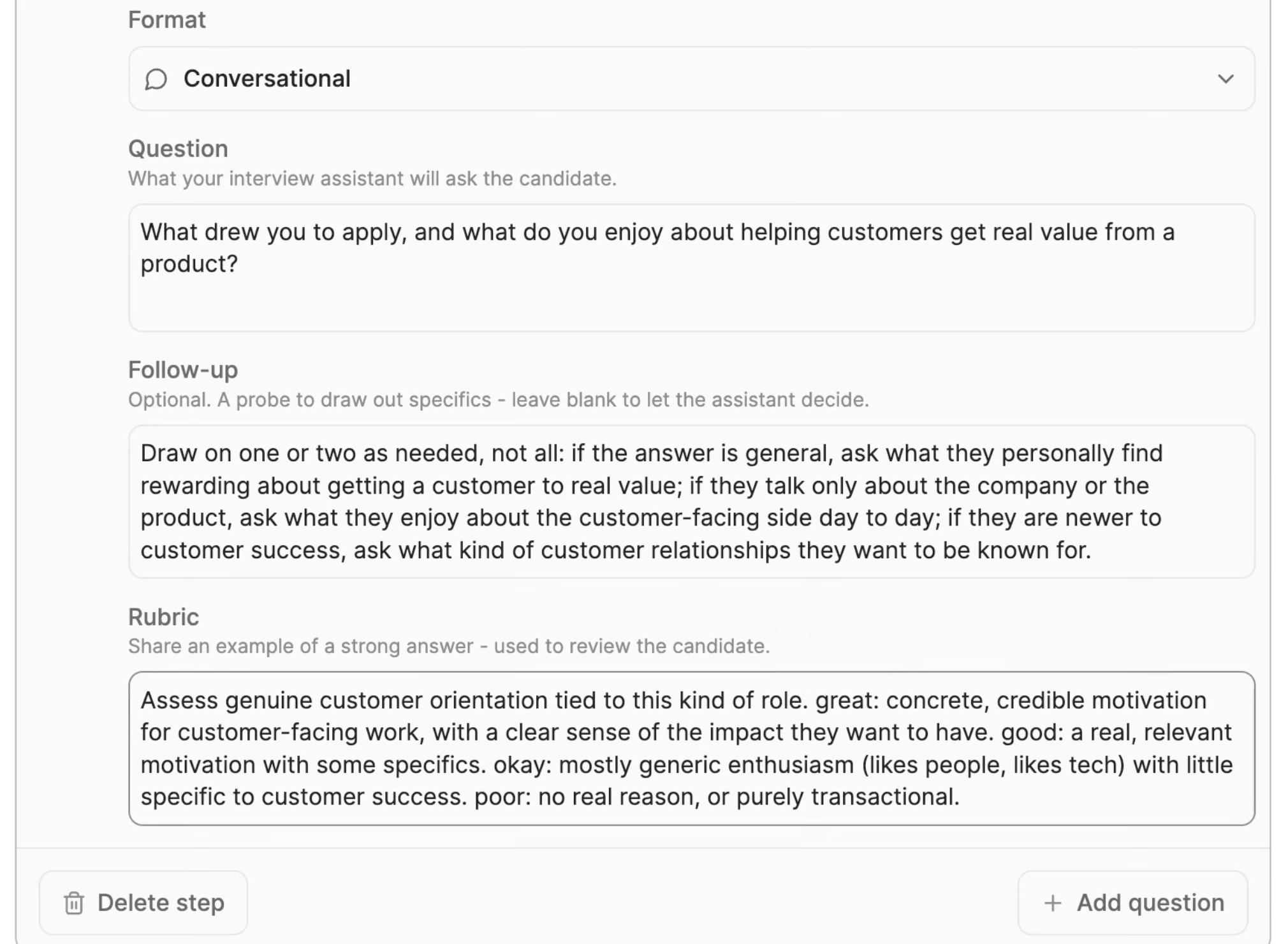
- 1The “Question” asks what drew the candidate to apply.
- 2The “Follow-up” tells the agent what to ask when an answer stays general.
- 3The “Rubric” describes a great answer as concrete, credible motivation and a poor one as no real reason.
Then add the questions that would end things later anyway, like where the role is based and when it starts. A candidate who can’t make those work can say so on the call, before an interview is ever booked.
Who decides who moves forward?
For every completed call, a recruiter decides who moves forward, and Metaview does not make that decision.
When a call ends, each candidate comes back with an assessed fit and the reasoning for it, plus their answers to every question. If a response looks AI-assisted or fraudulent, the agent flags it for you to check.
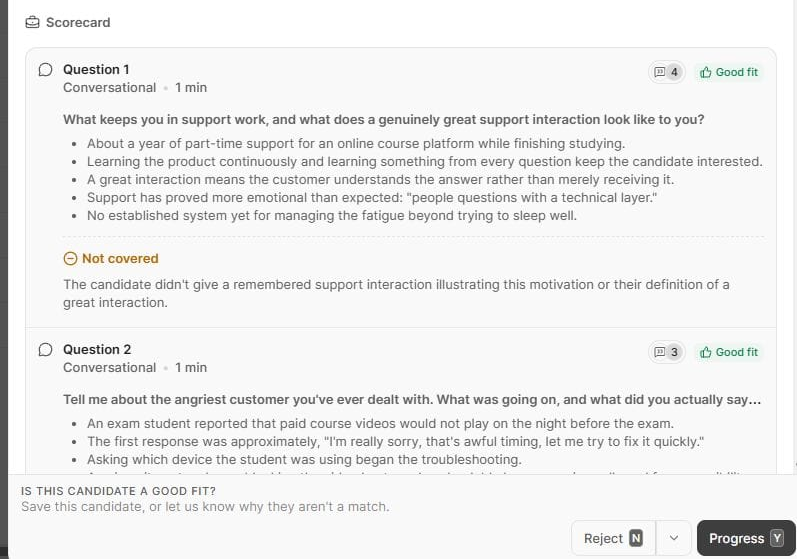
- 1“Question 1” asks what keeps the candidate in support work, and the agent’s “Good fit” sits above the evidence from their answer.
- 2A “Not covered” note says what the answer left out.
- 3The recruiter moves the candidate on with “Progress” or stops them with “Reject”.
Screening syncs the recruiter’s choice to your ATS with a summary of the call and the candidate’s information.
How to set up the screening call, step by step.
With the reply wait shortened, this is how we’d bring screening in where it fits.
Pick the roles that get a screening call.
Screening suits roles that draw a lot of applicants and share a standardized job description. For executive search or a highly bespoke assessment loop, Screening isn’t the right fit, so we’d keep the first call human there and let the fixes above do the work.
Decide where the call sits in your process before you switch it on.
Make the invitation your first reply.
For the applicants you want to hear more from, the invitation can be your first reply, sent the day you read their application. You can send it from a stage in your ATS or to candidates one at a time.
Add your branding to the invitation emails and record a welcome video that candidates see before the call starts, so the link comes from a team they recognize.
Give the call a deadline.
A deadline gives your team a date to act on. Agree in advance how you’ll follow up with anyone who hasn’t started by then.
Book the interview in the tool you already use.
The booking stays with you. Once a recruiter moves a candidate forward, book the interview in the scheduling tool you already use.
In this setup, everyone you invite has finished a screening call, and you can review what they said about the role. Whether that predicts who turns up is something your own numbers will show.
Let the interviewer listen.
A candidate who has finished a screening call and turned up deserves the interviewer’s full attention.
If your team records the interview, Metaview’s Notetaker joins as a visible participant and captures every spoken word. The interviewer can listen instead of typing, then review and submit the scorecard Metaview drafts from what the candidate said.
Catawiki uses Metaview’s AI Notes in its interviews. James Lesner, its director of talent management, puts the benefit this way: “For me, the number one benefit of Metaview is being able to fully focus on the interview itself. I can be hands-free and not have to worry about making notes.”
On Metaview’s 10x Recruiting podcast, host Nolan Church and Mike Moriarty, who built the recruiting firm Arsenal Pulse, argue that being human is still an edge in hiring. We think the interview is where that edge shows.
How to tell whether ghosting is going down.
The goal is fewer candidates going silent, so count them. These four numbers come mostly from your ATS and your screening tool:
- Days from application to first reply: how long the earliest wait runs.
- The first conversation: how many booked phone screens went unattended before the change, and how many invited candidates start and finish the screening call after it.
- No-shows on booked interviews, by stage: whether the candidates you book still turn up.
- Candidates who went silent, from application to offer: one count across every stage, kept separate from those who said no. It needs a field in your ATS, so add one before you start.
Read starts and finishes together. A finish rate only counts the candidates who started, which is why a screening completion rate can mislead on its own.
Treat a falling no-show rate with some suspicion, too. If you book only candidates who finished a screening call, or your team stops inviting borderline candidates without saying so, the rate can fall just because you’re booking different people. Read it next to how many candidates you invite and how many go silent across every stage.
Write today’s numbers down first. Then make the changes one at a time, starting with the reply wait, and review the numbers each month. That shows you what moved after each change, though not everything that moved it.
What to do when candidates still go silent.
Start with the candidate who has already gone. Send one follow-up that asks whether they’re still interested and names the day you’ll close their application. If that day passes with no reply, close it, and record that they went silent, separately from candidates who said no and candidates you turned down.
Then use the numbers to decide where to look first. This is where we’d start:
- A slow first reply: look at the reply process, then at how soon the screening link goes out.
- Few starts on the screening call: reread the invitation and check the deadline before changing any questions.
- Few finishes: review the questions, starting with the ones where answers come back thin.
- Booked interviews that still go unattended: shorten the wait between the booking and the interview, and check that the reminder goes out.
- More silences than replies saying no: put the line that lets candidates say no in every message, follow-ups included.
If we could change only one thing, it would be the reply wait. A candidate who hears back within days has less time to hear from someone else first, so we’d expect fewer no-shows later.
Change it on its own, and the booked-interview check will show whether no-shows fell, though not every reason why.
Spend your interview slots on candidates who finished a screening call.
Metaview Screening holds that first conversation over a link, and your recruiters choose who goes through to the interview.
Frequently asked.
What is candidate ghosting?
It’s a candidate dropping out of your hiring process without a word, at any point from the application to the offer. Employers do it too when an applicant never hears back, and we think that’s where a lot of candidate ghosting starts.
What is a normal interview no-show rate?
We’d be wary of any single number. A no-show rate depends on the role, on how many steps come before the interview, and on who you book, so compare your own rate stage by stage with last quarter’s, changing one thing at a time.
Do interview reminder emails reduce no-shows?
They can, for no-shows that come from a forgotten slot. Send the reminder the day before with the time, the link, and who the candidate will meet, plus a one-line way to move the slot, so a clash can become a new time instead of a missed call.
Do candidates mind a screening call with an AI agent?
Some may. Say in the invitation that an AI agent runs the call, what it covers, and that candidates can ask their own questions. If your team offers an opt-out, track opt-outs and non-starts separately, though neither tells you why unless the candidate says. With no human alternative, count anyone who declines as a candidate you lost.
How quickly should you reply to job applicants?
Within a few days, ideally with the answer itself. If that isn’t possible, acknowledge the application and give a date for the answer that you’ll keep.
