
Heavy hiring weeks leave both sides cooked for the same structural reason. The recruiter has run nineteen interviews back to back. The candidate has answered the same five questions across nine interviewers who haven't read each other's notes.
We call it interview fatigue. The cause is structural: signal doesn't carry between rounds. Recruiters carry attention forward from the last call. Candidates carry answers forward from the last interviewer.
The fix is structural too. Capture each interview once as structured signal. Route the signal to the next interviewer before they walk in. Both sides feel the lift at the same time.
Why interview fatigue is structural
Most interview fatigue conversations frame it as a stamina issue. Recruiters are doing too many interviews. Candidates are sitting through too many rounds. Reduce the number, the framing says, and the fatigue goes away.
The math is sometimes right. The framing is wrong. Interview fatigue is what builds up when the work of an interview doesn't carry forward: each round restarts from scratch instead of building on what came before.
Shorter loops with the same structural gap still produce fatigue, just in fewer rounds. Longer loops with the gap closed barely produce any.
Interview fatigue is the cost of running multiple interview rounds where the signal from each round doesn't reach the next. Recruiters pay it as cognitive load. Candidates pay it as redundancy.
That definition matters because it points at the fix. Reducing rounds without closing the signal gap reduces the symptom for one week. Closing the signal gap removes the cause.
How fatigue shows up for recruiters and candidates
The two sides feel different things. Same root cause, different symptoms. Naming each one specifically is the prerequisite to fixing either.
| Where it shows up | For recruiters | For candidates |
|---|---|---|
| In the moment | Attention splits between listening and writing | Déjà vu by round 3 |
| Mid-loop | Stacked calls bleed into one another | Energy drops before the offer stage |
| The visible tell | Post-call second-guessing | Flatter answers, less detail |
| The downstream cost | Decisions made from memory | Drop-off, or a cooled-off offer signal |
For recruiters: cognitive load
Recruiters and hiring managers run multiple interviews a day. Each one requires active listening, in-the-moment evaluation, real-time notetaking, and a write-up afterward. When all four happen at once, attention splits and the signal degrades.
The pattern shows up after the call. Did I ask the question I meant to ask? What exactly did the candidate say about the consistency model? Recall fades fast, and reconstructing a 45-minute conversation from memory two days later is the work that makes Friday look impossible.
Over a week, the cumulative load is what wears recruiters down. Not the volume of interviews on its own. The cognitive cost of running each one as if it were the first.
For candidates: redundancy across rounds
Candidates feel a different shape of the same problem. They tell the same story to four interviewers in a row. They explain their last project from scratch each time. They notice that the third interviewer doesn't seem to know what the first one asked.
The cost compounds as the loop gets longer. By round four, even strong candidates show up with less energy and more frustration. Some opt out before the offer stage.
The ones who finish often arrive at the decision with a worse impression of the team than they had at the start.
For competitive candidates the cost is bigger. They have other processes running in parallel, and a process that feels uncoordinated reads as a signal about how the company itself runs.
The cost is real and measurable. According to Metaview's 2026 AI & Hiring Alignment Report, surveying 505 recruiting leaders and hiring managers across North America and EMEA, the leak is consistent:
5 moves to make every interview build on the last
The structural fix is a shared signal layer that connects each round to the next. Five moves install it. The order matters; sharing signal between interviewers (move 2) is the highest-leverage starting point.
1. Scope each round so interviewers don't double up
Most redundancy starts at scoping. When every interviewer asks "tell me about a hard problem you solved," the candidate retells the same story four times.
Assign each interviewer one signal to test: skills, motivation, coordination, judgment, or communication. The redundancy disappears at the source.
The scope is set in the interview kit before the first round books. Each interviewer sees their own signal and the signals already covered. The work feels lighter because they aren't redoing what someone else already did.
2. Share signal between interviewers before the next round
This is the move that closes the structural gap. Every interviewer reads the prior round's notes 30 minutes before they walk in. They see what the candidate already explained, what the previous interviewer probed deeper on, and what the signal looked like.
The effect on the interview is immediate. The round 2 interviewer opens with "I saw you walked Andre through your work on the distributed cache; let's go deeper on the consistency model," instead of asking the candidate to retell the project from scratch.
The candidate hears that the team is paying attention. The interviewer comes in already prepared.
Recruiters would finish a phone screen and immediately second-guess themselves. Did I ask that question? What exactly did they say? Two weeks later, they're scrambling to remember details, creating that constant low-level anxiety that kills performance.”
3. Automate capture so attention stays on the conversation
Manual notetaking during the call is the single biggest source of split attention. The recruiter has to choose between listening to the candidate and writing down what the candidate is saying.
The structured-notes layer should do the capture in the background so the recruiter can stay in the conversation.
The shift is visible in the interview itself. Recruiters lean forward instead of looking at the laptop. They follow the answer where it leads instead of typing the previous sentence. Better signal, less cognitive load.
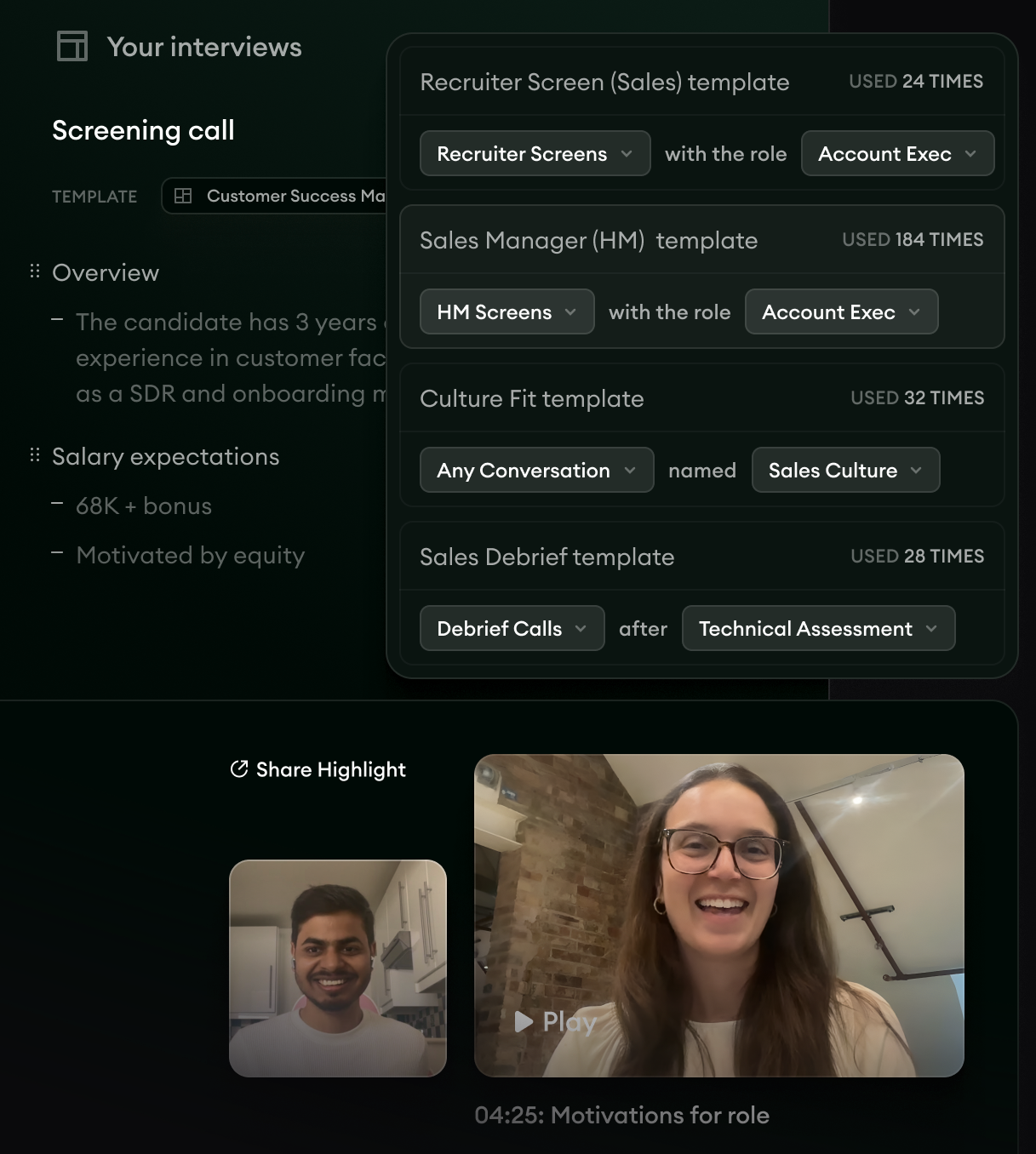
- 1Each interview captures structured notes against the panel's shared rubric, with the candidate's own phrasing kept verbatim.
- 2The right-rail highlights let round 2 read what round 1 already covered in under a minute.
- 3Auto-generated summaries route to the candidate record so the call ends with the write-up done.
4. Build recovery time into the schedule
Back-to-back interviews stacked into a single block guarantee cognitive load even when capture is automated. The reset between rounds is what makes the next conversation work. Without it, the third and fourth interviews land on a recruiter who is reasoning from the second.
The schedule fix is mechanical. 15 to 30 minutes between calls. The block that looks like four hours of interviews on the calendar runs to five hours total. The extra hour is what makes the four interviews land cleanly instead of compounding.
5. Keep the conversation live, not scripted
Structure and rigidity are different things. The first four moves all add structure: scoped rounds, shared signal, automated capture, scheduled recovery. None of them mean the conversation itself becomes scripted.
The interviewer has the scope, has the previous notes, has the candidate's prior answers, and uses all of it to follow the thread. Thoughtful follow-ups land where the candidate's energy is. The signal carries forward without the conversation becoming transactional.
How Metaview connects every interview round
The five moves describe the shape of the fix. The piece that makes them operational is a system that captures every interview as structured signal once, surfaces it to the next interviewer before they walk in, and routes the right candidates to the right rounds.
That is the layer Metaview was built to be.
- Notes live in four different docs that no one opens.
- The candidate retells the same project to round 2.
- Recruiters write up calls hours after the conversation.
- Structured notes land against the scorecard rubric.
- Round 2 opens with what round 1 already covered.
- Write-ups complete by the time the call ends.
Reports closes the panel-level loop. Once every interview is structured the same way, three patterns surface in seconds: which competencies the strongest candidates score on, where scorecards diverge, which interviewers run calibration drift.
The information was always there. Now it's visible.
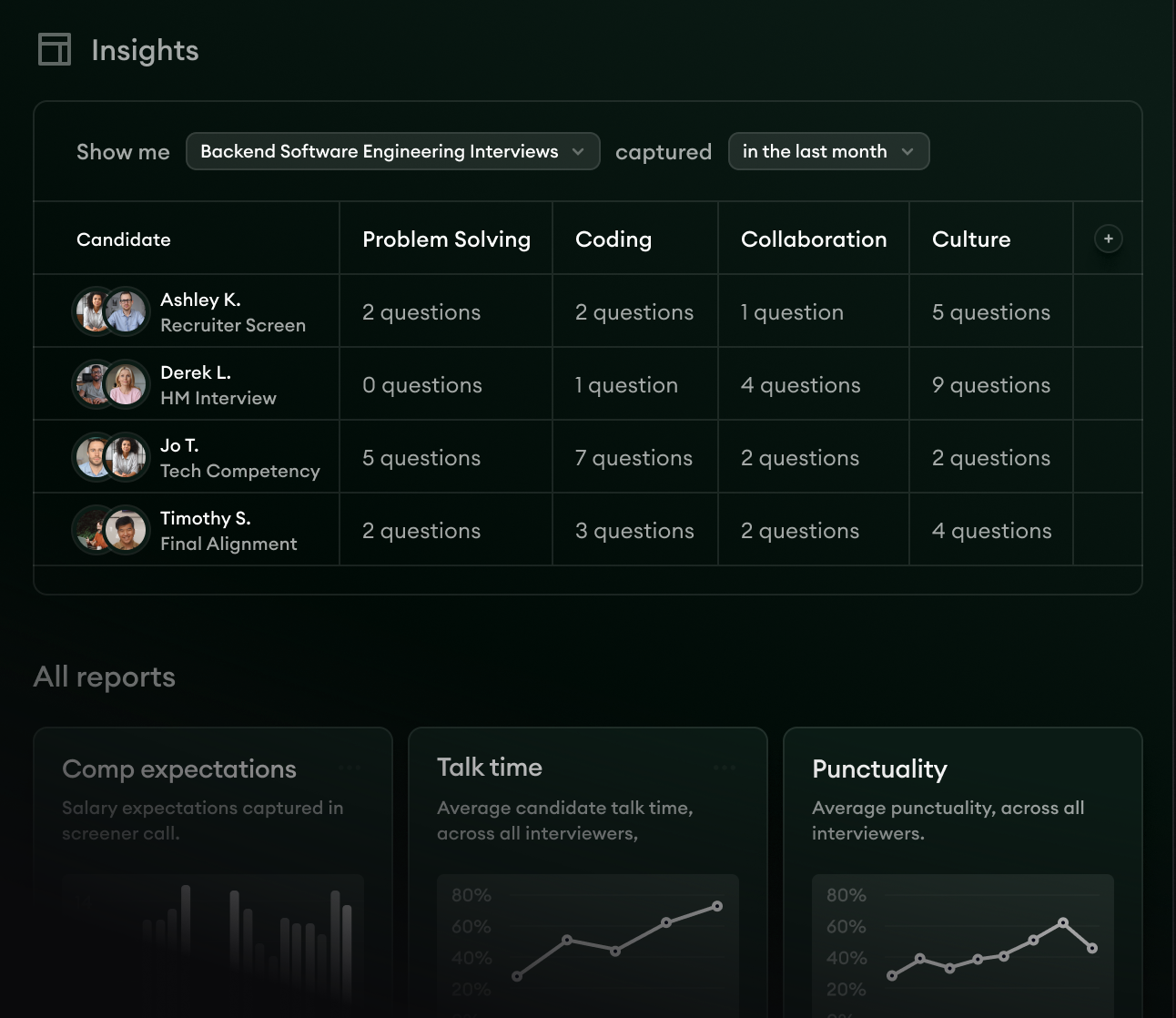
- 1Capture rates per competency show where each interviewer's signal lands and where it drops.
- 2Filter by panel and time window to spot calibration drift before it changes a hiring decision.
- 3Compare scorecard patterns across candidates so the next round's scoping rests on evidence.
Application Review handles the routing piece. Inbound candidates get triaged against scorecard context the team has already agreed on, so the recruiter spends time on the candidates who match.
Fewer screens that go nowhere. Fewer panel hours on candidates who weren't the right fit. More cycles for the candidates who are.
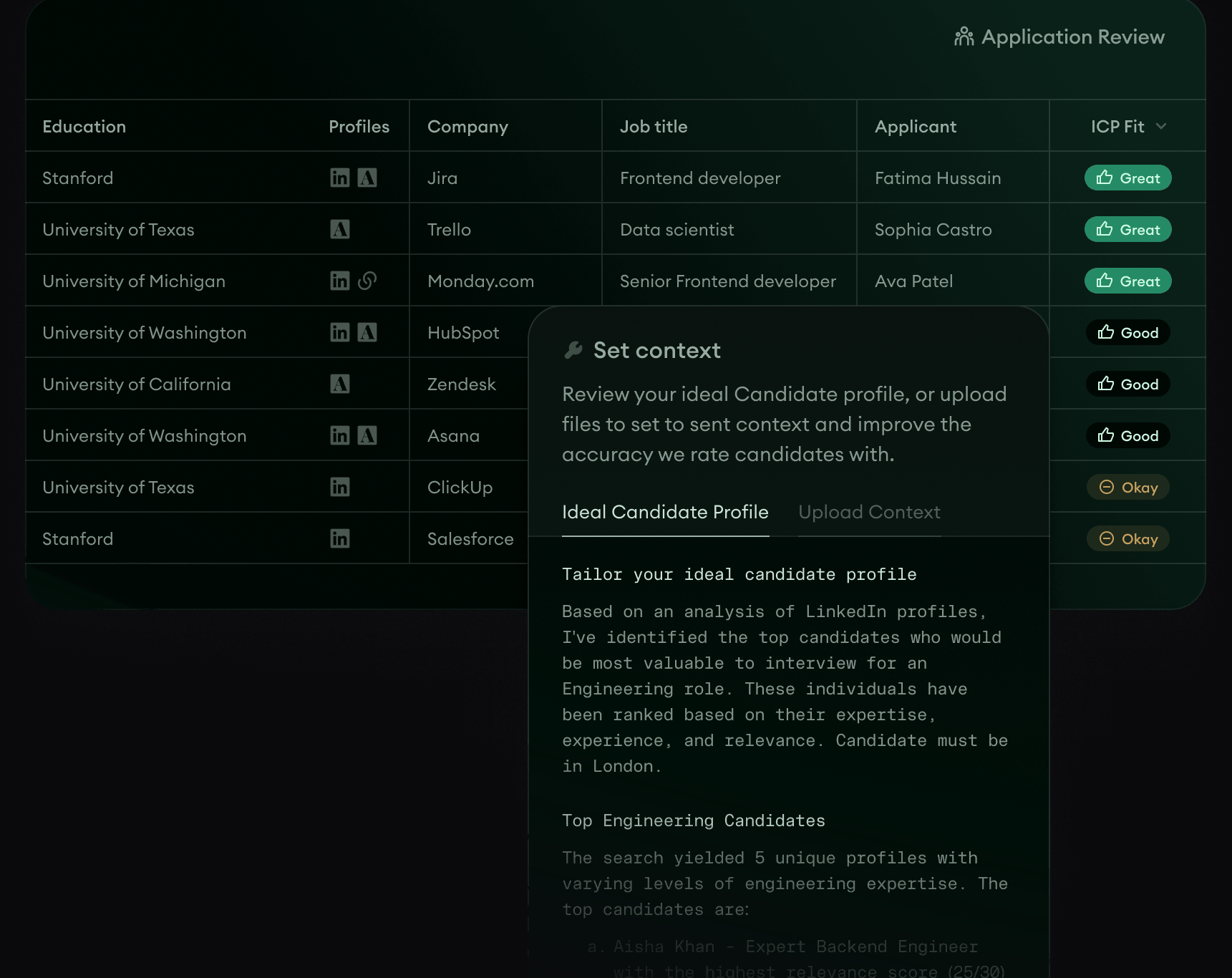
- 1Inbound candidates triaged against the role's scorecard context the moment they apply.
- 2Reasoning trails show which signals each verdict landed on, ready to share with the hiring manager.
- 3Progress or reject from the inbound table in seconds, so panel hours go to the candidates who match.
The three surfaces together hold the layer between rounds. Notetaker captures the signal. Reports surfaces the patterns. Application Review routes the right candidates into the panel.
Together they turn four disconnected interviews into one connected hire.
Interview fatigue is one of the few hiring problems where both sides win or lose together. When signal carries between rounds, the recruiter knows where to push and the candidate stops re-explaining. The conversation goes back to being about the candidate.
Bring Metaview into your hiring stack.
Live notes, structured scorecards, and ATS sync - set up in under 10 minutes.
Frequently asked
How do you know if interview fatigue is affecting your hiring outcomes?
Three signals together usually mean the structural pattern has set in: calibration drift across 3+ panels in the same week, late-stage drop-off creeping up, and recruiters reporting more recall second-guessing after calls. None of these alone is conclusive. Together they're the trigger to redesign how signal moves between rounds.
Can interview fatigue impact diversity and fairness in hiring?
Yes, and the mechanism is specific. Cognitive load biases recall toward most-recent and halo patterns, which advantage candidates who present in expected ways. Structured scorecards captured in the moment surface the evidence each interviewer relied on, which is what makes the bias correctable across the panel rather than invisible.
Is interview fatigue only a problem for high-volume recruiting teams?
No. The per-req threshold matters more than the function-wide volume. Once a single req involves 5+ panel interviews, typical of a Series-A engineering hire, the structural pattern shows up regardless of how many other reqs are open.
What's the first move to reduce interview fatigue?
Most teams try to shorten the process. The higher-leverage first move is sharing context between interviewers so each round builds on the last. Shorter loops without shared signal still produce redundant questions; same-length loops with shared signal eliminate the redundancy at the source.
Which ATSes does Metaview integrate with for cross-interviewer signal sharing?
Setup is self-serve via Settings > Integrations for most ATSes, and the live list at metaview.ai/integrations is the source of truth. If your ATS isn't there yet, your Metaview contact can confirm the roadmap.
Does using AI Notetaker require candidate consent?
Yes. Notetaker auto-discloses recording pre-call, candidates can opt out, and recording is opt-in per workspace so admins can match consent flow to local compliance. The default posture is consent-first, not capture-first.
