
An intake call is the one hour where a role actually gets defined. The hiring manager says what great looks like, what the last person got wrong, and which trade-offs they'll accept. Then the call ends, and someone has to turn all of that into a search.
The usual handoff does that by compression. An hour of conversation becomes six keywords, and the search runs on the six keywords. Whatever didn't survive that compression isn't in the results.
Metaview's sourcing agent cuts that step out. The agent takes the intake call and starts a search against the criteria in the conversation itself, so the first pass runs on the brief the way the hiring manager actually gave it.
The search runs on its own, and you still make every call that matters. A search that starts by itself is a first interpretation of an hour-long conversation, so your work moves from writing the keyword string to checking whether that interpretation got it right. Here's the mechanic, the numbers behind it, and the parts of the job that stay with you.
What the intake call gives you, and what the handoff loses.
The intake call is the best context you'll get on a role. It's the only point in the process where the hiring manager tells you what the job actually is, in their own words. You hear which requirement is genuinely non-negotiable, which one is just habit, and what the last rejection was really about.
Then it gets squeezed into a keyword string. Nobody can tell you what that costs, because the people a search never surfaced leave no trace in your data. Worth saying early, because it stays true even when the search runs itself.
One thing does get measured: whether searches start aligned at all. The 2026 AI & Hiring Alignment Report found that 68% of searches started with high alignment when AI was core to hiring, compared with 49% when teams didn't use AI. That survey, run by Metaview with Cint, covered 505 recruiting leaders and hiring managers at companies with 200 or more employees across North America and EMEA.
It's an association. The survey didn't test what produced the gap, and "AI is core to hiring" covers far more ground than one sourcing workflow, so the honest reading is narrow: teams leaning on AI report starting more of their searches on the same page, and the data doesn't show why.
What actually happens when the call ends.
Metaview records the intake call as a participant with consent, and turns that conversation into structured notes. None of that is new. It's the same notetaker that already sits in your interviews.
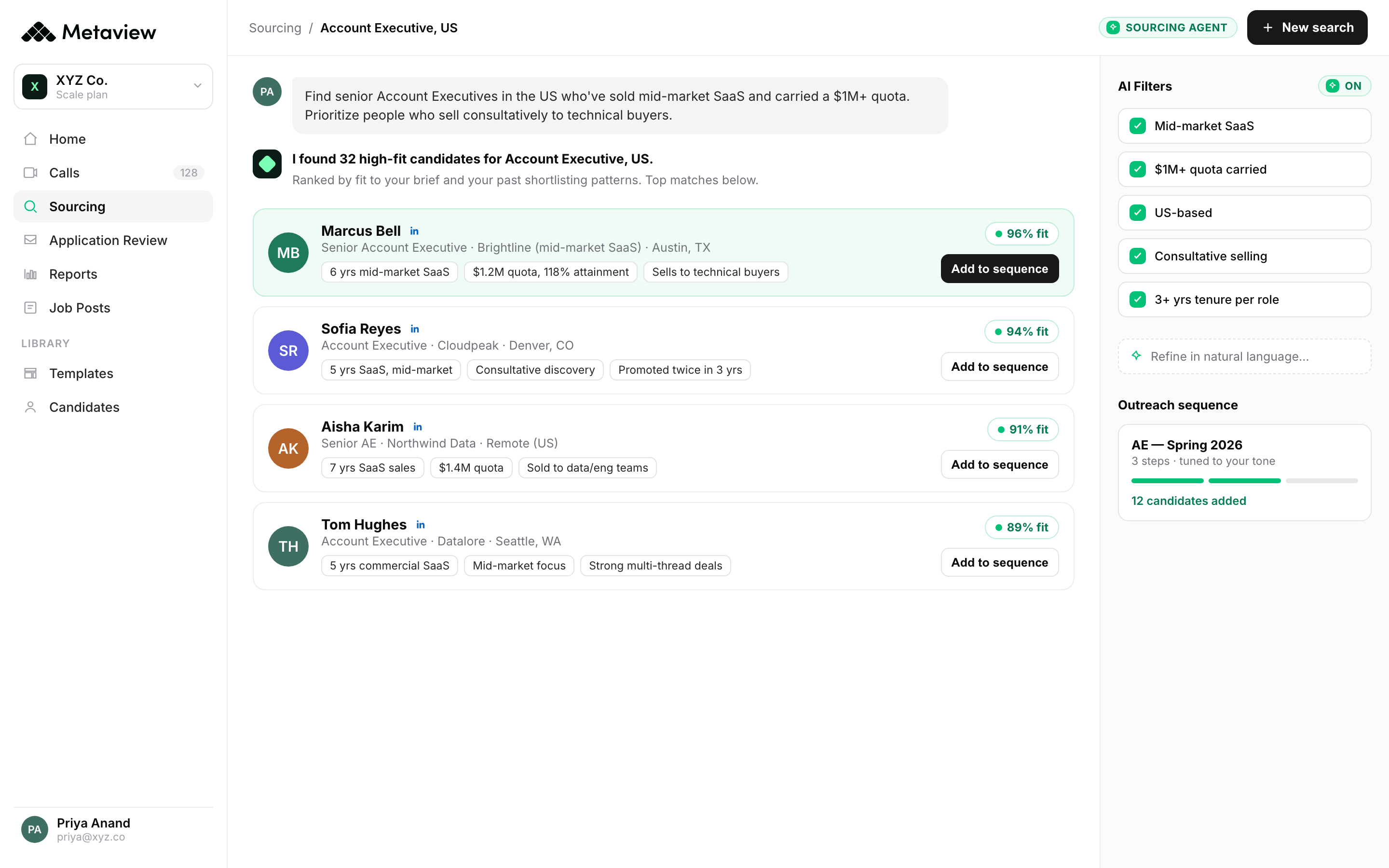
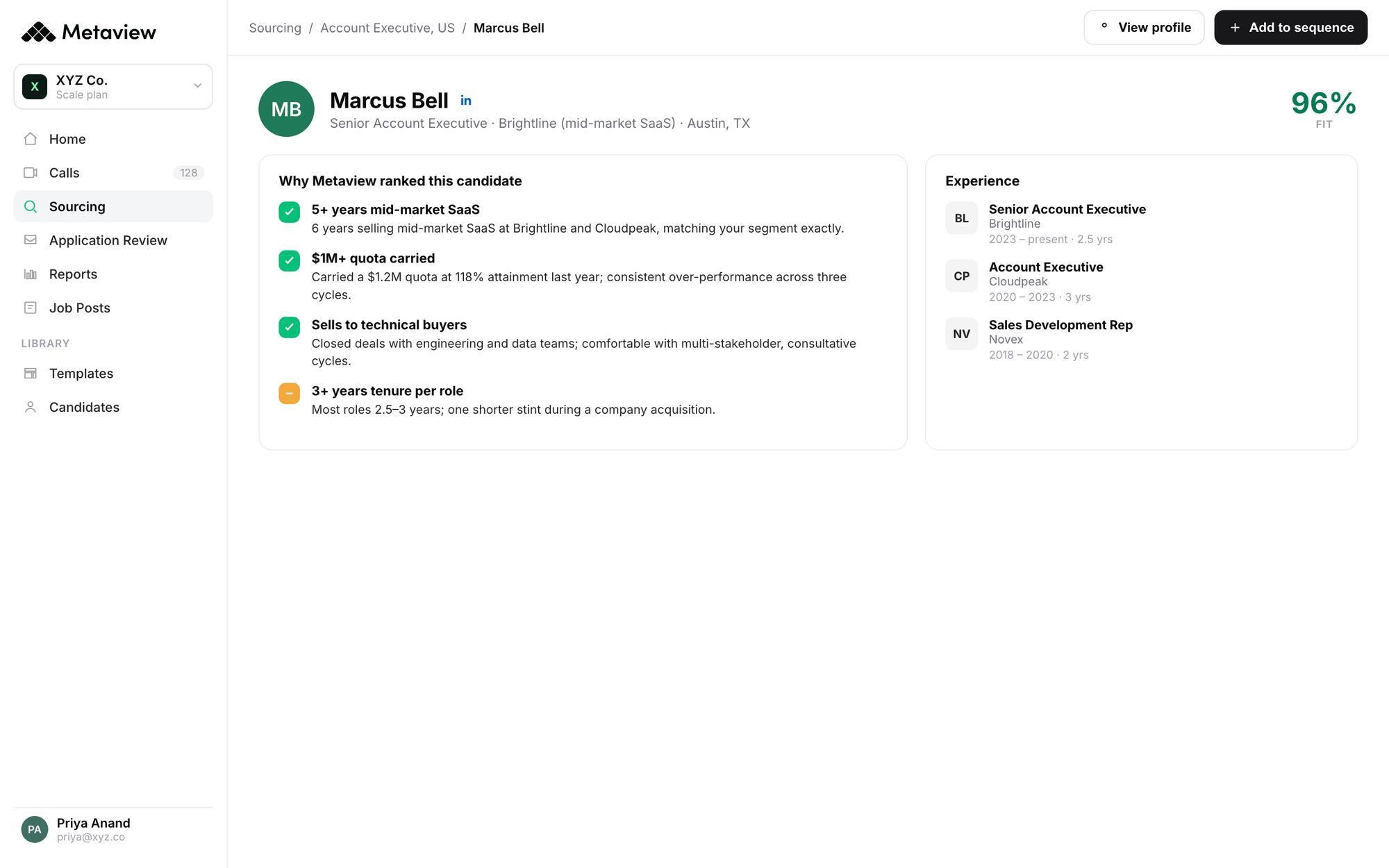
The new part is what happens next. The agent reads the criteria straight out of that conversation and starts searching against them. The sourcing agent searches the web, the candidates backfilled from your connected ATS, and your organization's own past Metaview conversations. Every candidate arrives with the reasoning for the pick. The agent surfaces and explains candidates; it does not contact or assess them on its own.
Two limits belong right next to that. The ATS half of the search covers candidates that have been synced from your ATS into Metaview, which is a far smaller set than everything that ever passed through it. And the criteria the agent worked from are its reading of an hour-long conversation, which is a different thing from what the hiring manager meant.
Metaview is explicit about that second limit elsewhere in the product. Application Review generates an Ideal Candidate Profile from the job description and whatever extra context you hand it, and you review and edit that profile before you approve it. Whatever you approve is the version candidates then get assessed against.
Sourcing doesn't wait for that approval, and that's the point of it: the first pass is already running by the time you open the tab. The same check just lands on you later. Your job is to read the criteria it pulled out of the call, fix what it got wrong, and run it again.
The premise underneath all of this is that the hard part of sourcing was rarely the query itself.
When you understand what you're looking for in a candidate, it's actually quite fuzzy in your head. Being able to articulate it is almost half the problem. That's where vibe sourcing comes in: you're moving from a world where you had to do a lot of upfront thought to get a machine to do something, to one where you just tell it what you want and let it figure it out.

That's the design rationale, and it carries a catch the quote doesn't settle. The machine reading your transcript inherits that half of the problem, because articulating what you want is still half of it. It writes a first draft of the brief out of the conversation, including the parts the hiring manager hadn't thought through yet. A first draft like that is where the argument with your hiring manager should start.
Where a brief beats a keyword string.
A Boolean string matches the words a candidate typed on their own profile. Describe the same experience differently and you're outside the result set, and the recruiter running it has no way of knowing you were missed. We've written before about what AI sourcing and Boolean search each actually measure, and the short version is that almost none of it has been compared head to head.
A brief describes the person, and the vocabulary stops mattering. The sourcing agent takes that description in plain language, which swaps one failure mode for a new one: a keyword string gets written too tight, and a plain-language brief can be read far too loosely.
- Matches the words a candidate typed on their profile
- Needs you to guess those words before you search
- Returns the same list every time you run the same string
- Takes the brief in plain language
- Covers the web, your synced ATS candidates and past Metaview conversations
- Returns each candidate with the reasoning for the pick
Qargo, a logistics software company hiring across three offices, works this way. Claudia Giles, Senior Talent Partner at Qargo, describes it from the recruiter's seat: Metaview records the intake call and creates the first search from it, and her job is adjusting what comes back. The whole thing starts at the intake meeting for her.
She also describes who turns up. One is someone outside transport today who spent three years in an operational role that maps onto what Qargo needs. Another is a French speaker settled in the UK whose profile says nothing about being willing to move back for the right market.
That's one recruiter's account of her own searches, and it deserves exactly that weight. Nobody ran a controlled comparison against the Boolean string she'd otherwise have written, and no such comparison is published anywhere. Candidates that neither approach surfaced stay invisible to everyone, Metaview included.
What it changes about your week.
The easy part to measure is the clock. The first shortlist arrived a median of 17.6 minutes after the intake call ended, across 26,356 intake-linked searches in Metaview's own product data, with the middle half landing between 14.2 and 23.2 minutes. That's what already happened, and it's no promise about your next search.
Qargo's team puts their own before and after at about 2 hours for a first search in LinkedIn Recruiter against about 10 minutes now. The two figures measure different things, one a recruiter's account of the work involved and the other elapsed time to delivery across many customers. They agree on the only claim either can carry: the first pass now takes minutes, where it used to take an afternoon.
Their scale matters here too. Qargo hired more than 100 people in less than a year, with 4 recruiters covering 3 offices in Ghent, London, and Chicago.

The next number decides how much of your week actually changes. The median shortlist is 48 candidates. That's a list you work through, and working through it is now the job that the afternoon of Boolean used to be.
Then you rate what comes back. Recruiters marked 41.5% as a yes once they'd committed to a yes or a no, across 1,228,405 rated candidates, with the ones parked as a maybe left out of that denominator. That's the mechanic working the way the product describes it: the agent surfaces candidates, and the recruiter decides which ones survive.
Reach is the quieter change, and it has a boundary. People you've spoken to before can come back up on a new role, because the agent looks at candidates already synced from your ATS alongside your own past Metaview conversations, so they stop sitting in a system nobody ever searches. Anything that hasn't been synced in isn't searchable, which turns the backfill into a prerequisite.
Who decides never changes. Metaview never auto-rejects and it does not make the hiring decision. The Application Review documentation is explicit that candidates are not re-assessed after the ICP changes or after you give feedback, so a correction shapes your next search and leaves the list you've already seen exactly as it was.
The intake call still decides whether any of this is worth anything. Your attention just moves somewhere else once it ends: onto the brief the agent wrote down, and onto the list it came back with. That's a smaller job than an afternoon in LinkedIn Recruiter, and the same trade shows up across the rest of an AI recruiting stack. It's still the job that settles whether the shortlist is any good.
Put your next intake call to work
See the first search run off a real brief, with the criteria and the reasoning in view.
Frequently asked.
What is intake call sourcing?
Intake call sourcing uses the intake conversation itself to generate the candidate search, instead of translating your notes into keywords by hand afterward. The brief the hiring manager gives you becomes the starting point for the search.
Does Metaview start sourcing automatically after an intake call?
Yes, and the search is the only automatic part. From your first intake call, the agent starts a search against the criteria in the conversation. You still read those criteria, rate the candidates that come back, and make every accept or reject decision. Metaview never auto-rejects.
How does Metaview turn an intake call into a shortlist?
Metaview records the intake call with consent and turns the conversation into structured notes. The sourcing agent then searches the web, the candidates synced from your ATS and your own past Metaview conversations, and returns each candidate with the reasoning for the pick. Across 26,356 intake-linked searches, that first list arrived a median of 17.6 minutes after the call ended.
Can the sourcing agent search my existing candidates?
Yes. It covers the candidates backfilled from your connected ATS and your organization's past Metaview conversations alongside the web, so people you have spoken to before can resurface on a new role. That is limited to what has actually been synced in.
How is this different from Boolean search?
Boolean matches the words a candidate typed on their profile, so you have to guess those words before you search. The sourcing agent takes the brief in plain language and returns each candidate with the reasoning for the pick. No measured comparison of the two is published, and neither approach can tell you who it never surfaced.
