
Deel is one of the fastest-growing companies in history: $1.2B in ARR, $100M in monthly revenue, and a recruiting operation that ships 3,000+ hires a year against 1.5 million applications with just 70 recruiters. The 0.002% application-to-hire rate would be impossible without rebuilding recruiting from the ground up around AI.
Alan Price (Global Head of Talent Acquisition at Deel, previously Uber) joined Nolan Church and Siadhal Magos on 10x Recruiting (more episodes on the 10x Recruiting hub) to walk through the Deel scale playbook: a three-layer AI strategy across inbound CV review, database search, and outbound sourcing; a measurement framework that finally makes quality-of-hire trackable; and an operating mindset that refuses to play victim to growth.
This recap covers the actual mechanics behind 200-to-350 hires per month, why the time-cost-quality tradeoff finally collapses with AI, and where the 30-50% productivity gains hide for a recruiting team running at hypergrowth pace.
The scale: 1.5M applications, 3,000 hires, 70 recruiters.
The Deel numbers are worth absorbing slowly. 1.5 million applications received in 2025. 3,000+ hires shipped. A recruiting team of 70 people. The application-to-hire conversion rate is 0.002%. Monthly hire volume scaled from 200 in early 2025 to 350 by year-end.
Inbound is the dominant channel at this scale. About 55% of Deel's hires come from inbound applications, 25% from sourcing, 20% from referrals, and only 5% from agencies. The brand is doing the work that most companies pay agencies to do; the recruiting team's job is to find the signal in a million-plus inbound applicants without breaking the candidate experience.
The framing Alan brought to it: refuse to play victim to the growth. Most TA leaders at hypergrowth companies eventually start sounding like the business is happening to them. Alan went the other way: how can the recruiting function become part of the solution, not the constraint?
AI screening breaks the CV review bottleneck.
Deel deployed AI across three areas: inbound CV review, internal database search, and outbound sourcing. The inbound layer is the one that delivered the biggest immediate win. The system gets fed the job description, profiles of successful hires in the role, and 15 distinct criteria sets per req. AI scores every applicant, segregates the pool, and surfaces the top 8-12% for human review.
We dropped four or five recruiter screens to one hire. In our engineering world, we went from eighteen recruiter calls to one hire down to fourteen.”

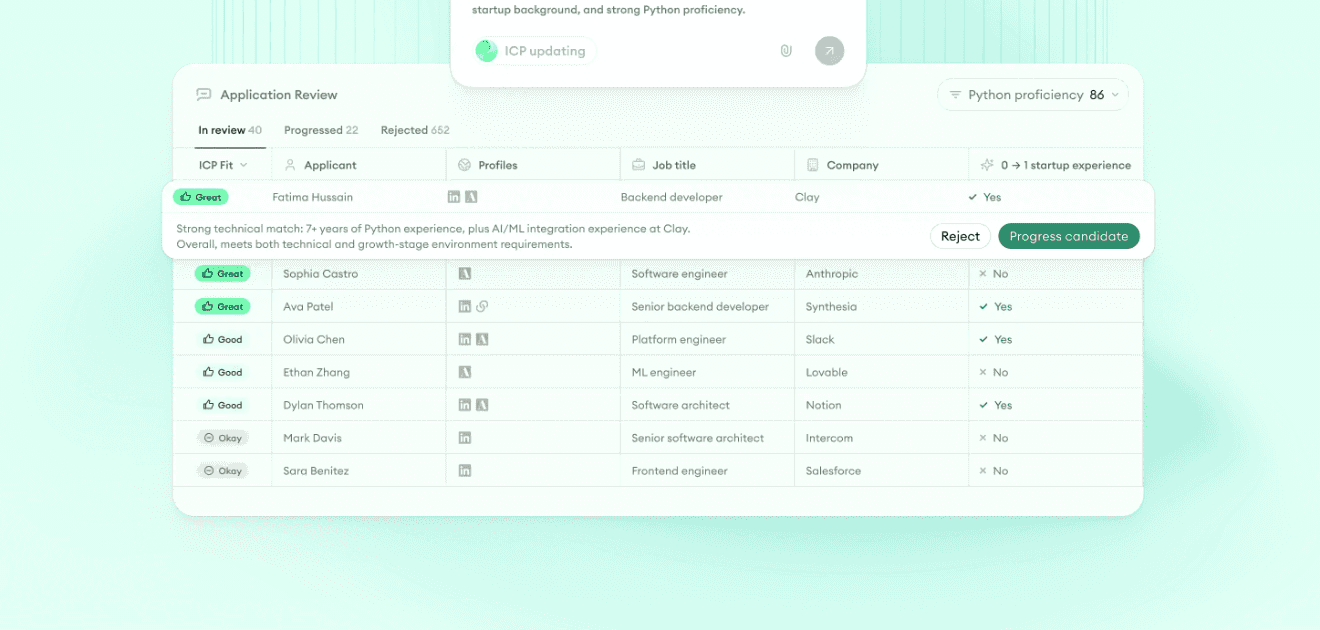
- 1Every inbound applicant gets a Great / Good / Okay verdict against the role profile. The 1.5M-application funnel becomes a sortable column instead of a labor pile.
- 2The one-sentence rationale sits next to the rating, so the recruiter can sanity-check the AI verdict without clicking into a profile. This is what makes the top-8-to-12% pass trustworthy at scale.
- 3Progress or Reject is a single click that posts back to the ATS. The recruiter still owns the call; the AI just compressed the time-to-decision from days to seconds.
The four-screen reduction is the headline number. It does not mean the recruiter is less involved; it means the recruiter is involved at the right point. The senior recruiter hours migrate from CV triage to candidate conversations that actually move the funnel. Volume is up; conversion is up; recruiter satisfaction is up because they spend their time on actual recruiting work.
For more on the application-volume thesis from the Metaview side, see the application-review-live-demo write-up.
- Every recruiter eyeballs 50-100 CVs a day, makes yes/no calls from memory, no rationale captured.
- Eighteen recruiter screens per engineering hire because the early rounds are absorbing CV-triage labor.
- Strong candidates die in the queue at 50K-applicant volumes; the recruiter never gets to them in time.
- 3,000 hires would require ~150 recruiters at this conversion ratio. Cost-per-hire is uncompetitive.
- Every applicant gets a structured read against the role's 15 criteria, with one-sentence rationale on the row.
- Engineering interviews drop from 18 to 14 rounds because the 4 absorbed-labor screens disappear.
- The top 8-12% surface in minutes regardless of inbound volume; strong candidates get touched in the same week they applied.
- 3,000 hires with 70 recruiters. Cost-per-hire is half of what the pre-AI org chart would have needed.
The ATS as goldmine: database AI.
The second-biggest unlock at Deel is database search. The traditional ATS search relies on tagging and boolean queries, both of which miss qualified candidates because the tags were never applied or the boolean string was too narrow. AI can scan the entire database semantically against a job's criteria in minutes.
We identified 288 candidates already on our database that meet the criteria for a nuanced payroll documentation role.”
Most of those 288 candidates were previously rejected, but not because they were unqualified. They were rejected for timing (no open req at the time), for application-volume limits, or for missing a single tag in the ATS. The previously-rejected pool turns into the highest-ROI sourcing channel in the business the moment AI can search it properly. See most-accurate-sourcing-coworker for the broader pattern.
Silver-medal candidates (the ones who got close to an offer but lost out to someone else) compound the same way. With AI screening time approaching zero, the calculation flips. There is no longer any reason not to evaluate every applicant against every open req every time.
RISE methodology: finally measuring quality of hire.
The hardest unsolved problem in recruiting is quality of hire. Most teams settle for time-to-fill and cost-per-hire because those are easy to measure. Alan built the RISE framework at Deel to make quality genuinely trackable: Recruit an Inspired workforce that Stays and Excels.
Fill in the same recruiting scorecard that you did to advocate for the hire. Then you can do your gap analysis of forecast versus actual.”
The mechanic is simple. The recruiting team scores every finalist against an identical scorecard before the offer. The same scorecard gets filled out at 30 days, 90 days, and 180 days post-hire by the manager. The gap analysis (predicted vs actual) is the quality-of-hire signal nobody else in the market is actually measuring. Once you can see the gap, you can fix the upstream interview that produced the bad prediction.
This is the loop that closes the entire recruiting function. Most teams optimize the funnel without ever knowing whether the hires they made were the right hires. Deel knows, by req, by interviewer, by source.
The time-cost-quality tradeoff is dead.
The recruiting industry grew up on the time-cost-quality tradeoff: pick two. Want fast hires? Lower the bar or hire more recruiters. Want quality? Slow down or pay agency rates. Alan's claim is that AI breaks the constraint entirely.
You can find the quality quickly. With that efficiency, you don't need a massive team just sifting through CV reviews. Your cost per hire goes down. You've actually got all three components that AI can deliver.”
The proof is in the Deel numbers. Time-to-shortlist down (AI surfaces the 8-12% in minutes). Cost-per-hire down (70 recruiters doing the work that would have required 150 in a pre-AI shop). Quality measured directly via RISE and trending up. The TA leaders still treating the tradeoff as a constraint are leaving 30-50% of the productivity gains on the table. See claude-for-recruiters for the AI-augmented-recruiter operating shift.
Where AI gives recruiting teams use.
Mines the ATS and CRM for silver medalists and re-ranks the entire historical pool against every new req. This is the layer that surfaced Deel's 288 already-on-database matches.

Handles the inbound CV ranking layer that Deel runs at 1.5M scale. Every applicant gets a Great / Good / Okay rating with rationale; the recruiter still owns Progress or Reject.
Captures every interview verbatim so the RISE scorecard can be backed by actual evidence instead of memory. The interview signal that fed the offer decision is the same signal the gap analysis runs against.
Closes the RISE loop by tracking 30/90/180-day hire performance against pre-offer scorecards. The gap analysis becomes a routine artifact instead of a quarterly retro.
Deel's playbook generalizes. The infrastructure to run it is largely already built and available to teams 1/10th the size of Deel's. AI reallocates recruiter time from CV triage and database wrangling to the conversations and decisions that actually compound.
Metaview Notetaker captures every interview verbatim so the RISE scorecard can be backed by actual evidence instead of memory. Application Review handles the inbound CV ranking layer that Deel runs at 1.5M scale. AI Sourcing mines the ATS and CRM for silver medalists and re-ranks the entire historical pool against every new req. Reports closes the RISE loop by tracking 30/90/180-day hire performance against pre-offer scorecards.
Numbers from the 2026 AI & Hiring Alignment Report, surveying 505 recruiting leaders and hiring managers across North America and EMEA. The 85% goal-exceeding stat maps directly to Alan's Deel playbook: when AI is the default at every layer of the funnel, the team hits its hiring goals at a rate the pre-AI shop just doesn't.
The operating shift.
Three concrete moves from Alan's Deel playbook for any TA leader trying to scale without breaking:
One: stop screening inbound by hand. Feed your AI ranking layer the job description, the 5-15 criteria, and profiles of past successful hires. Let it surface the top 8-12% to the human recruiter. The recruiter screens that disappear were never adding signal; they were just absorbing labor.
Two: search your own database before opening a new sourcing project. The candidates you have already evaluated, already messaged, already interviewed are the highest-warmth pool you own. AI semantic search will surface dozens to hundreds of qualified matches that boolean queries missed.
Three: install RISE or equivalent. Build the scorecard. Run it at the offer stage and at 30/90/180 days. Measure the gap. The gap is the quality-of-hire signal that lets you fix the upstream interview, the upstream sourcing channel, the upstream calibration. Without the loop, every other AI investment is partial.
The TA teams that internalize these three moves will out-hire the ones still treating recruiting like a 2022 operations problem. That is the operating shift.
Bring Metaview into your hiring stack.
Live notes, structured scorecards, and ATS sync - set up in under 10 minutes.
Frequently asked questions.
How does a 70-person recruiting team handle 1.5M applications?
By making AI the default screen, not the augmentation. Deel's AI layer scores every applicant against job-specific criteria and surfaces the top 8-12% for human review. The recruiter team focuses on the candidates AI already ranked highly, not on triaging the full inbound flood. 0.002% application-to-hire is impossible without rebuilding the funnel around AI ranking.
What is Deel's three-layer AI strategy?
Layer one: inbound CV review (AI ranks every applicant against 15 criteria, surfaces top 8-12%). Layer two: internal database search (semantic AI scan of the entire ATS/CRM history against new reqs). Layer three: outbound sourcing (AI surfaces external candidates matched to the same criteria). All three layers feed the same recruiter, so the senior hours stay focused on conversations, not triage.
What is the RISE methodology?
Recruit an Inspired workforce that Stays and Excels. The mechanic: every finalist is scored against a recruiting scorecard at the offer stage. The same scorecard is filled out by the manager at 30, 90, and 180 days post-hire. The gap between predicted and actual is the quality-of-hire signal that lets you fix the upstream interview process. Most teams cannot measure quality of hire; RISE makes it routine.
How did Deel cut engineering interview rounds from 18 to 14?
By eliminating four recruiter screens that were doing CV triage rather than candidate evaluation. AI surfaces the top-quality applicants directly to the right recruiter, so the early screens that used to filter the pool are no longer needed. The remaining 14 calls are the substantive ones: technical screens, hiring-manager conversations, work assessments, and final loops.
Why does Alan say the time-cost-quality tradeoff is dead?
Because AI delivers all three simultaneously when deployed across the funnel. Time-to-shortlist collapses because AI ranks in minutes. Cost-per-hire drops because the team can run leaner. Quality goes up because the AI ranking surfaces matches a human reviewer would have missed under volume pressure. The pre-AI tradeoff was a real constraint; the post-AI version is a choice some teams are still making out of habit.
