
The market for experienced in-house recruiters is structurally short. Every founder is hiring; the pool of practiced operators is not growing. The companies that solve this build their own recruiters instead of waiting for the right resume to land. Evan Connor has built that machine.
Evan Connor, VP of Talent at Ambience Healthcare (the AI-for-clinicians company), joined Nolan Church on 10x Recruiting (more episodes on the 10x Recruiting hub) to break down how Ambience produces full-stack recruiters from scratch. Evan came up as a paramedic in San Francisco before moving into recruiting, and his framing is operator-first: a recruiter who can't articulate the company's org design, financial health, and product roadmap is a recruiter who can't pick the right people. Ambience's onboarding program is built around that thesis.
This recap walks through the moves: hiring high-slope generalists instead of credentialed recruiters, why new grads are an underrated bet, the two-day immersive onboarding that includes a 20-second / 2-minute / 20-minute pitch certification, why business context is the recruiter's actual superpower, and the 30-60-90-day quality loop that makes the whole thing accountable.
Grow your own recruiters
The first half of Evan's thesis is supply-side. The market is not producing enough experienced in-house recruiters to meet demand, and the shortage is not closing. Trying to hire your way out of it puts every team in a bidding war for the same small pool of practiced operators. The teams that pull ahead build their own.
Evan's bar for who to grow: high-slope generalist athletes. Smart, driven, willing to flex across multiple business functions. A real example: he hired someone with agency + VC background and no in-house experience, because she had what he calls "all the potential in the world." Eight months in, she runs Ambience's onboarding program (more on that below) and is ramping as a recruiter at the same time.
If you give smart folks challenging and ambiguous problems and unleash them, I think these folks can be grown, and I think they can turn into high-impact assets for the business.”
The implication for any growth-stage talent leader: stop screening for the exact recruiting resume, start screening for the operator who can become a recruiter under your coaching.
New grads are the underrated bet
Evan's second supply move is leaning into the new-grad market that most companies are sleeping on. "New grad hiring is at an all-time low," he told Nolan. That makes the talent itself an arbitrage. New grads come in AI-native, comfortable with the tools transforming recruiting workflows, and crucially without the ego barriers that keep more experienced practitioners from learning new systems.
The structural play Evan likes: hire generalists with one or two years of post-college experience, train them as sourcers + recruiters + business partners in a deliberate rotation, and treat the first 18 months as a "tour of duty." The recruiter who learns the business in their first job at your company will be a far better recruiter for you than the experienced hire you imported.
The tradeoff is that some of those people graduate out of the recruiting seat into other parts of the business, and you have to keep refilling the funnel. Evan's view: that cost is worth paying. The alternative is a perpetual scramble for senior recruiters who are not actually available.
Recruiting does not end at offer-accept
The traditional recruiting org closes the file when the offer's accepted. Ambience flips the model. The VP of Talent owns the onboarding program, because the same brief-to-success logic that runs the search also runs the first 90 days. If you wrote a clear MOC for the role going in, you have the rubric for onboarding going out.
Ambience's onboarding is a two-day immersive. Every functional leader spends time with the new hire walking them through the business. The new hire then gets certified on the company pitch in three formats: 20 seconds, 2 minutes, and 20 minutes. The certification is not a vanity exercise. It's the test that proves the new hire actually understands the company well enough to represent it to candidates, customers, family, friends, and the random person they meet at a party.
After that two-day immersive, if you do it well, on day three they're ready to start making an impact.”
The downstream return: every new recruiter on Evan's team comes out of onboarding with the business context they need to make the next hire well. Compound that across a team of five or ten, and you have an org that picks talent off business signal instead of resume keywords.
Business context is the superpower
Evan's most direct framing of the recruiter's job: "What is the org design of this business? How does each role have the right scope and responsibility that actually ties back to the business objectives?" If the recruiter can't answer those, they're a sourcer, not a partner.
The practical bar he sets for his team: sit in on product meetings, understand where the roadmap is going, know how the business makes money this quarter and next quarter, read the financials. The recruiter who knows the business at that level can challenge the hiring manager's brief and propose a candidate profile the hiring manager hadn't considered. That is the seat at the table that recruiting has been chasing for a decade. It is earned with context, not titles.
The reason most recruiters don't operate this way, in Evan's read, is not on the recruiters; it's on their leaders. "That's on me as a leader to help build and grow and cultivate a team that has that seat at the table, but can also get in the trenches." Recruiting leadership's job is to make business context part of the actual role, not a stretch goal.
The 30-60-90 quality loop
The closing loop on Evan's whole system is measurement. Ambience runs automated quality-of-hire assessments at 30, 60, and 90 days for every new hire. Evan personally meets each new hire at 45 days and 90 days. The combination produces honest two-way feedback fast enough to course-correct on mis-hires before the cost compounds, and structured enough to feed the data back into how the next search runs.
Quality-of-hire is a long-cycle metric, but the only way to make it actionable is to break it into short checkpoints. Waiting for the annual review to find out the hire didn't work is six months too late. The 30-60-90 cadence catches the signal early, gives the manager and the new hire a structured place to surface friction, and gives the recruiter the data they need to recalibrate their screen.
The mechanism that makes this possible at scale is automation. Manually surveying 100 new hires three times each is a full-time job. Automated assessments collect the signal; the human time goes to the conversations the data flags as worth having.
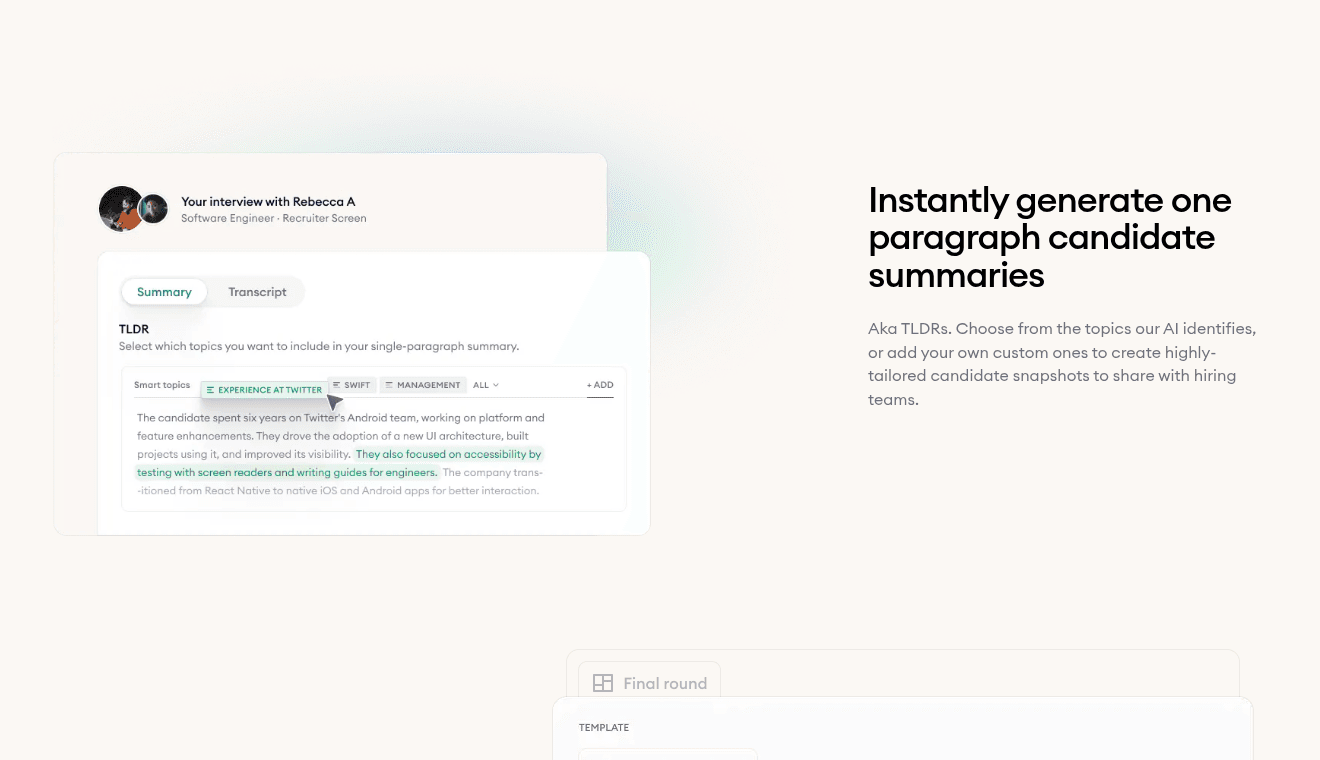
- 1Intake calls, screens, and onboarding check-ins land here verbatim. The new recruiter ramps from real conversations, not a stale doc.
- 2The structured template is what makes the 20-second / 2-minute / 20-minute pitch certifiable. Same words, every audience, every time.
- 3The TLDR is what the VP of Talent reads at the 45-day check-in. The pre-offer prediction sits next to the post-hire pattern.
Where AI gives recruiting teams use
The Ambience playbook is intensive. Per-candidate calibration, multi-stakeholder onboarding, longitudinal 30-60-90 measurement, deep business-context investment for every recruiter. The depth is what produces the outcomes. AI is what makes the depth possible without doubling the recruiting headcount.
The use points: Metaview Notetaker captures every intake call, every screen, every onboarding-check conversation verbatim so the recruiter can be present instead of typing. Application Review handles the inbound volume so senior recruiter hours go to the candidates who need real conversation. Reports tracks whether the people you hired actually performed at the 30, 60, and 90-day marks Evan cares about.

Frees the new recruiter from manual list-building so their first 90 days go to candidate conversations and business-context absorption, not Boolean strings.

Removes the CV-triage tax so the high-slope generalist hire ramps on real interviews instead of inbox archaeology.

Captures intake calls, candidate screens, and onboarding conversations verbatim. The 20-second / 2-minute / 20-minute pitch certification is easier when the source material is searchable.

Tracks the 30-60-90 quality loop across every hire and segments by interviewer cohort. The recruiter-development data lives next to the candidate-outcome data.
Numbers from the 2026 AI & Hiring Alignment Report, surveying 505 recruiting leaders and hiring managers across North America and EMEA. The 3.8x relationship lift is the one that maps cleanest to Evan's 30-60-90 thesis: when AI captures the evidence, recruiters and hiring managers calibrate from the same proof instead of arguing from competing recall.
The operating shift
Three concrete moves from Evan's playbook for any talent leader who wants to stop competing for experienced recruiters and start growing them:
One: open one rotational recruiting seat to a high-slope generalist. Hire for the operator profile, not the recruiting resume. Pair them with a senior recruiter and put them on a 12-month rotation that includes sourcing, full-cycle work, and at least one strategic project (onboarding redesign, comp benchmarking, ATS implementation). The first one teaches you everything you need to know about scaling the pattern.
Two: certify every new hire on the company pitch in three formats. 20 seconds for the elevator, 2 minutes for the recruiter screen, 20 minutes for the customer call. The certification proves the new hire actually understands the business. The byproduct is a team that can recruit and sell on the company's behalf in every interaction.
Three: install the 30-60-90 quality loop. Automated assessments at each checkpoint, plus a VP-level check-in at 45 and 90 days. Track the aggregate per recruiter. The data is the actual scorecard.
The talent leaders who build their own recruiters, embed them in the business, and measure quality on the 90-day curve outperform the teams running the old playbook on every dimension that matters from here.
Bring Metaview into your hiring stack.
Live notes, structured scorecards, and ATS sync - set up in under 10 minutes.
Frequently asked questions
Why does Evan say recruiters need to be grown rather than hired?
Because the supply of experienced in-house recruiters is structurally short and every growth-stage company is competing for the same small pool. The teams that grow their own from high-slope generalist athletes (and from new grads) build a durable supply that the market cannot give them.
What does Ambience's onboarding program look like?
A two-day immersive where every functional leader spends time with the new hire walking them through the business. The new hire gets certified on three company-pitch formats: 20 seconds, 2 minutes, and 20 minutes. On day three, the new hire is expected to be ready to make an impact.
What's an MOC and why does Ambience write one for every role?
A mission-outcomes-competencies brief written before the search opens. The MOC translates directly into the new hire's 30-60-90 plan, the interview rubric, and the onboarding outcomes. Writing it well forces alignment between the hiring manager, the recruiter, and the business goals before a single candidate is sourced.
How does Ambience measure quality of hire?
Automated assessments at 30, 60, and 90 days for every new hire, plus VP-of-Talent check-ins at 45 and 90 days. The combination surfaces mis-hires fast enough to course-correct, gives the manager and new hire a structured place to raise friction, and feeds data back into how the next search runs.
What business context does Evan expect his recruiters to have?
Org design, product roadmap, financial health, how each function works with every other, the operating rhythm of the business. The bar is that the recruiter can challenge a hiring manager's brief and propose a candidate profile the hiring manager hadn't considered. That's what earns the seat at the table.
