
10x recruiting isn't a tool. It's a system.
The teams that outhired the competition in 2025 didn't have more recruiters; they had recruiters spending more time on the work that mattered and less on admin. The 10 plays below are the ones we see show up most often across 4,000+ organizations on Metaview.
All 10 plays at a glance.
| # | Play | Outcome |
|---|---|---|
| 1 | Capture every interview | Time-to-feedback collapses |
| 2 | Run structured intakes | Re-sourcing cycles disappear |
| 3 | Automate sourcing | Recruiter hours move to candidate work |
| 4 | Nurture talent communities | Time-to-fill drops 40-60% |
| 5 | Standardize interviews | Comparability and fairness rise |
| 6 | Collapse time-to-feedback | Offer acceptance rises |
| 7 | Coach interviewers | Hiring decisions get sharper |
| 8 | Diversify channels | Quality of hire improves by source |
| 9 | Instrument the funnel | Bottlenecks become visible |
| 10 | Partner with hiring managers | Strategic seat at the table |
1. Capture every interview.
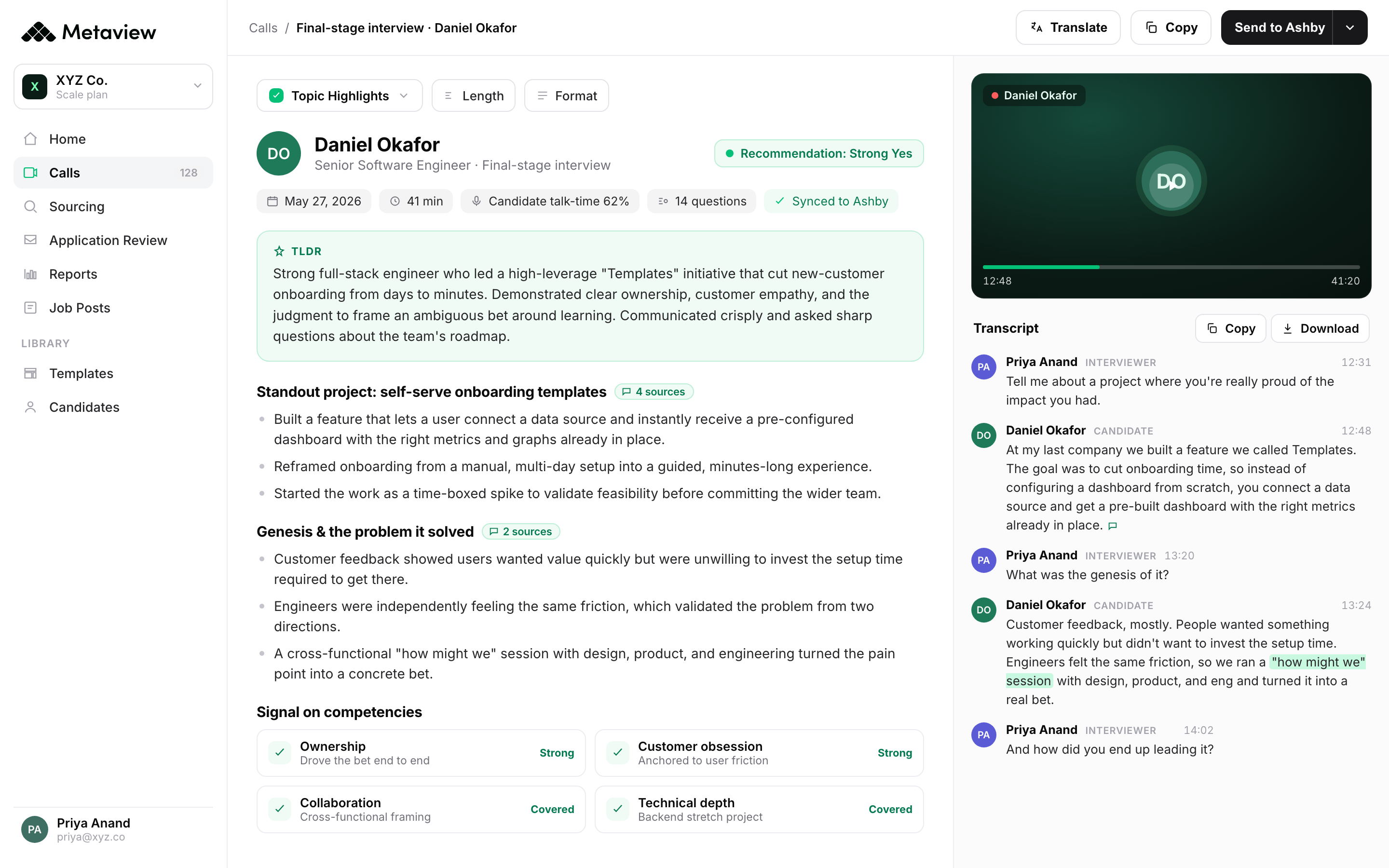
The high-impact play in 2026. Structured capture cascades into every other improvement: feedback speed, decision quality, candidate experience, interviewer coaching.
What to do: deploy AI notetaking with ATS write-back. Metaview's free tier covers it.
2. Run structured intakes before sourcing.
One of the costliest mistakes in recruiting is sourcing the wrong shape of candidate for two weeks before realizing it. A captured intake call pins down must-haves vs. nice-to-haves before any Boolean string runs.
3. Automate sourcing.
Manual Boolean sourcing is fading fast. AI sourcing agents read the brief and return ranked candidates in minutes. The recruiter spends time on shortlist review and outreach.
4. Nurture talent communities.
The cheapest hire is a candidate who already knows you. A nurtured community of 500 closes a senior role faster than a cold outreach campaign of 5,000.
5. Standardize interviews per competency.
Per-stage question kits tied to specific competencies. Interviewer can probe; the core questions are consistent across candidates. The shortlist becomes comparable.
6. Collapse time-to-feedback.
Days lost between interview and scorecard compound into weeks lost between role open and offer signed. Pre-populated structured scorecards collapse the gap to minutes.
7. Coach interviewers with real data.
Generic interview training doesn't change behavior. Specific feedback tied to real interview moments does. Captured interviews are the corpus you coach against.
8. Diversify sourcing channels with discipline.
The right answer is three deep channels, not seven shallow ones. Quality-of-hire-by-channel analysis surfaces which two deserve disproportionate investment.
9. Instrument the funnel.
Five metrics weekly: time to launch, time between stages, time-to-feedback, interview-to-offer ratio, offer acceptance. Most teams discover their bottleneck isn't where they thought.
10. Partner with hiring managers earlier.
The teams winning at recruiting in 2026 partner with hiring managers at the workforce-planning level, not the req-opening level. Recruiters become strategic advisors instead of process managers.
How to start.
The two plays that compound fastest are interview capture (play 1) and structured intakes (play 2). Together they collapse time-to-feedback and eliminate the re-sourcing cycles that kill velocity.
Add automated sourcing (play 3) and nurtured talent communities (play 4) next. Those two free recruiter hours that go straight back to candidate engagement.
Instrument the funnel (play 9) before scaling anything. Without baselines, you can't tell which plays moved which metrics.
Metaview captures every interview, writes structured scorecards back to your ATS, runs AI sourcing, and surfaces interviewer-level data for coaching. 4,000+ organizations now run hiring on Metaview, including Brex, emnify, Quora, Workleap, Lightspeed, Catawiki, and Automattic.
Bring Metaview into your hiring stack.
Live notes, structured scorecards, and ATS sync, set up in under 10 minutes.
Frequently asked.
What does 10x recruiting actually mean?
Recruiters spending their time on the work that drives outcomes (candidate engagement, hiring-manager partnership, workforce planning) instead of admin. The 10x label refers to the leverage shift, not literally 10x the hires.
Which play should I start with?
Capture every interview. It cascades into time-to-feedback, decision quality, candidate experience, and interviewer coaching. Other plays compound from it.
Can small teams play 10x recruiting?
More than large teams. A 2-recruiter team that absorbs the admin tax can take on 2x more reqs without dropping conversation quality. The leverage is highest where the headcount is lowest.
How long does it take to see results?
Per-play, six weeks. Compounded effect across the funnel shows up in the second quarter. The plays themselves don't take long; the operational discipline to sustain them does.
What if my hiring managers resist these plays?
Show them data they don't have today: structured scorecards, time-to-feedback metrics, panel consistency views. Most hiring-manager resistance is really resistance to the lack of data they currently have.
What's the most overlooked play?
Interviewer coaching with real data. Most teams know their interviewers vary in quality and never act on it. Captured interviews + per-interviewer analysis change that.
