
Most recruiting teams have a workflow problem, not a sourcing problem.
The hires come slowly not because the candidates aren't there, but because the work between "candidate identified" and "offer accepted" is choked with manual handoffs, slow feedback, and meetings that exist to compensate for missing data.
Streamlining the hiring process isn't about cutting corners. It's about removing the friction that turns a 21-day cycle into a 60-day one.
Here are the 10 tactics top recruiting teams are running in 2026 to move faster without dropping quality.
All 10 tactics at a glance.
| # | Tactic | What it fixes | Time saved |
|---|---|---|---|
| 1 | Automate the sourcing grind | Recruiter hours lost to Boolean strings | 5-10 hrs/week per sourcer |
| 2 | Stop screening every resume | Inconsistent first-pass screening | 50% on screening (Workleap) |
| 3 | End manual notetaking | Lost detail, split attention in interviews | 20 min/interview |
| 4 | Collapse time-to-feedback | Days lost between interview and scorecard | 48 hrs to 10-20 min |
| 5 | Align hiring managers early | Re-sourcing after first reject | Days to weeks per role |
| 6 | Automate scheduling | Calendar Tetris and reschedule chains | 2-3 hrs/week per coordinator |
| 7 | Standardize the interview | Interviewer variance and unfair comparison | Improves signal, not speed |
| 8 | Use structured scorecards | Vague free-form feedback | Halves debrief length |
| 9 | Run fast debriefs | Stalled decisions, ghost candidates | Replaces 3-day async loops |
| 10 | Instrument the funnel | Invisible bottlenecks | Compounds quarterly |
1. Automate the sourcing grind.
Manual sourcing is the largest single time tax on a recruiting team. The recruiter who spends three hours building a Boolean string and four hours scrolling profiles produces, at best, the same shortlist an AI sourcing tool produces in 20 minutes.
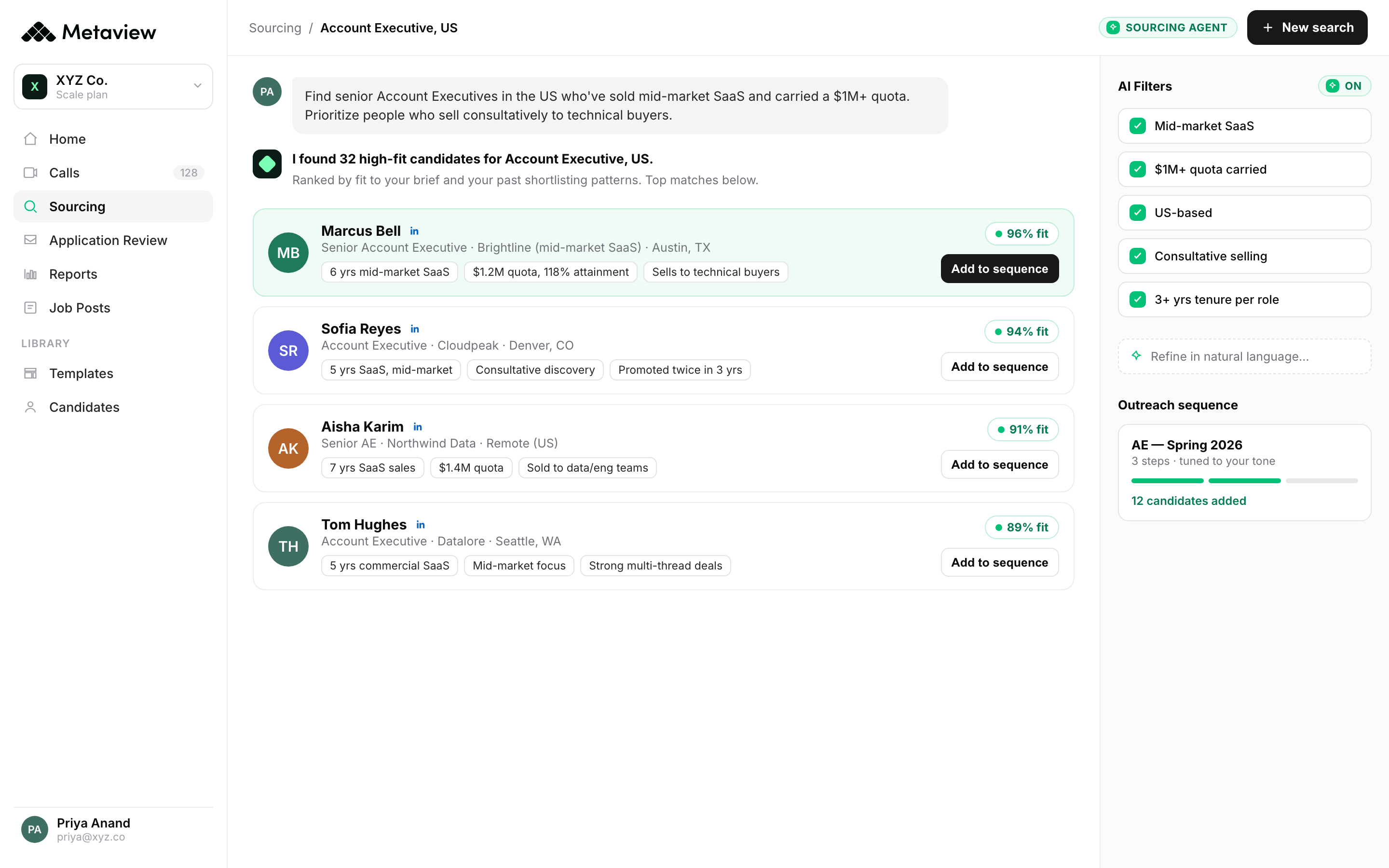
AI sourcing agents read the JD, rank candidates against your past successful hires, and surface new matches continuously. The human work concentrates where it matters: shortlist review and outreach.
What to do this quarter: pilot AI sourcing on one role family and measure recruiter time-to-shortlist before and after. Most teams cut it from days to hours.
This is exactly the shortlist-review-and-outreach split Metaview is built around, generating a ranked shortlist straight from the role brief so recruiters skip the Boolean grind:
2. Stop manually screening every resume.
Application review is the second-largest time tax, especially on high-volume roles. Reviewing 200-300 candidates per role at 30-45 seconds each adds up to two days of full recruiter time per req.
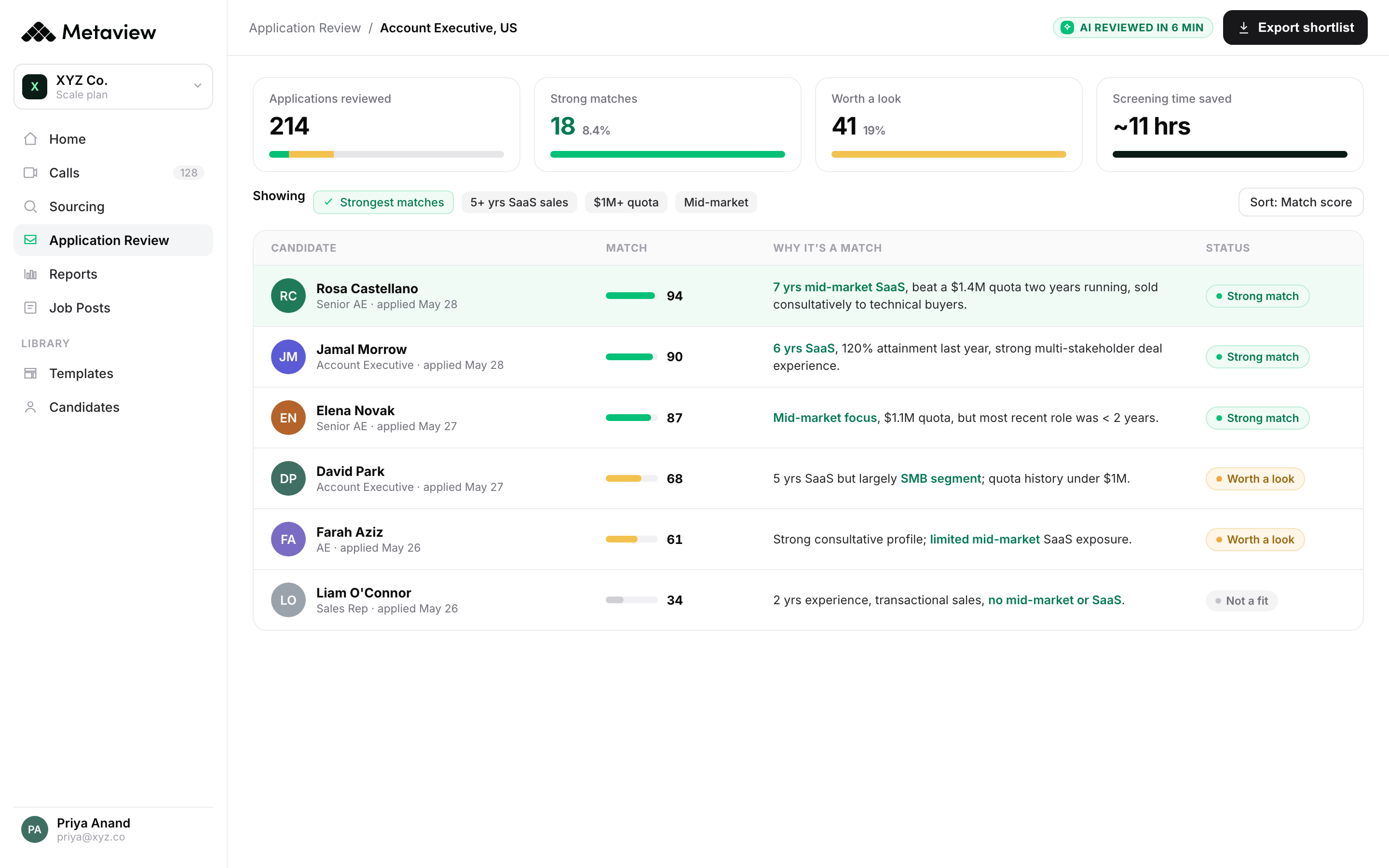
Modern AI screening doesn't just keyword-match; it evaluates candidates against the actual role requirements and explains the reasoning. That last part is what makes it usable: recruiters can validate decisions instead of accepting an opaque score.
What to do this quarter: add an application-review agent to one high-volume role. Measure recruiter screening time and overall candidate quality after four weeks.
This is the validate-don't-rubber-stamp screening Metaview runs on inbound volume, ranking every applicant against the actual requirements and showing the reasoning behind each call:
3. End manual interview notetaking.
Interviewers typing notes while listening to candidates lose signal both ways. The candidate experience degrades (they see the laptop, not the interviewer) and the notes themselves miss the high-signal phrasing that matters most.
AI notetakers capture every word, generate structured summaries, and map answers to your competency rubric automatically. The interviewer's job becomes what it should have been: a focused conversation.
What to do this quarter: roll out an AI notetaker across all hiring-manager interviews first, then expand to panel rounds once signal stabilizes.
4. Collapse the time-to-feedback gap.
Feedback delays kill more deals than salary does. Every day between interview and decision is a day the candidate is being courted somewhere else.
The intervention is simple: capture the interview structurally so the scorecard exists the moment the call ends. Hiring managers fill in faster when the rubric is pre-populated, and recruiters can chase a 10-minute review instead of a 2-day write-up.
All of our hiring team said that Metaview saves them hours. The feedback was awesome really quickly. We're now getting feedback from hiring managers in 10 to 20 minutes, which is just ideal for a recruiting team that works with time-to-hire targets.”
5. Align hiring managers before sourcing starts.
The most expensive mistake in recruiting is sourcing the wrong shape of candidate for two weeks before discovering it.
Run the intake call before the first Boolean string. Pin down must-haves vs. nice-to-haves, role outcomes, and how candidates will be evaluated at each stage.
Capture the intake call itself so the recruiter can refer back instead of re-asking.
What to do this quarter: templatize the intake call. Make it required before sourcing starts on any new req.
6. Automate interview scheduling.
Scheduling is the unglamorous time sink that compounds across every active role. Two hours per panel to find a slot, multiplied by 30 active roles, equals 60 hours a month of pure coordination.
Automated scheduling tools let candidates pick from available slots, coordinate across multiple interviewers, and handle reschedules without a human in the loop. The recruiter coordinator role doesn't disappear; it moves to higher-value work.
What to do this quarter: measure scheduling hours per recruiter this month, deploy an automation tool, measure again next quarter. The savings usually fund the tool inside six weeks.
7. Standardize the interview.
Unstructured interviews are the reason hiring managers can't compare candidates fairly. One interviewer asks about projects, another asks about culture fit, a third improvises. The shortlist becomes a coin toss.
Standardized interviews assign each stage a specific competency to assess and use a consistent question set for that competency. The interviewer can probe and follow up, but the core questions are the same per candidate.
8. Use structured scorecards.
Free-form feedback is what stalls hiring decisions. "I liked them" and "they seemed solid" don't compare across five interviews.
Structured scorecards force a rating per competency plus a short evidence note. The hiring manager fills it in faster, the recruiter can compare candidates side by side, and the debrief becomes a 15-minute discussion instead of a 45-minute re-argument.
What to do this quarter: standardize the scorecard template across role families. Tie each competency to a behavioral anchor so "good" and "great" mean the same thing across interviewers.
9. Run fast debriefs.
Async written feedback is fine in theory. In practice, the time gap between interview and review degrades the signal, and disagreements never get resolved.
A 20-minute debrief within 24 hours of the final interview replaces three days of Slack messages. It also catches the high-conviction objection that one interviewer would never write down but will absolutely say out loud.
What to do this quarter: book the debrief slot when you book the final interview. Don't let it slip more than 24 hours past.
10. Instrument the funnel.
Streamlining isn't a one-time project; it's continuous calibration. The teams that improve quarter over quarter are the ones who can name their bottleneck by metric.
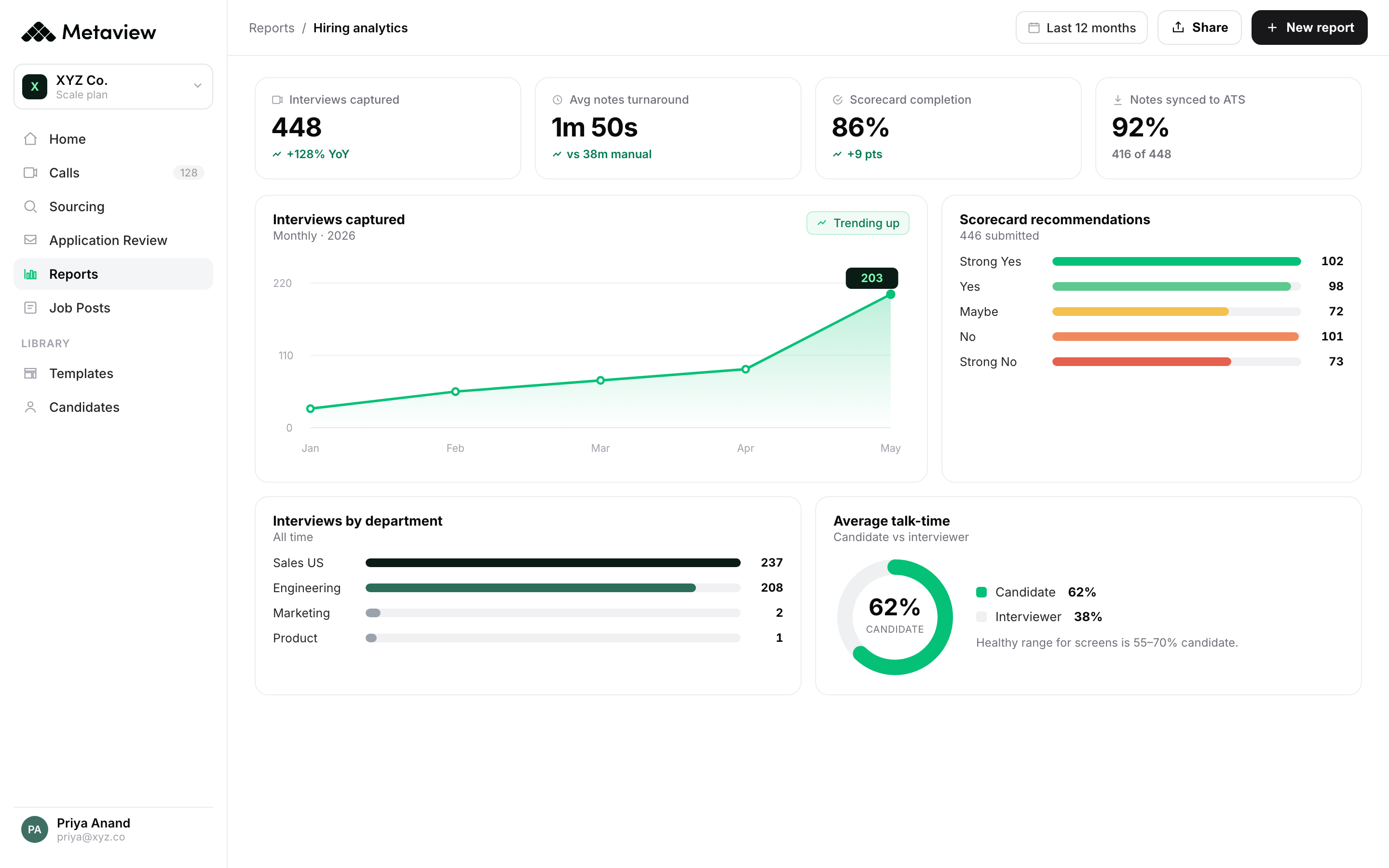
The five metrics worth tracking: time to launch, time between interview stages, time-to-feedback, interview-to-offer ratio, and offer acceptance rate. Review them monthly. Most teams find their actual bottleneck isn't where they thought it was.
What to do this quarter: instrument the five metrics in your ATS or BI layer. Set a monthly 30-minute review with the recruiting leadership team.
This is the name-your-bottleneck-by-metric view Metaview produces automatically, turning captured interviews into the funnel metrics most teams never see:
How Metaview streamlines the process.
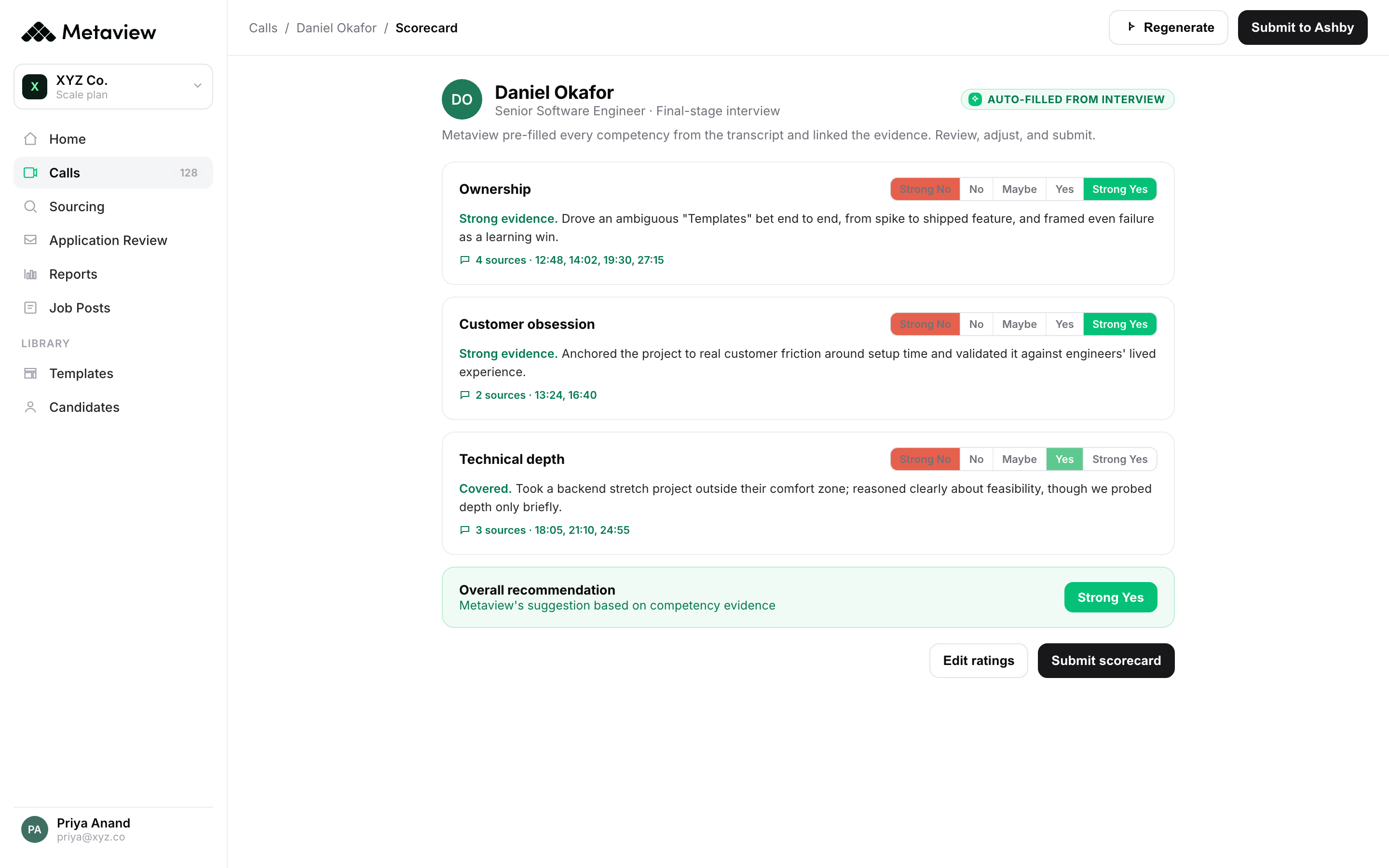
Most of the friction points above share one root cause: the interview is the highest-signal moment in hiring, and it isn't captured structurally.
Metaview captures it. Notetaker records every conversation across Zoom, Google Meet, Microsoft Teams, and phone. Reports map answers to your rubric.
The structured scorecard writes back to your ATS automatically. Sourcing surfaces ranked candidates from the brief, and Outreach drafts per-candidate messages grounded in the signal.
4,000+ organizations run hiring on Metaview, including emnify, Brex, Quora, Workleap, Cleo, Catawiki, Robinhood, and Automattic.
Bring Metaview into your hiring stack.
Live notes, structured scorecards, and ATS sync, set up in under 10 minutes.
Frequently asked.
What does it mean to streamline the hiring process?
Streamlining means removing manual handoffs and unnecessary steps so candidates move through the funnel without waiting on coordination. The goal is fewer days lost to administration, not fewer days spent evaluating.
Where do most teams lose time in hiring?
Three places: sourcing (manual Boolean and profile review), feedback (days between interview and scorecard), and alignment (re-sourcing after the first reject reveals the brief was off). Fixing any one cuts time-to-hire meaningfully; fixing all three compounds.
Does streamlining reduce hiring quality?
No. The opposite. Streamlined teams catch better signal because the data is fresh, the interviews are consistent, and the scorecards are structured. Speed and quality move together when the work is restructured, not just rushed.
What's the single highest-leverage tactic to start with?
Time-to-feedback. Most teams ignore it and it's the largest source of avoidable delay. Capture the interview structurally and the rest of the funnel benefits downstream.
How long does streamlining take to show results?
Per-tactic, six weeks is the usual window for measurable signal. Compounded effect on time-to-hire shows up in the second quarter after rollout.
Do small recruiting teams need to streamline too?
More than large ones. A 2-recruiter team that loses 5 hours a week to manual notetaking is losing a quarter of its capacity. The leverage on streamlining is highest at the team sizes that can least afford to waste it.
