

A pipeline comes back narrow, so the team buys a tool, and two quarters later the pipeline still comes back narrow while the tool has become a line item no one defends. That loop has a cause. “Diversity sourcing tool” is the label for any software sold to widen who reaches your shortlist, and it covers at least four kinds of product aimed at four different problems. This guide sorts the tools by the problem each one addresses, in each vendor’s own words, so you can buy for the gap your funnel has.
One thing first, because it changes how you read every list of these tools, this one included. Three of the seven vendors I looked at have no working diversity page. Their diversity page addresses return a 404, and two of them leave diversity out of their product navigation entirely.
So here’s my position. Work out which of the four gaps your funnel has before you look at a single vendor, because a feature built for one gap won’t fix the others. And when you do look, check whether the tool is guessing who someone is or asking them. That difference is bigger than any feature list on this page.
What happened to diversity sourcing tools as a category.
I went looking for each vendor’s diversity page. When I checked on September 25, 2026, three of the addresses returned a 404, and they still did on October 2.
SeekOut’s diversity hiring address returns a 404, as do hireEZ’s diversity address and Handshake’s diversity recruiting address for employers. Neither SeekOut nor hireEZ lists diversity in its product navigation. hireEZ’s homepage, platform page, and pricing page don’t mention it at all, and an older hireEZ diversity and inclusion page, which the Internet Archive recorded as live in March 2024, now redirects to a blog post.
Be precise about what that does and doesn’t show. A 404 tells you the address is empty, and nothing about whether the feature exists. SeekOut describes its filters in help-center articles, and the one quoted below is tagged noindex, which asks search engines to leave it out. Its pricing table lists “Advanced diversity filters & insights” only on the plans sold by quote. hireEZ’s descriptions live in posts on its own blog from 2022 and 2024.
That’s the context for everything below: check what a vendor’s own pages say today before you trust any list of these tools, this one included.
The gap is not the same gap for everyone.
When a shortlist comes back looking like the last one, I’d look for the cause in four places, and they aren’t interchangeable:
- You can’t filter for the thing you care about.
- You’re searching on the wrong attribute.
- You’re reaching into the same pool you always reach into.
- You can’t see the composition of your own pipeline well enough to know where it narrows.
Those four are the sort order for the rest of this piece. Answer yours first, then read the section that matches it.
When you cannot filter for it.
This is the gap most people mean when they say diversity sourcing tool. You have a database, and you want to narrow it by something it doesn’t hold.
SeekOut documents how it does this. Its help center says the filters “make it easy to identify talent from historically underrepresented groups”, and it lists the coverage by group and region, from women in every index to Hispanic candidates in the United States only.
The passage that deserves your attention is the one about method. SeekOut says candidates don’t usually list their diversity status online, so it has built “machine learning classifiers which use a large number of attributes found on candidate profiles”, among them names, educational history, group membership, and the terms people use on their profiles, “to make a best guess of the diversity status of each candidate.”
That’s the vendor’s own description, and it tells you exactly what you’re buying: an inference. Whether a best guess from a name and a school is a basis you’re comfortable sourcing on is a question for your legal and talent leadership, and a roundup can’t settle it for you. SeekOut also offers enterprise customers the option of “removing or limiting diversity filters to adhere to corporate policies”.
Worth testing: ask for the filters on a search where you already know several of the people, and see how the classifier does on candidates whose answer you can check.
hireEZ describes filters that highlight “women, veterans, Hispanics, African-Americans, and Native Americans”. It says users “can turn on bias-free sourcing so that decisions are made purely based on skills and experience”, and it describes “Blind Sourcing Mode and Blind Diversity Sourcing”, which it says let teams “source from talent pools of exclusively underrepresented candidates and manage unconscious bias, respectively”. All of that copy sits on hireEZ’s blog. Its product pages are silent.
Fetcher keeps its description short. Its homepage carries a feature block headed “Personalized diversity search criteria”, with one line telling you to “Add specific diversity goals to your searches” and promising to make those goals easy to meet. That’s the whole description. No attribute is named, no category is listed, and the page doesn’t say whether it infers or asks.
I’m reporting that as an absence rather than filling it in. Before a trial, ask Fetcher which attributes it searches on and whether that data is inferred or self-reported.
The table adds Untapped, an early-career sourcing platform covered in the next two sections, because it answers the method question the opposite way.
| Tool | What it says it filters on | Where the data comes from, in its own words |
|---|---|---|
| SeekOut | Women, Black or African American, Hispanic, Asian, and Veteran, with stated regional coverage per filter | “machine learning classifiers” that “make a best guess” from profile attributes |
| hireEZ | Women, veterans, Hispanics, African-Americans, and Native Americans, plus blind sourcing modes | Not stated in the hireEZ pages quoted here |
| Untapped | “75+ data points including demographic, experiential, and cognitive diversity”, and named institution types | Self-reported: “Untapped lets applicants tell you who they are” |
| Fetcher | Not stated. The page says “Add specific diversity goals to your searches” | Not stated |
When you are searching for the wrong thing.
This gap is harder to see, because the search looks like it’s working. The filters return people, the people look qualified, and they all came from the same handful of companies and universities. The filter is doing its job. The trouble is what it’s been pointed at.
Findem positions its search against filtering on titles or keywords. Its page on what it calls 3D data says: “Instead of filtering on titles or keywords, 3D data lets you search for patterns in how people’ve worked and grown.” Its examples include scaling exposure and leadership under pressure.
Its diversity-specific products are about veterans. Veteran Talent Source, built with RecruitMilitary, is sold through a demo request, and Findem describes it as pairing RecruitMilitary’s “over 30 years of military recruitment expertise” with its own sourcing technology. A second product, Veteran Sourcing Agents, described as agents that “translate military experience into civilian role context”, sits behind a “Get early access” button.
I read the 3D-data pitch as an argument that titles and keywords stand in for capability without measuring it, and that you can search for the capability directly. The diversity sourcing strategy guide makes the same argument about defining a role by skill rather than by school, and it’s where to go for the method rather than the tooling. Matthias Schmeisser, senior director of talent acquisition at emnify, makes the case from the hiring side in about a minute: look past job titles and the usual talent pools.
Worth testing: take a role you filled well and a role you filled badly, describe both by the work rather than the title, and see whether the two candidate sets differ the way you’d expect.
When you are fishing in the same pond.
The third gap leaves search alone. Your search works fine, and it’s running across a pool assembled by the same forces that produced your current team.
Untapped addresses this gap with institution filters and talent communities. Its sourcing page describes “filtering through 75+ data points including demographic, experiential, and cognitive diversity”, and names the institutions it reaches, among them historically Black colleges and universities (HBCUs), Hispanic-serving institutions (HSIs), and institutions serving Asian American and Pacific Islander (AAPI) students: candidates “who attended HBCUs/HSIs, Tribal Colleges and Universities, AAPI Serving Institutions, Women’s Colleges, graduated from a Bootcamp, and more”. It also describes inviting candidates “to exclusive and curated private communities”. The pitch is early-career hiring, with Gen Z candidates and interns named on the same page.
On method, it takes the opposite approach to SeekOut. Where SeekOut infers, Untapped writes: “Move away from inferred data to get high fidelity on how candidates identify themselves. Untapped lets applicants tell you who they are instead of making biased and false assumptions.” So two vendors in one category give opposite answers to the same question, and both say so in public. One check before you shortlist it: the sample job listings on Untapped’s homepage are labeled 2023 and its footer copyright reads 2022, so ask what it sells today before you plan around it.
Handshake belongs in this section for reach, and it needs a caveat I’d rather state than leave you to discover. Handshake describes campus scale plainly: “1,600+ university partners”, and an enterprise plan built to “Optimize job visibility across candidates and schools” and “Build your career fair and event strategy”. Its pricing is public, with a free tier, a paid tier at $450 per month, and enterprise on request.
The caveat: Handshake describes no diversity feature. Its diversity recruiting address for employers returns a 404, and its pricing page sets out the filters by plan:
- Basic, the free plan: school year, major, grade point average, and skills.
- Pro: those four plus student location and job role interests.
- Enterprise: “50+ filters”, which the page doesn’t name.
The same page has rows for “Custom school lists” and “Advanced school search and filters”. None of it is described in diversity terms. Handshake’s own pages don’t claim reach into historically Black colleges and universities or Hispanic-serving institutions, and I won’t claim it on their behalf. If a list of specific schools is what you need, ask Handshake whether its custom school lists will build it. Campus breadth is what Handshake documents, so breadth is what you’d be buying.
This gap is worth taking seriously because a default process has a default shape, and the shape is inherited rather than chosen. Laura Van Bellinghen, vice president of people and talent at Qargo, a logistics software company that uses Metaview, put the symptom plainly in its case study: “It’s difficult to find new potential candidates on LinkedIn. At a certain point, you feel that you've seen every face.”
The process you built to get good at hiring everyone is the same process that filters difference-makers out before they reach a hiring manager. Top talent needs its own motion.”

When you cannot see who is in the pipeline.
The fourth gap is visibility. You can’t fix the shape of a pipeline you can only see at the end of it.
Untapped describes a funnel view that fits its position on method: it lets you “Understand, track, and visualize how candidates progress through your hiring process to pinpoint disparities”, built on data candidates supplied about themselves.
hireEZ describes a “Diversity Analytics report” giving “visibility into the diversity breakdown of your talent pool”, and a team view where “you’ll be able to see your teammates’ metrics for their projects, pipeline, talent pool, diversity analytics, and engagements”.
One caution for any tool in this row. A report built on inferred attributes reports a model’s guesses, and any guess can be wrong. Self-reported data has a different gap: it only covers the people who choose to answer. Untapped says its data is self-reported. The hireEZ pages quoted here don’t say which kind its report uses, so ask.
Where Metaview fits.
Metaview Sourcing is a sourcing agent that searches the web, the connected applicant tracking system (ATS), and the organization’s own past Metaview conversations from one natural-language prompt, and returns candidates with the reasoning for each.
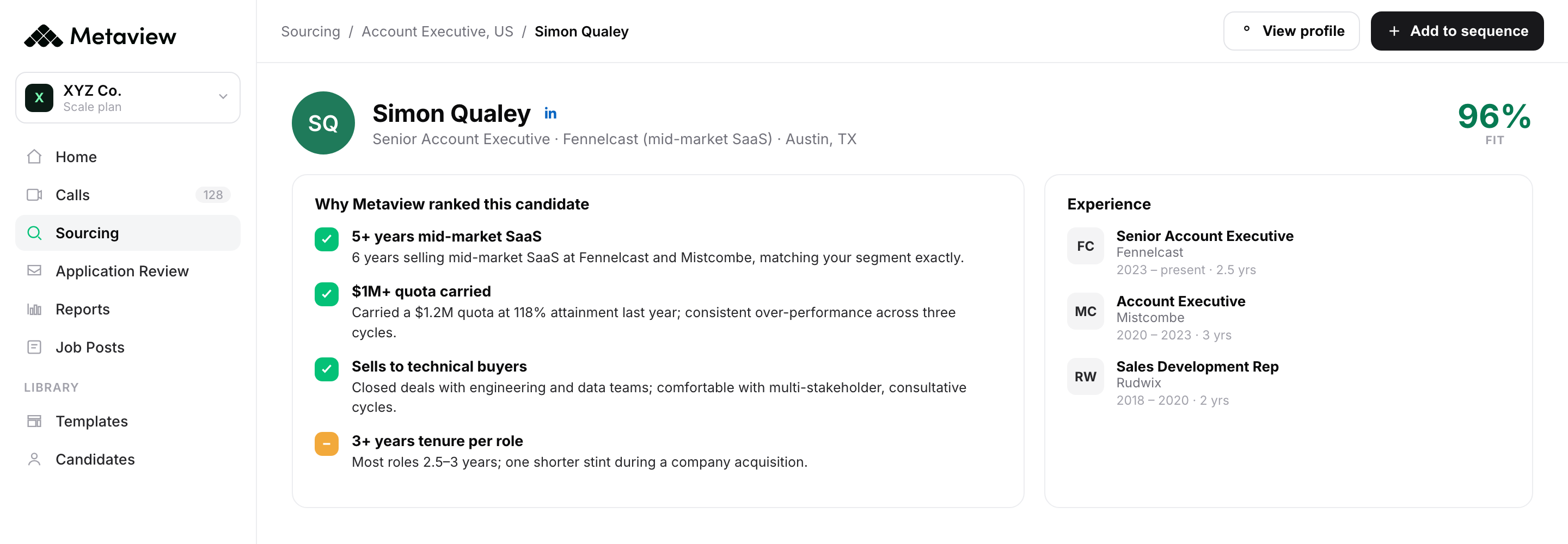
The agent surfaces and explains candidates; it does not contact or assess them on its own.
Buy for the gap you have.
So: one tool, for the gap you have. If you can’t filter, the filter tools are where to look, and the method question is the one to ask them. If you’re searching on the wrong attribute, a filter won’t help, and Findem’s argument is the one to test. If you’re reaching into the same pool every time, reach is what you’re buying. And if you can’t see the shape of your own pipeline, buy the reporting first and find out whether your problem was ever a sourcing problem.
Nothing on this page claims to change who gets hired. A tool widens what you can see and who you can reach, and the diversity sourcing strategy guide argues that what comes through is set by the inputs around it: the proxies you screen for, the channels you search, the job description you ship, and the criteria you apply.
Talk to the Metaview team about your next sourcing search.
See Metaview Sourcing with someone who can answer your questions.
Frequently asked.
Do diversity sourcing tools change who gets hired?
Nothing on this page measures that, and no claim here promises it. A sourcing tool changes what you can filter for, what you can search on, who you can reach, and what you can see about your own pipeline. All four sit upstream of a hiring decision. What happens after a shortlist depends on your interview process, your evaluation criteria, and your offer decisions.
Should I prefer inferred or self-reported diversity data?
They fail in different directions, so it depends on which failure you can live with. Inference, as SeekOut describes it, makes a best guess for each candidate from profile attributes such as names and educational history. It covers each candidate, and any guess can be wrong. Self-report, as Untapped describes it, records how people identify themselves, and only for those who choose to answer. Ask any vendor which one it uses before you ask anything else, and involve your legal team early if the answer is inference.
What if my funnel has more than one of these gaps?
I’d start with the reporting gap, because it gives you a way to check whether any other fix is working. If you can’t see your pipeline’s composition stage by stage, get that visibility first, then choose the next tool.
Why is a job description tool not on this list?
Because this list is about sourcing, and writing tools do a different job. Textio does describe a sourcing use on its own pages, saying it helps you “Write human, empathetic, and exciting sourcing messages”. But it writes the message rather than finding, filtering, reaching, or reporting on the candidate, so it fills none of the four gaps here. If your applications are thin rather than your sourcing, that’s a separate problem, and language tools are a reasonable place to look.
Can my applicant tracking system do this without another tool?
For the reporting gap, check what your system can already report before you buy anything. For the reach gap, probably not: if your system mostly holds past applicants and contacts your team has added, it holds the pool you’re trying to look beyond. Past applicants are still worth searching again in their own right.
