
Most hiring mistakes aren't mistakes of judgment. They're mistakes of process.
The 10 below are the ones we see most often across 4,000+ organizations on Metaview. Each one is operational, common, and almost always fixable without slowing hiring down.
All 10 mistakes at a glance.
| # | Mistake | First-move fix |
|---|---|---|
| 1 | Skipping a structured intake | Captured intake call before sourcing |
| 2 | Running unstructured interviews | Per-stage standardized question kit |
| 3 | Accepting vague scorecards | Behavioral anchors per competency |
| 4 | Tolerating slow feedback | Pre-populated structured scorecards |
| 5 | Trusting "gut feel" | Evidence-required scoring |
| 6 | Hiring for resume | Outcome-based JDs |
| 7 | Skipping references | Two refs minimum per finalist |
| 8 | Overweighting pedigree | Skills-first evaluation |
| 9 | Ignoring debriefs | Mandatory 20-min synchronous debrief |
| 10 | Not measuring quality of hire | 6 + 12-month retention + perf rating |
1. Skipping a structured intake.
One of the costliest mistakes in recruiting. Two weeks of sourcing the wrong candidate shape before realizing the brief was off.
The fix: mandatory structured intake call before any Boolean string runs. Capture it.
2. Running unstructured interviews.
Different interviewers ask different questions. The shortlist becomes a coin flip.
The fix: per-stage question kit tied to specific competencies. Interviewer can probe; core questions stay consistent.
3. Accepting vague scorecards.
"Liked them," "seemed solid" doesn't decide anything. The team relitigates from scratch every debrief.
The fix: structured scorecards with behavioral anchors per competency. One-sentence evidence note required.
4. Tolerating slow feedback.
Days between interview and scorecard cost more candidates than salary does.
The fix: capture the interview structurally so the scorecard pre-populates. Hiring managers fill in faster.
5. Trusting "gut feel" over evidence.
Gut feel is fine as an input. As an output, it's where bias lives uninspected.
The fix: require an evidence quote per scorecard rating. If the moment can't be cited, the rating doesn't count.
6. Hiring for the resume, not the role.
"10 years of experience in X" is a lazy proxy. The candidate who matches the resume can still fail at the actual outcomes.
The fix: outcome-based JDs and competency clusters. Test the work, not the credentials.
7. Skipping reference checks.
References surface what the interview doesn't. Even one substantive reference call catches signals the panel missed.
The fix: two references minimum per finalist. Ask specific behavioral questions, not generic "would you hire them again."
8. Overweighting pedigree.
The brand-name candidate isn't always the better hire. Pedigree weighting also narrows the funnel in ways that hurt diversity outcomes.
The fix: skills-first evaluation. Competency-mapped interviews; work-sample assessment where the role demands it.
9. Ignoring the debrief.
Async written feedback is fine in theory. In practice, the high-conviction objection one interviewer would never write down but will absolutely say out loud is the signal that matters most.
The fix: mandatory 20-minute synchronous debrief within 24 hours of the final round.
10. Not measuring quality of hire.
Speed and acceptance are worthless if the hire leaves at month 9. Without retention and performance data, you can't tell which parts of the process actually work.
The fix: track 6- and 12-month retention plus 90-day manager-rated performance. Segment by sourcing channel and interviewer.
How to fix them.
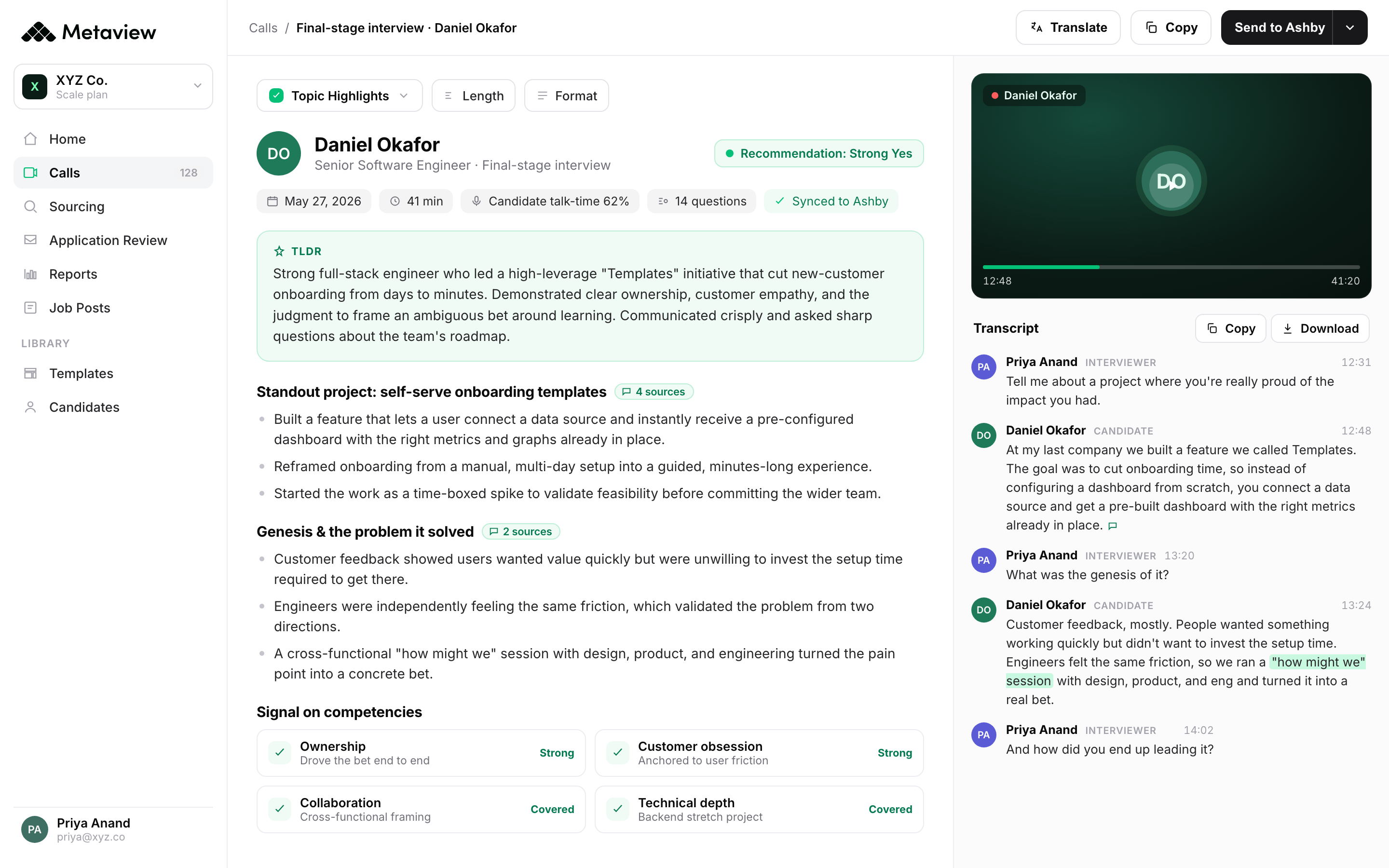
Most of the mistakes above share two root causes: the brief is unclear, and the interview isn't captured.
Fix the brief with a captured intake call. Fix the interview with structured capture against the rubric. The other eight mistakes become detectable from there.
Metaview captures every interview, structures the scorecard, and writes back to your ATS automatically. 4,000+ organizations now run hiring on Metaview, including Brex, emnify, Quora, Workleap, Lightspeed, Catawiki, and Automattic.
Bring Metaview into your hiring stack.
Live notes, structured scorecards, and ATS sync, set up in under 10 minutes.
Frequently asked.
What's the cost of a hiring mistake?
Bradford Smart's research puts the cost at 5-27x the candidate's annual salary. For a $200K role, that's $1M-$5.4M including opportunity cost, severance, and team disruption.
What's the most common hiring mistake?
Misaligned intake. Recruiters source against an unclear brief and burn weeks before the first reject reveals the requirements were off. A captured intake call fixes it.
How do I reduce mis-hires?
Structured interviews with behavioral evidence per scorecard rating, plus measured quality-of-hire by interviewer and source. The data surfaces the patterns that need coaching.
Should I always check references?
Yes, for finalists. Two references minimum. Ask specific behavioral questions; generic "would you hire again" calls produce no signal.
How do I measure quality of hire?
Combine 6- and 12-month retention with 90-day manager-rated performance. Segment by sourcing channel and interviewer to surface where keepers come from.
Are debriefs really necessary?
Yes. The high-conviction objection one interviewer would never write down often comes out only in synchronous discussion. A 20-minute debrief within 24 hours surfaces it.
