

Candidate matching is a scoring step, not a finding step. It runs inside every finding step you take, every shortlist you build, every triage decision at the inbound layer. The question it answers is narrow: is this person right for this role? Keyword filters were never built to answer that.
Keyword math hits a ceiling fast. Resume verbs, title overlap, years-of-experience floors. Surface signal that looks like fit but does not translate to performance. And when the hiring manager updates the spec on Tuesday, somebody spends Wednesday rebuilding boolean strings to chase the new shape.
What AI changes is the scoring layer itself, not the speed of running an existing search. The dimensions you can score against in the first place. The math AI just rebuilt distinguishes a candidate who looks credentialed on paper from one whose trajectory predicts they ship inside your environment.
Why matching is the layer that decides quality.
Matching gets confused with sourcing because the workflows blur. Sourcing is where you go to find candidates. Matching is what you do with the candidates you find. The recruiter who runs a great sourcing motion still needs a matching layer to decide which of the surfaced profiles fit the role. Without that, you have inventory, not a shortlist.
Three workflows share the same matching layer. Active sourcing scores outbound discoveries against the role. Inbound triage scores applicants inside Application Review. Past-candidate rediscovery scores ATS entries against new openings. The math is the same in all three: dimensions of fit, weighted by what matters for this role, scored against this candidate.
When the matching layer is precise, every workflow above it inherits the precision. Your channel mix produces fewer false positives. Your inbound triage filters real fit, not phrase overlap. Past-candidate rediscovery surfaces history that maps to the new opening, even when keywords drift.
Which is why what keyword math misses, and what signal-based math catches, is the lever that matters most when teams talk about raising hiring quality.
What keyword math misses (and what signal-based matching catches).
Two recruiters can run the same boolean search and surface a different shortlist, not because one is better but because they read the spec differently. Keyword math forces the spec into a query: a set of must-have phrases and would-be-nice terms. The spec was richer than the query. The candidates who match the richer spec but not the literal query disappear into the long tail.
Signal-based matching works the other way. The dimensions that predict fit, weighted for this role, are the inputs. Not the literal phrases the spec wrote down. Trajectory becomes a feature. Environmental fit becomes a feature. Growth pattern becomes a feature. What the resume says is one signal among many, not the only signal.
- Title overlap as the primary fit signal
- Years-of-experience floor as the gate
- Resume verbs and noun keywords scored as proxies
- School and network proxies for quality
- Static JD as the query, frozen at posting
- Trajectory shape, how the career progresses, not just where
- Growth curve, pace and scope of progression over time
- Adjacency, comparable roles in comparable environments
- Environmental fit, the kind of company someone shipped in
- Intake brief as live context, refreshed as the spec evolves
Same role. Different inputs. The shortlists that come out the other side rarely overlap, and the one built on signal math is the one whose offers convert.
The 5-move discipline that makes matching scale.
Treat matching as the function it is, and the 5 moves you make at the desk become the playbook for raising precision. Each move feeds the next; the loop closes on accept-reject signal back into the scoring layer.
1. Write the intake brief as the matching input (not the JD).
The JD is the public-facing spec. The intake brief is the matching-facing spec. They serve different jobs, and treating them as the same thing is why so many roles match badly from move one.
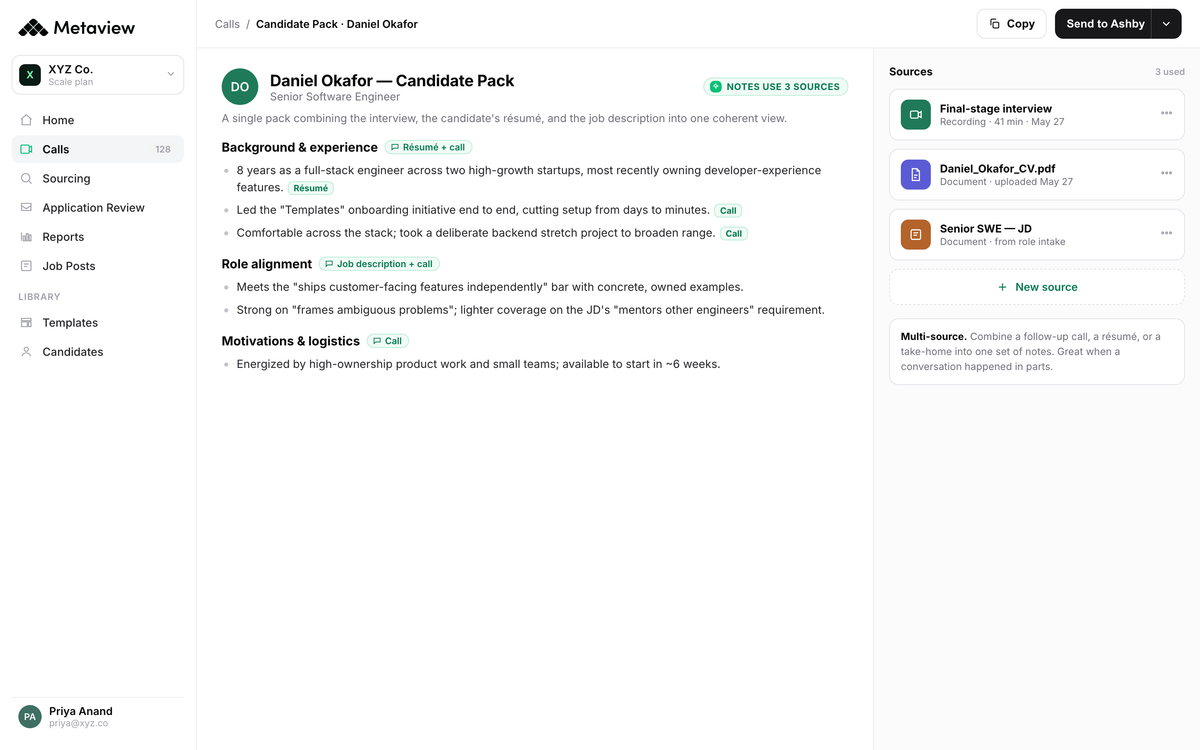
In a 25-minute intake call, you can capture the dimensions that the JD will never carry. Which adjacent industries the hiring manager respects. Which previous-role-shapes she already knows scale into the role. What failure she is trying to avoid this time. Our Notetaker captures the intake brief as structured data, so the matching layer reads it at the same fidelity the hiring manager spoke it.
The JD goes to the careers page. The intake brief goes to the scoring layer. Two artifacts, one source call.
2. Name the 4 to 6 dimensions that matter for this role.
Every role has a fingerprint of what makes a great hire. The dimensions are the components: trajectory shape, environmental fit, role-specific competencies, growth curve, adjacency, cultural alignment. Six is usually the upper bound. Past six, you over-fit the scoring layer to noise.
Different roles weight differently. A first sales hire weights environmental fit (sold into the same buyer before) and growth curve (carried a quota that grew) heavily. A senior IC engineer weights trajectory shape (scope and complexity of systems shipped) and adjacency (comparable codebases). The dimensions stay the same across roles. The weights are what change.
Write the weights down. The hiring manager who can name the weights at intake is the hiring manager whose shortlists convert.
3. Calibrate with a strong yes, a strong no, an edge case.
Before scoring anyone real, calibrate the scoring layer with three anchor profiles. A strong yes, somebody you would hire today. A strong no, somebody who looks plausible but you would not. An edge case, somebody the hiring manager would want to debate.
Three anchors do more for matching precision than 30 candidates worth of feedback. The strong yes gives the layer a target shape. The strong no gives it a negative-example boundary. The edge case shows it where the disagreement lives, which is usually where the real signal sits.
4. Score against the dimensions, not the keywords.
With the brief written and the layer calibrated, run the scoring. The shift you make at this step is the operational one: every candidate is evaluated against the dimensional weights, not the literal phrases.
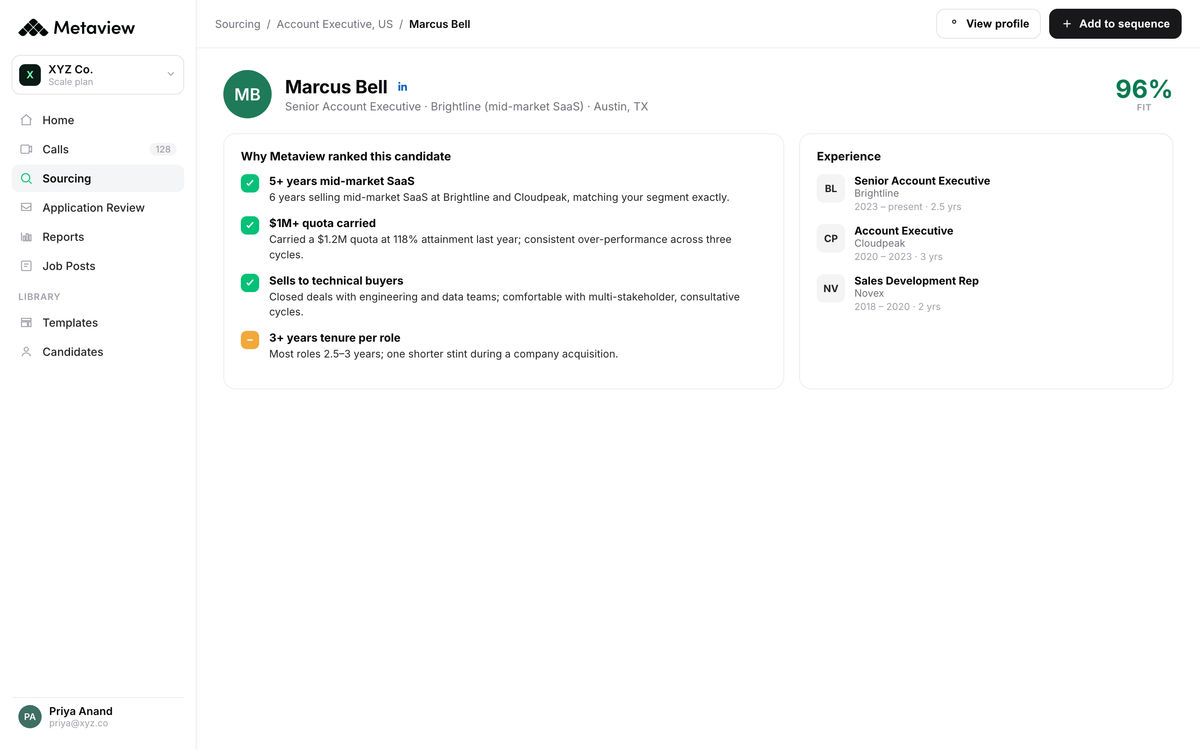
Our AI Sourcing takes the intake brief as the prompt, in natural language. Not a boolean string and not a keyword list. A structured description of what the hiring manager said the role is. The matching layer scores candidates surfaced from any channel (active sourcing, inbound, ATS rediscovery) against the same dimensional weights.
The output is a ranked shortlist where the ranking is the matching score. Click into any candidate to see which dimensions weighted them up or down. The math is auditable, and the recommendation is not a black box.
5. Close the loop, every decision sharpens the next match.
Every accept or reject decision is a signal back to the scoring layer. Done well, the layer learns the dimensions and the weights from your actual hiring decisions, not from a static spec. The layer learns your taste.
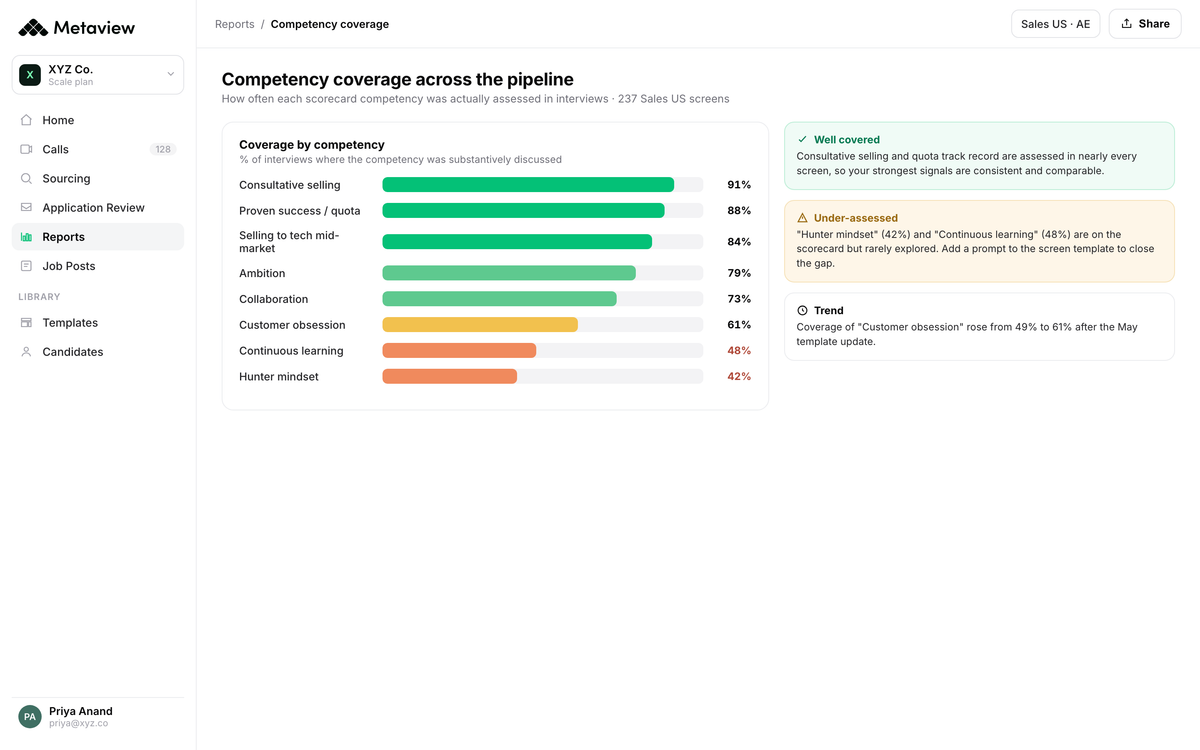
Our Reports surface where the scoring layer is converging and where it is drifting. A dimension that consistently produces accept signals gets weighted up. A dimension that consistently surfaces rejects gets weighted down. The hiring manager sees the calibration tightening as the requisition runs.
Over the lifetime of a role, the calibration loop is the difference between hiring on a static rubric and hiring on one that adapts to what the hiring manager values when she sees real candidates.
Connect Metaview to your ATS in under 10 minutes.
What precision matching looks like at the desk.
Most of the dysfunction at the matching layer shows up as friction between recruiting and the hiring manager, and the data on that friction is uncomfortable. According to Metaview's 2026 AI Hiring Alignment Report, surveying 505 recruiting leaders and hiring managers across North America and EMEA, AI changes the math on alignment from intake forward.
The pattern is consistent. When AI is in the matching layer, the work upstream of the hiring manager (the intake brief, the dimensional weights, the calibration loop) lifts alignment on the role itself. That alignment is what cuts the candidate loss.
Within 20 minutes of an intake call, I can present multiple candidate profiles to hiring managers on Slack and get immediate feedback. This isn't just about efficiency, it's about transforming the relationship between recruiters and hiring managers.”

What you get is sharper matches at scale. Not "AI does sourcing faster." AI does scoring better, and that flows into stronger signals, tighter calibration, and the candidate experience that comes with not chasing wrong-fit shortlists.
Bring precision matching into your sourcing stack.
Treat matching as the scoring layer, write the intake brief as its input, name the dimensions that matter, calibrate against real examples, and close the loop on every decision. The discipline is recoverable on a single role. Run it once and the lift on inbound quality shows up the following week.
Bring Metaview into your hiring stack.
Live notes, structured scorecards, and ATS sync - set up in under 10 minutes.
Frequently asked.
Is candidate matching the same as candidate sourcing?
No. Sourcing is where you go to find candidates; matching is the scoring layer that decides which of the candidates you find fit the role. The same matching layer runs across inbound triage, active outbound, and ATS rediscovery, so different sourcing motions feed into the same scoring function. For the broader sourcing-discipline view, our candidate sourcing guide covers the inflow choices upstream of matching.
Does AI matching require a perfect job description?
No, and it usually works better off the intake brief than the JD. The JD is the public-facing spec, written for candidates; the intake brief captures what the hiring manager wants, including dimensional weights and adjacency cues she would not put in writing. Thinner inputs produce broader matches; richer inputs produce sharper ones. The layer trades off accordingly.
Can matching reduce hiring bias?
Dimensional scoring breaks the correlation between fit and proxies like pedigree, school, or network because the layer weights signals (trajectory, environmental fit, adjacency) directly. Final decisions stay human, but the starting pool is more objective. The deeper mechanism sits in our contrast bias post.
How quickly does matching improve as we use it?
A few weeks of accept-reject signal is usually enough for the dimensional weights to stabilize on an active role. Brand-new roles with no historical data are the cold-start case: seed the layer with the 3-anchor calibration (strong yes, strong no, edge case), drawing analogue profiles from comparable historical hires.
Does AI candidate matching work for both high-volume and senior roles?
Yes, with different dimensional weights. High-volume roles weight transferable signals (academic patterns, adjacency, transferable competencies) because credential overlap is thin and the layer has to find non-obvious signal. Senior roles weight trajectory and scope progression because both candidates and roles have richer histories. The dimensions stay the same across roles. The weights are what change.
