
You audit the funnel and every number looks reasonable. Application-completion rate is steady. Time-to-interview is on plan. Interview-to-offer conversion is roughly where it was last quarter. Then you check offer acceptance, and it's quietly dropped six points over four months. Nothing in any single stage explains it.
The failure isn't in a stage. It's in the seams between them. The four days a candidate waited after the panel. The hiring manager who reopened the rubric mid-loop. The onboarding kickoff that didn't reach the new hire's manager. None of those show up on a stage-level dashboard, and together they're costing the offers.
That's what a candidate-journey lens makes visible. Signal leaks at the seams, not inside the stages, and you can't fix what you can't see as a system.
Why the journey lens beats the stage lens.
Stage-level optimization is what most recruiting teams default to, because every tool in the stack reports against stages. ATS dashboards show stage conversion. Sourcing tools report stage entry. Survey platforms ask candidates about stages. The instrumentation is in the stages, so the attention follows.
But the candidate doesn't experience your hiring process as discrete stages. They experience it as a sequence, and what they remember is the texture of the sequence: how each stage connected to the next, whether anyone was holding the thread, whether the signal from round one made it to round four.
Read that distinction as the order of operations. Without the map, every experience fix is a local optimization that might or might not move the outcome. With the map, you can see which hand-off is leaking, why the leak compounds, and what to instrument so you'll catch the next one before it costs offers.
The six canonical stages.
Every recruiting team starts from roughly the same six stages. The labels vary, the order doesn't. Hold this as the reference map; the methodology in section four shows how to adapt it to your funnel without breaking the structure.
| Stage | What happens, and what carries the weight |
|---|---|
| Awareness | Candidate first encounters your role through search, referral, or social. Brand and role description carry it. |
| Consideration | Candidate researches your culture and values, decides whether the role is worth their attention. |
| Application | Candidate submits and waits for acknowledgement; form friction and first-response speed set the tone. |
| Interview | Recruiter screen, hiring-manager round, panel, technical loop; where signal is generated and lost. |
| Offer | Decision, terms, the close; speed and personalization decide between sign and shop. |
| Onboarding | First-day prep, manager handover, first 30 days; often owned elsewhere, which is why it drops. |
Each stage has its own instrumentation set, which the measurement loop section unpacks. The sharper lever is between them.
The four hand-off points where signal leaks.
The stages are the rooms. The hand-offs are the doorways. Most candidate-experience failures happen in the doorways, where the signal from one room either makes it through to the next or doesn't.
According to Metaview's 2026 AI Hiring Alignment Report, surveying 505 recruiting leaders and hiring managers across North America and EMEA, the numbers on what hand-off friction costs are uncomfortable, and the AI-adoption gap on closing it is unmissable.
Read them as one story. Alignment lifts when AI is the substrate the team works from; that lift translates into business outcomes; the teams already doing this look 3.8x healthier on the inside than the teams that aren't. The hand-offs are where that substrate either holds or doesn't.
Four hand-offs recur on every team we work with. Each one has a specific failure mode, a specific cost, and a specific way to instrument it.
| Hand-off | Where signal leaks | What it costs | How to instrument |
|---|---|---|---|
| Candidate to ATS at intake | Resumes land, scoring is inconsistent, strong fits get parked. | Slower first response, lower top-of-funnel conversion. | Time-to-first-response and triage accuracy by reviewer. |
| Recruiter to hiring manager mid-loop | Screen notes never reach the panel; next interviewer starts cold. | Repeat questions, weaker calibration, candidate disengages. | Panel prep completion before each round. |
| Panel to debrief decision | Memory replaces evidence, the loudest voice wins, calibration drifts. | Longer time-to-decision, more debate, weaker offers. | Time-to-debrief and per-competency evidence coverage. |
| Hiring team to onboarding | Context the panel built is lost; new hire's first week starts from scratch. | Slower ramp, 90-day attrition risk, ROI delay on the hire. | 30-day check-in scores tied back to interview signal. |
The pattern is the same across all four. The team running the hand-off owns it, but no single tool reports against it, so it goes uninstrumented until offer acceptance drops or onboarding satisfaction tanks. The journey map is what makes the hand-offs visible. The measurement loop is what keeps them visible quarter over quarter.
Hiring problems are rarely about talent. The best teams win because recruiting, hiring managers, and leadership stay aligned, move quickly, and remove friction with the right systems, increasingly powered by AI.”

The five-step mapping methodology.
The map is a working artifact your team builds, reviews, and revises. Five moves get you to a first version any recruiting team can run inside a week. None of them require a consultant.
- Define the candidate personas you really hire. Pull your last 20 hires and group them by motivation, channel of entry, and what they cared about during the process. Two or three personas is usually enough. Imaginary "ideal candidates" disconnect the map from your real funnel.
- Map every touchpoint per persona. Walk each persona through the six stages and list every interaction, every email, every form, every interviewer, every silence. Touchpoints you forgot include the ones that hurt most when they break.
- Identify the friction. For each touchpoint, ask what slows the candidate down, confuses them, or makes them wait. Pull from candidate-survey data, drop-off rates, and recruiter post-mortems. Friction is rarely where you expect it.
- Assign ownership per touchpoint. Recruiter, hiring manager, coordinator, IT, People Ops. Every touchpoint has an owner, or it goes unowned and breaks the next time anyone is on leave. The org-level RACI is in the FAQ below.
- Set success metrics per stage and per hand-off. The measurement loop in the next section names the metric set. The mapping step is to attach the right metrics to the right touchpoints so drift becomes detectable, not assumed.
That's the first pass. The methodology produces a living artifact, not a one-time deck. The measurement loop is what keeps it living.
The measurement loop that catches drift.
A map without instrumentation drifts within a quarter. The metric set that catches drift is small enough to fit on one page and specific enough that movement on any of them tells you which hand-off or stage to look at.
- Application completion rate. If it dips, your application form added friction or your job description over-promised. Stage 3 signal.
- Time-to-feedback after each interview round. If it slips past 48 hours, candidates feel forgotten and start shopping. The earliest leading indicator on the recruiter-to-hiring-manager hand-off.
- Interview-to-offer rate. Drop means structured interviews aren't producing decisions, or the rubric isn't aligned with the role. Stage 4 signal that points at the panel-to-debrief hand-off.
- Offer acceptance rate. Drop means the experience between final-round and offer didn't close as well as the conversion suggested it would. Late-stage hand-off signal.
- Candidate NPS by stage. Where the qualitative signal lives. Pair it with the operational metrics above and the cause-of-drift becomes visible inside one review cycle.
The right cadence is a 30-minute monthly review of those five and a deeper quarterly review against the journey map itself. Three failure modes quietly undo the loop, in roughly the order they tend to show up.
The discipline is in the loop, not the map. The map is the lever. The monthly review is what makes the lever compound.
How interview intelligence closes the hand-off gaps.
Three of the four hand-offs in the table earlier are where interview intelligence does the heavy lifting. Each surface plugs into a specific hand-off with a specific output the next team needs.
Application to recruiter triage.
The first hand-off is the candidate-to-ATS friction point. Most teams either over-trust the ATS scoring or end up with a recruiter reviewing 800 applications a week from a cold start. Application Review sits in that gap: inbound profiles arrive at the recruiter's queue pre-triaged against your ICP, with the reasoning trail visible per candidate, so the hours saved go back into the candidates worth a conversation.
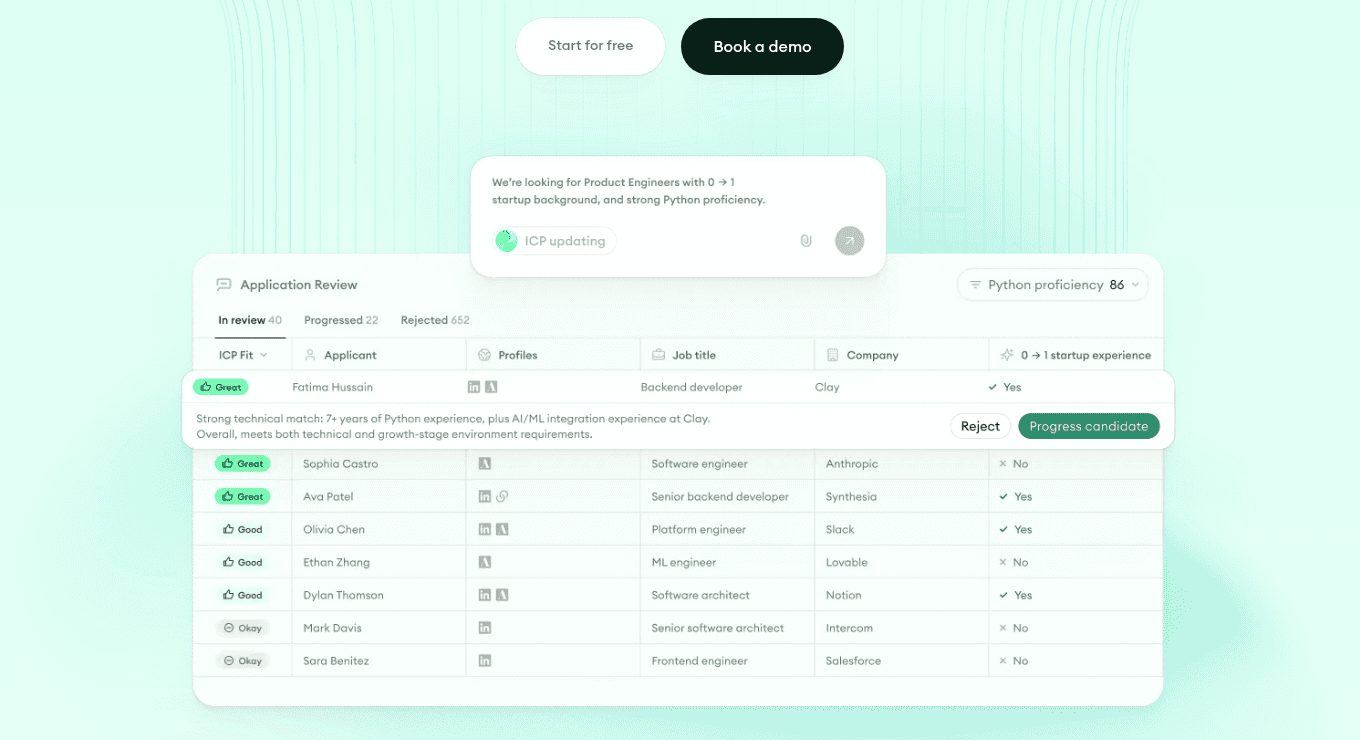
- 1The hand-off into Stage 4 carries the ICP-fit reasoning, not just the resume.
- 2Each progress or reject action sharpens the next pass; the friction at intake drops without the bar slipping.
- 3Fraud signals fire at the doorway, so the journey doesn't have to absorb them mid-loop.
Recruiter to hiring manager mid-loop.
The second hand-off is where most signal silently dies. Screen notes never reach the panel, the next interviewer asks the same questions, the candidate notices. Notetaker records the interview tied to the role's competency rubric, so the prep brief for the next round is assembled from prior-round evidence by default. The doorway between stages carries the signal, not just the candidate's name.
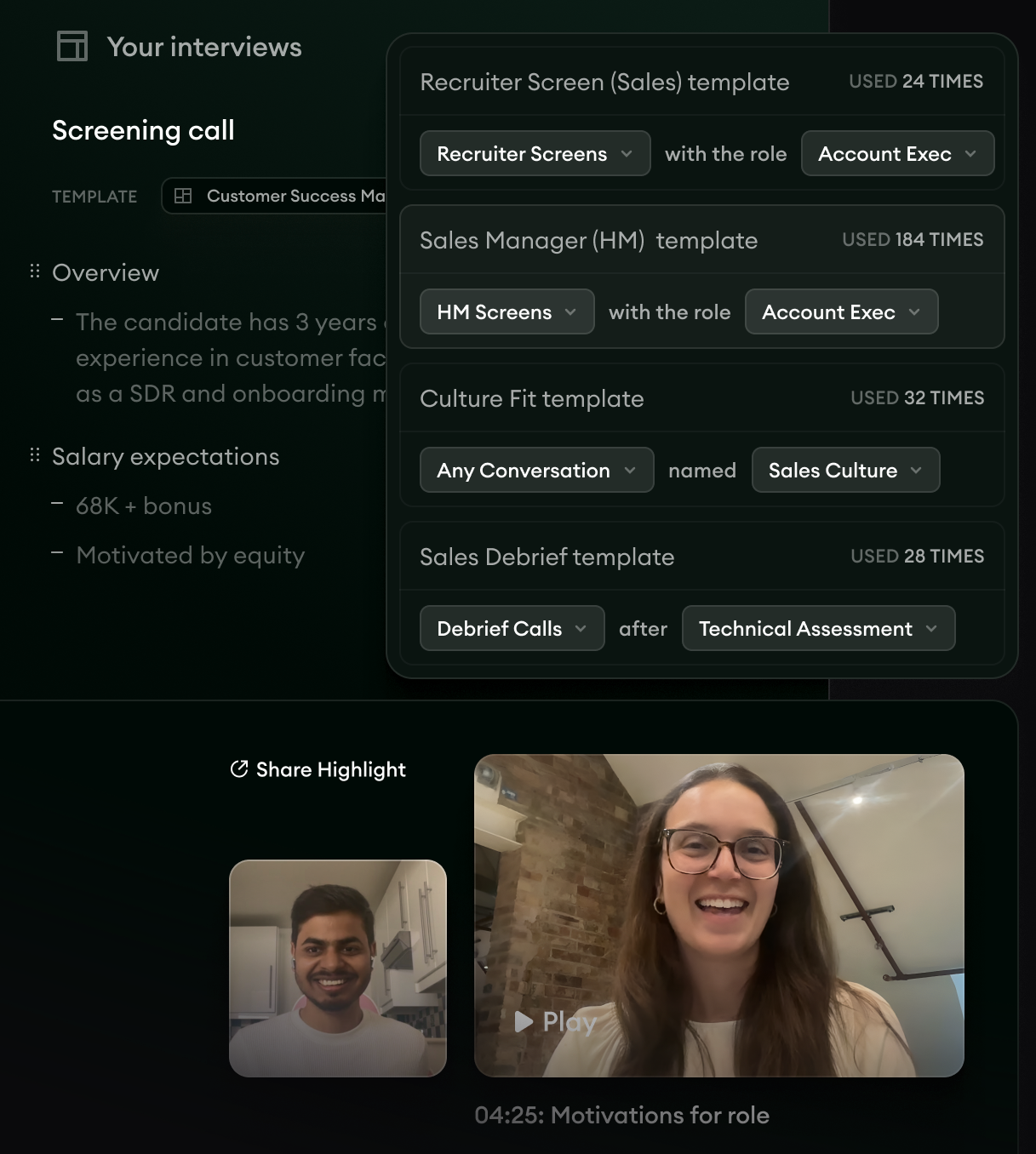
- 1The signal from this round is captured against the role's competencies as it happens.
- 2Auto-tagged moments mean the panel-prep document for the next stage is ready before the recruiter has to ask.
- 3The post-call summary closes the recruiter-to-hiring-manager doorway with structured evidence, not a verbal recap.
Cross-stage measurement.
The measurement loop runs on Reports. Per-competency capture across the panel lets you see what "qualified" looks like inside your team rather than against an industry benchmark, and the cross-stage view surfaces drift before offer acceptance tells you about it the hard way.
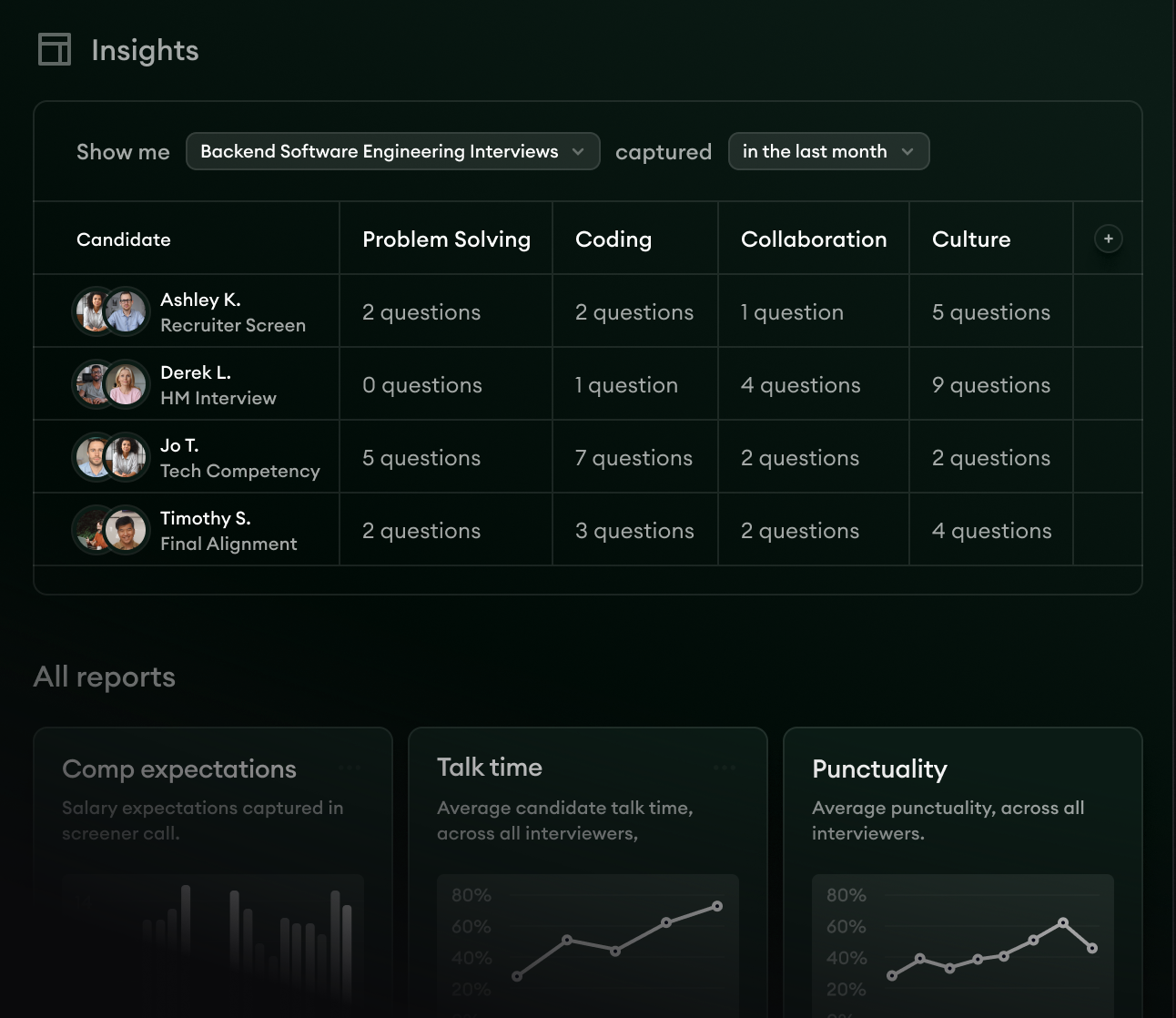
- 1Stage-by-stage signal aggregated against the journey map, not stitched together at quarterly review time.
- 2Hand-off latency surfaces by stage, so the recruiting lead can name the doorway that's costing offers this month.
- 3The metric set from the loop above lands here, ready to read against the map at the monthly review.
The competitive edge in hiring lives in the seams between stages, not inside any one of them. A journey map makes the seams visible, the methodology keeps the map current, and the measurement loop makes drift detectable inside one review cycle instead of two quarters. Pick the one hand-off your team will instrument this month, and start there.
Bring Metaview into your hiring stack.
Live notes, structured scorecards, and ATS sync - set up in under 10 minutes.
Frequently asked.
What's the difference between the candidate journey and candidate experience?
If you're working on the structure of your hiring process (stages, hand-offs, ownership, instrumentation), this is the post. If you're working on the felt quality of that process (clarity, speed, fairness, respect, personalization), read our candidate-experience playbook. The practical move is to map the journey first, then improve the experience inside it. The map is the precondition, not the alternative.
How often should I revisit my journey map?
Light review monthly, deep review quarterly. Triggers for a full re-map outside that cadence: new recruiting leadership, region or product-line expansion, a new ATS, an offer-acceptance drop greater than five points, or a time-to-hire drift of twenty percent. The lightweight monthly review is a 30-minute walkthrough of the metric set with the recruiting lead; the quarterly review is when you reopen the map itself.
Who owns the candidate journey map, recruiting or hiring?
Recruiting owns the map. Hiring managers are consulted per requisition, particularly on the panel-to-debrief hand-off. People Ops or HR is informed on the metric set so workforce planning ties back to the same data. The reset move when the map drifts into nobody-owns-it territory is to put the named owner next to every touchpoint in the artifact itself, then make the recruiting lead the single point of accountability for the artifact's freshness.
How is mapping the candidate journey different from drawing the recruitment funnel?
The recruitment funnel measures conversion through stages. The journey map instruments the experience inside each stage and the hand-offs between stages. They're complementary artifacts: the funnel tells you how many candidates moved, the journey map tells you what the movement felt like and where the friction lived. You need both, and most teams default to only the first.
What's the smallest first step if I've never mapped my journey?
Pick one role you hire repeatedly. List the six stages on a single page. Pick the one hand-off you suspect is leaking most, attach one metric to it, and watch the metric for 30 days. That's a 30-minute first pass that earns the rest of the methodology, and most teams find the suspected hand-off was the right one to instrument.
