
AI has created a strange problem for recruiting teams. Candidates can now tailor and submit polished applications faster than ever. Recruiters get more applications, more apparent "perfect fits," and more noise to work through.
Fake and misleading applications make it harder still to know what's real.
But AI also helps to overcome this challenge. AI screening gives hiring teams a way to speak with more candidates without adding hundreds of recruiter calls.
And they're quickly becoming mainstream: 63% of job seekers in 2026 have encountered an AI interview, according to Greenhouse.
But simply adding AI doesn't make screening better. Handled poorly, it’s an immediate turnoff for serious candidates. And it’s not just there for faster yes/no decisions with limited evidence.
Done well, more candidates get a chance to show what they can do, and recruiters get better signal. This guide explores what that actually looks like, and how to achieve it.
What is an AI screening interview?
An AI screening interview is an early-stage candidate conversation conducted by an AI interviewer, rather than a recruiter. It asks job-relevant questions, captures the candidate's answers, and gives the hiring team structured information to review.
AI screening interviews can happen through voice, video, or text. Some follow a fixed set of questions, while more advanced conversational systems respond to what candidates actually say and ask relevant follow ups.
And there’s a big difference between a one-way video interview where candidates record answers to preset questions, and a real conversation. Conversational AI can dig deeper into an answer, ask for an example, or clarify something unclear.
Crucially, AI shouldn’t make the hiring decision. It conducts the conversation, gathers evidence, and then recruiters decide what that evidence means.
How does an AI screening interview work?
The exact process varies between platforms, but a good AI screening interview should start with the hiring team, not the AI screening software.
Here's a typical flow:
- Define the criteria. The recruiter and hiring manager agree on the skills, experience, and other signals that matter.
- Set up the interview. Questions and evaluation criteria are built around those requirements.
- Invite candidates. Candidates receive access to the screening interview, often without needing to book a recruiter slot.
- Conduct the conversation. The AI asks core questions and, where supported, follows up based on each candidate's answers.
- Capture the evidence. Responses are recorded or transcribed and turned into structured notes or summaries.
- Evaluate consistently. Candidate evidence can be compared against the same agreed criteria.
- Review and decide. Recruiters review the results and determine who should progress.
This flow removes a huge amount of repetitive work. But the quality of the conversation matters. Automating a bad screening interview just gives you bad screening at scale.
The questions, follow ups, evaluation criteria, and candidate experience all still need to be well designed.
Why are AI screening interviews growing?
AI screening interviews solve a simple capacity problem: the number of candidates has grown much faster than the number of recruiters available to speak with them.
Application volumes have outgrown recruiter capacity.
Hundreds of people can apply for a role, but recruiters can't conduct hundreds of 20-minute calls. As volume grows, more potentially strong candidates have to be rejected before anyone speaks with them.
AI makes those conversations easier to scale. Recruiters can gather screening evidence from many more candidates without filling their calendars with back-to-back calls.
Resumes are getting harder to distinguish.
AI can help candidates produce highly polished, job-specific applications in minutes. That's useful for applicants, but it also makes the resume a weaker differentiator when almost everyone looks great on paper.
A conversation creates deeper signal. Instead of simply matching keywords, you can ask candidates to explain what they did, give examples, and add context to their experience.
Fake candidates create even more noise.
AI also makes fake or misleading applications easier to produce. Recruiting teams experimenting with AI screens specifically cite fraud alongside application volume as a reason for introducing them.
A screening conversation gives teams another opportunity to verify claims, explore experience, and identify inconsistencies rather than relying entirely on application materials.
Candidates expect hiring to move faster.
Traditional recruiter screens create their own bottleneck. A promising candidate may wait days for an available slot, then rearrange their working day around the recruiter's calendar.
AI screening is available on demand, and gives candidates control over when they participate. That's better for both sides, but only if the experience itself is good. Candidate research shows that poor disclosure and impersonal AI experiences can quickly undermine that advantage.
AI helped cause screening problems. Can it also solve them?
AI has made applying for jobs incredibly easy. Candidates can tailor resumes, write cover letters, and apply to more roles in less time. The downside is more applications, more polished resumes, and more difficulty telling genuine fit from optimization or fraud.
The worst response would be an AI arms race: candidates use AI to optimize applications, while employers use AI to reject them faster. We're already seeing signs of that escalation, including candidates embedding prompts in resumes in an attempt to influence AI screening systems.
A better path is to create more information, rather than filter and restrict tighter. AI screening interviews let more candidates explain their experience, provide examples, and show what sits behind the resume. Instead of making faster decisions from thin information, recruiters get stronger evidence to work with.
Benefits of AI screening interviews.
The obvious benefit is capacity. AI can conduct early conversations without filling recruiter calendars with hundreds of additional calls.
But the bigger opportunity is what that extra capacity lets you do.
Screen more candidates.
Traditionally, recruiter capacity determines who gets a conversation. AI screening lets teams hear from more applicants, including people who might not look perfect on paper.
Get candidates to screening faster.
Strong candidates shouldn't have to wait a week for an available recruiter slot. AI interviews are available now (whenever that may be), so you gather signal while candidate interest is still high.
Make screening more flexible.
Candidates can interview when it works for them rather than fitting around a recruiter's calendar. That can mean evenings, mornings, or any time when they're able to focus.
Gather richer signals than a resume provides.
A resume tells you what someone claims to have done. A conversation lets you ask for examples, explore motivations, clarify experience, and follow up when something interesting comes up.
Create more consistency.
AI doesn't get tired after ten back-to-back calls. Core questions and evaluation criteria stay consistent across candidates, while conversational systems can still adapt their follow-ups.
Give recruiters time back.
The aim isn't to remove recruiters from hiring. It's to reduce repetitive early-stage work so they have more time for hiring-manager alignment, candidate relationships, selling the opportunity, and closing great people.
Can AI screening actually improve candidate experience?
One of the biggest objections to AI screening is simple: candidates want to speak to people, not machines.
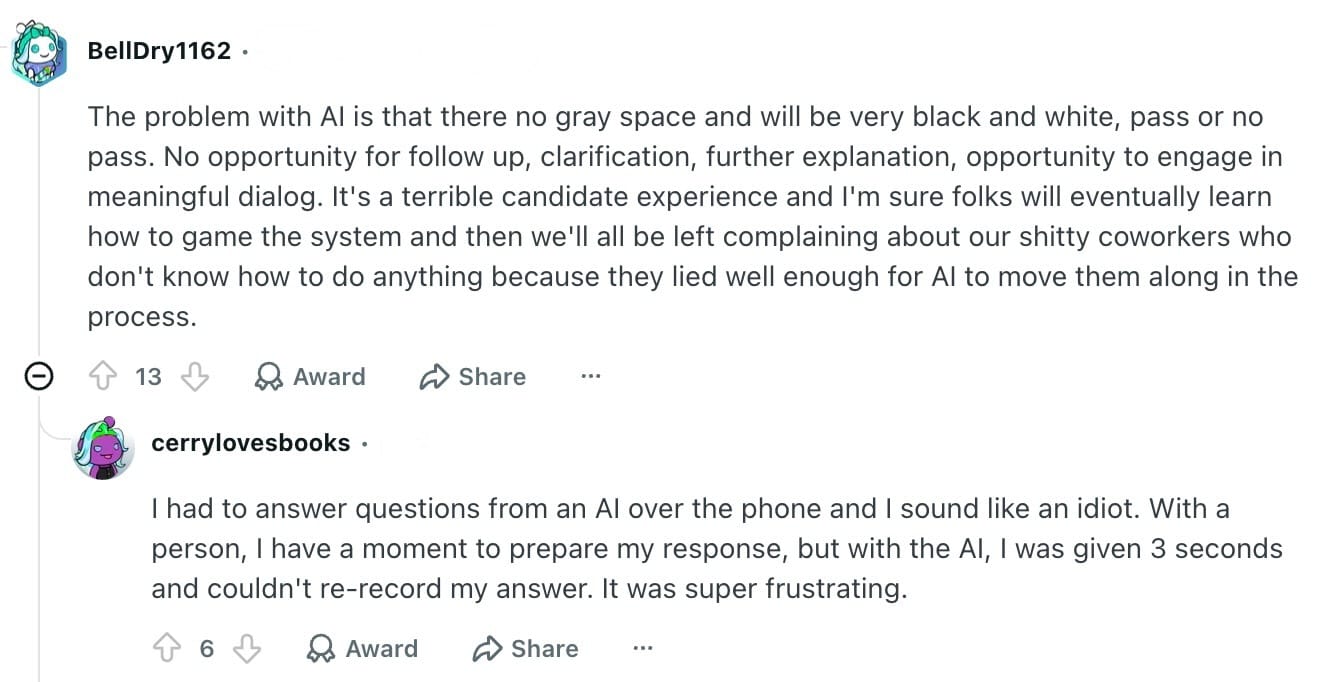
That's understandable. And badly designed AI interviews with opaque processes, rigid prerecorded questions, and no meaningful follow-up absolutely create a poor candidate experience.
Recent Greenhouse research 70% of US candidates who experienced AI evaluation said its use wasn't clearly disclosed. Transparency is a real concern.
But the comparison shouldn't always be AI interview vs. recruiter interview. At high application volumes, many candidates aren't getting a recruiter interview at all.
The real choice looks more like this:
- Traditional process: Apply → wait → resume rejection → never speak to anyone.
- Good AI screening: Apply → screen quickly → choose a slot → explain your experience → provide more evidence → receive human review.
That's where AI can improve candidate experience. It can give more people a genuine opportunity to be heard, while removing scheduling delays and letting candidates participate when they're ready.
Where AI screening interviews can go wrong.
AI screening can create more capacity and a better candidate experience. But bad automation simply scales bad recruiting by:
- Making the interview feel robotic. If candidates can't clarify an answer or respond naturally, you've recreated the worst parts of one-way video interviewing with newer technology. Good AI screening should respond to what candidates actually say and ask relevant follow ups.
- Hiding the fact that it's AI. Candidates should know who (or what) they're speaking with. Be transparent about how the interview works, what information is being collected, and how it will be used.
- Automating bad hiring criteria. If your screening criteria are poorly defined or unnecessarily restrictive, automation can apply those same problems at scale and create screening bias.
- Treating AI scores as the final answer. AI recommendations help, but recruiters should see the evidence behind an evaluation, dig into individual responses, and exercise judgment when something doesn't add up.
How to use AI screening interviews well: 7 best practices.
AI screening is an extension of a good recruiting process, not a shortcut around one. You still need clear criteria, useful questions, and a candidate experience you'd be comfortable putting your name on.
1. Start with a strong intake.
Define what a strong candidate actually looks like before screening begins. Align with the hiring manager on the skills, experience, and behaviors that matter, and separate genuine requirements from nice-to-haves.
The AI needs this context to know what evidence to look for and which answers are worth exploring further.
2. Screen for evidence, not keywords.
Don't turn the interview into a spoken version of resume screening. Ask candidates to describe specific projects, decisions, challenges, and results that demonstrate the qualities you're looking for.
The point of adding a conversation is to gather new evidence, not simply confirm that someone can repeat what's on their application.
3. Make it a conversation.
Good screening interviews aren't questionnaires. If a candidate gives an interesting, unclear, or incomplete answer, the AI should be able to ask a relevant follow-up and dig deeper.
That's an important distinction from older automated screening experiences, where candidates often faced a rigid sequence of questions with no real dialogue.
4. Be transparent about AI.
Tell candidates upfront that they'll be speaking with AI and explain what they should expect. Don't disguise an AI interviewer behind an avatar or imply that they're speaking to a person.
Candidates should also understand how the interview fits into the hiring process and what happens with their responses.
5. Give candidates flexibility.
One of AI screening's biggest advantages is that it doesn't have a packed calendar. Let candidates interview when they're ready, rather than restricting them to the same narrow slots they'd get with a recruiter.
This is particularly valuable for people interviewing around an existing job, across time zones, or with other commitments.
6. Keep evaluation consistent.
The conversation can adapt without changing the standard candidates are judged against. Use the same core criteria and scoring rubric for everyone, while allowing follow-up questions to reflect each person's answers.
Flexible conversations and consistent evaluation must coexist.
7. Keep humans accountable.
AI can conduct the interview, organize the evidence, and help recruiters review large candidate pools. But recruiters should be able to inspect the underlying responses, understand why a candidate received a particular evaluation, and apply their own judgment.
The aim is to give humans better evidence for hiring decisions, not hide those decisions behind an AI score.
What should AI handle, and what should recruiters handle?
AI is good at making repetitive screening work scalable. Recruiters are good at the parts of hiring that require judgment, empathy, and persuasion.
The strongest process uses each accordingly.
| AI screening is well suited to | Recruiters should focus on |
|---|---|
| High-volume early-stage conversations | Complex or ambiguous candidate decisions |
| Asking consistent core questions | Understanding nuanced motivations |
| Following up on candidate answers | Building candidate relationships |
| Capturing transcripts and evidence | Selling the role and company |
| Structuring information against a rubric | Advising and challenging hiring managers |
| Offering flexible screening times | Handling unusual or sensitive situations |
| Summarizing conversations for review | Closing high-value candidates |
Recruiter time is limited. AI can take on work that scales poorly so recruiters can spend more time where being human actually changes the outcome.
What makes Metaview Screening different?
Metaview Screening is a conversational AI agent that conducts early-stage screening interviews on behalf of recruiting teams. It gives every candidate a real chance to demonstrate their strengths, and recruiters better evidence to decide who moves forward.
- There's no AI avatar pretending to be a person. It’s voice-first, and clear that this is an AI conversation.
- It adapts to each candidate and the specific role.
- It asks smart follow-up questions based on what the candidate says. It knows the hiring criteria, but isn’t following a script.
- It speaks 18 languages.
- It can conduct situational and behavioral scenarios.
- It’s flexible with candidates, but consistent on scoring.
- It’s self-improving, based on who the recruiter advances or rejects.
Candidates can also complete their interview when it suits them. They can join from their phone or computer and choose a time when they're ready, rather than competing for space on a recruiter's calendar.
For recruiters, Metaview provides a call overview and lets them dig into specific answers, generate custom summaries, or review the full interview. The AI gathers and structures the signal, but a human decides who advances or is rejected.
And candidate experience isn't an afterthought. At launch, candidates rated the Metaview Screening experience 4.7/5 CSAT.
AI screening interviews should leave candidates excited, not with a bad taste.
The least interesting use of AI in screening is rejecting the same candidates faster. Responding to fraud and volume with increasingly aggressive automated filtering just means more candidates use AI to get through the filter, while employers use more AI to keep them out.
Great AI interviews are a different path. Instead of making decisions with less information, teams use AI to hear from more candidates and gather stronger evidence before deciding who deserves more human time.
That's the core opportunity behind conversational screening. Candidates get more opportunities to show who they are. Recruiters get better information without adding hundreds of calls to their calendars.
AI screening shouldn't make recruiting less human. It should give recruiters more time to be human where it counts.
Find the hiring signals only a conversation can reveal.
Screening is the voice agent that speaks with every candidate and scores each call against your rubric. For every completed call, a recruiter decides who moves forward.
AI screening interview FAQs.
How does an AI screening interview work?
The hiring team first defines the criteria and questions that matter for the role. Candidates are then invited to complete the interview, and the AI conducts the conversation and captures their answers.
The resulting evidence can be summarized and evaluated against agreed criteria for recruiter review. Depending on the system and process, recruiters can then decide which candidates should progress.
What questions are asked in an AI screening interview?
Questions depend on the role and what the hiring team needs to learn. They can cover relevant experience, skills, motivation, behavioral examples, situational scenarios, and practical requirements.
Good AI interview screening shouldn't simply ask candidates to repeat their resumes. Questions should uncover new evidence that helps the hiring team make a better decision.
Are AI screening interviews the same as one-way video interviews?
No. In a traditional one-way video interview, candidates usually record answers to a predetermined set of questions without interacting with an interviewer.
Conversational AI screening can respond to what a candidate says, ask relevant follow-ups, and adapt the conversation. That makes the experience closer to an actual screening conversation than a recorded questionnaire.
Can AI screening interviews ask follow-up questions?
Yes, conversational AI interviewers can ask follow-up questions based on a candidate's responses. This lets them clarify an answer, request an example, or explore relevant experience in more detail.
Not every AI interviewing tool works this way, though. Some still rely heavily on predetermined questions and workflows.
Are AI screening interviews fair?
AI can help make screening more consistent, but that doesn't automatically make it fair. The quality of the criteria, questions, evaluation methods, and human oversight all matter.
Teams should use job-relevant criteria, monitor outcomes, and make sure recruiters can review the evidence behind evaluations rather than blindly trusting an AI score.
Do candidates prefer AI or human screening interviews?
There's no single candidate preference. Some will always prefer speaking directly with a recruiter, while others may value the speed, flexibility, and lower-pressure environment an AI interview can provide.
The design of the experience matters enormously. Transparency, relevant questions, natural follow-ups, flexibility, and clear next steps can make AI screening feel very different from a rigid automated interview.
Can AI screening help identify fake candidates?
A screening conversation can provide another source of evidence beyond the resume. Asking candidates to explain their experience, provide examples, and respond to relevant follow-ups can help recruiters investigate whether application claims hold up.
But an AI interview shouldn't be treated as a foolproof fraud detector. Candidate verification may require other checks depending on the role and hiring process.
