
The top of the hiring funnel is where the noise is loudest. A single role at a high-volume employer pulls in two hundred to two thousand applications. A growing share of them are now generated, polished, and submitted by a model the candidate never wrote.
For the recruiter running fifteen open requisitions, reading every resume isn't possible. Reading none of them isn't safe either. The work compresses into a frantic middle of keyword pattern-matching and missing the candidate who described their experience differently.
AI resume screening flips the operation. The job stops being review every resume and starts being read the ranked shortlist. The top of the funnel turns from a bottleneck into a high-signal triage layer. It's the highest-leverage move a team running heavy inbound can make.
What AI resume screening is
Most teams already use some kind of automated triage at the top of the funnel. The ATS does keyword matching. Boolean strings narrow the inbound. That's not what we're talking about here.
AI resume screening reads a resume the way a senior recruiter would: as evidence of fit against a role. The system extracts skills, parses trajectory, and produces a ranked output with reasoning. The recruiter starts at the top of the ranking and works down, not from the inbox.
The shift looks small on paper. In practice, it changes the recruiter's day. The first hour of work moves from sorting to evaluating, and the rest of the funnel inherits the lift.
Prioritization, not filtering
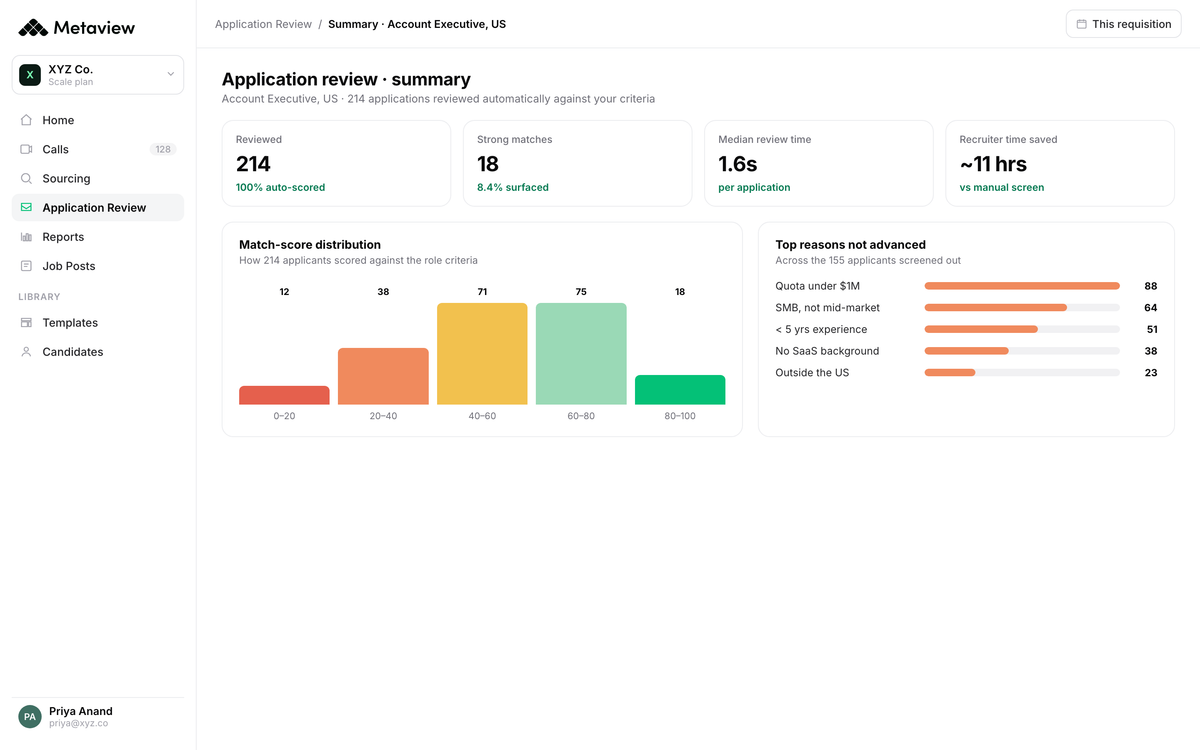
The argument for AI resume screening turns on the difference between filtering and prioritization. The first method throws candidates away. The second method orders them. Most ATS workflows still default to the first, and most teams have learned to live with the cost.
- Binary keyword pass or fail, with no middle
- List of "passed" candidates that still needs hand review
- Career switchers and non-linear paths filtered out silently
- Recruiter spends the first hour sorting, not evaluating
- Multi-dimensional ranking with a relevance score per candidate
- Ranked shortlist with reasoning the recruiter can audit
- Non-linear paths surfaced with the relevant experience flagged
- Recruiter starts at the top of the ranking and works down
When the top of the funnel is ranked rather than filtered, every interview hour goes to a candidate who already passed a contextual screen. The hiring manager calls feel different too. The shortlist is defensible because the reasoning is on the record.
How AI resume screening works
A capable AI resume screening system runs four moving parts. Understanding the four is the way to evaluate any tool that calls itself one, because the gap between basic keyword automation and real screening lives inside these steps.
1. Parse resumes into structured data
Resumes come in every layout, format, and self-presentation style. The first job is to turn the unstructured file into a structured candidate object: skills, role history with tenure, education and certifications, projects, employment gaps, location, work authorization.
Natural language processing handles the extraction. The lift is in the normalization. A "Senior SWE II" at one company and a "Lead Software Engineer" at another need to live in the same comparable shape. Standardized candidate objects make apples-to-apples comparison work.
2. Build the role understanding
The system reads the job description like a recruiter would: required skills, nice-to-haves, seniority level, domain context, team shape. More advanced systems layer in your own data: past hires that worked out, hires that didn't, the calibration brief your team built.
The output is a role model the screening will rank against. The role model is the spec, not the JD bullet points. Conflating the two ends up re-applying whatever screening bias was in the original requisition.
3. Rank candidates by contextual fit
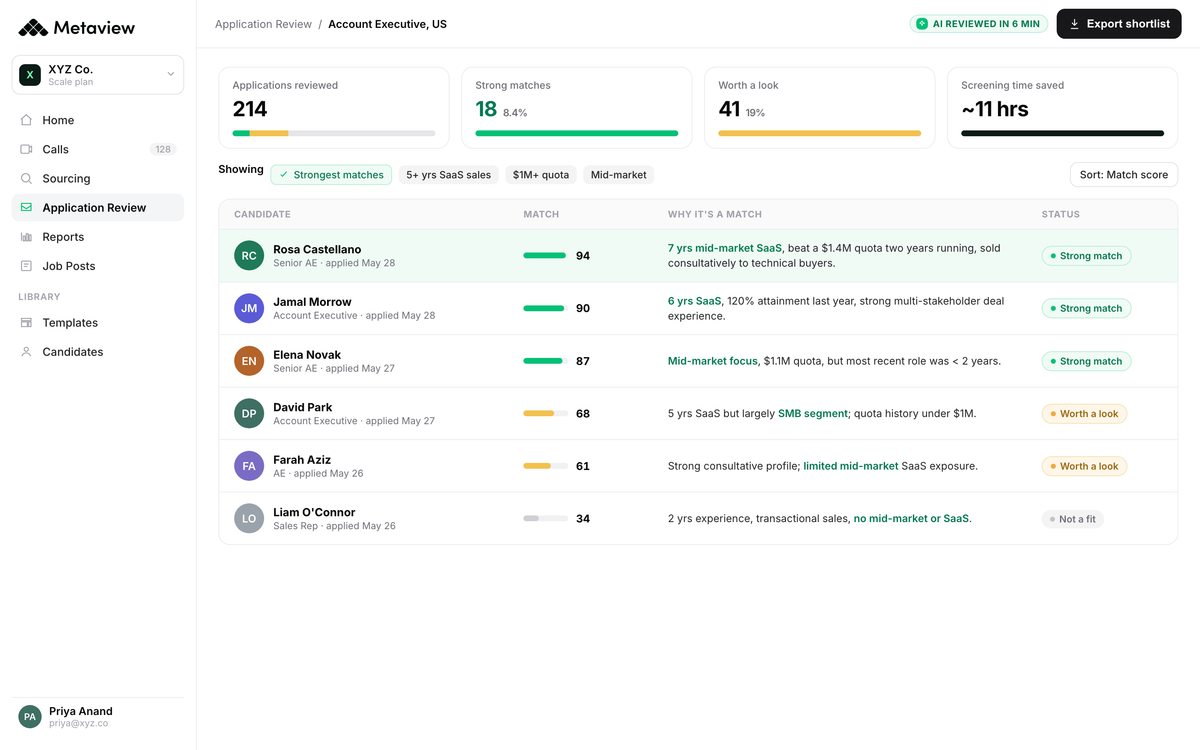
Each candidate object gets scored against the role model across multiple dimensions: skills depth, trajectory, domain relevance, recency of relevant work. The system produces a ranked list with a reason per candidate, not a binary advance or reject.
This is where context-aware screening earns its keep. A career switcher with three years adjacent plus one year direct doesn't get filtered out. They rank below direct-experience candidates with the why surfaced. Reasoning on every rank is what separates screening from filtering.
4. Improve continuously from recruiter decisions
The last step is the loop. As recruiters advance, reject, or comment on candidates, the system folds that decision back into the role model. Hiring outcomes downstream become the longest-cycle feedback the model learns from.
The compounding effect is the reason early adoption matters. The screening that runs in week one is generic. The screening that runs in month three is calibrated to how your team hires.
The risks worth addressing
Three concerns get raised every time AI moves into the candidate decision path. Each one is real, and each one inverts on closer inspection. The bigger risk is the one most teams already live with: manual review under high volume.
The pattern in all three: the system makes the failure mode visible, where the manual workflow lets it happen quietly.
What to look for in an AI resume screening tool
Most tools that market themselves as AI resume screening still default to keyword matching with a confidence score on top. The capabilities that separate real screening from dressed-up filtering are the ones to test in evaluation.
| Capability | Why it matters |
|---|---|
| Context understanding over keyword matching | Catches transferable skills and non-linear paths the ATS rules miss |
| Ranking with reasoning, not binary filter | Surfaces the top of the funnel with the why on the record |
| High-volume capacity with stable quality | Accuracy holds at 500 or 2,000 applications per requisition |
| Adaptation to your hiring criteria over time | Learns from your team's advance, reject, and outcome decisions |
| Transparent reasoning trail per candidate | Recruiter and hiring manager can audit and challenge any rank |
| ATS-native integration | Runs inside your existing pipeline, not parallel to it |
Context over keyword is the single most diagnostic of the six. A tool that reads "Java" as a keyword and "object-oriented backend in Kotlin" as a different keyword is doing automation, not screening.
How Metaview's Application Review runs it
Our Application Review runs AI resume screening on high-volume inbound. It reads each application against an ICP context the team configures per role. Reasoning surfaces at the row level. Fraud and AI-generated-pattern detection are on by default.
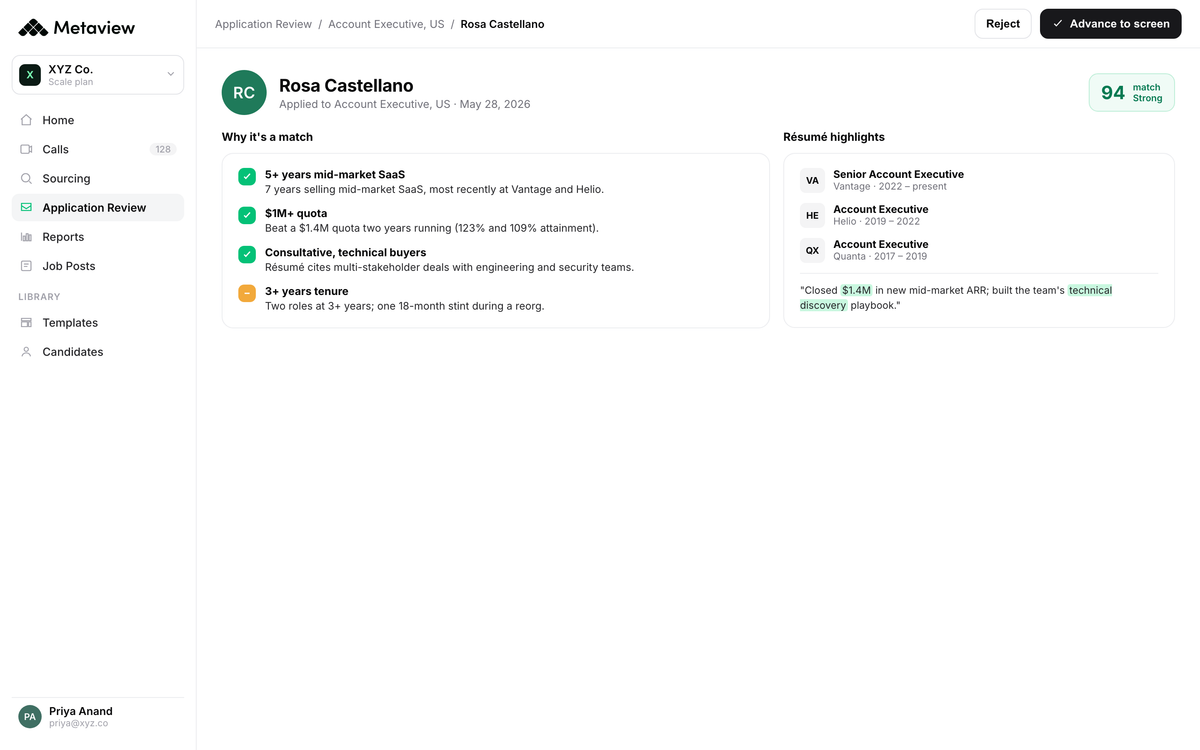
The four moves inside the surface map directly to the four-part mechanism. The ICP context carries the role understanding. The ranked rows carry the prioritization. Advance and reject actions feed back into the model, so next week's ranking reflects this week's decisions.
It runs ATS-native via our Integrations panel, so inbound applications flow through Application Review and out to your existing pipeline without parallel workflows. The list of supported ATSes is the source of truth on the live integrations page; new ones ship monthly.
Within 20 minutes of an intake call, I can present multiple candidate profiles to hiring managers on Slack and get immediate feedback. This isn't just about efficiency, it's about transforming the relationship between recruiters and hiring managers.”

The top of the hiring funnel is the highest-leverage fix when volume is the problem. Manual screening doesn't scale. Keyword filtering doesn't read context. The teams that moved past both spend less time reviewing and more time on the candidates already ranked at the top.
The shift takes a week to set up and a quarter to compound. The recruiters who run it stop asking whether they missed someone and start asking which of the top thirty to interview first. That's the difference between a manual bottleneck and a triage layer.
Bring Metaview into your hiring stack.
Live notes, structured scorecards, and ATS sync - set up in under 10 minutes.
Frequently asked
How long does it take to implement AI resume screening?
For the major ATSes, you authenticate inside Admin Panel and screening is running on inbound that week. The current integrations list updates monthly as new ATSes come online. Roles that depend on a connector still in the pipeline can run Application Review against CSV inbound while the native integration ships.
Does AI resume screening work for specialized or technical roles?
Specialized roles benefit more, not less. Context-aware ranking outperforms keyword matching exactly where keywords fail: rare skills, vertical-specific certifications, transferable expertise. The setup move that gets specialized roles ranked accurately fastest is training the role model on five to ten recent successful hires in the same family.
How does AI handle non-traditional career paths?
The mechanism that handles non-traditional paths is the multi-dimensional ranking. A career switcher with three years adjacent plus one year direct experience doesn't get filtered out; they rank slightly below direct-experience candidates with the reasoning surfaced, so the recruiter sees both and decides. The path-shape never becomes a silent reject.
What's the difference between ATS filtering and AI resume screening?
ATS filtering is rule-based and binary: keyword matches, candidate advances, no match, candidate rejects. AI resume screening is context-based and ranked: every candidate gets a relevance score with the reasoning attached. ATS filtering returns "11 of 200 passed." AI screening returns "all 200 ranked, top 30 highly relevant, here's why."
How do you measure success with AI resume screening?
Four leading indicators: time to shortlist (target under one day from req-open), shortlist-to-interview conversion (target above 60%), interview-to-offer conversion (the canary metric, should improve as shortlist quality rises), and recruiter time spent on screening per req (target 80% reduction). The compounding effect on quality-of-hire lands four to six weeks in.
