
AI is changing how every part of recruiting works. Most of the trade-press coverage focuses on the question of replacement.
The data says the opposite. Recruiters who've adopted AI are moving faster, having better conversations, and reporting more job satisfaction than the recruiters who haven't.
This post breaks down the efficiency gains, the survey data underneath them, the use cases recruiters are actually running, and a 3-step framework for putting AI to work on your team.
What hiring efficiency means.
Hiring efficiency is the ability to move quality candidates through your funnel as quickly, fairly, and cost-effectively as possible.
It's about minimizing friction for recruiters and candidates without sacrificing quality of hire.
When hiring efficiency is strong, teams see shorter time-to-hire, lower cost-per-hire, less recruiter burnout, more consistent candidate experience, and higher-quality hires at scale.
AI tools have become essential to those outcomes. Not because they replace any single step, but because they take the manual overhead out of every step.
The hidden cost of manual recruiting work.
A recruiter's calendar used to be ~40% sourcing, ~30% calls, ~30% admin. The admin half kept growing as application volume did.
Sourcing candidate profiles. Scheduling interviews. Summarizing applicants' experience for hiring managers. Writing up scorecards. Filling out feedback forms. Re-sending forms when interviewers don't fill them out.
The hidden cost is bigger than the time. When recruiters are typing notes during a screen call, they're not catching the small moments that matter. They're not asking the follow-up. They're not building the relationship.
The only way to get that time back is to delegate the manual work. Now there's somewhere to delegate it to.
Where AI moves the needle.
We surveyed 380 recruiters and recruiting leaders globally about how they use AI and what they get out of it. The benefit list ranks like this.
- 89% of AI-enabled recruiters say the main benefit is time saved.
- After that: 32% say AI helps them make more data-driven decisions.
- 28% say it improves candidate experience.
- 23% say it gives them more visibility into what's happening in the hiring process.
- 17% point to reduced time-to-hire.
- 6% say reduced cost-to-hire.
The faster feedback compounds. When notes hit the ATS within minutes of the call ending instead of the next day, hiring managers can debrief while the conversation is still fresh, and offers go out faster.
We're getting feedback within 10 to 20 minutes from interviews now, which is just ideal for a recruiting team that works with time-to-hire targets."

What recruiters actually ask AI to do.
The most useful read on AI adoption isn't the headline benefit. It's the breakdown of what recruiters actually type into the AI assistant when they sit down to work.
We pulled anonymized data from how Metaview customers interact with our AI assistant. The five most common asks:
- 26%: summarizing candidates' experience and responsibilities
- 11%: understanding candidates' specific skills, qualifications, and technical expertise
- 9%: recalling what candidates mentioned about compensation and benefits
- 8%: understanding candidates' motivation for wanting the role
- 6%: questions related to scheduling, availability, and logistics
The pattern: AI gets called in when memory and recall are the bottleneck. Three weeks after a screen, the recruiter doesn't remember whether the candidate said comp expectation was $180K or $200K. The AI does.
The other half of the value is presence. With AI taking the notes, recruiters can run the conversation instead of typing through it. For a wider view of where AI fits across HR work, Equinet Academy's guide to AI for HR teams covers onboarding plans, day-one emails, and handbook FAQs.
I am better at catching small nuances in conversation and going back to dig deeper without losing my train of thought while typing."
A 3-step framework for adopting AI in recruiting.
The teams getting the most out of AI work through three stages. They don't try to do all three at once.
Step 1: Individual performance. Map the workflows on your team and pinpoint where AI can take admin off a recruiter's plate. Notetaking is the obvious first one. Scorecard auto-fill from interview content is the second. Both are individual wins that show up in week one.
Step 2: Detection. Once AI is embedded in the workflow, you get access to data you couldn't see before. Which interviewers ask the most behavioral questions. Which loops are running long. Which candidates keep dropping at the same stage. Detection is where the recruiting team stops being reactive.
Step 3: Decision-making. The biggest gain comes last. When the team trusts the data, AI starts shaping decisions, not just describing them. Which candidates to prioritize. Which interviewers to coach. Which questions consistently surface the strongest signal.
Most teams park at Step 1 and call it done. The ones pulling away in the 2026 AI & Hiring Alignment Report ran all three stages.
How Metaview captures and coaches this.
Metaview Notetaker records and transcribes every interview automatically. AI Notes generates the summary in the format your team uses. AI Filters lets you query the corpus in plain language.
The integrations layer matters as much as the AI. Metaview connects to the ATS, video tools, and scheduling platforms your team already runs.
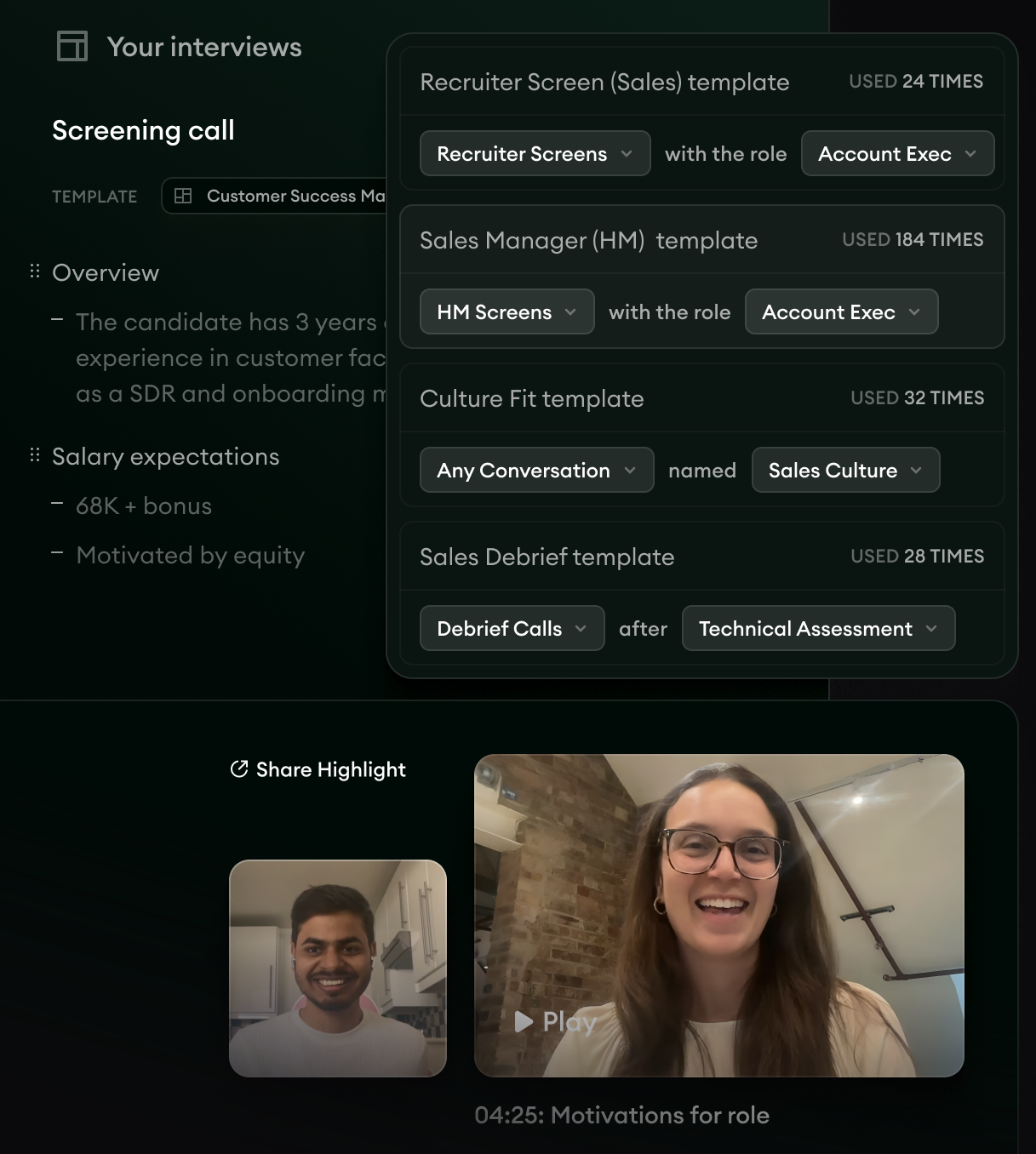
The same data set surfaces the three most common mistakes new interviewers make, which gives the team the second compounding lever: coaching from real interviews, not training decks.
The future of recruiting is human plus AI.
Recruiting is one of the most human-centric parts of any company. AI doesn't change that. It changes what recruiters spend their time on.
With manual work delegated, recruiters can do what they're best at. Judging fit. Selling the company to the candidate. Coaching hiring managers. Building the relationships that decide whether top candidates accept the offer.
The 2024 interview trends showed candidates already expect this. They're leading conversations about AI adoption inside the companies they're considering. The recruiters who can speak fluently about it have an edge.
Frequently asked.
What is hiring efficiency in recruitment?
Hiring efficiency is the ability to move quality candidates through the recruiting funnel as quickly, fairly, and cost-effectively as possible. The measurable outcomes are shorter time-to-hire, lower cost-per-hire, less recruiter burnout, more consistent candidate experience, and higher-quality hires at scale. Efficiency goes up when manual admin comes out and recruiter time goes back into work that requires recruiter judgment.
How does AI improve recruiter productivity?
By removing the parts of the day that used to eat the most time and produce the least signal. AI notetakers transcribe and label interviews automatically. AI assistants summarize candidate experience and recall specific details on demand. AI scorecard tools push structured data into the ATS without manual re-entry. The 380-recruiter survey found 89% of AI-enabled recruiters say time saved is the main benefit, and 42% say they'd lose "massive" productivity if AI were turned off tomorrow.
Will AI replace recruiters?
No. The 380-recruiter survey is clear on this: 74% of recruiters and recruiting leaders believe AI has had or will have a positive impact on their job. AI takes over the manual admin (notes, summaries, scorecards, scheduling questions) and frees recruiters to do the parts of the role that need recruiter judgment: assessing fit, selling the company, coaching hiring managers, and building candidate relationships. The recruiters at risk are the ones not using AI, who get outpaced by colleagues who do.
How do I measure AI's impact on hiring?
Track the standard recruiting metrics with a before-AI and after-AI cut. Time-to-hire, cost-per-hire, candidate NPS, offer-acceptance rate, and the time recruiters spend on admin versus high-value work. Customer benchmarks: Quora cut their feedback loop from days to 10-20 minutes per interview. Across the survey, AI-enabled recruiters speak to 25% more candidates per week and spend 41% less time on admin. If you can't see a clear delta in three months, your AI workflow is probably stopped at Step 1 (individual productivity) and hasn't moved into team-wide detection and decision-making.
Bring Metaview into your hiring stack.
Live notes, structured scorecards, and ATS sync - set up in under 10 minutes.
