
Most recruiting teams pick software by feature breadth. The teams that get it right pick by feature depth.
The 9 features below are the ones that actually move time-to-hire, candidate experience, and quality of hire. Every recruiting software decision in 2026 should be tested against this list.
All 9 features at a glance.
| # | Feature | Why it matters |
|---|---|---|
| 1 | AI interview capture | Highest-leverage layer in the stack |
| 2 | Structured scorecards + ATS write-back | Time-to-feedback collapses |
| 3 | AI sourcing tied to past hires | Precision matters more than database size |
| 4 | Automated scheduling | Coordinator hours saved |
| 5 | Triggered candidate comms | Silence between stages eliminated |
| 6 | Per-stage funnel analytics | Bottlenecks become visible |
| 7 | Per-interviewer analytics | Coaching becomes targeted |
| 8 | Compliance and audit logging | Defensibility at scale |
| 9 | Multilingual capture and outreach | Required for global hiring |
1. AI interview capture.
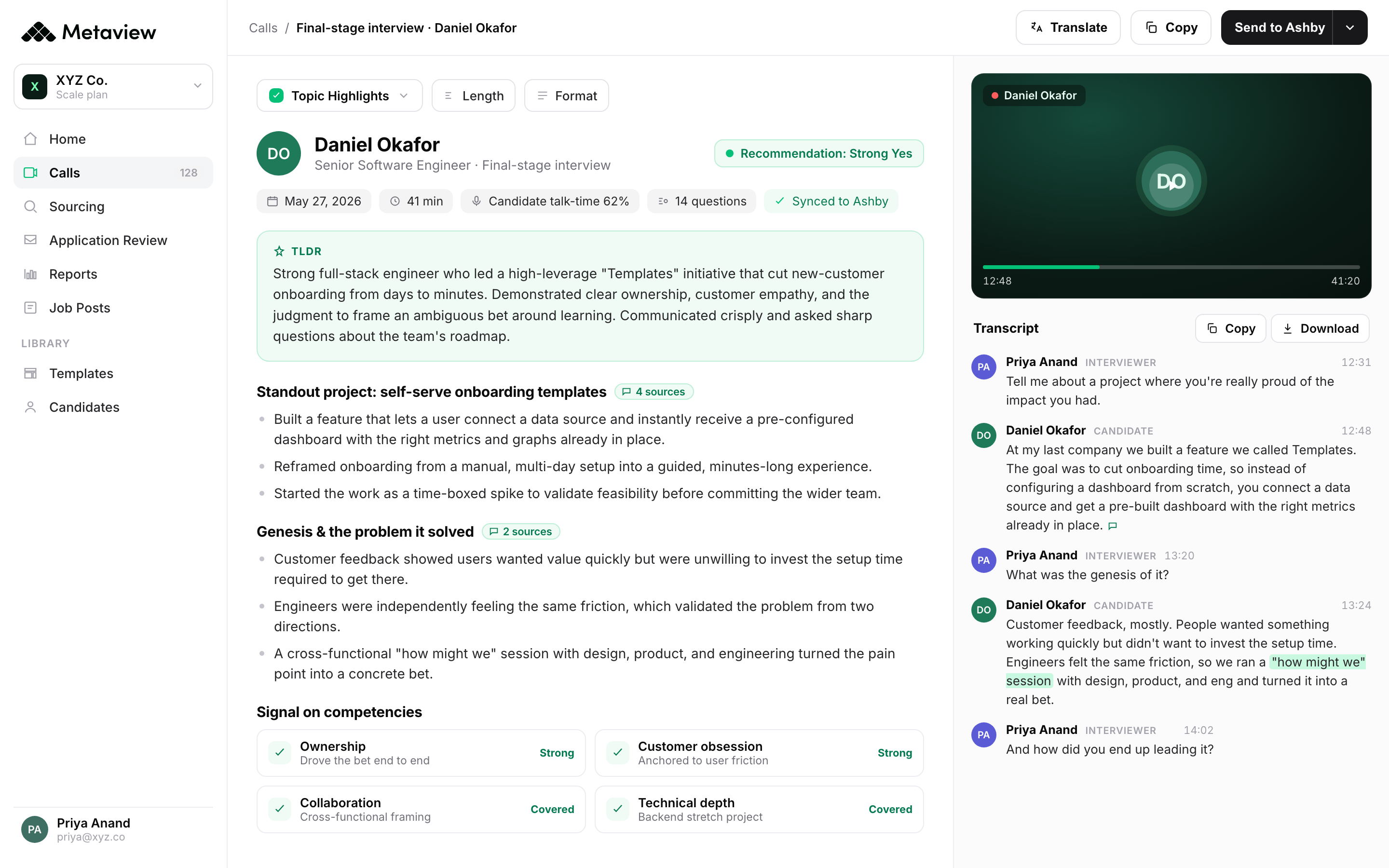
The high-impact feature in modern recruiting software. Captures every interview, transcribes in 50+ languages, structures notes against your rubric.
Without it, recruiter memory and inconsistent typing are your interview data.
2. Structured scorecards with ATS write-back.
Scorecards force a rating per competency plus a behavioral evidence note. Native ATS write-back closes the loop without copy-paste.
Time-to-feedback collapses from days to minutes.
3. AI sourcing tied to past hires.
The good versions weight candidates against the actual pattern of who's worked out at your company. Output is short, ranked, and reasoned.
Database size matters less than precision.
4. Automated scheduling with reschedule logic.
Self-serve scheduling that handles reschedules without a human in the loop. Multi-stage panel coordination matters at scale.
5. Triggered candidate communications.
Status emails fired automatically on stage transitions. Three triggered messages (received, status, decision) cover 80% of the silence problem with zero recruiter time.
For recruiting agencies, platforms such as Recruiterflow bring candidate communication, automated outreach sequences, and the rest of the hiring workflow into one place.
6. Per-stage funnel analytics.
Five metrics worth tracking weekly: time to launch, time between stages, time-to-feedback, interview-to-offer ratio, offer acceptance rate.
Most teams discover their bottleneck isn't where they thought.
7. Per-interviewer analytics.
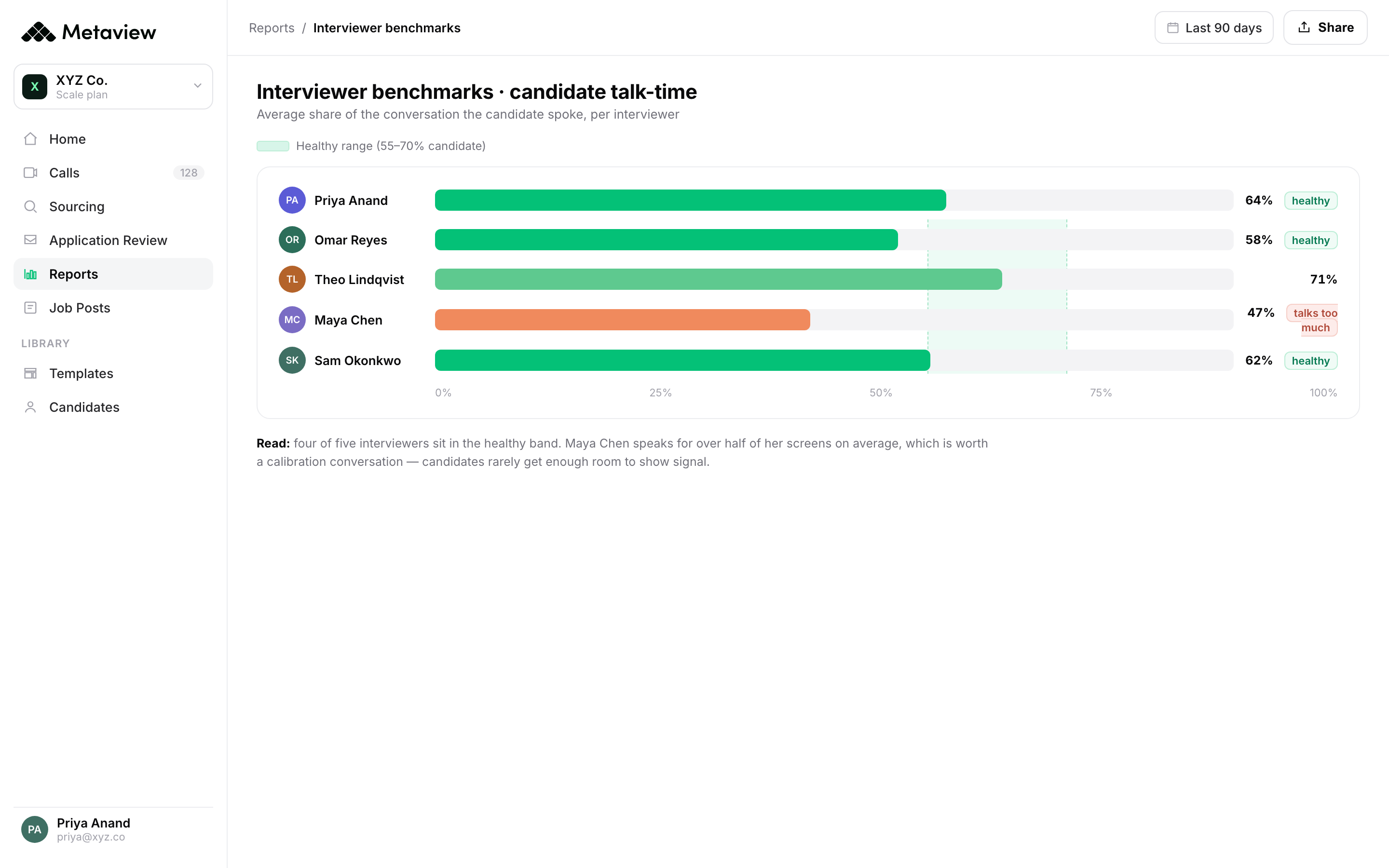
Interviewer-level patterns: question count, talk-time ratio, follow-up frequency. The patterns the team can coach against.
This is the feature most teams don't have and don't realize they're missing.
8. Compliance and audit logging.
SOC 2 Type II, GDPR-aligned controls, candidate opt-out flows, audit log per hiring decision. Required at enterprise scale.
9. Multilingual capture and outreach.
For global teams, captures need to handle 50+ languages without quality drops. Outreach personalization needs to translate cleanly across markets.
For written content in that workflow, tools like Lara Translate can help translate candidate outreach, role briefs, and interview instructions before recruiters review the language for local tone.
How to evaluate recruiting software.
Run any tool through this checklist before committing.
Does it write structured data back to your ATS automatically? If no, walk away.
Does it capture interviews against your competency rubric or does it just transcribe? If just transcribe, the value ceiling is low.
Does the free tier cover your use case? Most teams under 100 hires per year can run on free Metaview for capture, sourcing, and scorecards.
Does it integrate native scheduling, candidate comms, and analytics into the ATS event flow, or does it require a workaround? Workarounds compound over time.
Metaview is built around the nine features above. 4,000+ organizations now run hiring on Metaview, including Brex, emnify, Quora, Workleap, Lightspeed, Catawiki, and Automattic.
Bring Metaview into your hiring stack.
Live notes, structured scorecards, and ATS sync, set up in under 10 minutes.
Frequently asked.
What's the most important feature in recruiting software?
AI interview capture with ATS write-back. The feature cascades into time-to-feedback, candidate experience, decision quality, and interviewer coaching. Everything else compounds from it.
Do small teams need all 9 features?
No. Start with capture, structured scorecards, and AI sourcing. The rest can wait for volume. Metaview's free tier covers all three for teams under 100 hires per year.
How do I evaluate ATS integration depth?
Ask the vendor for a list of fields they write back into your ATS. If the list is short or generic, integration is shallow. Verify with a sandbox test before committing.
What's the difference between transcription and capture?
Transcription produces text; capture maps the text to your competency rubric and structures it for the ATS. The first is consumer-grade; the second is recruiting-grade. The difference shows up downstream in scorecards and analytics.
Are compliance features worth paying for?
For any team at enterprise scale, yes. For teams under 200 employees, SOC 2 Type II and GDPR-aligned controls (which Metaview ships free) cover most defensibility requirements.
What features should I skip?
Anything that requires manual data entry. Workflow steps the recruiter has to remember to trigger are a tax that compounds over time.
